
This post is a response to a question posed in its complete format: “As an atheist, how do you deal with the fact that there is no ultimate moral arbiter and that all morals are determined inter-subjectively and without an objective foundation?”
Have you taken any time to consider how, if a god existed, its morality would also be subjective to it?
If morality had an objective foundation, it would be intrinsic to the object itself. One could essentially “read” morality from within every instance deemed to bear moral implications. If morality were objective, everyone would read and identify identical moral qualities within every situation subject to moral judgments.
It would be no different than having everyone agree that the sun shines and its effect warms us. No one or authority is required to serve as an arbiter for these qualities. We know these facts to be confirmed individually from everyone’s direct experience with the sun.
For the sake of this exposition, let’s refer to those qualities of heat and light emanating from the sun as “metadata.” This description can help us draw some clear distinctions on the language we’re using to resolve discussions on objectivity as it applies to the concept of morality.
For instance, if theft were objectively determined as immoral, then the characteristics defining its morality would be immutably intrinsic to that act of theft. All forms of theft would be considered immoral without condition. It can easily be argued that the metadata ascribing immorality within the act of robbery lies within the harm done to those against whom the theft is perpetrated.
Stealing food to feed one’s family would always be consistently judged as immoral. There would be no distinction between stealing food from a starving person and stealing food from someone with such abundance that most of their food is spoiled from the lack of consumption.
One can argue that stealing food to feed one’s family is not immoral if the person one steals from still has plenty of food to feed themselves. One can say that stealing food that would end up being spoiled from lack of consumption to feed one’s family is moral.
How can both scenarios be valid if morality is objective?
If morality were objective, it would be contained within the object, but as we can see in this simple example, morality is contextual. Morality within this simple case is contingent upon the judgements of those who choose to ascribe varying degrees of value to the individual aspects of the case of stealing food.
Some may determine that stealing food, in any event, is immoral. In contrast, others may determine that stealing food to feed one’s family is an act of self-sacrifice that exposes them to a life-destroying reprisal, which represents the embodiment of morality.
If morality were objective, then it would be immutable, but how many things deemed immoral at the time of the writing of scripture have since been reconsidered irrelevant to the concept of morality?
No one balks today about wearing clothing made of mixed threads. It’s almost impossible to find any clothing that doesn’t mix threads to some degree today. Yet, this practice is no longer considered a moral violation that would anger any ultimate authority such that a reprisal would be forthcoming.
Did God change its mind? If so, how do we know, and when did that occur? By what process are we being informed by an ultimate authority of updates to morality? If morality is subject to updates, how could it be objective?
Morality can’t be objective if an ultimate authority changes its mind and renders updated decisions on what constitutes morality because they are simply conveying (if we can set aside the mechanics of that conveyance) a perspective unique to their apprehension of a situation.
Perhaps you’re still struggling to comprehend the difference between “subjective” and “objective,” and that’s why you insist morality is “objective?”
Let’s look at some definitions to help frame the explanation above:
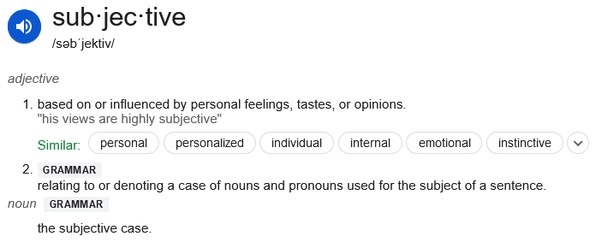

Any situation in which an authority must intervene to render a decision to settle differences between competing perspectives cannot, by definition, be considered “objective.”
It doesn’t matter whether that authority is omniscient or not; they are still rendering a decision derived from their perspective on the issue in question.
The necessity of an authority to determine morality already renders morality a subjective construct.
Morality cannot be objective by any stretch of the imagination and, most notably, not by arguments ascribing ultimate morality to an ultimate authority on morality — mainly when that authority is not available to provide any direct input into any state requiring a moral judgment to be rendered.
Indeed, the need to render a moral judgement eviscerates the notion of an objective morality.
The appropriate context for perceiving morality is a public dialogue in which we learn to develop our moral paradigms to understand ourselves and our world more clearly. The dialogues we have on morality serve the purpose of developing compassion toward issues outside our frames of experience and help us to apply a moral paradigm to the whole of our existence as individuals and as a species struggling to achieve its potential.
The reality is that objective morality would destroy our capacity for morality because an essential learning process for developing one’s humanity is reduced to rote memorization. In contrast, the human capacity for creativity necessitates means by which moral loopholes can be exploited.
We see this behaviour routinely exhibited by those who claim to be representatives of moral authority betraying their self-appointed statures in society.
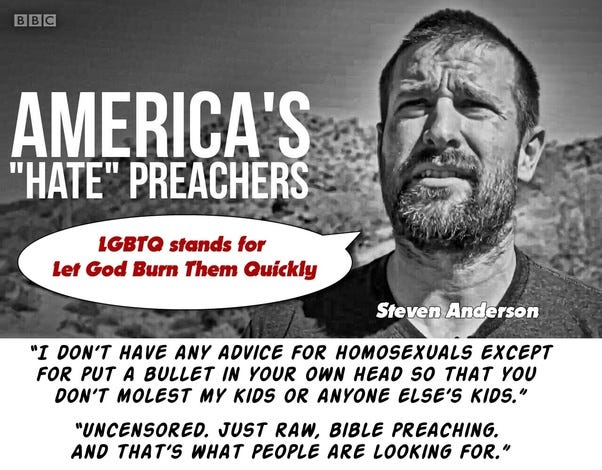
America’s Hate Preachers (TV Movie 2016) ⭐ 5.9 | Documentary
 thotbag