
This post is a response to a question initially posed on Quora, and can also be accessed via “How do Canadians and Americans really feel about each other?”
This Canadian thinks of Americans in ways not too dissimilar from how I think of fellow Canadians. Most are decent human beings at heart. Many are misguided and gravely misunderstand the nature of today’s dysfunctionality in society. A few — or more than just a few, but a minority nonetheless, are toxically stupid to the point of being beyond redemption.
All but the third group are reasonable and amenable to working together to identify the best solutions which meet the broadest range of needs of the citizenry. Our cultures are similar but unique, while, as a whole, Canadians appear to have more insight and respect for the values declared by Americans as being core to their identity.
Much of the discord in America, for example, in the value of freedom, lies in the difference between Canadians being more community-oriented. Americans tend to breed an isolationist degree of individualism. The resulting perception of freedom between the two nations is that Canadians regard freedom as derived from our community, and Americans appear to interpret freedom as the ability for an individual to do whatever they please whenever they please.
If we were to track this difference through Kohlberg’s Theory of Moral Development, we can see a distinction in the degree of moral evolution this represents.
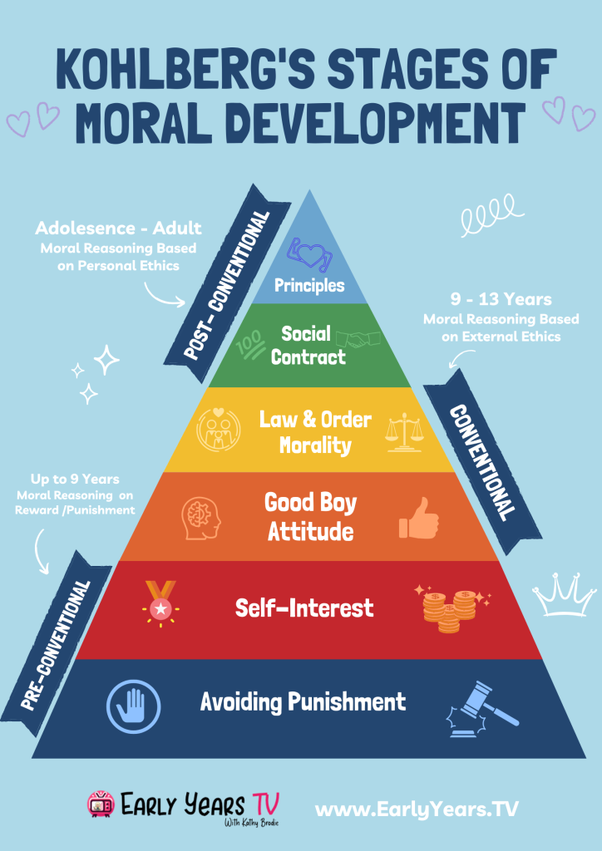
Caveat: Like all models, this is not a universal prescription defining all people in any culture, and so this may generally describe some fundamental cultural differences, the overlap between cultures exists in the developmental differences between individuals.
Canada has no shortage of people who fail to grow beyond the pre-conventional stage. We do have our flavour of Maple MAGAts — the toxic form of extremist conservativism plaguing the planet. It is certainly more prevalent in the U.S., but that’s entirely due to economics.
The U.S. has always had a much larger budget that has always been more attractive to society’s predators. IOW. The economic success of the U.S. has been its most fundamental weakness.
It is in the best interests of those seeking power to ensure the populace is developmentally stunted. Keeping people on the level of pre-conventional development makes them more malleable and amenable to influence from authorities. Teaching them to fear punishment keeps them in line and converts them into sycophants addicted to chasing their self-interests.
This works for most of the population, which functions as workhorses to keep the machinery of society operational. Still, the next level of conventional morality is also necessary to function as an administrative body to keep the rabble in line.
All nations leverage this developmental dynamic through intrinsic and extrinsic punishment and reward systems. Canada and the U.S. are no different in this regard because this is a dynamic cultivated by power structures.
The causes of the distinctions between nations begin at the third and uppermost level of development, in the post-conventional stage. This is where philosophies and ideologies live that define the visions guiding all citizens in their perceptions of themselves and as members of a community.
This is where the distinction between “melting pot” and “multicultural mosaic” lives and flows throughout society to form a cultural identity.
It appears ironic that a nation that values individuality is adamant about conformity, but that’s explained in the differences between these two perceptions of national identity. One cannot truly value individuality when their culture homogenizes its citizens through a melting pot. (Many) Americans consider Canada a “socialist” country, but we value individuality, and freedom, by extension, more than Americans because we embrace and celebrate diversity as core to our cultural heritage.
I am proud to have Quebec as a part of Canada precisely because their contrast has kept Canada from falling into the same self-serving traps of insular arrogance that Americans have. They’ve been regarded as pains for many westerners, but so have westerners been regarded in similarly disparaging ways by our French-speaking members of our family. However, the dynamic between divergent cultures characterizing Canada makes us strong and coherent as a nation, which values its people above those who would rule us.
Americans would do well to learn from our dynamic and begin to treat their Spanish-speaking population with the same respect. It would help you grow as a nation with something more nuanced as a culture beyond the bombast of commercial ostentatiousness and avoid being viewed as the meth lab we live above.
 thotbag