
This post is a response to a question posed in its complete format: “Has China become more democratic as its economy grew in the 1st quarter of the 21st century?”
China has become more accommodating of the needs of the people while maintaining a paternalistic attitude toward the masses — which has been effective, to a degree, in maintaining order while educating and empowering the people as they work toward common goals benefiting their society.
As a system of governance, Xi has been moving toward increased consolidation of presidential power while questions about how much control he has over the levers of power have arisen. In essence, however, China remains a single-party system that they sometimes call a “People’s Democratic Dictatorship,” and in other cases a “Socialist Consultative Democracy.”
The magical ingredient of their community-based social evolution has been lost within the hyper-independence cultivated in the West. China has avoided the manifestation of extreme sociopathic disregard for one’s fellow citizens from a philosophical perspective. However, they have profited from the paternalistic exploitation of workers to enrich the community and the rich in more of a partnership than as disposable commodities in the West.
In contrast to the planned societies in China, today’s “Western-based” corporatocracy has resulted in a legalized re-institution of a medieval social structure built upon publicly denied but implied class divisions as the plutocrat class feigns partnerships with the working class through empty slogans like “essential workers.” Ironically, China’s single-party rule of the people has been transforming from an iron-handed autocracy into a kindly old grandfather who watches and guides the product of their efforts to discipline their offspring and bear fruit.
China was rightly criticized for its suicide nets, and I’m not sure how prevalent those are these days, nor how gruelling their factory work remains, but the sacrifices of those who gave their lives in service to a horrid existence appear to be making way toward the emergence of superior societies built around advanced technological progress. Planned cities like Zhenzhen and Chengdu have become global technology hubs, making breakthroughs that rival American developmental efforts.
At this rate, American dominance in technological breakthroughs will become a memory within the next few decades.
As more technologically sophisticated societies emerge, the less reliant the public will be on autocratic structures to maintain order because they will become capable of the self-regulation that accompanies higher technological and psychological development levels.
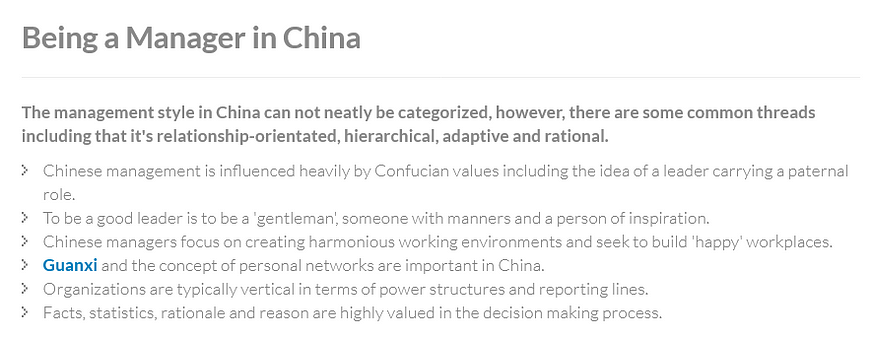
Knowledge work has been woefully misunderstood by Western thinking. Capitalists like Musk, who consider highly educated people disposable assets rather than allies, rely on controlling talent they treat in abusively disposable ways instead of leveraging them as partners who could help him overcome his limitations. As we see with Chinese corporate structures, the way of the future is a more nurturing management style in their operations, favouring mentorship and career development support, than Western corporate autocracies favouring cultures with toxic cutthroat competition.
The Chinese Management Style
A free guide to being a manager in China. Learn about Chinese Management styles, Business Management, Project…www.commisceo-global.com
For the last few decades, workers in Western high-tech environments have been far more competent than leadership incapable of comprehending, much less appreciating how much more skilled their employees are than they are in their knowledge domains. Companies in the West hire down to the level of incompetence of the management rather than hire up to empower their organizations with capabilities that can empower their growth. They are still stuck in the dark ages of employment, which is why most people still don’t understand how disastrous DOGE’s cuts will be for the functional needs of the nation.
Far too many believe the laid-off labourers can be replaced like obedient cogs to continue functioning as before. They fail to realize they’re impacting human lives and professionals who once cared about their roles and their impact on their operations. They fail to recognize the cost of replacing professionals is not as simple as identifying another body to fill a space. Workers are now being incentivized to disengage and stop caring because they’ve been consistently confronted with proof that their contributions bear no value to any psychopath with power.
If the public was ever upset when dealing with dispassionate bureaucrats who did the least they could get away with in their jobs, welcome to “I don’t give a shit version 2.”
The deterioration of the human spirit currently prevalent within the Western sensibility merely gives China the impetus to continue empowering its people because global leadership is just around the corner for them.
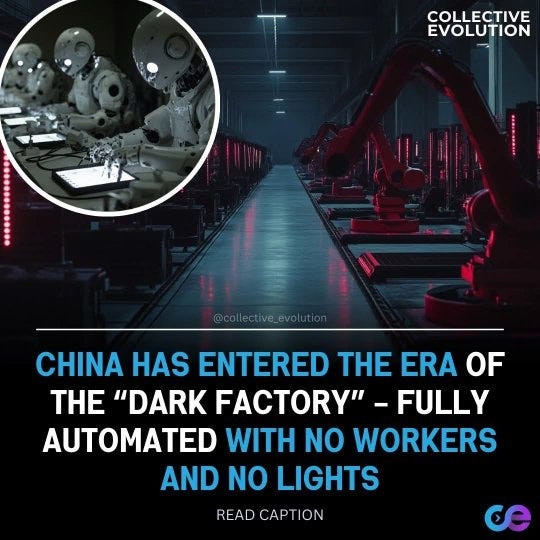
With the advent of “Dark Factories” — fully automated factories, the Chinese people are ahead of Western Industries and their government is likely better equipped psychologically to transition their support systems for the people than what we’re seeing now in the reckless Chainsaw antics of cutting necessary systems indulged in by American plutocrats.
How this translates into a better-equipped governance system to represent the people makes American-style pseudo-democracies appear less capable of being the governments of the people and for the people than the Chinese government of a paternalistic entity ruling the people. It’s no wonder people had become more amenable to a fascist style of government before Trump’s bull-in-a-chinashop rampage began.
Fortunately, the world has better models for democracy in the Nordic styles of social democracies, which borrow concepts from both governance styles to create an effective balance between necessary support infrastructures and free market capitalist principles with realistic restraints on power.
In short, China hasn’t “become more democratic,” but it has become more efficient at meeting the needs of the people. Their system will continue to evolve as their industrial sector evolves and drives social change as it has since the beginning of the Industrial Age.
 thotbag