
This post is a response to a question posed in its complete format: “Are factory jobs the jobs of the future in the United States? How would that work?”
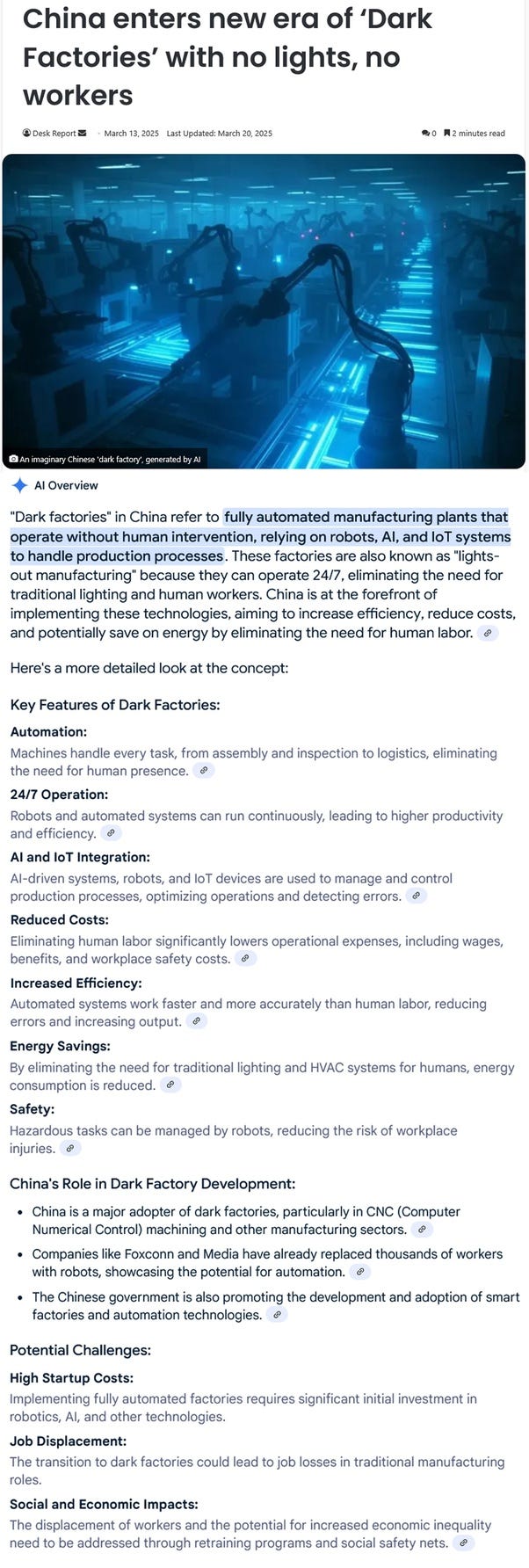
Factory jobs will mostly go the way of blacksmith jobs worldwide as “Dark factories” become the norm.
Here’s a video introduction to a massive change that is already transforming the factory landscape on an enormous scale to displace over 10 million factory workers in China alone:
Below this bit of my two cents is a long assessment by AI that will give you an overview of the reasons driving this transformation.
How that affects us as individuals is another issue altogether.
Much of what we can do as individuals is determined by our resources. As individuals or small groups of friends, we can focus our resources on investing in small business ventures that can generate profits by producing custom solutions, services and/or products that will still be in demand.
Almost all mass-produced products in society will be handled by automated systems with minimal human oversight.
Smaller markets will emerge, however, as 3D manufacturing matures enough to create local production facilities for customized products. As 3D matures, we will likely see growth in creative design areas where people will buy product designs or templates rather than products, which they then print with their in-home 3D printers. These will, of course, be limited in their capacity as they become more available to consumers, as laser printers have, which will create cottage industries for a higher production level.
In essence, I can envision three levels of production: large-scale factories producing for a global market, local factories producing for local municipalities (which begs the question of raw materials like PLA, along with a radical evolution of printable materials to expand production choices made on a global level), and home-based production.
Factory jobs and jobs where people go to every day by the hundreds or thousands to perform functions for a large organization’s profits are disappearing. That type of work dynamic is vanishing, particularly on a production floor.
We may see organizations grow out of opportunities for innovation, where, instead of going to a job to perform mechanical functions in a production process, we will see large groups emerge in an innovation-driven enterprise model. Hundreds of scientists, engineers, electricians, programmers, etc., will collaborate on new technologies for space exploration, for example, or medical advancements.
Companies specializing in material sciences will emerge to create new printable materials to advance 3D printing technologies, for example.
At any rate, here’s the screen grab of an AI overview of dark factories:
Here’s another bonus video on the Future of Tech:
 thotbag