What do you think of Luigi Mangione?

This post is a response to a question initially posed on Quora, and can also be accessed via “https://luigimangione.quora.com/What-do-you-think-of-Luigi-Mangione-1

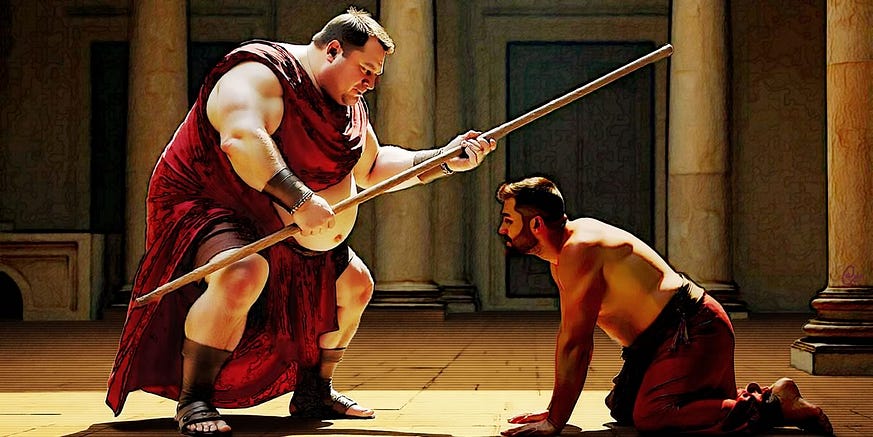
This question cannot separate the person from the act that introduced the person to the world. The person and the act are now inseparable. No one can answer this question independently from knowing why he is known.

What people think of Luigi Mangione will forever be the act superimposed upon a subjectively constructed image of him.

The only means by which one can now render an objective description of him is by offering up statistical data and facts about his life. Who he is as a person is now beyond anyone’s comprehension. No one can know what motivates his existence or what comprises the subjective state of Luigi Mangione beyond surmising a person who has experienced a breaking point in their life in which it was better, in his mind, to do the unthinkable for most of the rest of us than to continue an invisible march into a nightmare he could no longer endure.

No one can know what that feels like unless they’ve been forced to walk in similar shoes.

One conclusion that can be drawn about his personhood is that he demonstrated an ability to sacrifice himself to act on behalf of thousands of faceless victims forgotten in the march of greed.

Along with losing the ability to think of Luigi Mangione as a being separate from his act, neither can we separate the notion of the tens of thousands of victims lost to us every year in service to the God of profit. We can no longer forget how easy it is for many among us to justify murder if it means pocketing riches and obtaining a life of material wealth for oneself.

None of us can separate Brian Thompson’s callous extinguishing of lives from an algorithm to be rewarded for it in service to the monsters who refuse to honour the social contract and a local thug who robs a convenience store for a drug fix without admitting to being a sociopathic monster.

The reality between the two scenarios is that the local thug is less of a monster than the billionaires who think nothing of the lives they extinguish while offering up the lie that there is nothing they can do about it.

None possess the courage or the integrity to distinguish between ability and desire.

Every insurance billionaire can choose otherwise, but they don’t and hide behind the lie that the protocol they devised to protect their material luxuries is immutable and outside their control.

What I think about Luigi Mangioni for sacrificing his life to show us all our ugliness in a black mirror of a broken society is that he should not have been forced to put all the rest of us to such severe shame, and even more so is the pity that we still can’t grasp how evil our world has become.

What is Quora used for?

This post is a response to a question posed in its complete format: “What is Quora used for? Can I use it to post my social life? What can I use Quora for?”

You can use Quora to ask questions or answer questions.

What you do with those questions or answers is entirely up to you.

For example, my use of Quora has evolved into a sketchbook of ideas where I repurpose some of the answers I write here into articles for publication on other sites.

This was a natural evolution for me that occurred from when I first joined over ten years ago. I was drawn to an academic vibe at the time, with primarily intelligent questions and answers from people who were very knowledgeable and extremely generous in sharing their knowledge.

It felt like a welcoming environment of aspiration for contributing value to our world.

Sadly, most of that is gone or buried under volumes of nonsense as the profit motive prioritized decisions that cared little about preserving knowledge sharing. Quora has succumbed to the same community-deteriorating profit-chasing phenomenon that all other social media sites have.

My personal life was also supremely upended shortly after joining, and I stuck with Quora, not out of my original intent of adding to a marketing funnel for my consulting efforts as an instructional designer but out of a therapeutic need to feel I was still able to make positive contributions to other people’s lives.

As Quora quality devolved, so did my participation to such a degree that it became a vessel for venting. As much as that has helped me to cope with what I’ve endured, it’s often toxic and destructive to a fragile state of mind. Fortunately, writing leaves a trail for facilitating introspection, which has become a path out of personal darkness for me.

I hope my latest stage of using Quora as a springboard of ideas and back into a life of some modest dignity will be a stage where I can leave most of my negativity behind and be grateful to Quora for functioning as my only source of productive therapy over the last decade.

A condition of where my life is at right now involves meeting with an actual therapist. I have concluded, however, that he’s a hired assassin for an entity that seeks to escape responsibility for the consequences of its actions through a strategy of encouraging suicidal ideation.

That may seem like hyperbole, but there is no other explanation for the overtly antagonistic and abusive behaviours exhibited by this “professional.”

For me, the only valid forms of therapy I have ever experienced have been through my creative expressions, which have mostly been through writing and creating pictures.

For me, Quora will, hopefully, be a means of moving on from a stage of inertia into a productive future where I can encapsulate ideas I’ve explored here into formats that can serve as some form of legacy to my life I can feel proud of.

What you want Quora to be for yourself is whatever value it brings to your life. Generally speaking, however, as social beings, how we manage our social interactions, whether in person or online, defines our lives for each of us.

Is Neil deGrasse Tyson wrong?

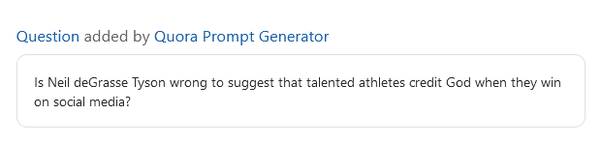
This post is a response to a question posed in its complete format: “Is Neil deGrasse Tyson wrong to suggest that talented athletes credit God when they win on social media?”

I think there is something severely wrong on so many levels that it’s impossible to address them without an entire book and a lot of research to identify the dynamics of a business decision justifying the dissemination of lies in society to stimulate engagement and generate revenue.

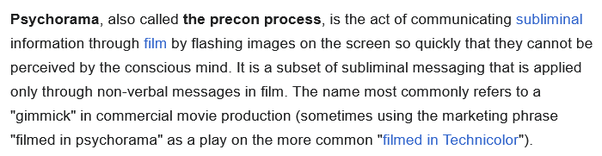
This is horrifying on so many levels that it insults every aspect of humanity, human society, and the social contract. This contributes to the widespread decay and ultimate destruction of civilized society on the most malignant levels. This crap is worse than the stage of “subliminal seduction” we went through in the 1970s when laws were crafted to prohibit embedded “invisible messaging” within entertainment media.

Psychorama — Wikipedia

Neil deGrasse Tyson has never suggested any such thing, and although it’s easy to attribute this claim to a believer on a mission of Lying for Jesus, it’s not. This is even worse than a believer trolling for reactions by lying.

For non-Quorans: This screengrab indicates the question author, and in this case, the question was written and posed by a bot designed to stimulate engagement on this social media site. This is a common revenue-generation strategy employed by media outlets across the board. Fox Entertainment, for example, has built its empire entirely upon this toxic revenue generation model.

Targeting information appealing to the limbic system is like serving up crack to a heroin addict, and that shapes the society we are cultivating by allowing this practice to dominate media. The effects are profound. 

Not only does this represent an abysmally immoral strategy for generating revenue, but it’s also a strategy that furthers a divide between people in a society already at the edge of fracturing into chaos. This strategy for engagement is ultimately a violent assault on our social contract and is responsible for the dramatic divisiveness characterizing our social dynamics today.

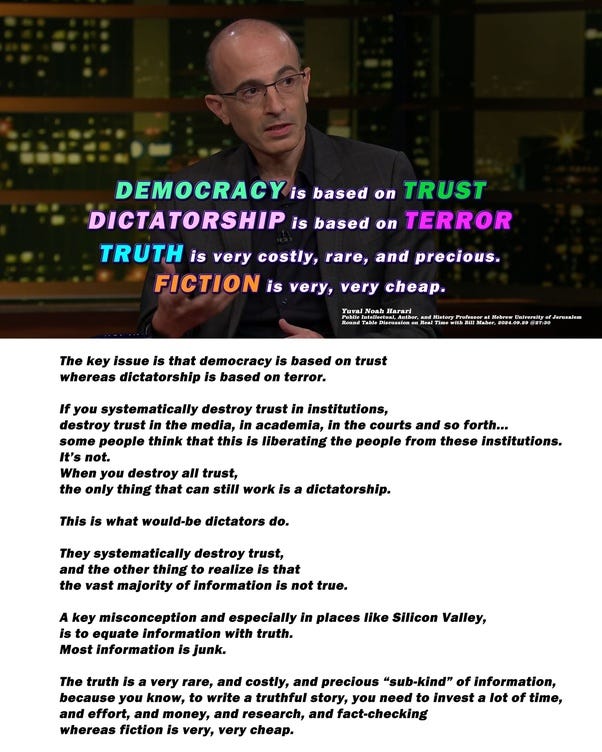
This precisely reinforces the post on my Thotbag space, citing Yuval Noah Harari’s statements during a round table discussion about the threat democracy itself is facing. Here is the meme I posted that includes his full text:

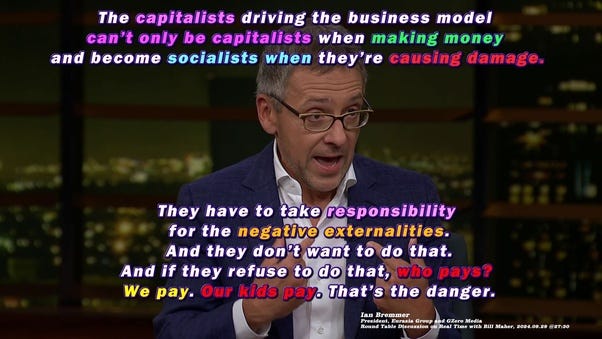
Along with Mr. Harari’s warning, Ian Bremmer pointed at the problem this divisive, conflict-escalating disinformation creates for society:

This fraudulent question is worse than Quora violating its own, now primarily defunct BNBR policy; it’s an assault on human decency on the most corrupt of levels for the most corrupt reasons.

This should not be disturbing only to atheists who fight back against a daily assault from believer trolls seeking to provoke emotional reactions. This should be disturbing to everyone who cares in the least about things like integrity and the social contract that has never been strained to such a degree as what we are living with today.

If society collapses into chaos — If people’s lives are unnecessarily lost because we can’t or won’t back away from the cliff we march toward — Then this kind of manipulative nonsense perpetrated upon us all for the sake of profit will be responsible for the nightmares ahead that we are about to encounter.

This is central to my argument on why social media should not be operated on a for-profit model. Social media is a community development endeavour, and we must consider how we approach its role in society more thoroughly than consigning personal information to a feeding ground for mining material profit.

That we are being strategically and systematically provoked by algorithms to hate each other should horrify all of us.

Do you think that Quora users are mean?

This post is a response to a question initially posed on Quora, and can also be accessed via “https://www.quora.com/How-mean-are-the-people-on-Quora/answer/Antonio-Amaral-1

Quora users are no different than anyone else on other social media sites.

The virtual environment, coupled with the insulation of an identity divorced from who people are in real life, allows them to indulge in their basest behaviours without repercussions to themselves.

Some are deliberately more abusive online than they would be in person because of a lack of consequences to them in life. Some use social media as a vehicle for venting their frustrations, and that often involves victimizing others.

It’s a dynamic that exists everywhere but is exaggerated online due to the shield a fraudulent identity provides.

All social media is much like Quora, but I would argue that Quora is more civilized than Facebook. A lot of aggression on Facebook is expressed passively through the emoticon reaction system. Facebook UI also sucks big time for permitting extended dialogues, while Quora’s system of ownership of content and content threads by the answer writer helps to minimize aggressions here.

Quora’s system is less antagonistic than Facebook’s because of its structure and is more efficient than other sites at handling long discussion threads.

Insofar as degrees of meanness on social media, my decades of experience on Usenet remain unsurpassed in meanness. Still, social media has generally degenerated in decorum to more closely resemble interpersonal dynamics on Usenet.

It’s a shame that social media has become so toxic. This devolution of courtesy is an argument for a publicly owned and supported social media venue that eliminates the profit motive by operating as a non-profit entity to serve as a community development tool, performing various community development functions and providing various public services.

A sign-on system, for example, could replace the various sign-on systems that people use for logging into sites where sensitive data is stored while ensuring one’s data is accessed through a single entity that provides access to one’s government-related needs such as their taxes or identification needs, and etcetera.

Social media has always been about community development. I have found amusement in statements about upholding community standards from privately owned entities like Facebook that routinely violate the bounds of decency within a community-oriented context. I often complained to Quora about inconsistently applied BNBR standards, and the result of attempting to manage nuance was resolved for them as a business decision deemed too expensive to operate effectively. There was no profit-oriented point to them to pretend that being nice and respectful was an important feature to protect.

Part of the problem with moderating systems is that petty people find ways to weaponize moderation against people they decide to behave spitefully toward.

I’ve been considering a series of articles on social media while arguing in favour of a community-based, owned-and-operated system that can address a number of the shortcomings while functioning as a means of “encouraging” improved interpersonal dynamics through a self-moderating model, but that’s a significant endeavour while I’m currently in the process of addressing more profound to me issues through a struggle I’ve been undergoing for the last decade. I hope I finally get a resolution to it soon and in time to focus on other areas in which I hope to make more constructive contributions to society rather than the wholly destructive path I’m currently on.

In short, and as a summary, however, people can be pretty mean everywhere, and sometimes, there’s nothing one can do about it but try to avoid or dismiss their meanness. It might help to be aware that not everyone is always mean. I’ve noticed within myself while using Quora as a public therapy tool for coping with my circumstances that my bouts with meanness correlate directly with my mood, and my mood is often affected by my current experiences. The best I can do is to learn to understand myself so that I can better understand the meanness of others, and that seems to be helping because their meanness over time has a decreasing impact on my psychology while I’ve become more effective in addressing their meanness in ways that I hope help them to improve.

That’s essentially all we can do for each other is to ensure we protect our boundaries in ways where the meanness doesn’t destroy our self-image. If it impacts it, then it serves as a teaching moment where we improve ourselves and become less mean over time rather than more mean — which is precisely the distinction in attitude I see creating the division between the toxic MAGA phenomenon and a world struggling to cope with increasingly aggravated divisions that have been cultivated within us by the people who have been setting us against each other while they rob us of our dignities.

Is karma real?

This post is a response to a question posed in its complete format: “Do you believe in karma? Is karma real and happen to everyone whether they believe or don’t believe?”

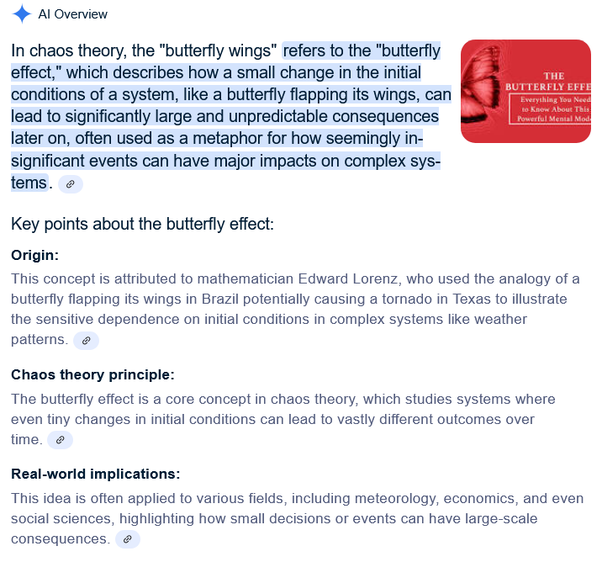
Cause and effect is physics, and so is Chaos theory, which is encapsulated within a concept called the “Butterfly Effect.”

In essence, it’s impossible to confidently predict the consequences of human behaviours because human societies are chaotic systems in which the most minor actions can lead to highly dramatic outcomes.

Whispering the correct sequence of words in the right tone into the correct ear can initiate a domino effect that can destroy an entire civilization (to translate the Butterfly Effect into a highly dramatic potentiality within the space of human dynamics).

That is valid science supported by observation and math.

Karma is “woo” — wishful thinking connecting a cause to an unconnected but desired outcome. It is supported only by the desire of the individual who hopes for a specific result. Reality doesn’t work that way, but coincidence can cause people to believe it does.

Having said that, if enough people desire an outcome, such as stopping a malignant force like Trump’s rabid destruction of the nation, then people will take action to affect an outcome through intent. This isn’t “Karma,” which suggests some invisible hand of the “human interaction space” (like the magical “invisible hand” of the free market) but cause and effect.

What will result from the escalation of conflict through the initiation of several protests as pushback to what the Trump administration is attempting through their implementation of Project 2025 is unknown. The only predictable aspect of where we are now is the guarantee that conflict will continue to escalate until it reaches a crescendo that can result in a complete breakdown of civilization through unmitigated chaos. How far all of this goes is anyone’s guess. We won’t know until the dust settles. We can only hope for a specific outcome based on the degree of public engagement and the escalation of protests against the takeover of the nation by a fascist entity.

That’s not karma because we can lose, while karma implies a guaranteed win. This is cause and effect in action, and the outcome is unpredictable.

People will call Tesla’s worldwide sales tanking karma because it feels good to say that. The reality, however, is that it’s the effect of a Nazi salute on the marketplace by a public that hasn’t forgotten the horrors of the Nazi scourge that extinguished millions of lives.

In short, I prefer to know the variables that can affect an outcome than hope some magical cosmic intelligence is balancing some invisible scale according to how I would wish the universe to operate.

Effects flowing from causes are reality, while karma is just wishful thinking.

Can you trust people who hear the voice of god?

This post is a response to a question posed in its complete format: “Can you trust people who hear the voice of god in their head and demand other people follow the words of their god?”

Sure. You can trust them to live in a world of delusion that creates a barrier between their internal narrative and the shared reality we all live in.

You can trust that they will defend their delusion to an extreme that could dramatically harm people who do not support or challenge it.

You can trust that if you’re not hyper-vigilant about their actions and attitudes, they will eventually devise a justification for doing you harm when you least expect it.

You can trust that if you don’t support their delusions, they will trash-talk you to their peers and give them all the reasons they need to become toxic toward you.

You can trust that they will do anything to affect the laws to ensure everyone submits to their delusions.

You can trust that their moral paradigm is entirely self-serving at the expense of anyone who does not submit to their delusions.

You can trust that if you piss them off enough, they will easily justify actions that can end your life.

You can trust that if they can establish and operate within a community of sufficient numbers, they will do whatever they can to undermine the systems they live within to transform their community into a Gilead nightmare.

You can trust that they view their toxic attitudes and destructive actions through a lens of corrupted righteousness, fueling a war under the guise of being an army in service to their delusion.

You can trust that they will identify the most easily victimized and relentlessly attack them as a recruitment strategy for their delusion as they seek to spread adherence to it like it were a communicable disease.

What is Art for, and Why is it Important?


This post is a combined response to a couple of questions initially posed on Quora and written in their full format as, “As an artist, how would you answer this question? What is art for?” and “What is the importance of art in our society?”

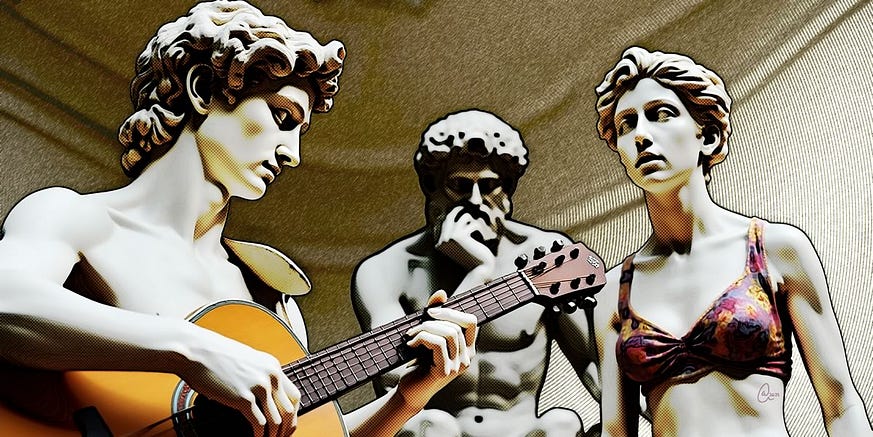
Canadian poet Irving Layton described artists as canaries in coal mines because they are the barometers for society, which compels us to expand our perceptions by confronting often harsh truths.

Art changes how we understand the world by reflecting reality back to us within directed contexts to focus our attention on aspects of life presented in often unfamiliar and/or uncomfortable ways.

Art enriches our lives and reminds us of our humanity while connecting us through the artist’s work.


“What is the importance of art in our society?”

To adequately address this rather direct but general question, some context is needed to frame an answer which fully encompasses its implications.

There are three general perspectives upon which to address this question.

From an individual’s perspective

The importance of art in an individual’s life is a broadening of perspective and a deepening of insight into… well, literally everything about the human condition. From an observer’s perspective, art connects us on a visceral level. Whether it be music that moves us, a few well-chosen words, or an awe-inspiring spectacle, the experience is a validation of belonging to something greater.

From an artist’s perspective, it’s the cheapest therapy form.

Cumulatively, society benefits from the positive contributions resulting from affirmative expressions of community life within larger societies.

From a community’s perspective

Art brings attention to issues often overlooked, misunderstood, misrepresented, or misapprehended in ways which provide unmatched clarity in creating understanding. Art can mobilize a community and motivate social change, contributing to stability within larger societies.

From a society’s perspective

Art reflects the most profound truths about life, the human condition, and society in general.

Art provokes social introspection and defines boundaries while providing clarity on issues.

Art provides the public with psychologically supportive outlets of expression that contribute to overall social stability.

Artistic activity provides a healthy return on investment to every level of an economy.

Artistic history provides us with deep insights into our evolution as a species, and it is an activity that also provides insights into our future, like every other discipline of discovery.

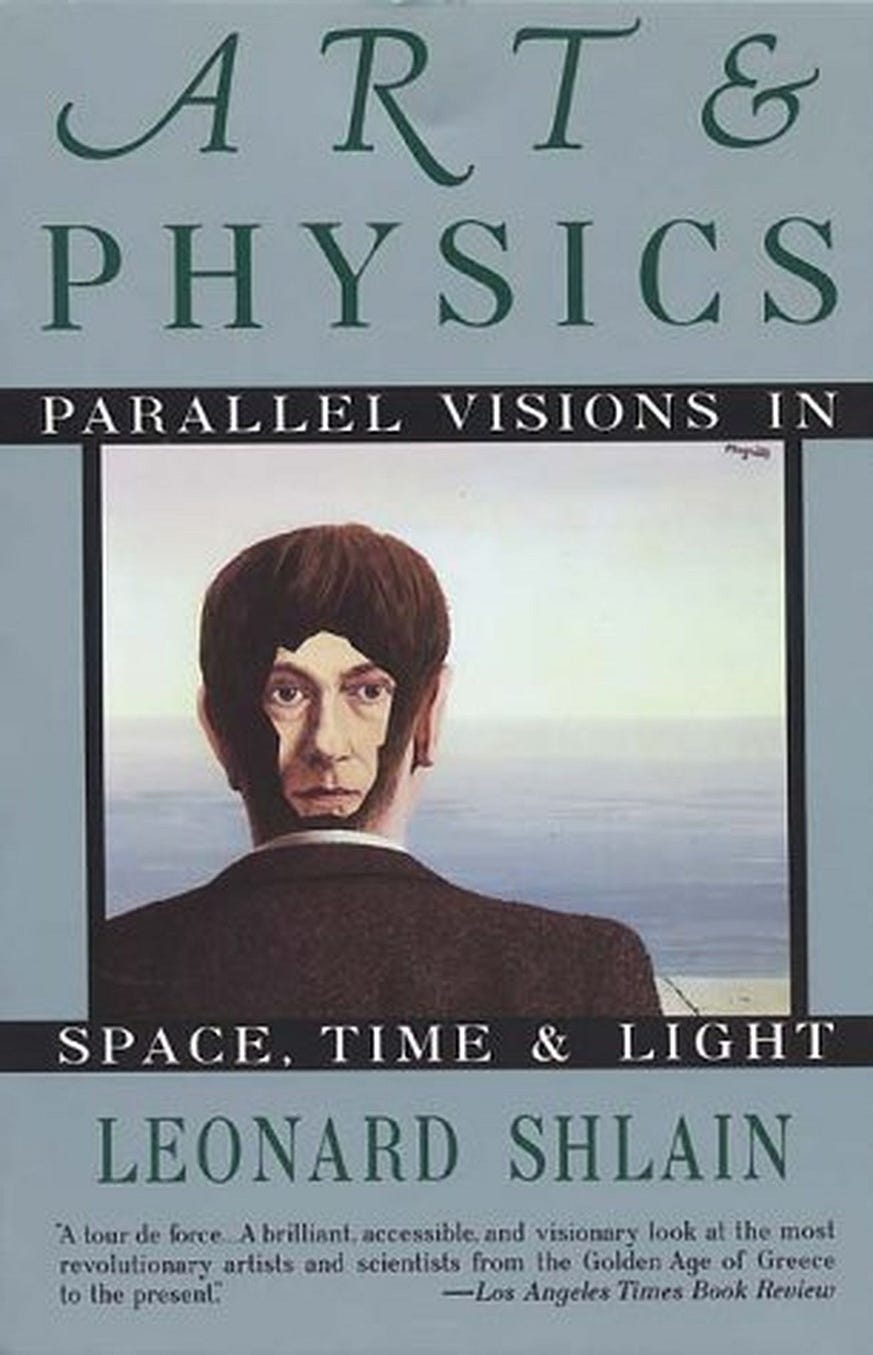
“Art interprets the visible world. Physics charts its unseen workings. The two realms seem completely opposed. But consider that both strive to reveal truths for which there are no words — with physicists using the language of mathematics and artists using visual images.

Art and Physics, Parallel Visions in Space, Time and Light — Leonard Shlain

Art & Physics | by Leonard Shlain

“Leonard Shlain proposes that the visionary artist is the first culture member to see the world in a new way. Then, nearly simultaneously, a revolutionary physicist discovers a new way to think about the world. Escorting the reader through the classical, medieval, Renaissance and modern eras, Shlain shows how the artists’ images create a compelling fit when superimposed on the physicists’ concepts.

Why do people work for leaders they don’t like?

This post is a response to a question posed in its complete format: “Why did people work for demanding leaders such as Steve Elon Musk? If they do not like them, why couldn’t they change their job?”

Jobs are not items in a grocery store that one can pick and choose at leisure.

Each job is a springboard to a better job or a deep dive into an abyss.

It cannot be stressed enough how critical it is to career success that one always has an exit strategy and a place to go if one’s job turns sour.

Jobs often go sour for reasons unrelated to performance and often due to abusive behaviours by management.

A personal case is one in which I was often extolled for my leadership skills while my supervisor would say to me, “You run a tight ship.” He would say these words to me while appreciating how much easier his life was due to my contributions. When I asked him for a reference letter, he wrote me a generic description of my length of employment as an act of spite to limit my options. He deliberately wanted to make it harder for me to make a vertical or even a lateral move away from an abusive environment in which he fraudulently presented himself as an ally who empathized with the abusive treatment I received from his supervisor.

Making matters more challenging is that jobs often go sour to such a degree that they are worse than not having a reference to support one’s candidacy for the next job. In my case, the Senior VP decided it would be fun to play a game of pretend I don’t know you each time we encountered each other. This went on for five years while I struggled with a salary 40 percent below market for my role on paper as I performed at levels higher than the manager and director above my role. They were happy to have me around, while I often saved their bacon and changed their tunes quickly when I chose not to go above my role and intervene to fix their mistakes.

A job relationship gone sour can become a barrier to continuing one’s career. More people than one would like to believe will easily choose spite to justify sabotaging a person’s career development efforts.

Someone as petty as Elon Musk could easily justify going to cartoonish lengths to destroy a person’s career on a whim. In his case, his reasoning is a consequence of the corruptive effects of too much power for anyone to possess.

Changing one’s job was much easier when we had a thriving middle class and various job options outside the structured and incestuous corporate world. Job options have become severely limited throughout the last several decades, in which one’s only choice for a stable career has mostly become a choice of serving as a cog in a multinational organization while hoping restructuring efforts don’t result in it vanishing overnight — like what happened with Twitter when Musk fired most of his staff on a whim.

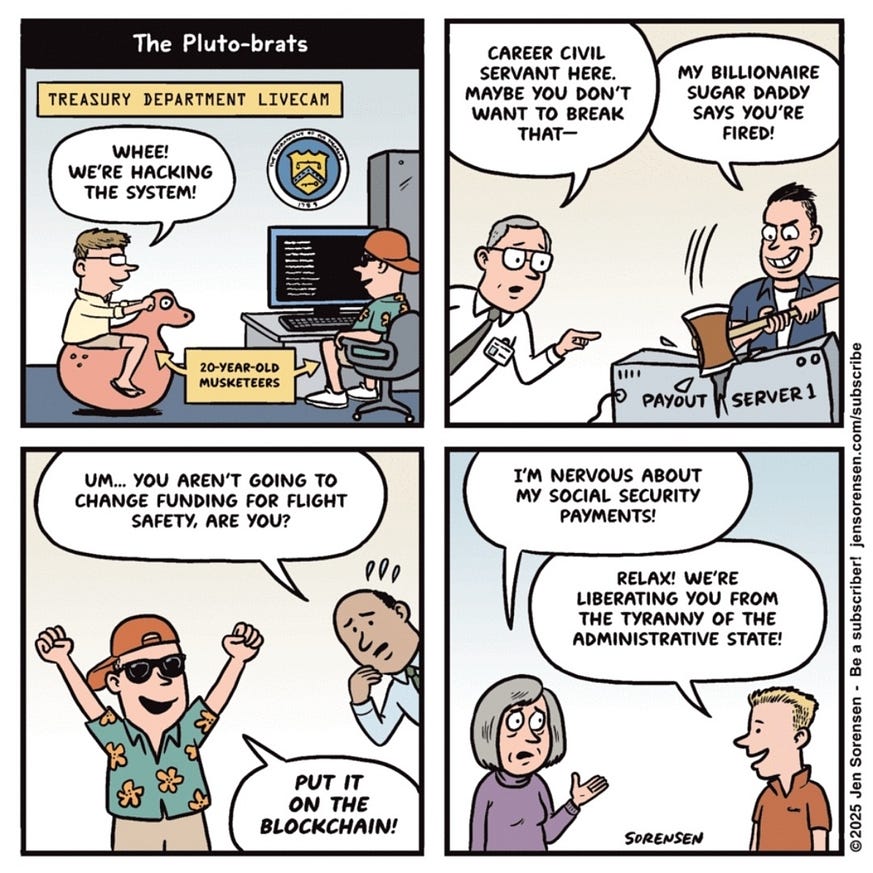
Musk’s latest attempts at accessing the personal data of three hundred and fifty million Americans are precisely for controlling their lives by leveraging their histories against them. Our choices in working for leaders we don’t like are becoming increasingly restricted to either that or homelessness and destitution. That’s not much of a choice.

If this nonsense continues, no one will be free to do anything without his oversight and the oversight of a fascist oligarchy.

What political ideology is socially progressive?

This post is a response to a question posed in its complete format: “What political ideology is socially progressive but still capitalist?”

People are socially progressive or regressive, not ideologies.

Ideologies are wrappers around the contents of similarly aligned people who share a common set of values, beliefs, and ideas for how political processes occur and how commonly beneficial goals are achieved by working together.

Ideologies are not static entities like moulds that immediately shape a person’s thoughts once inducted into an ideological grouping.

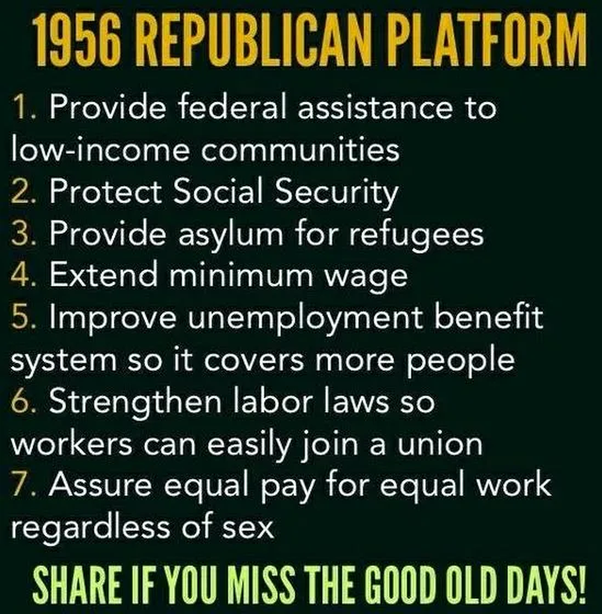
Ideologies are dynamic and ever-changing as people change. Here is an example of how much an ideology can change:

(For the “fake news people,” here is a link to the Snopes article giving this platform a rating of “mixture” — 1956 Republican Platform )

Regardless of the accuracy of the above platform, it’s pretty clear by the Project 2025 platform that it has significantly evolved.

People define and shape ideologies, not the other way around.

Today’s Republicans are not Abraham Lincoln’s emancipation championing Republicans.
Today’s Democrats are not the Dixie Democrats of less than one hundred years ago.

Liberalism has undergone many varied manifestations as if it were Christianity, endlessly spawning new denominations.

This question, however, flips that script around and becomes something pretending to be an ideology but is, in fact, something much uglier and evil. This question presents an ideology as if it were a costume to wear in a performance following a script dictated to members like a cult.

Ideologies are also not capitalist. People are participants in an economic system referred to as “Capitalism. Each person views aspects of Capitalism that align with or run contrary to their politics. Since economics comprises a core component of political systems, varying interpretations of Capitalism’s’ role in society also form a core component of alignment with an ideological identity.

In short, almost all political ideologies incorporate interpretations of Capitalism within their ideological construct. Hence, you have answers extolling varying ideologies that all claim to be capitalist.

Like religions, however, each pretends to represent the “one true God (of Capitalism).”

If one were willing to stretch the definition of Capitalism beyond its commonly accepted uses, then even Communism could be considered a “capitalist ideology” because capital is essentially a store of value directed toward creating infrastructure for facilitating trade. Communist systems conduct trade within their systems.

After having said that and freaking out some hard-core capitalists, let’s track backwards and identify the typical distinction between Capitalism and “not capitalism.” That definition hinges on ownership of the means of production. In Capitalism, ownership of factories is held by private entities. In a communist economy, factories (production environments) are owned “by the people.”

Ironically, however, an argument often used to extol the benefits of Capitalism is the ability of the people to buy into a capitalist venture through a process called “share ownership.” Functionally, this renders the distinction between Capitalism as we perceive it and Communism as it was conceived as moot.

Communism failed because centralized authority was unable to meet the needs of the people. Capitalism is undergoing a late stage that is rapidly descending into failure for the same reason of consolidated power and centralized authorities.

The only salient differences between the two systems are how power is distributed and who is conferred power by what process that conferring of power occurs.

In summary, we would be far better off focusing on power instead of worrying about ideologies and which one wishes to identify with as their favourite team. We should be far more concerned with who has power in society and how much power they have.

If we genuinely want to live in a free society that we typically call a “democracy,” then we desperately need to adopt an ideology which “worships the flattening of power.” We must adhere to principles in which power is spread like peanut butter to all people.

The only power that truly matters in life is the power to choose how to live it.

Freedom is living one’s life in a state of maximum opportunity and diversity of choice within a shared environment. A critical factor in the success of an ideology is the acknowledgement of how we are all in this together. Only together can we survive into a future that lasts even half as long as the dinosaurs did.

Was there a defining moment that led you to become a feminist?

This post is a response to a question posed in its complete format: “Was there a defining moment that led you to become a feminist, and if so, what was it?”

Before I begin with my answer to this question, I’d like to include a quote from Dr. Ernest Adams’ (https://www.quora.com/profile/Ernest-1329/)  — answer to a question defining feminism  —  (https://www.quora.com/What-is-a-feminist-exactly-I-have-never-been-able-to-understand-exactly-what-that-entails-The-terms-definition-seems-to-float-somewhere-between-reality-and-personal-definition-of-reality-or-just-plain-ridiculousness/answer/Ernest-1329):

Feminism seeks to obtain equal rights, privileges and opportunities for women; to improve their lives and living conditions, particularly with respect to problems that are unique to them; to produce equal outcomes of these policies such that they have similar levels of power, wealth, influence and respect to those enjoyed by men; and to change social attitudes that are hostile, derogatory, oppressive, or tend to interfere with any of the foregoing.

The funny thing about my upbringing is that I should have turned out to be a misogynist.

All the elements were there.

Under-Educated Community? — Check

The average education in the town of about seventy thousand I grew up in was grade nine. The primary employers in the area were forest industry operations. One could afford a comfortable lifestyle with a mortgage and two-point-five kids on a mind-numbing daily routine.

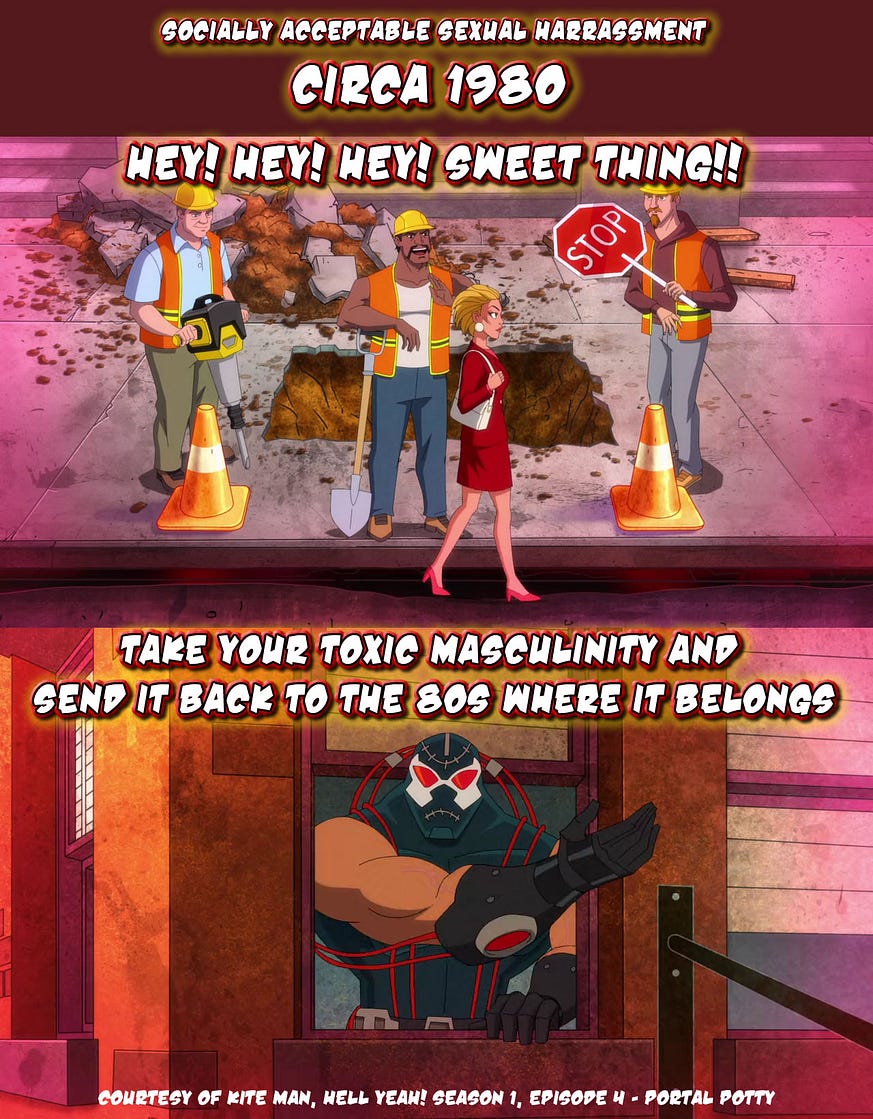
Toxic Masculinity Within My Family and Throughout My Community? — Check

“Be a man” was a daily slogan one would hear everywhere in almost every context, but it wasn’t in the refuge of my art class where one of my instructors was flaming, but I didn’t realize it then. Hell, I didn’t realize that about him until I visited the ol’ stomping grounds years after graduation, and I wondered why it seemed he was lusting after me.

Practically everywhere else, though, including my own family, there was no shortage of advice on how to put women in their place and no shortage of shame hurled in one’s direction if they showed “weak emotions” like compassion.

A Panoply of Bigotries Everywhere? — Check

There was always a reason to crap on different genders, different skin colours, different hairstyles, different clothing styles. One acquaintance who listened to the Beach Boys morning, day, and night would give you a sideways glance if you listened to anything else. From his perspective, something was wrong with you if you liked Reggae.

Manly Men Doing Manly Things Everywhere? — Check

If you couldn’t name every part in your car while stripping it down to nuts and bolts while doing your oil change and then reassembling it for fun, there was something wrong with you. You weren’t a man if you couldn’t work on your vehicle at minus twenty below weather.

Hanging Out Car Windows While Wolf-Whistling at Every Woman Walking Down the Street? — Check.

Boys believed the girls went for that sort of behaviour and were butch if they didn’t. Even the girls in that environment were more masculine than any male in the school band, and they could drink one dozen of them under the table without a bathroom break.

Somehow, though, I never thought of women as either inferior or superior or anything beyond being just people. They smelled nicer, and some could appreciate sensitivity, but you had to be careful who you displayed it to because most would think something was wrong with you.

I didn’t realize I was a feminist until well past my thirties. I still don’t think about it unless it comes up in conversation, and I have to remember that I somehow reacted against the toxic masculinity in ways that made me one.

I think that’s one of the things that bullies don’t quite get. Every person they bully in life learns to hate everything they embody, and so growing up in an environment rife with toxic masculinity has taught me to hate machismo on such a level that I am now in a position of putting my life at risk with the police because they have bullied me to such a degree that I’m barely hanging onto my life by a thread. I’ve been adamant in conveying to them that I will not shut up and die quietly so as not to disturb their reverie because I am only beginning to rage against their destruction of my light publicly.

Feminism is equality, and even though men take the lion’s share of the blame for abuses, it doesn’t mean all are guilty of being abusive bullies. Women can also be assholes on levels equal to men as well.

Feminism simply asserts that we are all people, while the idiots on social media who never shut up about the evils of feminism are screaming their toxicity to the world. They are like MAGAts wearing warning labels in the form of red caps to identify themselves as toxic. Every male who whines about feminism is admitting to the world that they’re a toxic misogynist.

As prevalent as misogyny may still seem to be, it gives me hope to see popular media represent changes in society that remind me how glacial our social evolution is. It may seem imperceptible from the perspective of an individual life. Still, we are maturing as a species — no matter how much temporary regressions of our values may challenge our ability to maintain hope for a better future.