Why can’t I accept failure?

This post is a response to a question posed in its complete format: “Why can’t I just accept failure? Like if I fail on something I always almost grandiosly believe that there is no way that’s the end and begin comming up with a whole palet of things to do that could potentialy “fix the situation”?”

Instead of asking why you can’t accept failure, you should ask whether failure is acceptable within specific contexts. You should also ask yourself what you might learn from what you perceive as a failure, which also begs the question of why you perceive a specific outcome as a failure.

For example, if you’re interested in someone and wish to develop an intimate relationship with them, and your advances are met with rejection, do you perceive that as a failure? If you perceive that as a failure, does that motivate you to persist in your advances, hoping you can convince them to change their mind?

Suppose your approach is to persist in pursuing a relationship after being rejected because you can’t accept what you perceive as a failure. In that case, you are failing to understand the dynamic in play.

Lack of success in achieving a goal does not equal failure.

Being rejected by someone else isn’t a situation you can fix.

Let’s move on to a different context commonly associated with a perception of failure, such as not achieving the goal of becoming a millionaire. The paths one can take to achieve such a goal are innumerable, while the variables affecting the outcomes are more easily quantifiable. For example, elements in achieving this goal amount to the degree of opportunity extant within a particular strategy, the material resources one has on hand to help them achieve their goal, their interpersonal relationships and the successes and advantages one may gain through their networking efforts, timing, market reception and demand for their product or service, their competitive difference, the uniqueness of their offering, the quality of their branding, and how they can leverage media to maintain a top of mind that contributes toward steady growth.

These combined can almost be a prescription for guaranteeing one can become a millionaire in time. However, any single tragedy or traumatic life-altering event in their lives can derail all of that.

Failing to achieve their goal of becoming a millionaire doesn’t mean they have failed because it’s impossible to predict random events in one’s life that can dramatically alter its trajectory.

In this case, to contrast against the former example, one can return to pursuing their original goal of becoming a millionaire while being entirely hobbled in all the areas one initially relied on to achieve their success at the outset of working toward their goal. What can happen at a point where one realizes their goal is not only much more difficult, if not impossible, to attain after so much had been lost, is that their initial goal is no longer as important as it once was, or at least no longer defined by the same parameters or reasoning one applied at the outset. Instead of becoming a millionaire, they adjust their goal to a more modest level of meeting needs and fulfilling some desires while realizing how some choices they made the first time are no longer acceptable.

The nature of their goal will have changed in ways that make its first interpretation moot.

That process is called learning — growing as an individual and adapting to a reality that one has a limited capacity for influencing.

One hasn’t failed if they can succeed in adapting to new circumstances. Quite frankly, the opposite is true in such a case because such tragedies often result in even worse tragedies from being unable to cope with traumatic losses. People frequently commit suicide when faced with intense trauma that destroys what they had accustomed themselves to accept as true about their lives.

The point is to help you understand the genesis of failure lies within one’s perceptions. If you struggle intensely against what you perceive as a failure, you fail to understand your circumstances’ deeper level.

IOW, your perception of failure is a failure to restrain your ego because it assumes you have complete control over outcomes when you don’t.

Sometimes, “failure” is failing to accept failing to achieve a goal. Failing to achieve a goal is an opportunity to learn something about reality and oneself. If people can walk away to continue living their lives while learning something they did not understand before their experience of failure, then they haven’t failed at all.

The point of life is learning, not achieving.

Temet Nosce

Why aren’t Americans taught that freedom from debt is an important freedom?

This post is a response to a question initially posed on Quora, and can also be accessed via “https://www.quora.com/Why-arent-Americans-taught-that-freedom-from-debt-is-an-important-freedom/answer/Antonio-Amaral-1

For someone who values a debt-free existence, it can undoubtedly be viewed as an absence of a burden that enables greater freedom of choice. However, the entire system of capitalism is based upon leveraging debt to create revenue.

Revenue and profits are seen as far more powerful versions of freedom within a system that can be leveraged in ways in which the debts themselves can be resolved by servicing them with the increased revenue they generate or by being forgiven.

Of course, this form of debt is not the same as implied by the question, which is based on the notion of debt accrued in purchasing lifestyle augments. For example, a purchase of an air purifier I made just today was made through a credit card, constituting an assumption of debt on my behalf. This purchase will generate no revenue, but I applied my justifications to the decision before making it.

One can argue that my decision decreased my freedom, but that’s only a tiny part of my decision. I can easily say in favour of the practical benefits of making this purchase, even with the context of it ultimately increasing my freedom (from headaches, specifically). However, that makes this degree of granularity in decision-making a cartoon.

Suppose the point of this question is to criticize people for spending thousands on a 100″ television through credit debt instead of a quick payment of a couple of hundred for a 24″ television that would leave them debt-free. In that case, these discussions are merely psychological masturbation sessions where people are attempting to objectify subjective considerations for themselves and applying essentially bigoted reasoning to determine values of rationality toward decisions made by others for things they value.

The reality, however, is that if one is going to argue how debt freedom is an important freedom, then so are many other forms of freedom. For example, freedom from a crushing health exploitation system through a universal healthcare system is also an important freedom that many don’t consider freedom because they’re obligated to support it through their taxes — even if it means a reduced fiscal burden and improved services. The fact that they have no choice but to contribute to it, whereas they do have a choice in a privatized system to pay much more and be rejected by their insurance carrier to die, is also considered an important enough form of freedom for many that universal healthcare remains unimplemented in a nation that likes to think of itself as a bastion of freedom even though it has the highest incarceration rates in the world.

The point is that no matter how vital debt freedom seems to some, sound fiscal management skills are more critical because debt is contextual. The largest corporations in the world carry the most significant amount of debt and begin by getting deeply into debt. Our financial systems are geared around rewarding debt.

Your credit score, for example, drops when you’re debt-free and increases when you have debt and show that you can manage it. The only way to improve one’s debt ceiling is to go into debt. You can live your entire life being a cash-only person and living debt-free, but when you reach a point where you need debt to resolve an issue or accomplish a goal, going debt-free becomes a liability in your application for debt.

In short, Americans are not taught that freedom from debt is an essential freedom because it isn’t. The ability to service one’s debt through revenue constitutes a far greater level of freedom. After all, there isn’t one investment manager who counsels investing one’s money into risky investments. They always counsel investing other people’s money.

Some may wish to argue for a return to debtor prisons based on this dynamic, but that would just penalize the wrong people.

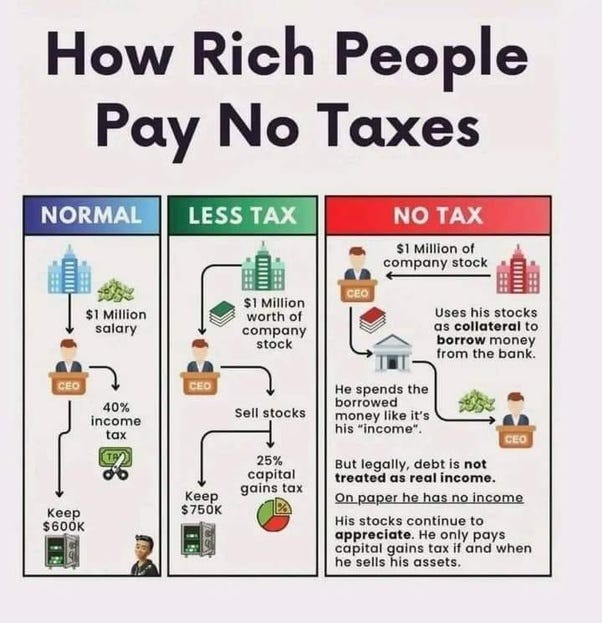
Here’s how wealthy people leverage debt to lower their cost of living, for example:

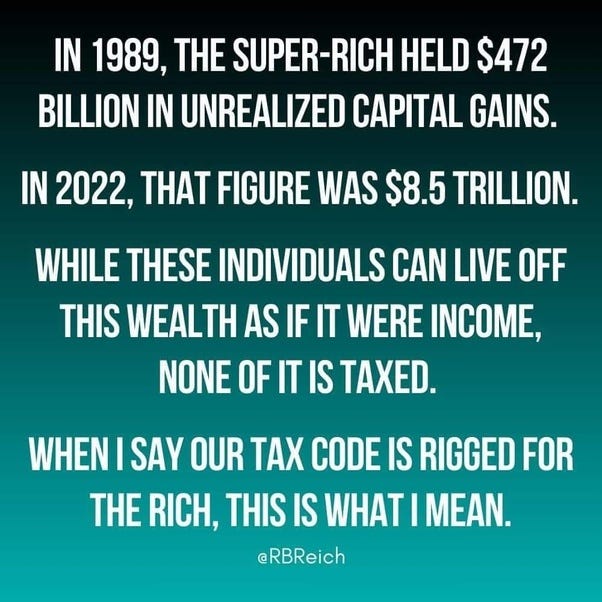
The wealthiest among us experience the most significant degree of fiscal freedom precisely by how they manage their debt.

The kind of debt and the thinking about debt described by this question is from an era when people could count on stable 40-year careers, prudent personal economic management, and modest living that would result in a comfortable retirement. Those days are long gone.

Will people understand greed is a miserable state?

This post is a response to a question posed in its complete format: “When will people understand that their constant selfish reckless belligerent greed is what brought society to its current disgusting miserable state of existence?”

Let’s look at someone like Donald Trump. He has spent an entire lifetime spreading hatred while bullying people to feed shallow desires, and he entertains himself through acts of cruelty he enacts on fleeting whims. He’s been behaving in ways that epitomize constant selfish, reckless, and belligerent greed, ostensibly his entire life.

His response to being criminally convicted was not remorse but to have the conviction overturned.

This question naively presumes that a person who behaves in destructive ways throughout their life will magically experience an epiphany of conscience in which they will transform into the “decent human” imagined by this querent.

Never has any evil monster throughout history found any turning point in their life that magically transformed them into saintly beings. Most who claim to have “seen the light” assume such a position as a fraudulent means of continuing their prior agenda of self-benefit at the expense of others.

The short answer to your question is “never.”

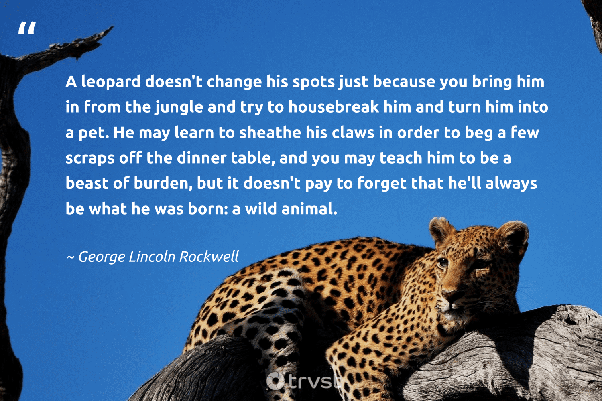
People cannot change their essential nature. They may choose to improve, but that presupposes desire that has always existed and a lifetime of dedication toward that end.

People like Donald Trump see nothing wrong with their behaviour and so will never make an effort to improve.

Epiphanies such as this question presume to be possible constitute wishful thinking on a highly destructive level of delusion that prevents us from addressing the fundamental issues of broken psychology that we must dedicate ourselves as a society to addressing on the most basic levels.

We can never truly call ourselves civilized if our systems enable and empower the kind of evil embodied by people like Donald Trump — and make no mistake about it, we encourage his evil.

Our societies embrace and enable selfish, reckless, and belligerent greed.

Until we can address the fundamentally broken human psychology on a system-wide and social scale, we will continue to be plagued by these behaviours.

Ten percent of the world’s wealthiest are destroying our planet at a rate practically matching the total of the other 90% of the rest of humanity. Instead of doing something to restrain their destructive behaviours, we put them on pedestals and worship their harmful behaviours.

Changing humans in ways that address destructive behaviours embodying selfishness, recklessness, and belligerent greed means we must start at the top and change all of human society.

Could poor employee performance be due to being forced into a job?


This post is a response to a question posed in its complete format: “Do you feel that Wal Mart employee’s lack of performance could be due to the fact that welfare literally forces people to accept a job offer or lose benefits that provide Food and Housing? Support #UBI”

When employers don’t care about their staff, their staff stops caring about them.

When employees stop caring about their employers, they disengage and produce the minimum they can get away with. They focus less on productivity and more on toxic politicking to gain personal benefit over others in an increasingly misanthropic culture that pits people against each other.

The sociopathic Walton family is teaching their people to hate them, their operation, and the society which permits them to exploit the vulnerable. Their people, staff and customers are being virtually trained to devalue everything about human life and modern society. This naturally results in the disengagement that every other historic failure of society has experienced preceding widespread systemic collapse.

This isn’t rocket science. It’s reciprocity.

Most people understand it clearly as “you get what you give.”

Sadly, we’ve allowed our societies and our systems to forget the most critical principle to acknowledge and characteristic of the human condition to preserve within everything we do. Strangely, it’s also a core principle within almost every religion throughout the history of religion.

It’s not complicated in the least.

Even science acknowledges it.

It’s cause and effect.

“Do Unto Others As You Would Have Them Do Unto You.”

It’s only a matter of time before the greedy, misanthropic Walton family finds themselves confronted with the bill for the consequences of their sociopathic and parasitic disdain toward society. In effect, they are no different than this person who justifies shoplifting.

They are responsible for breeding this kind of thinking because this is precisely their reasoning as they disempower their people and force them to rely on government assistance so that they can increase their hordes in an escalation of the misanthropic decay of society.

They are spitting on the social contract from the comfort of their luxurious mansions.

They are no different from this person and are responsible for validating this skewed justification.


UBI is a basic correction to veering off-course in the last several decades.
UBI is insurance for the transition toward automation, which is well underway.
UBI is a stabilizing societal element that will eliminate poverty, homelessness, and various social problems that create conflicts from which we all suffer.

Why do people think I should feel guilty about shoplifting?

This post is a response to a question posed in its complete format: “Why do people think I should feel guilty shoplifting, when literally so many people in the world want to use other people for what they have?”

You seem to want to justify shoplifting as a form of protest.

Meanwhile, protesting is a means by which systemic injustices are challenged by publicizing grievances. The point of doing that is to garner widespread support and enough momentum to make a systemic change that addresses a grievance over a condition which victimizes many people.

Sometimes, protests must be escalated to such a degree that some form of tradeoff between victimizing an aggressor and sacrificing someone in an act which alerts an otherwise unaware public of the severity of a grievance.

The incident between Luigi Mangioni and Brian Thompson from United Health qualifies as a situation in which escalation was deemed necessary (by Luigi) to sacrifice one’s life to alert the public to the severity of a systemic injustice.

Most often, protestors sacrifice only time and effort to address injustices. The goal of protesting, however, is to help people other than themselves who may or may not participate in the protest itself.

The purpose of a protest that can successfully gain support and make meaningful change is never to benefit an individual at the expense of victimizing someone else because that’s just another form of victimization.

It may be true that the degree of victimization is practically invisible to the victim such that they suffer a loss on an unnoticeable level, but they remain victims nonetheless.

It may very well be that the stores absorb their losses from your thefts with little impact on their operations, but that’s mostly because they amortize their losses across their operations. That means that a proportion of the cost of their products contains a piece of math they’ve determined recoups their shoplifting losses through every product sold.

Your thefts as an individual may be unnoticeable. Cumulatively, however, with others who think the same way you do, your thefts contribute to the increased cost of products that everyone bears while the store factors in a profit margin for managing those losses. Your thefts contribute to their net revenue while further victimizing those who pay full price for their products.

You may view your theft as a personal protest, but it’s an act that solely benefits you and injures all other consumers more than it injures the store you steal from. For this reason, your behaviour is considered selfish, over and above being a crime that contributes no benefit as a protest to the issue you criticize.

Your reasoning shares more in common with the stores you steal from when they add surcharges to an expected percentage of loss that’s padded enough to profit from.

Your reasoning and theirs are based on misanthropic, spiteful, and opportunistic thinking to justify an essentially parasitic behaviour.

You may not feel guilty about your choices, but they are neither justifiable nor actions to be proud of. However, the risks you take will one day result in criminal charges against you, while no one will be interested in empathizing with your reasoning.

You will carry a stigma of shame for the rest of your life once that happens, and no one will be sympathetic to whatever suffering you might experience as a consequence of your criminal choices.

Furthermore, your shame will be compounded by the reality that you will have become exactly the type of person that you justified harming through your thefts.

In short, your reasoning makes you a hypocrite, and you may not feel guilty about stealing from a greedy operation. You might still want to consider alternative forms of protesting to make your point — assuming, of course, that you believe your reasoning instead of just making excuses for being precisely the same as the people you criticize.

The circular and self-serving nature of your reasoning is precisely the same reasoning every criminal uses to justify their behaviour.

After all, in their minds, they also believe “everyone else does or would do the same in the same situation they’re in.”

Try to imagine the chaos that would ensue if everyone made the decisions you have made for yourself using the same reasoning you employ.

Society would shut down, and that’s why you will get no mercy when you inevitably get caught. After all, it’s never an issue of “if” with repeat offences but “when.”

Your luck will eventually run out, and you will be caught. If guilt isn’t enough to motivate you, then understanding how impossible it is to shoplift indefinitely might help you to reconsider your choices.

Security systems are improving every day. It’s already impossible enough for security experts to keep up with all emerging technologies, let alone someone like yourself. Cameras are cheap nowadays and tiny. You won’t know where you might be recorded, and it’s only a matter of time before you won’t know about the GPS tracker hidden in the liner of the coat you steal.

Good luck, though. Maybe you’ll convince a billionaire to give their people a decent raise just to convince shoplifters to stop shoplifting… which will happen after cows learn to fly. 😜

How can I motivate myself and feel less miserable?

This post is a response to a question posed in its complete format: “Sometimes I cry inside myself that I’m not like other intelligent people in my school and it hurts me every single day. I want to do my best but it just feels hard and my motivation dies off quickly. How can I motivate myself and feel less miserable?”

You joined Quora about three years ago and appear to have only two questions, including this one. The other question is about the lack of support and apparent abuse you endure from your parents.

It seems you are dealing with some intense emotional struggles that you do not deserve. However you perform in your academics and to improve yourself and achieve your goals, your parents have a moral obligation to be supportive.

Since they are not, you get saddled with the doubly hard challenge of finding your way through life’s confusing mess.

It’s not fair to you, but it may help you to understand how utterly broken most of the world is. We live in a world where a whopping majority (70%-80%) of families are dysfunctional.

You are not alone.

You can overcome your challenges.

A few things to consider while struggling to make something worthwhile of your life include;

  1. Focus on doing what you love doing. By investing your energies into something that brings you joy, you can create successes that will help you develop the confidence and motivation to succeed in other areas of your life.
  2. Find people who can empathize with your struggles — mainly because they endure similar struggles. Develop friendships with them to experience the emotional support your parents cannot give you.
  3. Read and read a lot to experience life through different eyes and learn to understand the complexities of life and its struggles through perspectives different from your own. Learn from what other minds have to teach you, and you will find strength within that you cannot feel now.
  4. Get a pet, if you can — a dog or a cat that can fill your heart with unconditional love and give you a reason to carry on through your toughest challenges.
  5. Spend as much time as you can with nature to feel that you belong here and to something much greater than the box of sorrow you have been given to bear.
  6. Know that nothing matters more than your ability to grow and change and adapt to an increasingly chaotic world undergoing a dramatic change that is pushing all of us to our limits. If we can survive this period of change, we will find a much friendlier world awaiting us on the other side of these challenges.
  7. Believe in yourself even when you make mistakes. Indeed, feel good about recognizing your mistakes because they are lessons you have succeeded in learning. It is much worse to make mistakes without identifying them as mistakes. It means you will repeat them like banging your head against a wall and hurting yourself even more.
  8. Allow yourself to see your parents as human beings like all other human beings. All of us have been damaged in some form or another by life, and it is a consequence of having undergone generations of struggle to emerge from a darkness of barbarism.
  9. Whatever you do, if you approach it with honesty, you are doing your best. You don’t have to try to do your best. You will always do your best if you are honest with yourself about what you do. Expect nothing more from yourself than complete honesty because knowing yourself matters most in your life. Knowing yourself is where you will find the strength to endure all the many challenges your life has in store.

I wish you all the best in your journey through this madness called “life.”

Temet Nosce

What should you never say to an atheist?

This post is a response to a question initially posed on Quora. For answers to additional questions, my profile can be accessed via “https://www.quora.com/profile/Antonio-Amaral-1/

“Atheism is a belief.”

“Atheism requires faith.”

“Atheism is a religion or cult or institution.”

“Atheists are a group which share characteristics or interests or views in common beyond disbelief in a God creature.”

“Atheists have no morals.”

“Atheists reject or hate God or worship Satan or any fictitious creature imagined by theists.”

“Atheists believe in science.” (No one, atheist or otherwise, who understands or has a basic understanding of science “believes in” science. Science is not a matter of faith, so please stop superimposing your insular paradigm onto others.)

“Creationism is an alternative to evolution.” (Also, don’t ever call people, atheists or otherwise, “evolutionists” because that’s just plain ignorance at an incredibly ignorant level of insular stupidity.)

Other statements like “God bless you” are contingent upon an individual atheist’s perspective on the matter. (I’m okay with people expressing positive sentiments in terms they are comfortable with and interpreting them as such.)

Atheists do not, as a whole, hate theists; they want them to stay in their lane and stop pretending like their beliefs trump facts because they don’t. Freedom of religion is the freedom to believe as you wish, not the right to impose your beliefs onto others. I don’t care if you think your interpretation of your scriptures causes you to believe homosexuality is wrong; you’re not God, and you have no right to pass judgment on people for how they were born… oh, and stay out of politics or start paying taxes like everyone else does.

By the way, Jesus wasn’t white, and his views were liberal. He did not support wealth but service to his fellow humans. He was not a narcissist who cared more for himself than the poor. His life was dedicated to peace, not war, nor to becoming wealthy or superior to others. He washed the feet of lepers to show you what that means, so betraying your saviour with your idiotic divisiveness and hatred will only send you to the hell you fear (if your beliefs pan out to be confirmed).

Even worse than simply betraying your beliefs, you make life hell for others — yes, I know, not all religious types are hypocrites. Still, all religious types must call out hate-mongering hypocrites like Steven Anderson, Kenneth Copeland, Jim Bakker, and the Westboro Baptist Church, who all prey upon your fellow believers by feeding on their insecurities. Make an effort to show the world you do believe what you claim to believe by raising a humungous stink over the very many atrocities committed by supposed religious leaders. There is no bloody way any religion can have any claim on morality when the predation of minors is institutionally protected. You must clean out the corruption in your own house first before you can hypocritically claim to care about so-called “unborn babies.” All this hypocritical crap makes people justifiably hate you and everything you claim to believe in — even the innocent ones among you; and worse for you, it makes people run away from your toxicity while eviscerating your credibility in everything you claim to believe.

That should cover most of the broad strokes I can identify from the top of my head (yes, it’s true, my references were Christian because that’s what I am most familiar with, but that doesn’t mean every other form of theist fantasy gets a pass because these sentiments apply to you, too.) We are living in a world characterized by disinformation and hatemongers to disenfranchise innocent people who cannot defend themselves. At the same time, hate crimes escalate as a monstrous hypocrite profits from selling autographed bibles.

(I wrote this five years ago and have been discussing these issues throughout my entire life, and instead of seeing any improvements with your lack of integrity issues, we’re seeing an increase in the kind of hypocrisy that would send chills down the spines of your venerated saviours. It’s horrifying just how little effort religious followers put into holding their leaders accountable for the hate they spread, and you dare to pretend you have a moral high ground. It is this kind of hypocrisy that’s driving people away from you.

If you want to be legitimately viewed as a moral people, then concentrate on feeding children in your schools instead of putting up fraudulent props like your Ten Dogmatic and repetitive Commandments. Kids need nutrition to focus on school and succeed at getting an education, not orders barked at them with threats of eternal punishment. This isn’t supposed to be the dark ages any longer. Those were over 500 years ago.)

All I can say as a summary is, Thank God I live in Canada because Americans are in for one helluva wake-up call over these next four years. What truly sucks, though, is how much of a negative impact you’re going to have on the entire rest of the world as you grapple with your lack of basic human decency.

Why do poor people move all the time?

This post is a response to a question initially posed on Quora, and can also be accessed via “https://www.quora.com/Why-do-poor-people-move-all-the-time/answer/Antonio-Amaral-1

Their options are always limited to housing, which most often includes conditions that would be unbearable for those who take their ability to afford decent housing for granted. Consequently, any time spent with anyone living a marginal life will reveal horror stories most people could not believe were real.

As an example, someone I know had no choice due to prior “accommodation difficulties” (of which this person was a victim of the behaviours of others in this prior matter), chose an opportunity of availability and expedience because neither time nor resources allowed the luxury of shopping and waiting. As a result, a choice was made for a temporary resolution to bide time and save money for something better. The living conditions were rather horrendous as it was a suite within a house (which tends to be what’s most available at the lowest costs) owned by a hoarder who often snooped and eavesdropped while generally inebriated every waking moment — fortunately, not the violent type.

At any rate, this temporary accommodation was six months filled with fun and adventure, ending in an almost surreal form of coincidence. Upon having found another, more appropriate suite in a moderately priced complex and beginning preparations for moving, the owner was found unconscious. He was rushed to the hospital and treated for a heart condition, but since his mental faculties had failed so severely, he was moved into a care facility. Of course, this turn of events meant relocating sooner rather than later.

This person’s new and seemingly stable accommodation required some austerity to maintain a stable and relatively comfortable lifestyle. After the one-year lease expired, the rent increased by its legal maximum. Shortly thereafter, they were informed that the building complex had been sold and that the new owners were considering redevelopment, which may require them to move again.

This is one of the overlooked details of poverty. The lack of stability itself is an incredible drain on resources, which means this approach to living by addressing crisis after crisis over time is psychologically, physically, and financially draining. The consequence is this is just another forgotten example of how poverty is an existence of perpetual punishment for simply being poor while having little to no access to escape.

A harrowing statistic I’ve just recently posted in another answer to another question since answering this question 6 years ago is the number of people who work full time and are homeless.

I was also prompted by what’s been happening in California with predatory real estate corporations owned explicitly by Blackstone and headed up by Stephen A. Schwarzman from an email I received from Brave New Films. It prompted me to create a provocative meme to post on Xitter that may be a bit too provocative for some but can’t be ignored as a practice that can only be endorsed by psychopaths who are responsible for the current state of dire straits experienced by victims of theirs.

This is an argument against corporate ownership of residential real estate.

Why don’t people realize our plutocracy causes our problems?

This post is a response to a question posed in its complete format: “Why don’t people realize that it is plutocracy (our country being governed by the wealthy elite) that is causing our economic problems?”

People don’t magically “realize things.”

People must be educated, informed, and aware of circumstances and details.

They need to be walked through the information presented to them as if one functions as a guide on a tour, answering questions.

People also don’t respond to laments, particularly when entrenched in counterfactual bigotries that prevent them from apprehending reality through an objective lens.

In essence, if this is an issue of concern for you, which I’m glad to see it is, then you need to start banging drums and sharing information and details because there are at least 76 million people in the U.S. alone who are entirely so oblivious to what you’ve determined for yourself that they contribute to the problems caused by the plutocracy.

There are many reasons why many people support self-and-socially destructive agendas, and most of those reasons can generally fall into only a few camps:

  1. They benefit directly from the corruption,
  2. They interpret the economic problems of the victims of a corrupt system as personal failings,
  3. They imagine themselves as potential beneficiaries of corrupt powers by supporting them,
  4. They lack the wherewithal to do anything about the corruption, so they cope with what they don’t believe they can change by resigning to hate the more easily victimized,
  5. They support what they believe is a natural state of a zero-sum existence encapsulated as a butchered interpretation of life often referred to as the “law of the jungle,” in which there are only predators and prey in this world,
  6. They’re psychologically dysfunctional — which is an explanation that applies to all the preceding points,
  7. Their education is woefully lacking — which also applies to all preceding points and leads back to the onus placed on those who know better by providing the support necessary to make positive change while also receiving a reminder that lamenting the sad state of affairs does nothing to change them. It does, however, give the broken among us a target to jeer and mock and use as an example to justify their corrupt interpretations of life.

Now, arm yourself with the information you need to fight as a keyboard warrior and do something more productive than issue lamentations to elevate humanity from this dank pit of misanthropy.

Good luck in this war for basic human decency.

Are far-left and far-right ideologies inherently about hating people with different lifestyles?

This post is a response to a question initially posed on Quora, and can also be accessed via “https://www.quora.com/Are-far-left-and-far-right-ideologies-inherently-about-hating-people-with-different-opinions-of-lifestyles/answer/Antonio-Amaral-1

The presumption in this question is an oversimplification. It’s like saying the flu is about the sniffles, the chills, the sneezing, and the perpetual flow of mucus when it’s inherently about a virus infestation.

The hatred is the symptom of an underlying cause, or set of causes, as it were. The first cause is always the same and has always been the same throughout history, driving every public conflagration: living insecurity. In today’s world, that translates into economic insecurity.

We’ve had an odd confluence of events occurring throughout this modern phase of the class war we’ve been undergoing for centuries now and since the dawn of human civilization, as the small group of the most powerful among us seek (and have always sought) to sublimate the majority in service to their will.

Quality of life for the middle class has been steadily tanking while the ownership class has been leveraging the benefits of technological progress to ameliorate and offset the increasing hardship they’ve been imposing upon the rest of us.

For example, poverty only one-half-century ago was evident in that the appearance of failing to meet essentials like clothing for appearance was a hallmark indicating poverty. That’s no longer the case, as many of the most impoverished among the working class avail themselves of systems that allow them to maintain an appearance of modest living while enduring severe degrees of economic insecurity.

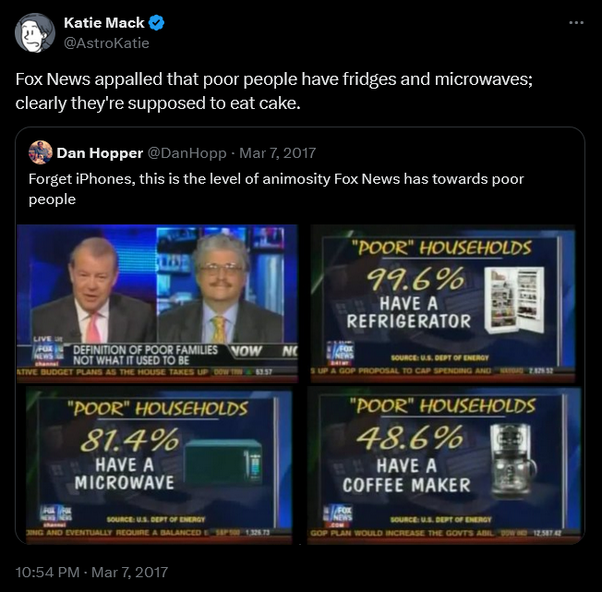
The Fox network made a big deal about people not living in poverty because they had refrigerators and microwaves. It is that kind of difference between poverty today and the poverty of last century that allows the ownership to more easily shame the victims of their efforts at impoverishing the majority in service to their hoards.

The harsh reality, however, is that most essential components of psychological health and emotional stability have been steadily stripped from the middle class in a stream of primarily invisible and ignored cuts over time.

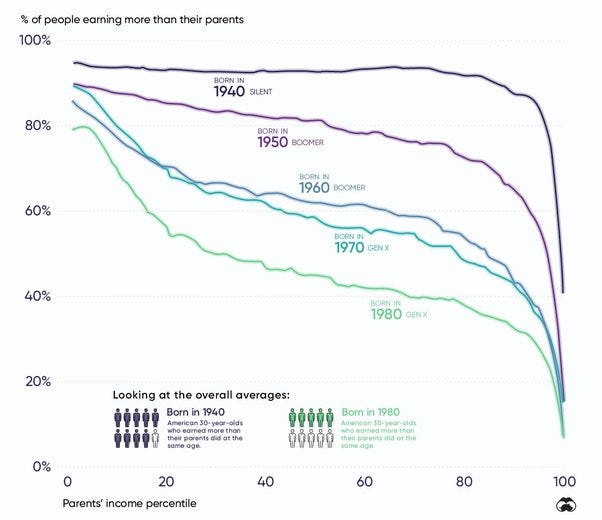
Compensation increases virtually halted for the middle class (and have even experienced shrinkages due to inflation), while income has skyrocketed for the ownership class.

The promise of capitalism raising people out of poverty from good ol’ fashioned elbow grease and modest living has vanished. The age of the Wealthy Barber lasted only a couple of decades before it was stripped from the people.

What we are left with now is a perpetual struggle for survival that has been steadily increasing year by year in the number of victims and the scope of theft perpetrated. The most privileged among us have had enough of an economic buffer to weather the storms that have destroyed the lives of millions victimized by the economic war waged by the ownership class against the working class. For many of those who would have qualified as being “upper middle class” fifty years ago and whose wealth would be more than double what it is today had the economy continued growing as it did during the heyday of Eisenhower tax rates, the economic war has remained largely invisible to them because they have not had to face the threat of food and housing insecurity that millions of working poor do today.

They may still face medical bankruptcies because those are huge bills that could and should be non-existent in a nation as wealthy as the U.S. However, the percentage of victims of that particular form of theft is relatively rare compared to the general population. We would otherwise have already had many Luigis acting out on their frustrations by now.

Instead, we have extremist right-wing groups on terrorist watch lists because they align themselves within their tribes and stoke their hatred toward those they blame for their woes. Occasionally, their outbursts gain public attention, but mostly, they’re made manifest in the ongoing and almost daily mass murders of innocent citizens and schoolchildren.

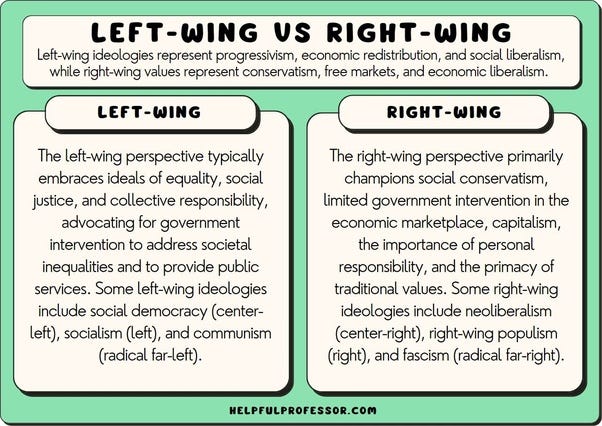
While the extreme right acts out their anger in unfocused ways, the left is targeted specifically on the causes of their anger. While the right victimizes anyone who doesn’t capitulate to their dogmatic adherence to the power wielded by those most responsible for victimizing them, like Stockholm Syndrome candidates, the mostly non-existent “extreme left” campaigns for economic justice through programs that restore equity.

Conflating the two as being identical is worse than oversimplifying a complex issue; it’s empowering the conditions that give rise to the hatred one seeks to demonize. It serves the narrative of a culture war perpetuated by the ownership class to divide the people further and distract them from the thefts perpetrated against them.

The irrational conflation made within this question merely functions as a self-fulfilling prophecy in which one declares a bullet wound fatal while stabbing the patient in the heart with a hunting knife to dig out the bullet.

This question is like accusing people of being jealous of Elon Musk’s money when the reality is that they hate white supremacists who install puppet rulers to destroy nations to attain their goal of empowering themselves at the expense of impoverishing the world. It’s a rather short-sighted attack on reality and the countless victims suffering needlessly in service to gluttonous powers.