How can the concept of authority be explained?

This post is a response to a question initially posed on Quora, and can also be accessed via “https://www.quora.com/How-can-the-concept-of-authority-be-explained/answer/Antonio-Amaral-1

There appear to be two distinct perceptions that dominate public responses to authority.

On the one hand, an authority is an entity with the power to issue demands, impose edicts, and enforce compliance. On the other hand, an authority is a trusted entity that serves as a resource for empowering people and enabling their ambitions.

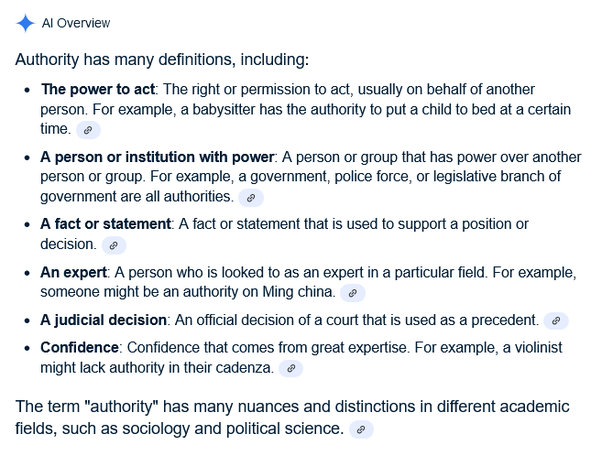
Our good friend and authoritative source of plagiarized information, AI Bot (Ayebot? iBot? EyeBot? — It needs a name so that it can be further anthropomorphized. “Gemini” seems a bit too much like impersonal woo.), provides a bit more detail:
Wikipedia has this definition, which appears to favour an interpretation based on an exercise of power:

Authority is commonly understood as the legitimate power of a person or group over other people.[1][dead link][2] In a civil state, an authority may be practiced by legislative, executive, and judicial branches of government,[3][need quotation to verify] each of which has authority and is an authority.[4] The term “authority” has many nuances and distinctions within various academic fields, from sociology to political science. ”

Let’s comb the world of language authorities to see how they interpret authority:

Collins has this to say about authority:
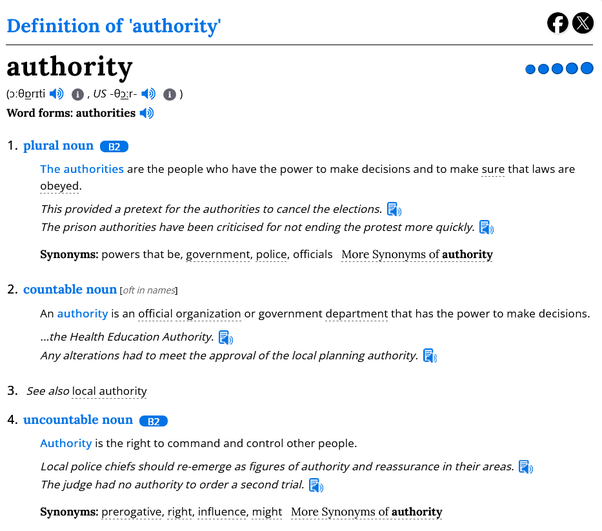
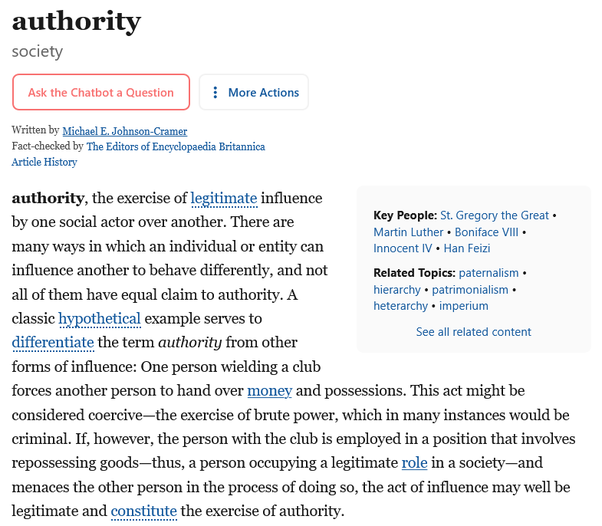
Britannica attempts a more concise definition favouring “influence” over “imposition” like Collins.
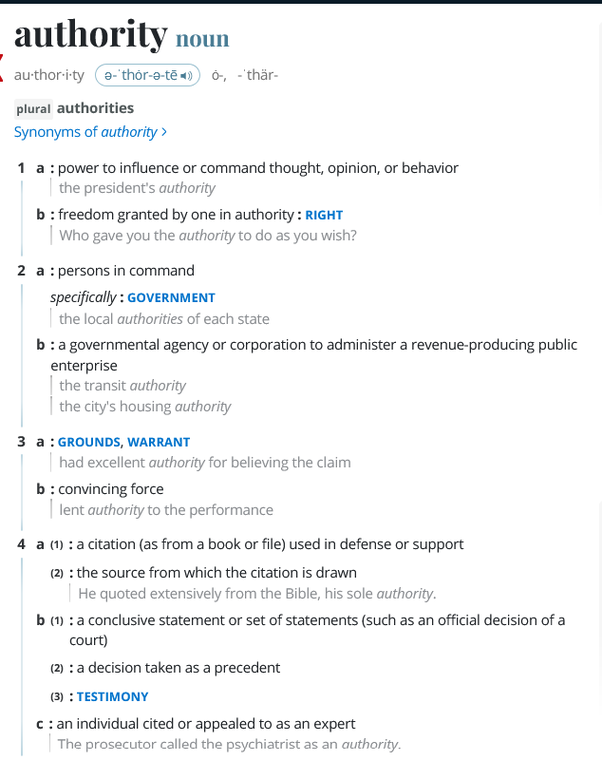
Merriam-Webster provides a more comprehensive overview of how “authority” is apprehended and implemented in society — although imposition precedes influence in its hierarchy of interpretations.
Interestingly, two of the world’s premiere language authorities place a profit premium on sharing basic definitions for words… which begs the question of the value of definitions versus profit and whether these institutions actually are authorities in realms beyond basic definitions.

Oxford at least asks for personal information to be granted access to elementary information, while Cambridge’s efforts are laughable.

These last two efforts suggest to me that their authority is entirely contingent upon reputation — part of the “old boy’s club” of authoritative prestige in the world, which essentially shuts out the plebians among us who must wrestle with “inferior language authorities.”

Meanwhile, freebie entity Dictionary dot com presents itself as a superior authority in marketing and business development to the two staid elements of anachronistic society above and provides an even more comprehensive set of definitions than Merriam-Webster.
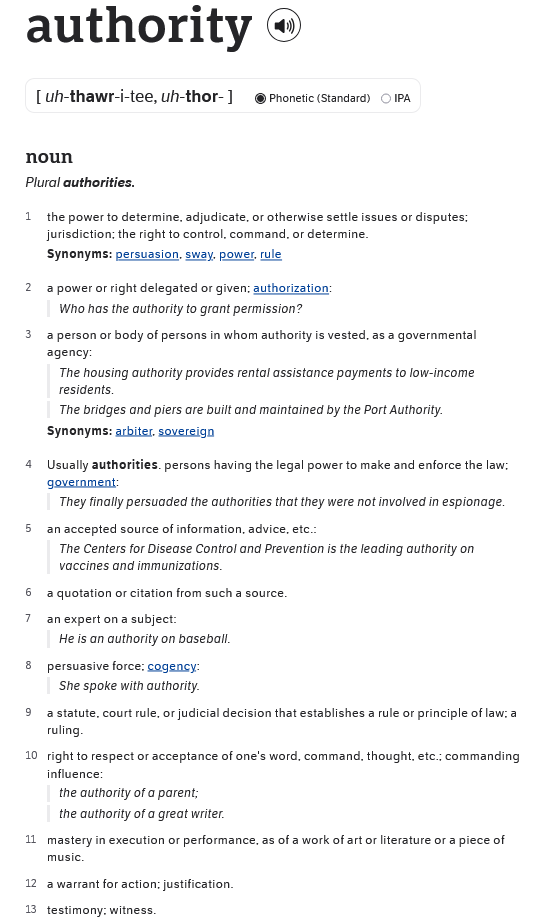
This tells us that authority is actively cultivated by those who desire it and then, once achieved, is actively protected and zealously guarded beyond levels resembling reason. At the same time, newcomers overturn established authorities who fade into oblivion as the barbarians at the gates no longer storm them out of existence but supplant them through more effective forms of adapting to an ever-changing world.

In short, “authority” can be explained entirely by the dynamics of ego, power, and how much one is addicted to asserting their prominence in a chaotic world.

Interestingly, the most respected authorities throughout history have rejected the impositional form of authority flowing from within in favour of empowering the people at large by serving as a resource for enabling their assertions of personal authority within their relative spheres of influence.

For example, people still recognize the names of rare individuals who embodied humility, such as Gautama Buddha — or even a more modern instance like Nelson Mandela. Still, few outside dedicated historians can remember the many “authorities” throughout history who imposed their will upon the public. Those remembered are often anomalies serving as massive engines of destruction whose names are whispered rather than revered. Few among those whose authority was impositional in nature are remembered for their introspective wisdom, like Marcus Aurelius and Sun Tzu, but are revered for their insights in contrast to those of the conquerors like Alexander the Great or Genghis Khan, who are studied for their strategies (and often critiqued for their human failings).

For example, I predict that if humanity survives in some form resembling the humanity we know today, Jimmy Carter will be remembered with deep reverence and respect one thousand years from now. In contrast, Donald Trump will be remembered as the cautionary tale of a bull in a china shop whose lesson for humanity is the necessity of restraint and accountability.

Should there be fact-checking on social media platforms?

This post is a response to a question posed in its complete format: “Do you support Meta’s (Zuckerberg’s) decision to end third-party fact-checking on Facebook? Should there be any fact-checking at all on social media platforms? Why?”

Social media appears to be entering a stage where its profit-based model is “eating itself out of existence” as the latest in end-stage capitalism’s string of “Ouroboroses” (Ourobori?).

Along with stripping costs for an expensive venture, Mark is also adding AI bot profiles to create the appearance of engagement.

This reminds me of why I lost interest in dating sites. The easiest way to know a site’s ethics is when they create bot profiles to entice people into paying membership fees to engage with non-existent people.

As much as Zuckerberg flaps the trappings of community within Facebook and social media, none of his views are legitimately about community or supporting community development.

If social media were authentically social, its focus would be community development, not profit generation.

It is precisely the model of profit generation that puts social media into a death spiral of profit chasing to the bottom of the bottom-feeding barrel.

Their metrics for engagement are derived from a superficial analysis of what engagement means. As long as someone clicks something or posts something, that counts as “engagement,” and that interpretation of engagement counts as justification for advertising rates.

Meanwhile, no one gets anything from the deal but a massive case of blue balls.

Without a mission of serving a higher purpose of community development, social media and society, by extension, cannot but devolve into the technological equivalent of a pack of stray dogs begging strangers for treats.

We will experience social anarchy in the virtual world before it greets us in the real world. Hopefully, that will create enough pressure to do something proactive to support community development before the real-world communities devolve into chaotic monstrosities of “former civilization.”

All of this is an argument in favour of social media, on some level and in some capacity, being a publicly owned and managed enterprise that exercises its self-restraint divorced from the misanthropic profit-chasing model that dehumanizes people while pretending to serve human social needs.

As much as our dialogues focus on almost everything but community development, they all serve a community needs focus.

For example, all of the discourse surrounding AI and its replacement of human labour may be considered an economic, political, or labour issue, and it’s essentially a community response to a significant change transforming human society on a fundamental level.

All social media forms the basis of community development because all social media is public discourse. However, our problems with social media stem precisely from its growth being motivated by profit over principles.

At this stage, growths in profit that can satisfy hungry boards and investors justify cutting costs to the degree that whatever spirit was initially capitalized on that prompted the development of any particular social media site has been stripped from its operation.

The justifications for stripping costs have ironically been derived from concerns about the costs of managing social engagement. Who woulda thunk it’s too expensive to properly manage human behaviour to afford the cost of developing a media enterprise focused entirely upon squeezing profits from social engagement?

People need social media. It won’t go away, but social media proves today that profiting from human interaction is the wrong way to think about social media.

We have been watching the effects everywhere as social media has been devolving into a dynamic I remember from what I used to refer to as “usenut” — that many may be more familiar with as “Google Groups,” for example. I remember this as the gutter of human interaction — where the most extreme of the extreme was its primary denizens who were free to indulge in the most hateful of behaviours and attitudes.

I still “fondly remember” one character I used to refer to as “Grog” — which wasn’t their real name, and I’m not going to publish it because he’s still active on what shreds still exist of Usenet groups. He’s still advocating for the death penalty for gay people. It turned out that his father came out of the closet late in life, and that had a devastating impact on his psychology.

At any rate, this underground dynamic of toxic attitudes has slowly been seeping into an above-ground and public state of dialogue over time. If one had not ventured into the gutters of human detritus to discover its prevalence, one would not realize it’s an undercurrent that has always existed.

We will continue witnessing a devolution to the level of bottom-feeding slugs in human interaction characterized by social media as this trend of cost-cutting and profit-squeezing continues. It’s an inevitable characteristic of the capitalist chase for profits.

At some point, we’ll experience a confluence between the demand for social media interaction and restraint on toxic behaviours that normalize the intolerable throughout society. People will grow to hate people like Zuckerberg more than they do now, as one can already see an influx of disparaging posts about him beginning to flood the social media space everywhere.

Accountability and restraint on social media will become a widespread demand because social media fulfills a human need for interaction and dialogue that has always been present in less technologically based forms, such as letters to the editor in every newspaper that once littered the landscape.

Social media won’t disappear but will require transforming from a privately profitable industry into a public service. Nations like China are already ahead in this game by using their social media enterprises as tools for managing public dynamics through social credit scores and demerits.

If we’re not careful, social media will transform from a chaotic enterprise focused on chasing profit into a tool of oppressive control over the people in a much more pernicious way than media enterprises like Fox do now with their disinformation campaigns.

What do you do if you’re a lost cause?

This post is a response to a question posed in its complete format: “What do you do if you’re just a lost cause and there’s nothing anyone or you could say or do to change that?”

Stop believing that’s true about you, or resign yourself to a long and slow death while proving you are a lost cause.

Everyone can change, and it always boils down to desire and the effort one makes toward change.

Without a desire to change, neither you nor anyone else can do anything to change that.

First and foremost, you have to want it because that allows you to find the motivation to develop the discipline you need to change to prove to yourself that you’re not a lost cause.

You otherwise are and will always be what you believe yourself to be.

Robert Anton Wilson described the dynamic in simple and entertaining terms that might help, “Within each of us is the thinker and the prover. Whatever the thinker thinks, the prover proves.”

One can only be a lost cause by giving up one’s responsibility to oneself to live one’s best life. No matter how lousy the cards you’re dealt are, you still can make the best of them. Wallowing in defeat is a living a death. Use other people’s disparaging views of you as fuel to change.

Allow those unjust views to anger you justifiably. Convert them into a giant act of rejection and prove them wrong.

Good luck.

Is self-sacrifice the greatest gift that an individual can give to the community?


This post is a response to a question initially posed on Quora, and can also be accessed via “https://www.quora.com/Is-self-sacrifice-the-greatest-gift-that-an-individual-can-give-to-the-community/answer/Antonio-Amaral-1

No.

Self-sacrifice isn’t a “gift,” it’s a responsibility and a call to action.

Self-sacrifice can occur as a parent sets aside their desires to make way for their children to achieve successes outside their reach. For example, a parent who works multiple jobs to help their child get an education that will give them a better life than they could attain has generally been regarded as a “typical” or “common form of self-sacrifice” and often considered noble.

Other forms of self-sacrifice, such as jumping on a live grenade (for an extreme and improbable example to make a point) to protect a crowd, are a requirement created by circumstances that would be unnecessary if extreme conditions were not present. This form of self-sacrifice is an artificially created necessity that could have been avoided if the motivations behind the person throwing the grenade were mitigated proactively.

This form of self-sacrifice is an instinctive form of preservation that extends beyond the limits of one’s life. It is an expression of commitment to the social contract historically responsible for elevating humanity beyond the baser instincts that drag us backwards into primitive states of existence. Over and above the preservation of one’s self, selfless preservation is performed from the exact sentiment of a parent sacrificing themselves for their child. It is an act of love in the extreme. It is an embodiment of the best of what humanity can be.

Like the child whose life is enriched by their parent’s self-sacrifice, the beneficiaries of such an act of selflessness have not received a gift to luxuriate in but an obligation to follow suit and make life better for those who come after.

This is how social evolution must progress in the face of apathy and against those who place themselves and their desires above the needs of others.

Without the capacity for self-sacrifice, the future of humanity is decay and self-destruction.

Self-sacrifice within this context is a warning that without the courage demonstrated by the few willing to alert an apathetic world of the need to take action, the conditions causing the suffering that demanded the sacrifice of one’s self will worsen and create more victims.

Self-sacrifice within this context is the canary in the coal mine warning the rest of humanity that death is on its way and alerting the people that they are facing a choice to serve a higher purpose than their fleeting whims or be sacrificed by parasitic forces as fodder for the conditions demanding their blood.

Self-sacrifice is a warning to the apathetic that if they do not rise against the threats facing them, their turn will come, and it will be far worse for them than the person sending their message of warning through their self-sacrifice.

Self-sacrifice can be defined with a simple quote: “Silence in the face of evil is itself evil.”


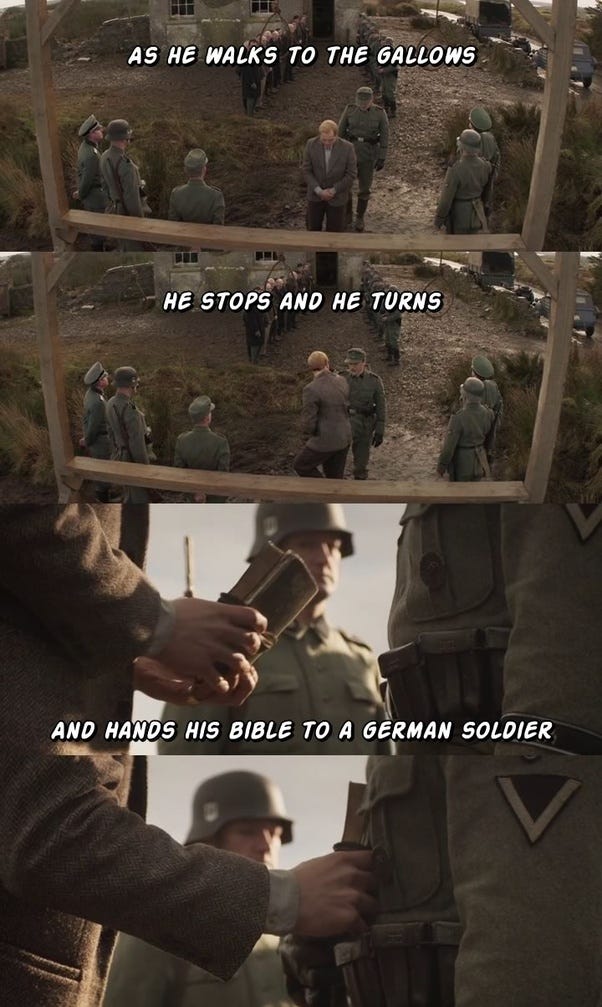
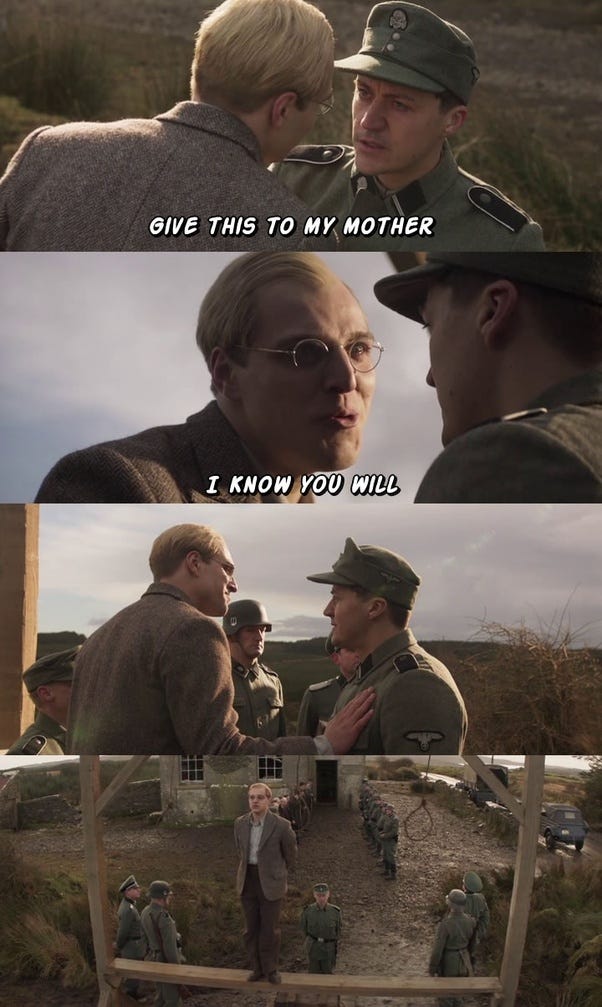
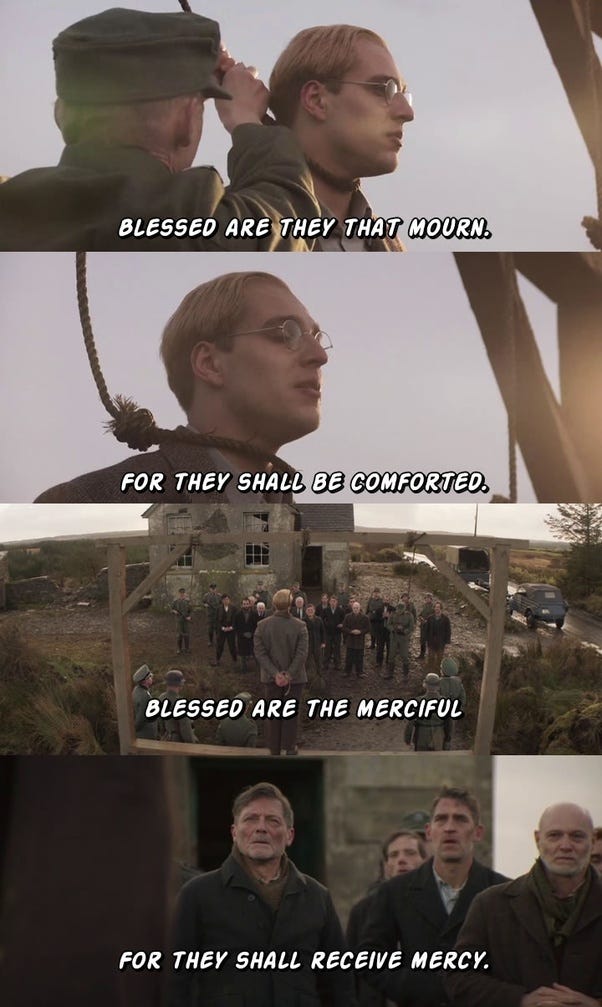
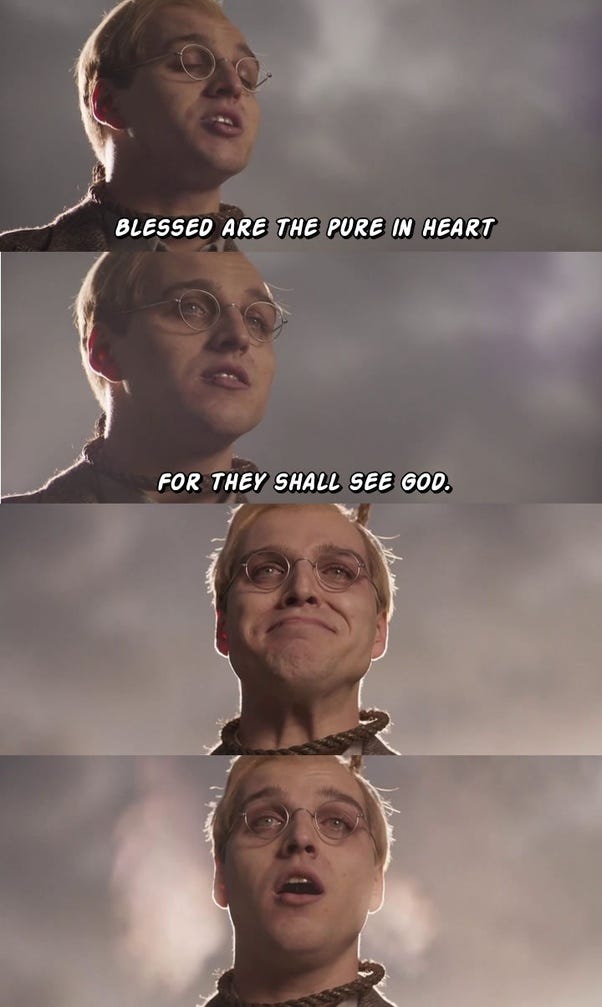
Here is an example of a story about a Pastor who sacrificed himself to try and stop Hitler while saving numerous lives. I’m posting it here because the space I otherwise posted seems unwilling to approve it in another answer because it’s appropriate to this question and because we are at a point where we are repeating history.

Dietrich Bonhoeffer — Wikipedia

Dietrich Bonhoeffer February 1906–9 April 1945), was a German Lutheran pastor, neo-orthodox theologian and anti-Nazi dissident who was a key founding member of the Confessing Church. His writings on Christianity’s role in the secular world have become widely influential; his 1937 book The Cost of Discipleship is described as a modern classic.[1] Apart from his theological writings, Bonhoeffer was known for his staunch resistance to the Nazi dictatorship, including vocal opposition to Adolf Hitler’s euthanasia program and genocidal persecution of Jews.[2] He was arrested in April 1943 by the Gestapo and imprisoned at Tegel Prison for 1½ years. Later, he was transferred to Flossenbürg concentration camp.

Bonhoeffer was accused of being associated with the 20 July plot to assassinate Hitler and was tried along with other accused plotters, including former members of the Abwehr (the German Military Intelligence Office). He was hanged on 9 April 1945 during the collapse of the Nazi regime.

Bonhoeffer: Pastor. Spy. Assassin. (2024) ⭐ 6.6 | Biography, Drama, History

How is dissent the foundation of democracy?

This post is a response to a question initially posed on Quora, and can also be accessed via “https://www.quora.com/How-is-dissent-the-foundation-of-democracy/answer/Antonio-Amaral-1

  1. The opposite of dissent is subordination.
  2. Subordination is the foundation for authoritarian regimes.
  3. Authoritarian regimes are rigidly hierarchical.
  4. Rigid hierarchies are inflexible and abusive toward all people downward in the power hierarchy.
  5. Authoritarian regimes eventually break because humans have limits on the abuses they can tolerate.
  6. Democracies survive because they are fundamentally adaptable to change.
  7. Democracies are fundamentally adaptable to change because they accommodate individuality.
  8. Individuality empowers self-determination to maximize flexibility and adaptability.
  9. Flexibility and adaptability are contingent upon responsiveness to succeed.
  10. Responsiveness demands input and engagement from diverse perspectives to be effective.
  11. Dissent filters out ineffective processes that inhibit adaptability.
  12. Navigating change requires dissent to ensure that adaptation initiatives succeed.
  13. Without dissent, changes are made blindly to make adaptability impossible and guarantee failure.

Hence, dissent is the foundation of a democracy.

Furthermore, embracing dissent improves all of us, particularly in the essential skills area of critical thinking.

The greater our embrace of dissent, the better our thinking skills become.

The better our thinking skills become, the more robust our democracy.

Democracies are being threatened worldwide because we have been failing to equip citizens with the skills they need to build a better world together.

We have been failing to equip our citizens because arrogant assholes with too much of a desire for power wish to reduce citizen efficacy in self-governance systems because they deem themselves superior humans entitled to their power and to lord over the little people.

It’s past time they begin to relearn their lessons in humility.

Is there a way for those who have lost their jobs to declare war on AI?

This post is a response to a question posed in its complete format: “Imagine that millions lose their jobs due to AI. Is there a way for those who have lost their jobs to effectively declare war on AI?”

Well, that’s pointless.

People will not lose their jobs because of AI but because corporations save money on labour costs.

AI is a tool, and the argument that ammosexuals love to barf up applies here: “Guns don’t kill people. People kill people.”

AI doesn’t kill jobs. Capitalists kill jobs because they can and are incentivized by it within a system that worships personal wealth above all.

We, as citizens, kill jobs through our apathy and through our empowerment of those who prioritize their material benefits at the expense of the many they can exploit.

We bring this upon ourselves by not having a coherent social development roadmap. We allow our societies to grow by chaos rather than responsible systems management strategies.

We empower our leaders through a reactionary process of social development rather than a strategically reasoned and proactive process.

Sadly, authoritarian regimes are far more successful along this vector than democracies because their decision-making is limited to small, centralized powers.

This is part of the reason that the public has been increasingly questioning the value of democracy while looking toward authoritarian models to solve our problems for us.

Sadly, the solution for democracies to be far more effective in mobilizing social development in a coherent and unified direction is entirely contingent upon the quality of the education the public receives.

For instance, the transition to a fully automated society is an inevitability. There is no point in resisting it. We would all be much better off by leaning into it and demanding we adapt our systems to manage the transition better so that we can mitigate collateral damage.

Instead, we are experiencing a chaotic transition led by random powers following personal visions motivated by personal benefit rather than social good.

If our education systems provided a more comprehensive insight into social development, much of the public would be engaged in the political process in strategic rather than reactionary ways.

We would be more unified as a people in identifying trends and developing coherent strategies for successfully managing the challenges we face.

Instead, we are burdened by a dearth of education that reduces a population into cheerleading camps driven by emotionality that can be characterized as juvenile reactions against authorities. Considering how democracy means each person is a governing authority member, this is beyond an asinine apprehension of how one’s government works or how it can be made effective.

Democracy demands engagement, yet our apprehension of engagement is limited to how many likes one gets on one’s post. That’s not even remotely resembling engagement.

That’s like claiming every celebrity walking a red carpet and waving at the throngs is socializing with friends.

Sadly, part of the problem has been deliberately cultivated by the capitalists who want us distracted enough from the sausage-making process to allow them to remake human society into their image.

They have been succeeding remarkably within the U.S. as it has become a dystopian corporatocracy that prioritizes gun sales over the lives of children and billionaire profits over the healthcare needs of citizens.

The public has been so conditioned to prioritize profit at all costs that they will fight to preserve a billionaire’s right to kill people for profit.

We can’t govern ourselves in a democracy if all of our time is focused on survival and profit-churning. Most of us don’t care to be involved in the decision-making process, which would be okay if we could trust our information systems to prioritize informing people over chasing profits.

Instead, we have media that has become a singular, massive entity of public influence predicated upon churning conflict to maintain attention justified by revenue increases.

Instead of informing the public on issues of criticality to the future of the people, we have this kind of incendiary rhetoric from an attention whore indulging in shock stupidity to justify their salary increases by ginning up the rubes to create conflict.

Less than one hundred years ago, this kind of crap would be shut down immediately because it would be considered a precursor to war.

Instead, the attention-seeking mentality justified by the profit (and power-seeking) motive does not care about the casualties created by irresponsible language.

The value of human life has been downgraded, if it ever mattered to society, to a level that’s no greater than the Roman arenas when people were killed for entertainment.

If we don’t start asserting some standards on coherent behaviour that cultivates the best of us as a species, we will continue careening headlong into chaos.

Humans can take only so much abuse before they break. Everyone can break, and people like Watters are playing with fire. There’s no way he will be safe again crossing the border into Canada because of his disgusting language. Some might argue that any aggressive response against him is unjustifiable, and that may be valid, but it doesn’t change how humans behave when aggrieved. I’m confident few Canadians will give him a warm reception for his remarks if he ever crosses the border. At best, at least from my perspective, he’s earned a bloody nose for his garbage.

This kind of bullying rhetoric is toxic to society and is a betrayal of the social contract.

The acceptability of this nonsense and its prevalence is why we have no coherent strategy for managing our transition into a fully automated society. The acceptability of this kind of incendiary distraction from critical information the public needs to make proper decisions to minimize casualties in our transition will create unnecessary casualties. This kind of thinking is what permits bigotry to determine outcomes that dramatically affect lives.

This kind of nonsense is why this question exists in so many forms everywhere and why I’ve already answered this question in several forms by now.

The issues are not complex, but they are made so because we’re not talking about them where we need to be talking about them. We’re allowing jackasses to troll for reactions in “respectable mainstream media” that we would mute and block online if they were individuals and not expensively dressed and cosmetically pampered media personalities.

We are being betrayed by the Fourth Estate each and every day — and to the degree that a majority of the world now believes the U.S. is a tragic case of end times for a nation that has become so corrupt, it can never be trusted for leadership in the world again. However, anyone may parse the 2024 election, and one cannot ignore the role of the media in installing a monster in the top job for the nation.

If you genuinely want to declare war against the loss of jobs, then you need to take it to those who benefit from displacing jobs. You need to start pressuring the billionaires and the corporations they benefit from while ripping off the public through tax avoidance schemes.

Instead of war, you should demand responsible management for an unavoidably dramatic and traumatic societal transition by insisting on the only sane solution to this period in human history, UBI, as a starting point toward sanity in our social development.

The worst thing about where the world is at in this transition is that the next four years are being defined by a parasitic presence seeking to empower further those who are disempowering the working class while replacing workers with automated solutions to toss millions out onto the streets to fend for themselves.

We must stop blaming AI for job losses because it’s just a gun in the hands of mercenaries.

Why do a lot of Americans think politics is a dichotomy?

This post is a response to a question posed in its complete format: “Why do a lot of Americans think politics is a dichotomy that consists exclusively of democrats and republicans who are fully aligned with the platforms of either party?”

It might have something to do with almost every elected representative being a member of or closely affiliated with one or the other party.

It might have something to do with the notion that votes cast for alternatives are generally wasted protest votes that accomplish little more than a token form of expression that, at best, is viewed as a spoiler between the two major parties.

It might have something to do with the harsh reality that electoral reform will be necessary to change the current power dynamic. It might also have something to do with how much the oligarchic powers like it the way it is because it works in their favour to reduce their costs of buying government representatives and their risk of losing their investments.

It might also have something to do with a population that can easily be characterized as so much the walking wounded that they’ve developed Stockholm Syndrome because the alternative in changing the dynamic will demand a severe degree of chaos. At the same time, everyone hopes some magical solution will present itself to help them avoid risking everything while getting their hands dirty.

Finally, it might have something to do with the American people not being quite at their breaking point and have shown incredible resilience as they’ve learned to live in a dystopic environment under a perpetual threat of losing everything, including their children to gun-toting lunatics using their schools to vent their childhood rage. Since they’re okay with giving up their lives to enrich billionaires, it seems they’ve given up on being the home of the brave and the land of the free.

How can you make $100 every day as an 11-year-old?

This post is a response to a question initially posed on Quora, and can also be accessed via “https://www.quora.com/How-can-you-make-100-every-day-as-an-11-year-old/answer/Antonio-Amaral-1

An 11-year-old trying to generate $100 daily is a travesty of epically dysfunctional proportions for society.

That’s a friggin horror show straight out of a Dickens novel.

An 11-year-old should be playing dress-up and letting their imaginations soar, not concocting survival schemes.

As much as I can feel compassion towards whatever circumstances motivate you in this direction, I’m also highly disgusted by them.

This question makes me want to pull out guillotines and give billionaires free haircuts below the neck.

The problem you face is that you have no leverage to make that amount of money daily.

That means you will have to spend every waking moment focused on generating that amount of money by performing services for people who will treat you like dirt. Many won’t even pay you for a day’s work because you cannot force them to pay you.

You will become an embittered sociopath by the time you hit twenty. That will make you able to justify ripping off everyone you encounter as you learn to treat people like marks and evolve as a predator in society.

I don’t know what solutions might be available, but selling lemonade won’t work. Door-to-door sales of products might work, but that exposes you to predators.

I’m not even sure it’s legal for you to earn money in an employment capacity. Laws in your area may be different, and if you’re American, child labour is just around the corner with a Trump presidency.

Even worse is that making yourself available to generate revenue exposes you to the ugliest of predators who would choose to use you as a playtoy for inhumanly sick and twisted people.

Damn, but this question severely bothers me.

You’re a frigging child.

You should have a childhood with friends, playing ball outside in the sun at the park with other kids, not trying to make money.

Please try talking to a counsellor at your school because the way you’re thinking right now means you’re giving up your childhood and almost literally guaranteeing you’ll be chewed up and spit out by your early twenties. You’re nearly guaranteeing you won’t make it to your thirties.

Please talk to someone who cares and can help you because there’s nothing anyone online can do for you — and if anyone offers, you can’t be sure they’re not a wolf sizing you up as a tasty meal.

Which type of party system is best for a country?

This post is a response to a question posed in its complete format: “Which type of party system is best for a country, one party system, two party system or multiple party system?”

The more parties, the more broad the representation of the people.

The more parties, the less polarized the people are by ideology.

The more parties, the less gridlock on issues preventing progress on their resolution.

The more parties, the less able the plutocrats are to manipulate groups of public representatives to corrupt the entire system.

The fewer the parties, the more prone a system becomes to internal conflicts and widespread instability.

The fewer the parties, the more prone a system is to authoritarian control of the people.

The fewer the parties, the more prone the system is to civil unrest and the factors leading to a systemic collapse.

The fewer the parties, the more prone the entire system becomes to corruption at all levels, from the leadership down to the core units of society.

The fewer the parties, the more prone the people become to developing a sociopathic fragility and a callous disregard for the social contract.

The more parties, the more prone people are to cooperative negotiations in a culture of mutual respect for the social contract.

The more parties, the more democratic the system and the more egalitarian the people become.

The fewer the parties, the more prone the system becomes to toxic competitiveness that corrodes the natural goodwill of the people toward each other.

How do we stay hopeful when fascism is on the rise?

This post is a response to a question posed in its complete format: “How do leftists stay hopeful/resilient in times like these where fascism is on the rise and history is repeating itself?”

History has shown us that fascism always gets beaten back when the public realizes how much less they like fascism than the chaos of democracy. Every time and after enduring a period of suffering under the rule of despots, voter turnout makes a strong comeback as fascism encourages the apathetic non-voters to rethink their strategy of staying home.

Think of fascism as a lesson in consequences where people need to suffer enough to realize just how precious the delicate balance of freedom is in society and how vital the sausage-making process is, no matter how boring and dry it may otherwise seem.

People eventually learn they prefer to get off the couch and go to the polling stations to cast their votes for people they want to trust to represent their best interests. They also eventually learn that no matter how much the fascists want to paint their opposition as being identical to them, they’re not. The fascists inevitably piss off the people enough to go to war against them, and that’s precisely what Trump and Musk are inviting from the world.

They’re poking a tiger, and they’re going to get burned while they set the world aflame.

The only real question left on the table is, Just how much more pain will the people endure before the riots break out?

This isn’t even about being hopeful because we already know, just like everyone who’s been pushed past their limits, that once the anger takes over, there’s no stopping it. That neighbour who’s been pissing you off with their loud music invariably gets an earful that may embarrass you afterward. Still, it’s an emotional explosion that can’t be controlled during its moment of emotional release.

My guess is that if Luigi Mangione gets the death penalty, that might be the final trigger before all hell breaks loose. It’s hard to tell because Americans seem able to tolerate incredible horrors without doing anything substantial about them.

I know that if I was living in Flint, Michigan, for example, and I had a kid who died from the poisoned water, I would have pulled a Luigi myself. If a kid of mine were gunned down in a school while my local representative did nothing to institute sensible measures to prevent this from happening again, I’d lose my shit.

As it stands right now, from what I’ve been put through on a personal level, I’m already doing everything I can to keep from doing something stupid while attempting to resolve an issue in the most civilized manner possible. As it stands, the bullies responsible for destroying my life are behaving as if they’re going to walk away without suffering any consequences for their actions as they tell me to shut up and die quietly.

I know I’m not the only person at the end of their rope, and all it will take is the right match to set this nightmarish dystopia ablaze.

People like Musk will have to come around or beef up their security because it’s only a matter of time before their arrogance blows back like a nuclear bomb in their faces.

“Those who make peaceful evolution impossible make violent revolution necessary.”

The trouble with this dynamic is that millions of people have to be pushed to their breaking point before they realize how much less pain there is in risking death in a revolution than to continue enduring a walking death in slow motion toward oblivion.

This is all just history repeating itself.

It’s not new by any stretch of the imagination.

Those who refuse to learn from history force us all to replay it, and we all get uglier about it each time we must endure the stupidity of people who refuse to read the writing on the wall.

The only salient aspect of hope in this mess is that we can avoid the worst chaos before returning to sanity.