We have cultivated it by allowing our societies to grow into corrupt monstrosities that people have no choice but to struggle to survive within.
We have placed a physical resource like money at the top of our values and have dehumanized people every step of the way. At the same time, we convert human beings into disposable commodities.
We are dehumanizing ourselves at every level by endorsing a system that devalues the ineffable qualities of humanity because they are not viewed as profitable by industry. Instead, we have ways of further dehumanizing people by leveraging their despair against them with global institutions that dictate dogma to follow without question.
Everything has become reduced to a competition for tentative comforts that bear no intrinsic value or meaning beyond serving the immediate gratification of shallow desires.
None of this contributes toward the growth of those qualities of humanity that we value. None of this brings us together as people in common cause for the betterment of all. Everything is catered toward the propulsion of individuals we stratify with blind worship.
When we replace human qualities we cherish with an avatar, like money as a metric for determining their value, we become divorced from our humanity.
While living in a world that views wealth as an indicator of all positive human qualities, people inevitably start to develop disparaging views toward their neighbours because everyone has been left fighting over the same scarce resources that are left behind by the plutocrats dehumanizing all of us with a system they parasitically siphon of wealth at our expense.
We can only live so long with oppressive conditions before the effects grow out of control and well into making our environments breeding grounds for chaos.
Misanthropy is just an early stage of widespread systemic collapse.
Identifying a specific group of people to be regarded with respect and care is an approach to an issue akin to “preaching to the choir.” Those who already understand, appreciate, and embrace the concept of positive support toward a marginalized group don’t need to be reminded of their mistreatment and told they should not mistreat them.
Meanwhile, those who already harbour ill will to marginalized groups tend to respond with ill feelings toward the message while citing reasons why such a sentiment is exclusionary to them and their feelings. This is why “All Lives Matter” became a response to the message “Black Lives Matter.”
That black lives are snuffed out at rates which prominently indicate a social bias against them that results in a significant degree of avoidable victimization is irrelevant to them in this issue. Such people already feel victimized themselves, and providing positive attention toward other marginalized groups gives them the excuse to feel even more marginalized than they already do.
It may be true that they are not victimized to any additional degree by statistical contrast. However, a large part of their animosity is derived from feeling marginalized from society in general.
The marginalization they feel is universal. The extremes of income disparity we live with today universally exacerbate anxieties throughout the population. In contrast, only those who do not live with economic insecurity find some insulation from the challenges of daily living.
Encouraging people to develop respect for and care for others requires addressing the barriers preventing them from alienating others from a small and shrinking circle of safety in the face of an increasing array of reasons for insecurity.
Most people are already clear that when life is good for them and without survival issues predominating their concerns, it’s much easier to be open to strangers. Strangers are always viewed as a threat when life itself feels threatened. Accepting strangers without instinctively assuming they’re an additional threat to pile onto their activated fight-or-flight instinct is much easier when life isn’t under an omnipresent threat. Increased anxiety levels are a consequence of our economic disparity. Fixing that makes it easier for people to open themselves up to tribal outsiders naturally.
I remember experiencing directly how familiarity seemed to function like a cure for bigotry through a few simple words, “We don’t think of you as a Paki, Biker.”
Biker was a quiet and unassuming personality who worked hard and performed well within the McDonalds restaurant I worked in during my teenage years from 15 to 16. He was one of the gang who would join us in our “car parties” and was appointed as our designated booze-buyer. I don’t remember how old he was, but he passed inspection well enough to never run into any trouble buying alcohol for the rest of us.
In retrospect, I don’t think we pronounced his name correctly, but he never indicated that he minded it. I think it made him feel part of the crowd. I do remember feeling awkward whenever someone gave him that back-handed compliment with complete sincerity, “I don’t think of you as a Paki.”
I grew up in a predominantly blue-collar town with an economy primarily sustained by several sawmills and pulp mills in the area, situated at a significant crossroad between north and southern highway arteries. The average education of the town at the time was grade nine, and bigotry was so rampant it became invisible, but it was there for those who cared enough to pay attention.
Gay people were tolerated as long as it remained only speculative that a person was gay. The moment they were outed, however, they risked severe injury. No one wanted to think of people they liked as being gay, and so few would overlook the obvious to avoid feeling like they needed to do something about them.
The gay people I knew from school had their friends who accepted them as they were; whether or not they revealed their “status” was not a matter I was privy to, but I could tell and just kept my mouth shut and treated them like anyone else.
About ten years ago, an old high school “friend” looked me up, and we had coffee together while he brought me up to speed with gossip from school. One piece of news he had for me was that Lawrence had come out of the closet. He spoke those words while still expressing surprise, and my nonchalant response confused him. I quickly changed the topic before he could ask why I wasn’t surprised. I asked him about someone who had demonstrated some kindness to me as a bullied fat kid in school, and his response made me feel like we had travelled back in time, “Oh, she’s a slut.”
That meeting made me feel justified in completely cutting myself off from the people I grew up with because they hadn’t changed. I remember being invited to the first ten-year reunion from our high school by telephone. I was informed of someone who had committed suicide, and that made me feel sad for her. In the background, I could hear someone make a joke about swallowing a shotgun and that sent chills down my spine. I asked myself why I would want to travel to the toxic town I grew up wanting to escape it to endure entirely obnoxious people. I remember indicating that I might attend, but I wasn’t sure. I knew then that I didn’t want to go and haven’t been to any they may have held.
I had and still have no desire to surround myself with such a tone-deaf form of sociopathic toxicity. It doesn’t change within the individual once it’s set within their personality, mainly from their upbringing and early socialization experiences.
People don’t grow to respect and care for those groups they’ve spent a lifetime marginalizing. They only become more tolerant and less overtly abusive but can easily get triggered into being abusive if the conditions are ripe for it.
Living in hardship makes it easy for latent bigotries to surface. That’s why MAGAts are so easily riled up. They will never be convinced to respect and care for the people they’ve learned to hate unless they’re exposed to them in person and begin to think of those people they know as different from the bigoted image they have of that group within their mind.
That tone softening happens only when their lives are more manageable, not more complicated.
This is the very crux of our class warfare as people are weaponized against each other by the plutocrats in our midst who have stolen trillions from the working class and exacerbated their struggles. They further weaponize the undereducated by messaging designed to stoke hatred while pointing fingers of blame at the marginalized groups for their struggles.
The ownership class deliberately riles these people up to set them against their neighbours because that distracts us from their efforts to benefit themselves while further impoverishing the rest of us.
We may sincerely want to cultivate respect and care for each other as citizens, but we must approach the issue from a universal perspective. We must address the stressors serving as barriers to caring. Sadly, the solution appears more and more to require chaos to force a return to sanity.
“Those who make peaceful evolution impossible make violent revolution necessary.”
During this time of year and this “sacred” day when we are all called to regard each other as members of a family we call humanity, we can only hope that sanity will return without requiring the ritual blood sacrifices we’ve paid throughout history.
For what it’s worth, I hope your day today is filled with peace and contentment.
This post is a response to a question posed in its complete format: “I won’t give up my faith, but what are the 3 things that atheists would like from Christians (or any religion really), in order to live in the best society possible?”
No one is asking you to give up your faith, and if someone does, then you have every right and justification to tell them where to stuff their opinion. You have every right to whatever belief you choose to hold. Sovereignty over one’s mind is an inalienable right (regardless of whether some might disagree — I’ll fight this one to the death — which is my belief, and if I choose a belief and hold onto it strongly enough to go to war to defend it, then I have to respect another’s right to do the same).
Having said all that,
I don’t impose my beliefs onto others (what I spoke of above was defending my belief — a big difference), and I do not want others to impose their beliefs onto me. I am severely offended by attitudes that do not respect my choice, yet I expect respect for theirs.
#1. STOP proselytizing. I don’t care if it’s a mandated directive. Do NOT impose your beliefs onto others if they do not want to endure your rendition of them. Please respect that you have the right to your beliefs ONLY because you acknowledge another’s right to their beliefs.
What this means in “real world terms” — NO MORE anti-abortion nonsense. NO MORE sexist, misogynistic imposition of your religious beliefs onto a society of individuals who do not share your beliefs. STOP PROSELYTIZING. PERIOD. Nothing of your belief system belongs in a shared society’s laws… nowhere in educational policy… nowhere in anything beyond its context.
By all means, use your existing houses of worship and your homes to worship, practice, or do whatever you like concerning your beliefs. DO NOT attempt to push your interpretation of your own beliefs onto a public sphere. Your beliefs are yours, not everyone else’s. Learn to respect that and put it into widespread practice. Speak out against toxic hypocrites like Jim Bakker, who pushes an ignorantly incendiary and self-serving agenda by riling up his “flock” into supporting violence to further his cause. That is entirely disgusting behaviour. Your beliefs do not belong anywhere outside the context they serve you.
#2. Get out of politics and learn to respect what is sacred about the separation between church and state. While you’re doing that, start paying taxes and take every dollar back from the rich evil monsters who are preying on the weak to con them into supporting their personally lavish lifestyles. (I don’t remember who it was now, and I’m not going to research it, but an example I remember from recent news was one hypocrite crying about needing a personal jet because public air transportation is full of sinners. — — I’m happy to report that person did not say that directly to my face because I’m not sure I would have contained my disgust with that particular attitude. Still, I can tell you, every one of those entitled monsters who prey upon the weak have nothing but enmity from me, and I’m pretty sure many others as well. Do SOMETHING about them because they certainly do NOT represent any spirituality or belief. They are the same cut of sociopathic monsters as those who lead terrorist groups from other belief systems.)
#3. Get out of science and learn to respect your boundaries and the role of religion in society. Your beliefs are not science or scientific in any nature or stretch of the imagination. Your beliefs do NOT trump scientific discovery within the realm of science. Evolution, for example, as your beliefs don’t bind a topic. Evolution occurs whether you want to believe it or not. Still, you need to understand how the moment you think your subjective belief somehow forms an equivalent counter-argument to hundreds of years of an evolving discipline, you betray your faith by stepping into territory which doesn’t belong to your faith and is not beholden to any subjective conclusions you may arrive at.
Facts are Facts. Period.
Arguing creationism as some form of valid response to evolution is a disgustingly stupid form of willful ignorance. It has polluted this world far too much already, and the disgusting attitudes of believers concerning this issue are just too much to deal with now. We have more significant problems as a species, and being bogged down by idiots who think their personal, insular, and subjectively defined perspectives on life should be given enough credibility to be treated seriously in a public dialogue only makes things worse for everyone.
Keep your faith, but know this; it is subjective and not remotely determinate about our physical universe. Learn to understand how faith does not trump facts because it should work the other way around. Physical reality should determine our beliefs because we are bound to this existence. Anything beyond it is speculation. If you want to call it a belief, go ahead, but it means nothing to the facts we all must live by together.
No. The so-called “gig economy” is just a scam for large corporations to get away with paying people on a minimal scale for tasks without any commitment or standard employee protections, benefits, or pay equity.
It’s a way of paying as little as possible for disposable and interchangeable cogs who are desperate for any scraps they can get.
Even worse are the parasitic behaviours of gig exploiters like Uber, who leverage the vehicles supplied by drivers to create enough revenue to finance self-driving vehicles that will eventually eliminate all the gig workers. It’s like enriching someone who will throw you out onto the streets as a thank-you for the loyalty they expect from you.
It’s just a way of further exploiting people into poverty to leave them with nothing at the end of it all.
Forty years ago, an independent professional could earn a lucrative income from a thriving ecosystem populated by an entrepreneurial class of mom-and-pop shops that were everywhere. There was no need to deal with any large corporation to earn a comfortable living where one could easily afford a mortgage and meet all the expectations of the middle class.
Now, it’s impossible to sustain oneself without tapping into the corporate realm to earn an income. Meanwhile, their practices have grown increasingly insular while adapting to the rapidly changing technological landscape through utter ignorance and making inept judgments about candidates whose skill sets are so beyond their experience that they can’t hope to comprehend what they’re hiring for.
This is why we’ve had jokes about unicorn candidates with three years of experience with six-month-old technologies.
Surviving a gig economy is just a shortcut to long-term poverty.
The entire world is undergoing a massive transformation that has steadily escalated in speed and scope year by year for decades. Although the world has constantly been changing, this degree of change is unprecedented.
I remember Alvin Toffler’s predictions on this in Future Shock from when I was a kid in school, and we had the opportunity to watch his documentary in the classroom. Among the many predictions, this rate of escalating change has always stood out for me as a consequence of being repeatedly reminded of it throughout my lifetime. I thought the beginning of the Information Age represented a peak of speed of change, but that was just the beginning of ramping up the rate of change to come.
With great changes come great uncertainty, and that fires up anxiety levels everywhere.
Making matters worse has been the class warfare reaching new peaks of disparity driven by thefts of the working class by the tens of trillions over the last few decades as world politics began shifting rightward.
Before Reagan and Thatcher, many of the democracies in developed nations around the globe still viewed the government as somewhat of an ally, even after experiencing perceived betrayals through global events like the war in Vietnam and Britain’s mishandling of the IRA in Ireland and “Sunday Bloody Sunday.” JFK’s assassination shocked the world. Labour strikes rocked the world.
People were fed up then with disruptive elements and had developed a level of comfort with their daily lives and their expectations for their future that they lost touch with the value of disruptive events like strikes. No one then realized how a disruption to their air travel plans was a positive and necessary event in a healthy democracy when negotiations broke down. The general attitude of entitlement to expectations of service became an easy wedge to force between the public and the labour organizations fighting to maintain equanimity between the classes.
Demonizing government became a path to power within government because the people in democracies began believing corruption was also as endemic to the government as unions. Political systems began being viewed through a cynical lens, while conservative politicians have since leveraged that sentiment to gain political power for themselves.
Regan’s firing of air traffic controllers was accompanied by a cheering public who saw their travelling conveniences disrupted rather than their quality of life being protected. People had begun forgetting almost a couple of centuries of sacrifice in fighting for fundamental rights and protections like weekends off, overtime pay, and healthcare benefits.
Employers had begun implementing progressive strategies for supporting staff, so the protections provided by unions began to seem redundant and perceived as an unnecessary cost for supporting a political organization that often ignored the needs of its constituents. Unions began being viewed as corrupt organizations rather than protectors of the middle class that they helped build and grow.
Conservatives took advantage of this new embrace of the ownership class and cultivated a belief that it was within reach of everyone who worked hard and lived responsibly. The American dream was possible by the beginning of disassembling the structures that gave rise to the middle class.
Reagan’s tax cuts and the heyday of spending, which characterized the 1980s, made it seem like the wealthy were just like everyone else and were equal members of a human community willing to share in the prosperity.
It was easy to support conservative ideology because it seemed the most pragmatic. Even today, people will describe themselves as “conservative” more out of an avoidance of needlessly attracting unwanted and disparaging public attention and appearing reserved than out of an embrace of a political ideology.
When people refer to themselves as “conservative,” they usually do so to appear “normal,” “predictable,” and “approachable,” while those who are not are generally viewed as “erratic” and “disruptive.” This perception is what has made conservativism most popular. It is easy to equate “fiscal conservativism” with sound financial management strategies, even though political conservatives constitute the worst among the worst economic managers. We have had decades of conservatives blowing up debts across every nation they held leadership roles in and are still publicly viewed as fiscally competent.
Conservativism represents an imaginary form of stoicism in which people hunker down and do what needs to be done because that’s the only way to survive adversity.
In times of stress and fear, withdrawing from positions of risk seems generally the safest approach toward surviving adversity. We’ve had countless generations learning to do without to make ends meet. Our forefathers lived during times of scarcity while production efforts scrambled to keep up with demand.
Most people lived independently and without the social support fought for and won by the progressives in society who demanded equitable treatment from the ownership class. They also responded to adversity by hoarding their assets as a survival strategy through adversity. Scarcity was a fact of life until only a few decades ago when our means of production exceeded our demand.
We are already living in an entirely new world, while most people born before the advent of the information age still live as if scarcity were a challenge for the human species. Most do not understand how dramatically opportunities have shrunk for people starting today like they did yesterday. Many, if not most, perceive today’s complaints and social disruptions as a consequence of overreach by attitudes of unearned entitlement.
Many live in today’s world as if it were still the 1980s without realizing how much they once took for granted has been stolen by the ownership class. What they see is increasing disruption to the predictable life and world they once knew, and they seek to blame progress itself as the culprit responsible for their anxieties. This causes people to turn inward in a protectionist strategy for survival.
The attitude of protectionism has been steadily rising while being stoked by conservative politicians as they have cultivated a cynically misanthropic attitude among their supporters toward their fellow neighbours. They take every opportunity to demonize concepts that make people feel uncomfortable and politicize them for personal gain.
Everything about the conservative ethos today has been geared toward hating anyone and anything that can potentially disrupt the sanctity of a predictable existence. Fear and hatred have been the weapons of choice wielded by conservative power mongers, and it works because people respond to threats on a visceral level before they can afford the risk of examining them for their rationale.
Conservativism is a “shoot first and ask questions later” approach to anxiety, and that used to work on some levels in a simpler world with simpler problems. Unfortunately, it only exacerbates the issues we face today.
Fortunately, within the hard swing to the right throughout these last several decades exist the seeds for reversing the course of a political pendulum that has been perpetually swinging to either extreme before being yanked back to an inevitable centre where stability lies.
It may be that we will continue swinging further rightward, but the further we go to the right, the more powerful the backlash becomes. If we find ourselves facing full-blown fascism as a clear threat to our democracies, then we may be in for some seriously chaotic times, but that’s when the voice of reason becomes influential as a guide out of madness.
We desperately need bold leadership that can press for the necessary changes we must make to our systems to ensure our transition into a fully automated society creates minimal casualties, or we will risk warfare. We can no longer afford capitulating gestures because the conservative opposition has been clear that it doesn’t negotiate in good faith. Like all situations with bullies, the only solution to their entrenchment is to meet them on their level and overpower them to such a degree that they relent.
This is the prisoner’s dilemma in game theory, where tit for tat is the only way out of this mess right now. We can face the issues head-on or watch everything collapse, hoping some miracle saves our assets. We are most definitely at a crossroads as a species, and the right appears hellbent on subjugating everyone not approved as core representatives of their tribe.
This post is a response to a question posed in its complete format: “Attempting to increase global problems to bring societal collapse sooner, would that do more harm than good?”
Societal collapse is, by definition, the most harm that can be done.
It may seem like the easiest way to address the rampant corruption we see today, but there is no guarantee against a new and next-generation form of corruption taking root in the ashes of the old. The odds are greater that a new form of corruption will be even more corrupt because they will have better learned how to protect themselves from reprisals.
If you look at the responses to Brian Thompson’s execution for crimes against humanity, there is no remorse being displayed by the monsters among us. They feel righteous anger at having been assaulted so violently.
Their response to a situation where their victims strike back is to hunker down with increased security measures.
They learn nothing from random acts of violence.
It may be the case that destroying all of them at once will eliminate the currently most powerful of the corrupt among us. There are always new generations following who are eager to outdo their forerunners.
Indeed, this generation of corruption defining the ownership class is a case study of learning from their prior mistakes. It is precisely why they have essentially co-opted all media.
The best thing we can do is build from where we are while learning to embrace values and contribute to solidifying the social contract we share.
We must stand up against the corrupt in whatever way we can. We must also be evident in our statements so that the world understands how violence is treated as a last resort after all other options have been exhausted. This is the only way to minimize the destruction of everything we have built together. This is the only way to preserve and protect the best of what we want for our society and our children’s future.
This post is a response to a question posed in its complete format: “Is it possible that the ability of the Western-style capitalistic system to create great individual wealth will eventually lead to its own eventual destruction?”
I clearly remember my only extended holiday trip out of the country to visit Mexico in the late 1980s — around 1988. It was a fantastic month-long experience I had hoped I would do again within a few years while I was eager to explore the world. I had been living at that point, under the illusion that stability in my income would continue indefinitely while growing year by year as I applied my efforts diligently to what I was doing for employment.
At that point, I worked as an “Educational Counsellor” (according to HR) on the SAIT campus in Calgary, Alberta — a more familiar title for those with experience in post-secondary residence life would be “Residence Life Co-ordinator” — of which I learned many things. In this case, I realized job titles might be universal, but the roles vary dramatically from environment to environment. For the uninitiated, my function was essentially “Community Development,” I wore several hats to succeed in that role while being informed that I had developed — on a green field — the most advanced program in Alberta. I was pretty proud of my accomplishments and still have many good memories from that time.
In my early to mid-twenties, I believed I had developed a firm professional grounding that I could build a successful career for my future. That was less the case than I had hoped because I didn’t follow a defined career prescription and chose to carve out a path unique to my specific interests. There are many reasons for divergence from choosing the road more travelled, but they constitute a divergence from the opening sentence of this answer.
Rather than emulate Grandpa Simpson, I’ll say capitalism isn’t a formula or a universally applicable prescription anyone can follow and achieve great results if they stick to their map. The world I grew up in was filled with people who applied themselves throughout a forty-to-fifty-year stint in a role many hated but stuck with because they had mortgage payments and a family to feed. They could maintain their commitments for so long because the carrot of retirement at the end of their trek meant mortgage-free home ownership.
The first winds of change to that dynamic began to blow around the time I managed to see a small part of the world that was foreign to me. Ronald Reagan was president then, and his betrayals of the working class hadn’t been felt or predicted because the heyday of tax cuts left a lot of cash on the table for people to party it up. It wasn’t until the spend-like-a-drunken-sailor party began winding down that the hangover of austerity began kicking in — then came the dramatic downward slide of uncertain futures.
Lifetime jobs began to disappear as fast as the unions started disappearing.
At any rate, this was all academic to me at a time when I was excited to go on a month-long excursion to an exotic tropical locale that I had been familiar with from books but was eager to experience first-hand. I spent a couple of months in preparation for my trip by learning Spanish as best I could — which was relatively easy for me, having been raised in a Portuguese-speaking household. In several cases, it was more challenging for me to separate the two languages while I spoke. I had to think about my word choices to realize I may have used an unfamiliar Portuguese word when greeted with a quizzical expression.
On the other hand, it was like music to my ears when I heard a Spanish word identical to the Portuguese version of the concept. “Bastante” was such a word that made my heart jump in realization of how much both cultures have in common. The locals seemed to appreciate my efforts at communicating with them in their language and, at times, treated me like one of them. My travelling partner at the time received no such courtesy and was open about expressing her disdain toward this dynamic. For the record, I did try to help her learn the languages alongside me. However, she wasn’t very interested because she felt we would encounter enough English-speaking locals to manage without all that trouble.
Ironically, this was also my first experience with Americans abroad. I learned why many Americans affix Canadian maple leaves to their luggage when travelling abroad. I found it very easy to pick out an American from a crowd in Mexico. This isn’t to say that all were quite so brash and boorish in their entitlement, but every time I witnessed someone behaving in an overtly aggressive manner, it was always an American. To be clear, my point isn’t to trash Americans in general because I’ve known several who are decent people, but we can’t ignore the psychosis plaguing the nation at the moment without lying to ourselves about how much of it has existed for a long time. It had just never been so apparent before the afflicted began donning their colours in a political alignment of hatred as we have now.
At any rate, Mexico was and is a capitalist country, and that’s what this answer to the question intends to address. Of the many things I noted and was in awe of, such as the culture and witnessing with my popped open eyes, and the marvellous artworks of notables like Diego Rivera’s murals, was that the nature of its capitalist culture stood in stark contrast to what I had experienced in the much more subdued Canadian environment.
For example, my younger and naive self was quite shocked to see armed guards outside and inside every bank and shop that sold luxury goods like jewelry. This was in the “Zona Rosa” (Pink Zone) in Mexico City — a multi-block area expressly set up for tourist accommodations. Poverty was rampant, and street vendors, known as “ambulantes,” were everywhere outside the Zona Rosa in Mexico City that we travelled who set up tables at the train stations. (I remember being excited to see the Metro Station area we used as our starting point to our daily destinations a couple of years later in the 1990 movie Total Recall.) Walking around Mexico City in parts was like walking through a gigantic outdoor flea market where one could buy from an assortment of cheap electronics, music CDs, and crafts.
We travelled a lot by bus on excursions outside Mexico City while there for about one week. Each time we boarded a bus or when the bus stopped at locations along our route, three to five vendors wearing strapon trays filled with goods stepped on board to make their rounds and entice people to buy sticks of gum, candy, breath mints, and what have you of small goods they could carry.
(This is a screen grab from a video on a NYC subway that I found while searching for vendors at transit stations in Mexico. The hustle-culture trend from impoverished nations to the south has moved Northward. During my visit to Mexico, this was such a common event that no one responded with the shocked surprise and suspicion seen in this video. There would have been at least two or three other candy vendors on this subway if it had been the Mexico I experienced.)
This was the definition of a “hustle culture” before the term was coined.
Every poor person was a budding entrepreneur.
Mexico was dealing with serious political issues that were mainly responses to the widespread poverty that existed then. I remember hearing news of a Zapatista uprising nearby when we stayed in Oaxaca for a time before arriving at our final destination in Puerto Escondido, a beautiful and secluded beach resort.
At this beach, I experienced my most stark introduction to the world of capitalism through the lens of poverty.
I had been lazily falling asleep under a tree on the beach when I felt something graze the top of my head. I initially swatted away what I thought was an insect, but it continued to flicker on the top of my head. When I opened my eyes to see what was going on, I saw what must have been a barely eighteen-month-old child wearing only diapers and holding a wire coat hanger with handmade bracelets attached to it.
I was pretty confused by the scene as it presented itself to me, and then I saw a woman standing about ten metres behind him with a smile, nodding her head and pointing to the child. That was when I registered that this child was a street vendor in the making and his mother was using him as emotional leverage to make sales.
That’s the image I can’t get out of my mind when I think of capitalism.
Capitalism is a promise made to the desperate to survive that they can succeed if they’re willing to be creative and put in the effort to work at selling either product or themselves to get their material success.
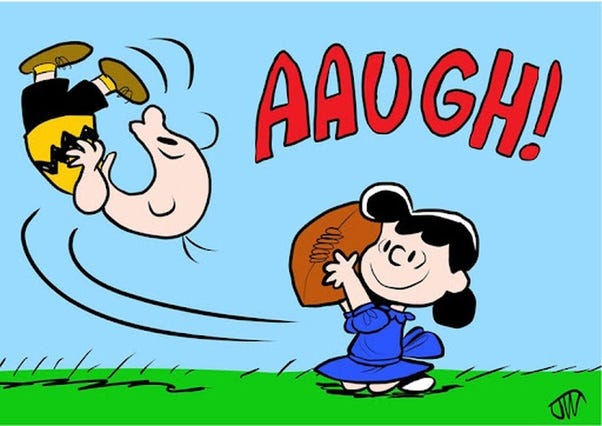
Unfortunately, it’s a promise made by the Lucys of the world to the Charlie Browns of the world that they, too, can kick the football over the goalpost if they concentrate enough and put all their effort into making that magic kick to achieve their dreams.
The desperate to survive have no choice but to play the game while knowing after a while and after having the football yanked away at the last microsecond before each kick attempt that capitalism is a game played at their expense.
There have been too many times in my life when that magic kick was within my reach, and it was yanked away by some greedy sociopath who decided their desires outweighed the needs of the many. Their Lucy attitude was rationalized in the same terms every person who combines psychopathy with manipulation as their vocational strategy for material wealth does; collateral damage is justified as the cost of doing business. If people go bankrupt as a consequence of some decision to benefit personally, then it’s their fault for making a bad choice.
Because we have put no restraints on greed, capitalism will fail, not because capitalism is flawed but because humans are flawed in their social contract-betraying greed. Moreover, humans lack the desire to regulate greed, which has always resulted in the harshest lesson in life, as history has repeatedly informed us and that the Brian Thompsons of this world have been ignoring.
There are many more Luigis among us, and if the perceived solution for the billionaires is to beef up their security, they will also regret not taking the road less travelled… not because anyone wants that. Victims only ever want justice.
“Those who make peaceful evolution impossible make violent revolution necessary.”
This post is different from my typical fare. It is an answer to a question posed on Quora, but it’s also a response to a post I’ve read about AI replacing human writers. My arguments have consistently been that as long as an AI is incapable of feeling emotions like love, sorrow, hatred, anger, and the entire range of emotions bred into us throughout centuries, it will never be capable of stimulating emotion within people. AI will never, on its own, connect with humans emotionally. Humans may imbue their AI experiences with emotions, but those are projections. Those emotions are mirror reflections of oneself and one’s biases. They can certainly help develop mindfulness techniques, but that becomes a self-referential silo.
Socialization is how we grow past our self-imposed boundaries, and we need input from other humans to understand ourselves truly. The purpose of this post is to prove this contention. How I will be doing that may seem somewhat circuitous, but please be patient enough to get to the punchline because I think it’s amusing, and I hope you will be too. Thanks for reading my gurgitations.
You ask this question as a believer because you must choose to maintain your belief consciously.
Every day is a day of ritual affirmation of your belief. At least once per week, you socialize with people to reinforce your choice to believe.
Your crises of faith are caused by the fact that you sometimes struggle to maintain your beliefs. You have doubts about your beliefs, but you do what you can to put them aside, and that may include a prayer or a castigation against Satan invading your thoughts with temptations to stray.
You may even turn to your book to find inspiration to hang onto your belief. You see words that confirm how hanging onto your belief is sometimes a struggle and that you must stand firm and never lose that belief.
You fear losing your belief because you feel like you’re letting down a paternalistic entity that will be disappointed and angry with you for not maintaining.
You struggle with the fear of an eternal punishment for betraying your commitment to your belief, and yet, after all of that, you still wonder why you endured all that turmoil.
You may tell yourself that it’s a test of your character and that if you pass it, you will be graced with an eternal reward instead of an eternal punishment.
You still wonder how people can live without that struggle, so your curiosity prompts you to ask how people would choose against what does not feel like a choice.
In your mind, you may think you have a choice, but you have a choice because a choice between Heaven and Hell isn’t much of a choice. It’s a no-brainer. After all, who would be stupid enough to choose eternal torture?
This prompts your curiosity because many people seem unconcerned about what you believe will happen to them.
Your mind struggles with the notion that people would choose eternal torture on a lake of fire as if it’s never going to happen to them.
It makes no sense whatsoever to you that people would choose to reject Paradise in favour of Hell.
The problem, however, isn’t that people choose not to believe because you can’t actually “choose” to believe. You know this yourself because you don’t “choose to believe.” You choose to maintain your beliefs.
What you do not understand about atheists and atheism is that people do not choose to become atheists.
People awaken to a new reality about themselves that they no longer believe the illusion and realize after the fact that they have become atheists.
Here’s the punchline:
An AI may be trained well enough to identify what I identified in the question posed. I don’t believe an AI could trigger the querent on such a visceral level by being so on point that they become defensive and dismissive of the information they encounter. This is a technique I refer to as “forced introspection.” This person will continue to deny, as we already know from our experiences with the MAGA mentality. However, they won’t forget how they were triggered to discover that their dismissal of what they read will vanish from their consciousness without an impact.
This dynamic can only occur between humans, so I feel comfortable putting all my economic eggs in the creative content basket. I’ve wasted a lifetime attempting to fit into a broken system and have become worse for wear. I may not ever see the same income potential I was well underway in achieving before a nuclear bomb on my life ended that aspiration. At least I can spend whatever time I have left expressing myself and permitting myself to be the “real me” through doing what I love doing.
This post is a response to a question posed in its complete format: “Why don’t big businesses reduce profits instead of increasing prices when forced to raise wages?|
Never in the history of generating income for oneself has anyone ever said, “Gee… I think I earned too much money. I should give some of it back.”
The answers you’ve gotten essentially echo the above sentence.
For example, many companies, like Walmart, deliberately underpay their people by enforcing tactics like union-busting and denying employees full-time status to permit them to qualify for additional benefits.
What they save on employee costs forces their people to qualify for government benefits. So even if you’re not their customer, you still subsidize their operation through your taxes. Their major shareholders laugh at you and your question.
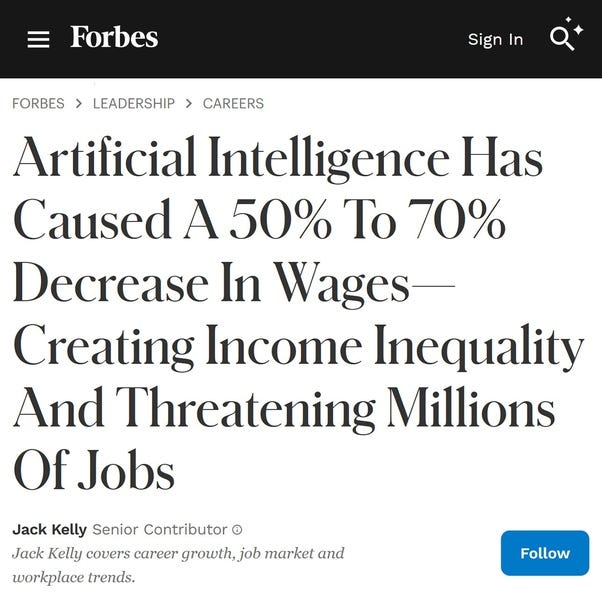
There is no way to solve this problem within the status quo. Even worse, this problem will continue to worsen as technologies in AI and robotics mature while automation replaces jobs to reduce employment costs even further.
The Walton family doesn’t care about how their employees might struggle. Jeff Bezos considers employees dying on his warehouse floor as collateral damage and the cost of doing business. A few thousand dollars toward a token effort to address optics is a low price to pay to force people into running according to the inhuman scheduling they’re forced to endure by filling orders according to a timed system.
Part of the problem with this question is that it presumes wages determine the costs of products that you pay for when that is the furthest thing from the truth. Wages are a minimal determinant in the price of products you buy.
Products are priced at the highest level that a market will bear. IOW, the price of a product is based on a formula applied to the speed at which shelves for that product are emptied. You have probably heard of the phenomenon of “supply and demand.”
The more demand for a product, the easier it is to justify its increased cost. The company knows it will still sell its product but get a higher margin, growing annual revenue and making it more attractive to investors. In turn, its stock value increases, and it appears much more successful as a company doing business in the marketplace. The entire system is geared around pricing products as high as possible while reducing costs as much as possible. The cost of labour is considered the most significant repeat cost of an operation, so it’s always targeted for reduction. Capital costs are written off in tax deductions, so a one-time purchase far exceeding the cost of labour for the year is still cheaper than labour because of that tax benefit.
When employers, capitalists, and their flying monkeys threaten higher costs for products due to higher wages, they’re just lying to the public to create the optics that their products require price increases that are functionally unnecessary but acceptable because people believe the justifications that are given. This happened due to the COVID lockdown when companies took advantage of public sentiment to indulge in price-gouging strategies.
Solutions to this and many related problems, such as the persistence and even increase in poverty, involve multiple strategies.
First, the downward pressure on wages can be addressed by eliminating the leverage of destitution that employers have with employees. Suppose an employment candidate doesn’t like the pay scale offered by an employer. In that case, they currently have a choice to begrudgingly accept being underpaid or face the risk of homelessness, starvation, and premature death. The solution to this problem is easily implemented through a Universal Basic Income. If candidates are free to turn down insufficient wages, then employers are put into a position of being more competitive to attract those they want on staff.
Corporate structures are an inherently antiquated holdover from medieval organizational structures. Corporations are strictly hierarchical entities that function like mini-autocracies. This dynamic existing within a democratic society cannot be but at odds with the society it operates within. It is in the “corporate DNA” to essentially function as a subversive entity within a democratic society that inevitably plots the demise of democracy and its overthrow to institute an oppressive two-class society of owners and serfs. The solution to this problem exists within worker co-ops.
Worker Co-ops (continued) Richard Woff is an economist and a professor emeritus of economics at the University of Massachusetts who provides compelling arguments in favour of worker co-ops. — Richard D. Wolff — Wikipedia — RDWolff –
4. (Numbering Bullets in this kind of HTML formatting truly sucks the big one) Finally, the primary solution to the greed infesting human behaviour today that functions as a threat to human society is to place a global cap on personal net worth. This is the most difficult of all challenges to implement because it’s already hard enough to have an entire nation agree on something. For the world to develop solidarity in this matter appears to be an unreal fantasy, but it may be the case that Donald Trump and Elon Musk are opening the door for the world to get on board with it. There is no valid argument against it, particularly since the only argument that once held validity — financing large-scale endeavours — is now rendered moot through crowdfunding. The more money that exists in the working class’s hands, the more able the working class can participate in a democratic economy rather than be subjected to the whims of psychopathic power-mongers. We must first drop this delusion that wealth is accrued only by “special humans” who stand above the rest of us. It’s becoming ever more apparent to the public that not only does power corrupt, it is the corrupt and corruptible who are attracted to power.
We are rapidly approaching a point of no return in which we will either quickly resolve the problems threatening human civilization or lose the ability to respond to a global environmental threat.
This post is a response to a question posed in its complete format: “Why is the MAGA cult proud of being ignorant? Is it a lack of self-awareness and/or emotions dictating their every thought over any logic?”
That’s a mischaracterization. They’re not “proud of being ignorant” because no one is ever “proud of being ignorant.”
They are proud of feeling they were right because they got their way and got the guy they wanted. They are pleased to beat those they view as their enemies.
They are proud of what they perceive as winning.
They are proud of what they perceive as defeating their enemies.
They are driven by emotion because reasoning at high levels is confusing, frustrating, and tiresome. They tend to despise reason when it is used in ways that make them feel inferior.
They tend to mistrust people capable of using reason in ways that confuse them and contradict their intuition. They will often misinterpret what is being conveyed through reason by simply adopting a polar extreme to what they experience.
Their reaction is no different than a familiar dynamic between an emotional child and an adult.
Here’s an example I discovered as I have been poring through texts I’ve written (many to myself as a way of coping with reality), which typifies the mentality in question:
Loren,
Let’s walk back through our last conversation.
(paraphrasing)
You: “Should I peel the apples and put them in water?”
Me: “No. Just sprinkle a little lemon juice on them.”
Later, when I came downstairs:
Me: “You didn’t need to put them in water.”
You: “Sorry. They’re not perfect because you didn’t do them.”
Now I’m wondering how I can have respect for someone who responds to me with the emotional development of a teenager. The sad thing is that this is VERY typical of what I often experience with you.
In retrospect, I should have given this note to this person, but I wrote it to myself, as I stated, to record my frustrations so that I could learn to manage my emotions better.
This dynamic is precisely the nature of dealing with a MAGA mentality that refuses to see past their insecurities to focus on a rational apprehension of the reality they are dealing with.
There aren’t many options to dealing with this mentality if they’re not a literal child who can be given a dose of negative reinforcement to ponder the consequences of failing to think through their position on any given matter.
The dynamic of parent and child is the most straightforward form of addressing such negative behaviour because there are many options to how one approaches the emotionality of their response. One can be supportive in how they deal with it, such as by using the Socratic method and turning their thoughts inward to question their motivations while guiding them through reasoning. This is impractical in most cases because it requires significant time, concentration, and strategic evaluation of the direction in which their mind goes.
With an adult, there is no wiggle room for conveying the implications of such thinking because they will have already perfected their entrenchment while having no obligation to respond to a parental dynamic in their conversation. Just like the example above. Any attempt I would have made to have that person understand how utterly toxic her thinking was would have escalated a conflict between us.
If you ever try to have a MAGAt understand how the notion of “small government” is an entirely irrational statement, you will quickly realize how fruitless such a conversation is. The problem lies in their adherence to principle and an inability (mainly a lack of desire, not capacity) to process reasoning. Any criticism of the soundbite they’ve planted as a territorial flag in their mind is interpreted as an assault against their principles, not a critique of the concept they haven’t bothered to flesh out in detail.
Every issue they champion is practically the same approach to standing fast on principle and counter-attacking any criticism like they were defending a great fortress from barbarians at their gate.
Their self-worth is derived from the strength of an adherence to their principles and loyalty to whomever they pledge allegiance to. They are proud of standing fast on their principles.
This mentality has long been a template for any cult leader to exploit.
Anyone who can communicate with them in the same atavistic language of emotion, appealing to their egos and baser instincts with soporifics that soothe their defences and confirm their biases, will be able to convert that person into a willing puppet on a string who will kill one’s enemies on their behalf. That’s why January 6th occurred without them questioning the irrationality behind storming the nation’s capital. None of them considered what would have happened had they succeeded in taking control of the building and its grounds. Fortunately for them, they didn’t succeed.



















 thotbag