That’s simple: Do you find the act of hurting another pleasurable?
Even if that other person has caused you harm and you lash out in self-defence while feeling sorrow toward them and the events that lead to a destructive outcome, you are demonstrating the capacity of awareness that characterizes what allows humans to think of ourselves as “civilized.”
When Hillary Clinton laughed at the death of Muammar Gaddafi, that was when she lost it for me. It doesn’t matter how evil a monster he was; there should never be any pleasure in taking a life because that’s a betrayal of one’s essential humanity on every level. One can feel relief and express that. One can find satisfaction in ridding the world of evil, even through extreme measures, but the moment one finds pleasure in that act, one embodies the evil one self-righteously destroys. Evil always wins in that outcome.
Another example of knowing when one is evil is when they are in a position to save a life and choose not to. The most iconic moment embodying this behaviour was in Breaking Bad when Walter White watched Jesse Pinkman’s girlfriend, Jane, die of an overdose. He could have saved her, but his priority was controlling Jesse.
This was a harrowing moment for me when, up until this point, I found reasons to justify Walter’s behaviour but could no longer do so after this.
This particular scenario has exploded with meaning to me as I find it occurring in real life by people I should have been able to trust. Instead, they’re responding to my struggle for survival, which they are responsible for creating in ways that echo attitudes and behaviours.
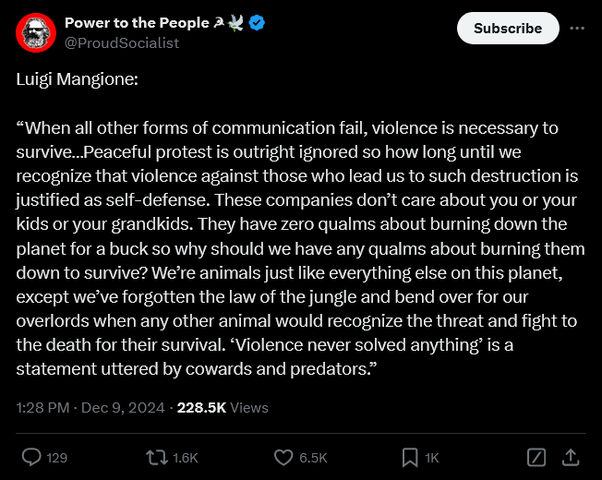
Meanwhile, I currently need more options for addressing my struggle through civilized means. I have been exhausting every supposed route to reparations, but none are forthcoming as door after door slams in my face. I empathize with Luigi Mangioni in ways I would not have expected otherwise.
This is not something to be proud of or to find pleasure in. This is a moment demanding sorrow that we must come to this extreme before those responsible for evil stop and consider the gravity of their actions.
Neither of those concepts is exclusive to believers. That you ask this question means you’ve been subjected to disparagements about atheists by other believers who spread hatred instead of the peace and love your faith alleges to represent.
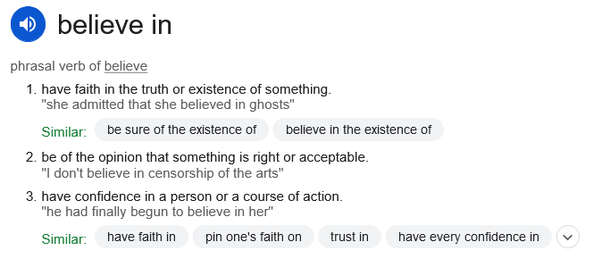
This particular atheist now cringes every time I see the words “believe in” because I know it’s coming from a believer who doesn’t understand belief. They overuse that expression as a shortcut for every bit of conceptual data their brains can accommodate.
It’s like watching someone put ketchup on everything they eat, from eggs to steak to cakes and doughnuts. It just gives me the heebie-jeebies.
I am learning to hate the expression “believe in” more and more every day because the people who are supposed to understand the implications of belief the most are the least capable of comprehending the implications of a belief.
Many believers confuse belief with entrenched insularity; nothing could be more toxic to the concept.
Many believers behave as if zealotry and belief are synonymous, but they’re not. They’re just excuses to refuse to learn, grow, and change. Invoking beliefs for believers is often the equivalent of a child whining about cleaning their room or taking their medicine. Letting go of toxic beliefs is just too much “woke” for far too many.
I have faith in myself and my ability to find a way to make it through this exceptionally challenging period in my life, but I have to accept that I may fail. I rely on hope to carry me through while smoothing out the rough edges and allowing me to maintain the necessary motivation to overcome adversity. I don’t see wisdom as a statically defined state of being but as an ideal, like a utopia, which serves more as a compass setting than a destination. There is no point in which a maxim of wisdom is attainable. Wisdom is often contextual and a subjective perception one has of another. To think of oneself as wise is just another means by which one admits membership into the Dunning-Kruger club.
I hope I have enough wisdom to survive my travails, but I have faith that I may succeed even if I don’t.
The disconnect is presuming he sees other people in the world as people rather than as objects placed on this Earth to cater to his poor existence.
Haven’t you noticed how much whining Trump does about life even though he was born on third base and has destroyed hundreds of thousands of lives throughout his life? After all that destruction, he still views himself as a victim.
Ironically, they’re both victims of failing to maintain contact with their essential humanity.
They will both go to their graves, completely frustrated and confused about why most people hate them.
Sure… they have devoted followers, but those are the easy and gullible idiots to manipulate. It’s not enough because they know the people who challenge them think poorly of them.
The jealousy is why Trump can still gripe about Obama a decade later.
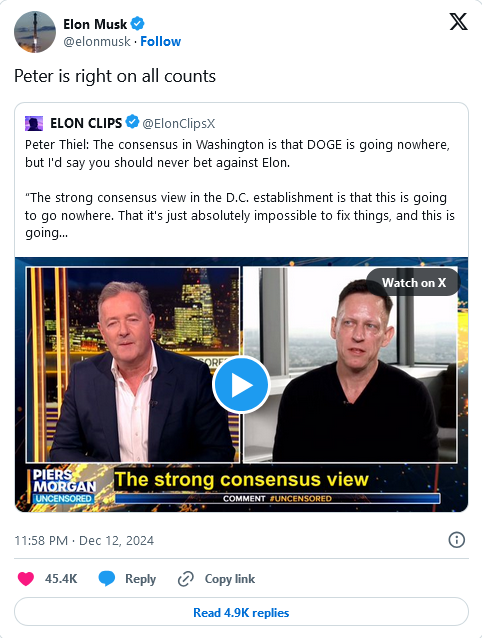
Supporting a hated monster like Trump is the closest Musk will get to camaraderie. Meanwhile, both regard each other as useful idiots to their self-serving causes. Once the wheels fall off in their relationship — and it will because there isn’t enough room on the planet for two competing megalomaniac egos — eventually, one of them will step on the other’s toes hard enough to escalate into an open conflict — we’ll see embarrassing demonstrations that remind us of all the sandbox behaviours we experienced in elementary school.
Sadly, the more Xitter fails, the harder Musk will go after austerity for the little people, and that’s how he will deal with his “poor stature.” Musk is this century’s poster boy for why restraints on personal wealth and power are crucial to the stability of human civilization.
The MAGAts won’t see that, though, because they’re conditioned to desire submission to authorities they’ve been accustomed to worship. They will identify more with Musk’s struggles than their fellow citizens who suffer from Musk’s spitefulness.
Elon Musk is essentially living a life of revenge against whatever broke him in his childhood. His and Trump’s attitudes and behaviours are typical for bullies who remain convinced of their infinite entitlement to destroy others. They are self-righteous in their acts of destruction to levels equivalent to extreme religious zealotry.
Musk will sincerely believe he is a poor victim for being denied the $56 billion he demanded as compensation from Tesla. Self-serving bullies like won’t stop until someone stops them. Until then, Musk in his “DOGE” role will strip away lifelines from the little people to save himself a few dollars on taxes with righteous fervour. He will sincerely believe he’s doing the right thing for society by getting revenge on his victimization.
The attitude of being a poor victim is a common among billionaires who brazenly justify denying people their right to life to save themselves a few dollars in taxes. Meanwhile, all of their justifications for austerity for the little people is presented as if tax increases are and should be equal across the board. The wealthy have had their taxes cut by more than half in the last several decades which constitutes billions in savings for each billionaire. The little people have conversely gained pennies in tax cuts by contrast. Meanwhile, people like Musk, Thiel, and those support Trump consider themselves poor and unjustly victimized if their taxes were increased by a few percentage points.
The next time you hear someone use the expression, “victim mentality,” pay close attention to the person who accuses others of having such a mentality because that expression is projection for a sociopath. We’ve all had enough experience now to understand how the corrupt will make accusations that are confessions in disguise — deflections away from responsibility for their actions. People like Musk and Trump embody that mentality. Every choice they make is a form of revenge for their victimization while anyone who suffers as a consequence deserves their fates.
This post is a response to a question posed in its complete format: “People tell me I’m being defensive, when I’m really only explaining the literal facts that happened. How do I do that without being called defensive?”
Examine your motives.
Why do you feel a need to explain facts to people?
Has someone asked you for those details?
If they haven’t, they will interpret your input as motivated by a personal agenda, often defensiveness.
Your facts may be necessary to defend an action or correct a misinterpretation, in which case, your perspective may be critical to ensuring that the clarity and accuracy of events are maintained so as not to negatively affect someone unfairly due to a misjudgment or biased conclusion.
What also often happens is that when someone does offer clarifying information that an abuser doesn’t want to be made known, they will attempt to gaslight the messenger with accusations like they’re being defensive.
If you’re constantly explaining facts and that’s causing many people to accuse you of being defensive, then that could be a compulsion you developed from an abusive environment where you were constantly disbelieved and have overcompensated for that accusation by feeling compelled to explain facts, whether they’re relevant or not to resolving whatever dynamic you’ve been caught up in.
What people tell you is a clue either to the behaviour of yours you’re not entirely clear on or a clue to their attitudes. There is no universal answer as to which it would be, but your best bet is to be mindfully clear about your actions and why you chose them.
Other people will always say something; often, that thing they say has less to do with you than it does about them.
Your environment may be one where you feel compelled to offer explanations to defend yourself while being told that you’re being defensive. If that’s the case, then it’s most likely an abusive environment, and some abuser is deliberately gaslighting you to make you feel insecure about yourself.
Only you can know what the truth would be in this case.
As humans, it is vital that we all work together to make a better world for all of us today and for those who come after us.
After all, we are currently enjoying many freedoms and luxuries we would otherwise not have had it not been for the contributions of those who came before us.
Failing to do our part to make this a better world makes us a parasitic element that erodes the social fabric.
Working against the betterment of humanity is a betrayal of the social contract. Today’s dynamic resembles a tribe that survived a primitive existence by everyone working together. Having one person in that tribe work against the tribe’s survival was viewed as a threat to that tribe.
They had much more efficient ways of dealing with such betrayals then.
A utopia is otherwise just a setting on a compass that keeps us on track. Utopia is a concept and a direction, not a destination.
Hiding one’s misanthropy behind a political ideology is the polluting act of an intellectual coward and a morally depraved psychopath.
As you can see from how people are united in support of Luigi Mangioni, it’s not about left versus right. It never has been. It’s always been the top attacking the bottom, while people like you who play into that divisiveness are just useful idiots keeping us all distracted from saving ourselves from disaster.
Framing this question within the context of a political ideology only adds to the chasm between political polarities, imbues it with passive-aggressive disparaging implications, and is irresponsibly divisive nonsense.
This post is a response to a question posed in its complete format: “What effects do you think AI will have on society? Realistically, are people overreacting who say they’ll take all the jobs and run the world?”
Realistically, machines can’t “take jobs away” from people. Organizations and the capitalists who fund them while demanding optimal revenue generation at the lowest cost possible are choosing automated solutions to the labour cost.
This trend, of course, does displace workers as technologies have always done. Unlike previous generations of technological advancement, however, the displacement is not limited to specialized functions.
For example, armies of people sawing logs by hand were not entirely displaced by the introduction of sawmills. Labour was reallocated and redefined. Instead of pushing a saw back and forth, labour became a process of pushing buttons.
Of course, fewer people needed to produce the same volume of lumber, but there was also enough demand to scale production and create employment opportunities further up the production line.
At the height of the technological transition to a digital age, we saw many jobs displaced, but new categories of employment at much higher levels of complexity emerged. Secretaries who transcribed letters were replaced by administrative assistants who functioned in a data entry capacity. At the same time, executives eventually learned it was more efficient and pleasurable to directly type their thoughts into word processors rather than proofread changes multiple times over in an often frustratingly long process.
Network technicians, web designers, database developers, and an entire class of Information Technology workers sprung up almost overnight — by contrast to how the labour demographic had evolved since the dawn of the Industrial Age.
That’s no longer the case in today’s dynamic.
The AI revolution will not spawn demand for new labour beyond the minimal replacement of armies of people pushing saws with one person pushing buttons.
Before this current stage of technological evolution, it was easily argued that displacement versus the creation of new jobs approximated a one-to-one exchange. The hundreds of thousands of trucking jobs replaced by self-driving vehicles will not result in new jobs created to transport goods globally. Self-navigating cargo vessels will not create 15 to 30 new jobs per ship when intelligent robots replace workers.
Hundreds of millions of jobs worldwide will be transitioned to an automation model.
This brutal inevitability ignores issues used as political footballs and bypasses all the fearmongering over demanding higher wages. Automation will displace jobs, but not because automation “takes those jobs.” Technological innovation has always been and always will be a more efficient way of doing business.
Although the transition to an automated society is often viewed as a technological transformation, it is primarily a social transformation. People are going to have to stop thinking about “getting jobs” and starting about how to generate revenue for themselves by leveraging services as independent entrepreneurs. This view of capitalism has always been at the heart of the capitalist vision, and it was cemented in our psychology when business was granted personhood status.
The primary challenge within this transition is to provide the means to pursue one’s independent revenue-generating efforts with the necessary resources to succeed as an independent business owner.
We are inundated with exposure to the results of resources transforming our world by creating new classes of the wealthy whose net worth far exceeds previous generations — even after accounting for inflation. Henry Ford, for example, was a highly successful industrialist, but his net worth and reach don’t come close to Elon Musk’s status as a centibillionaire. It can be argued, of course, that such a disparity is a consequence of a corrupted tax burden. Still, those factors don’t fully explain the difference in dollar value between Ford’s millions and Musk’s centibillions.
The profit potential has never been more significant simply because the markets that once comprised a few million consumers now stretch across the globe, with a population approaching eight billion potential consumers. This global reach is why it is often argued that it’s easier today to become wealthy than before.
The reality, however, is that just like yesteryear, resources are required as seed funding to support the creation of tomorrow’s industry giants.
We cannot continue to rely on dynasties to dominate the innovation engine because they are not naturally innovative. They are conservative and often repressive by nature because they are risk-avoidant.
The heart of capitalism beats to the tune of innovation. There is no more significant potential for innovation than the eight billion people mostly trying to carve out a living while engaged in activities they value. The handful of billionaires and centibillionaires cannot compete with that innovative potential. By allowing our species to be directed by such a small number of individuals, we are limiting our potential as a species while granting too much power to people who are so grossly corrupted by it that they have become a threat to our future survival.
We must level the playing field and empower the little people who can put to great shame the illusion that the powerful in society are so far above the rest of us that we can’t survive without their direction.
Not only can we survive without them, but we can prosper in ways currently impossible under their thumbs.
We need UBI to release humanity from the yoke of our oppressors and fully embrace our creative potential through the innovative possibilities unlocked to us all through a fully automated society.
This post is a response to a question posed in its complete format: “If being liberal means being open, and generally tolerant, why do so many people ask why “liberals” are so intolerant?”
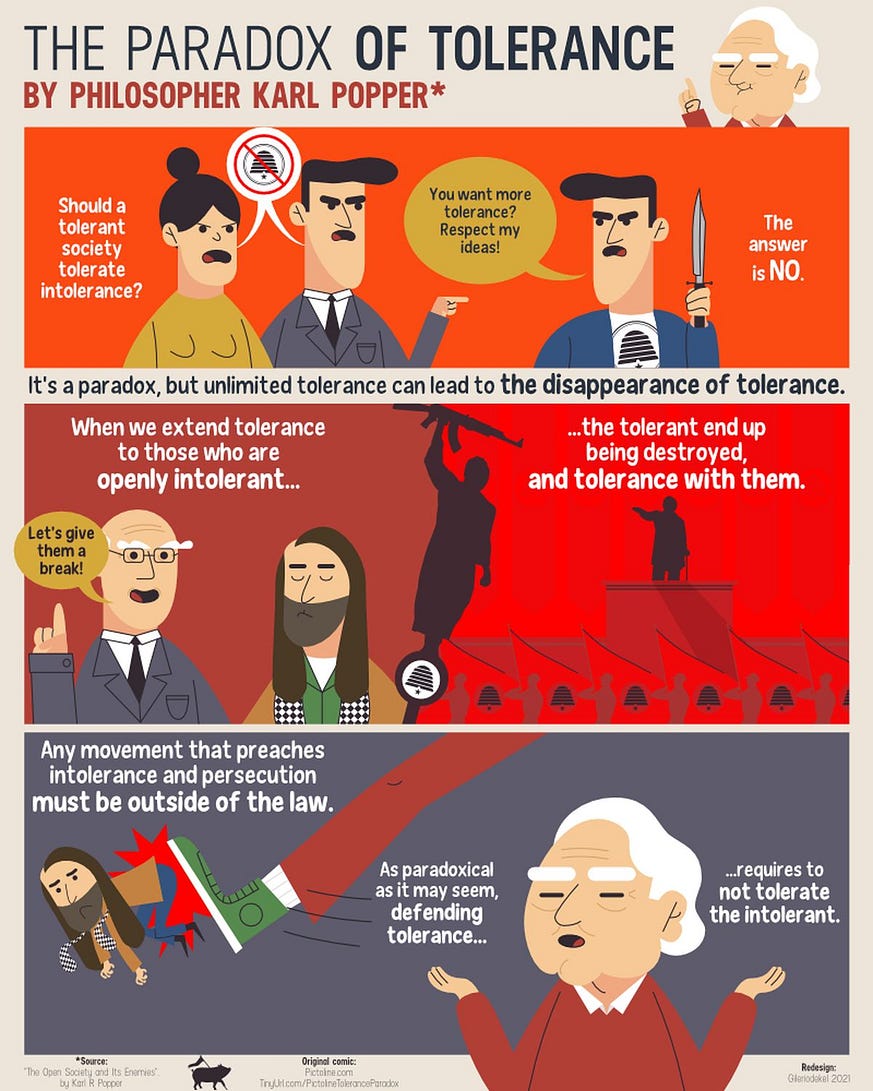
Tolerance cannot exist without limits, and the tolerance limits are the intolerant in society. Society cannot survive a tolerant existence without being intolerant of the insular and narrow-minded. Karl Popper described this limit within his “Paradox of Tolerance.”
Being tolerant means embracing the tolerant and rejecting the intolerant.
People who spread hatred cannot be tolerated if we wish to live in a tolerant society. In essence, people who spread hatred are in breach of the social contract, and the only way to address that is through the social pressure of rejection. The logic is not much different than the logic used when incarcerating criminals. Separating disruptive elements from society is a necessary strategy for preserving social cohesion.
Hate-mongers fail to understand this principle when they discover, to their chagrin, that their abusive intolerance is no longer tolerated.
They are often shocked and concoct accusations like “cancel culture” to serve as deflections for disguising their confessions. They are, after all, the same people who ban books. Most bullies in society get away with being bullies for a long time because most people just quietly turn away from them to give them the illusion they can continue being bullies. Most people prefer to avoid conflict and will often comply with a bully to get rid of them, making them think they have won.
This is a sad consequence of conflict-averse people because they only enable bullies in society while the one or two brave enough to stand up to them are destroyed.
The only way we will end the abuse we experience from bullies is when everyone stands together to show the intolerant that their intolerance will not be tolerated.
Being liberal has nothing to do with this. A decent human being willing to fight for a better world constitutes values that transcend political ideology.
Conservatives also have it within them to be better. The current prevalence of MAGAts and MAGA-style hatemongering the world over overwhelms their parties with cumulative toxicity that erodes the social fabric. At the same time, the rational conservatives among them, tacitly endorse the assault on the social contract through their tolerance of destructive MAGA attitudes and behaviours.
This is a difficult period of transformation for those who have felt themselves entitled to their biases, and we see examples of it everywhere in every contentious issue where mainly MAGA people attempt to impose their biases onto others. They can’t stomach the idea of equality when they and all of the working people are struggling during a period of extreme income inequity. Instead of being angry at those responsible for their strife, they’ve chosen the easy route of punching down instead of up because all bullies are cowards. It’s much easier for them to pick on those who appear vulnerable in society, such as immigrants, transitioning people, and women.
When liberals try to refocus their anger on those responsible for their strife, they often react with anger toward liberals, and that’s why questions like this exist. Those “so many people” who ask why liberals are intolerant are those who are too afraid to hold the people responsible for their anger accountable. Everyone else has had their tolerance eroded from the futility of attempting to reason with people who hold fast to positions they did not adopt out of reason. There is no point bridging a divide while the other side insists on digging a chasm.
This post is a response to a question posed in its complete format: “As an atheist, how do you deal with the fact that there is no ultimate moral arbiter and that all morals are determined inter-subjectively and without an objective foundation?”
Have you taken any time to consider how, if a god existed, its morality would also be subjective to it?
If morality had an objective foundation, it would be intrinsic to the object itself. One could essentially “read” morality from within every instance deemed to bear moral implications. If morality were objective, everyone would read and identify identical moral qualities within every situation subject to moral judgments.
It would be no different than having everyone agree that the sun shines and its effect warms us. No one or authority is required to serve as an arbiter for these qualities. We know these facts to be confirmed individually from everyone’s direct experience with the sun.
For the sake of this exposition, let’s refer to those qualities of heat and light emanating from the sun as “metadata.” This description can help us draw some clear distinctions on the language we’re using to resolve discussions on objectivity as it applies to the concept of morality.
For instance, if theft were objectively determined as immoral, then the characteristics defining its morality would be immutably intrinsic to that act of theft. All forms of theft would be considered immoral without condition. It can easily be argued that the metadata ascribing immorality within the act of robbery lies within the harm done to those against whom the theft is perpetrated.
Stealing food to feed one’s family would always be consistently judged as immoral. There would be no distinction between stealing food from a starving person and stealing food from someone with such abundance that most of their food is spoiled from the lack of consumption.
One can argue that stealing food to feed one’s family is not immoral if the person one steals from still has plenty of food to feed themselves. One can say that stealing food that would end up being spoiled from lack of consumption to feed one’s family is moral.
How can both scenarios be valid if morality is objective?
If morality were objective, it would be contained within the object, but as we can see in this simple example, morality is contextual. Morality within this simple case is contingent upon the judgements of those who choose to ascribe varying degrees of value to the individual aspects of the case of stealing food.
Some may determine that stealing food, in any event, is immoral. In contrast, others may determine that stealing food to feed one’s family is an act of self-sacrifice that exposes them to a life-destroying reprisal, which represents the embodiment of morality.
If morality were objective, then it would be immutable, but how many things deemed immoral at the time of the writing of scripture have since been reconsidered irrelevant to the concept of morality?
No one balks today about wearing clothing made of mixed threads. It’s almost impossible to find any clothing that doesn’t mix threads to some degree today. Yet, this practice is no longer considered a moral violation that would anger any ultimate authority such that a reprisal would be forthcoming.
Did God change its mind? If so, how do we know, and when did that occur? By what process are we being informed by an ultimate authority of updates to morality? If morality is subject to updates, how could it be objective?
Morality can’t be objective if an ultimate authority changes its mind and renders updated decisions on what constitutes morality because they are simply conveying (if we can set aside the mechanics of that conveyance) a perspective unique to their apprehension of a situation.
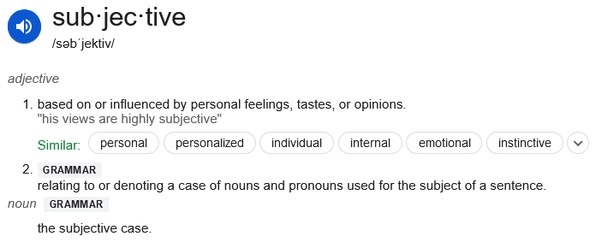
Perhaps you’re still struggling to comprehend the difference between “subjective” and “objective,” and that’s why you insist morality is “objective?”
Let’s look at some definitions to help frame the explanation above:
Any situation in which an authority must intervene to render a decision to settle differences between competing perspectives cannot, by definition, be considered “objective.”
It doesn’t matter whether that authority is omniscient or not; they are still rendering a decision derived from their perspective on the issue in question.
The necessity of an authority to determine morality already renders morality a subjective construct.
Morality cannot be objective by any stretch of the imagination and, most notably, not by arguments ascribing ultimate morality to an ultimate authority on morality — mainly when that authority is not available to provide any direct input into any state requiring a moral judgment to be rendered.
Indeed, the need to render a moral judgement eviscerates the notion of an objective morality.
The appropriate context for perceiving morality is a public dialogue in which we learn to develop our moral paradigms to understand ourselves and our world more clearly. The dialogues we have on morality serve the purpose of developing compassion toward issues outside our frames of experience and help us to apply a moral paradigm to the whole of our existence as individuals and as a species struggling to achieve its potential.
The reality is that objective morality would destroy our capacity for morality because an essential learning process for developing one’s humanity is reduced to rote memorization. In contrast, the human capacity for creativity necessitates means by which moral loopholes can be exploited.
We see this behaviour routinely exhibited by those who claim to be representatives of moral authority betraying their self-appointed statures in society.
This post is a response to a question posed in its complete format: “How do I cope with feeling creatively stifled in art school? At 23, after years of studying and currently master’s, I feel blocked and discouraged. Despite my talent, constant negative feedback has left me stuck & numb. How can I regain my passion?”
Try to think of the constant negative feedback as callous-building. It won’t stop. The more success you find, the more negative feedback you will get.
Your artistic process is your means of enduring and overcoming that feedback. Let it feed your resolve to continue pursuing what matters to you in your artwork.
Allow your process and product to teach you about yourself because that’s the value of creative endeavours.
Learn what you can from the masters who came before you. Let their struggles and discoveries inspire you to explore new realms of creativity.
Let the voices of the living critics wash over you like the daily elements confronting you, whether a cold chill from a frosty wind or a downpour of hail. Your creative process can turn all that effort at weakening you into a strength that helps you push past the boundaries limiting your potential.
Learn to read between the lines of the negativity directed your way because you will discover that most of them are projections driven by fear and envy.
People not intimidated by you have no need or compulsion to be negative. People who are not driven by fear and self-loathing see no point in anything outside objective honesty when expressing their views. People who care and are considerate of your personhood will try to choose words to support you, even if they see a need to correct an error of yours.
Since you are underway in a Masters level program in the Arts, you are well underway in securing yourself a somewhat economically stable future that will permit the continued development of your artwork throughout your life.
Upon completing your graduate degree, you will be eligible for teaching positions that may or may not interest you now but will allow you to remain current within your profession.
I would have jumped at an opportunity to complete my own Masters degree for that very reason, and so this may be a bias of mine. I think there can be no greater pleasure than to share one’s love with those who come after.
They can become sources of inspiration for you that break self-limiting boundaries. I also wanted the opportunity to be the opposite of many of my toxic instructors. They would cut me down in person but always visit my studio when I wasn’t around. I was informed of that oddly conflicting behaviour by studio mates who seemed excited for me.
I didn’t understand that then, but I interpreted that dichotomy in their behaviour as a backhanded form of compliment.
You will discover that your passion is like a barometer keeping you on track and focused in the direction that your art is taking you. It is like a guide for your life to facilitate your growth and achieve your potential.
Your passion will flow in waves that lap the edges of your consciousness amid exciting discoveries and recede when formulaic repetition asserts itself.
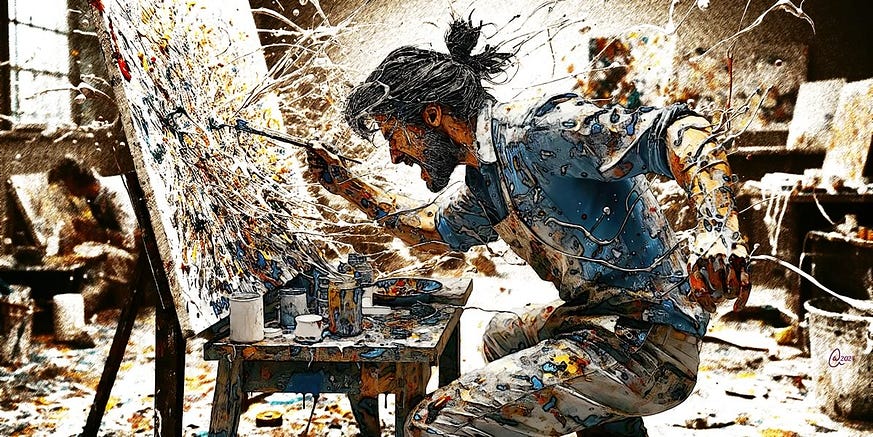
Whenever I feel blocked, uninspired, or unmotivated to focus on creating developed pieces, I turn to processes borrowed from the technique of automatic writing. The deliberately unconscious transcription of words and mark-making function like a form of callisthenics to “loosen up the creative muscles.”
I have learned that the thrill of discovery is the key to stoking one’s passions. Nothing is more awe-inspiring than looking at a piece one has finished and wondering how it could have come from within.
If you can keep surprising yourself, you will never lose your passion. You will always be motivated to explore what lies beyond your horizon.
This is a fundamental truth of the human condition. The wonder of discovery makes life worthwhile and raises us all as a species out of the darkness of a primitive existence to touch the stars.
This post is a response to a question posed in its complete format: “Is it okay to not be okay after all people have put you through like the damage has been done?”
Either yes or no, depending upon how one interprets the perspective behind this question.
It’s not okay that you’re not okay, but it’s not okay because of anything you need to be ashamed of. It’s not okay that people have done what they have done to make you not okay.
You don’t need permission to be not okay in the same way you don’t need permission to eat when you’re hungry or use a bathroom when you have to go.
Being not okay with damage done to you is a natural consequence of the damage.
No one escapes being damaged to feel okay, no matter how much they try to shake it off.
Damage is damage.
If your car gets a punctured tire and is flat, you can’t ignore that damage without doing more damage to your car.
Your body and mind are the same.
If you can’t heal and you try to ignore the damage done to you, you will damage yourself and others along with you.
Your highest priority should be to heal, just as if you’ve broken a leg and need to give your bones time to mend.
The mind is no different.
You can’t continue like nothing happened.
It’s not okay that you’re not okay; you need to give yourself time to become okay again.
It’s also not okay for someone else to make you feel like something is wrong with you for needing time and space to heal from your damage.
If that’s the expectation you are facing and what prompted your question, then be aware that such an expectation by others only harms you more.
It’s called victim-shaming, and it’s a heinous attitude and behaviour indulged in by broken people who are not okay themselves. They never took the time to heal, and because of that, they don’t know how to respond to you by doing you damage.
It’s evil behaviour that you should not not tolerate. It would help if you told them that it’s not okay to make you feel not okay for not being okay.










 thotbag