Metaphors for the 2024 election (the second one is available as a teeshirt on TeePublic via PolyTix – I am currently awaiting approval on the first from RedBubble):


Metaphors for the 2024 election (the second one is available as a teeshirt on TeePublic via PolyTix – I am currently awaiting approval on the first from RedBubble):

This post is a response to a question initially posed on Quora, and can also be accessed via “https://donewiththebullshit.quora.com/Who-were-the-big-winners-and-losers-in-the-2024-presidential-election-3“
The biggest losers are the MAGAts.
They don’t see it yet.
By the second year of his term, they’ll start to wonder what’s going on.
By the time the next election rolls around, they’ll begin seeing it’s no longer “business as usual.”
They will begin to realize that he meant what he said when he said no one would have to worry about elections any longer.
That’s when the fear will creep into them… the last of them because many will have already undergone harsh awakenings when discovering that prices have skyrocketed while employment protections have vanished. They will freak out when they find out they cannot count on retirement as they struggle with minimal incomes to survive on bare minimums. The entire nation will plunge into a recession that could very well become a depression due to environmental and regulatory mismanagement that will make the Bush housing crisis and the “Great Recession” pale by comparison.
Drug prices will skyrocket, as will medical bankruptcies. Millions will lose their healthcare as employers will cut back on employee expenses, and nothing will prevent them from converting the entire working class into a slavery system worse than it is now. The economy will radically shrink through their isolationist approach to international politics, and whoever remains will fight their neighbours for scraps.
That’s not the worst thing for them to lose, though.
No.
The worst and most profound loss they will experience is the compassion of their fellow citizens who warned them.
When they begin crying foul, they’ll find no sympathy.
There will be no quarter for them. No sympathetic shoulder will await them when they realize they’ve hit rock bottom.
They will finally get the disdain they’ve consistently demonstrated toward their fellow citizens for decades.
They will find their hatreds finally reciprocated in the harshest of terms with a simple “we told you so.”
They will find doors of sympathy slamming shut on them because they won’t be the only ones suffering from their hateful motivations. The entire nation will learn to hate MAGAts on such a visceral level that an escalation of antagonism will become the norm for the following unpredictable number of years — possibly the entire next century.
They’re going to learn how the fabricated hatred they’ve been displaying toward their fellow citizens is nothing like genuinely earned hatred.
When they finally realize the profundity of what they have lost, it will be experienced as a prolonged moment of debilitating horror that transfixes them. They will mourn the loss of a nation they professed to love. They will be overcome by paralyzing guilt accompanying the realization that they killed it by their ignorant and envious “stick-it-to-the-libs” attitudes, their hateful projections, and their self-fulfilling prophecies of doom they feared were to be caused by their fellow citizens.
They will have only themselves to blame. They will become this century’s brownshirts in the aftermath of the destruction they wrought against their people, neighbours, and fellow citizens. The entire world will regard them like drug addicts who have hit rock bottom and can’t be trusted ever again.
When they finally achieve their moment of harrowing clarity, it will be too late to turn back the clock and regain the stature of world power they enjoyed. The entire world will have marginalized the nation while permanently considering it a threat to global peace and security instead of its protector.
They will discover such a profound degree of shame accompanying a sense of loneliness and being lost and adrift in a massive ocean surrounded by the enemies they made of their fellow citizens that many will turn to suicide… and worse, no one will care if that’s what they choose for themselves. Many will feel the same relief they did when Rush Limbaugh finally stopped polluting this Earth with his hateful noise.
It will take all of the rest of this century for Americans to recover their dignity.

This post is a response to a question initially posed on Quora, and can also be accessed via “https://www.quora.com/Why-doesn-t-the-government-just-give-everyone-1-million-each-to-save-people-from-poverty/answer/Antonio-Amaral-1“
That’s an utterly ridiculous idea for many reasons. Probably the best example for showing how utterly absurd this idea is is not the devastating impact it would have on the economy.
The best example of why this idea represents a monolithic level of naivety is what happens when people win lotteries.


Massive lifelong windfalls are often mismanaged because people have no experience managing large sums and overestimate how far that will take them.
It’s much better to adopt the approach the wealthy class adopted with their children.
Providing people with enough to meet their needs until they can manage their affairs intelligently.
If they are responsible and resourceful, they will find they won’t need to rely on their entire inheritance to survive when it becomes available.
We are all part of a system into which we were born and collectively form a social contract by which our cumulative efforts guarantee the health of the whole.
Since we produce more than we consume, society is accountable to all its members to ensure everyone benefits enough to meet their basic needs.
The government should not participate in and create upward wealth redistribution schemes but spread the cumulative wealth to ensure people can survive with dignity.
We are at a point where it is not only feasible but inherently a superior form of economic management than we have in place now.
It will become ever more clear to ever more people as we march headlong in our transition to a fully automated society and entire classes of jobs vanish to be replaced by robots and AI.
Creating a sustainable lifeline gives people the space to be innovative because people are naturally creative problem solvers. Allowing people to determine their life course based on their interests is the quickest and most effective way to motivate them to invent new solutions to innumerable problems we all collectively face daily.
The solution is not a windfall because that is entirely counterproductive and a short-lived benefit with dramatically adverse effects on our economy that would radically increase poverty.
The solution to our economic and social issues is to provide for the basic survival needs determined by Maslow’s Hierarchy of Needs.
Food, shelter, clothing, security, and the ability to invest in oneself to build a future with dignity for oneself and one’s family.
Most people’s needs are modest and don’t require a radical sum of money to transform their lives without effort magically.
Most people rise to the challenge of building a better life if they can access systems instead of being barred from access because of prohibitive costs.
For example, instead of giving away money to drain into a sinkhole, provide free access to education, and people will take advantage of that to create better opportunities for themselves on their own and without any prodding.
The difference between thinking of supportive solutions and cynical solutions like this question is between a disparagingly misanthropic view of humanity and one’s neighbours and a caring and supportive view of one’s fellow citizens as human beings simply trying to live their best lives.
The sooner we can cure ourselves of this wholly destructive attitude toward each other that we have allowed to fester and grow in society, the sooner we can progress in making this a better world for everyone.
This wholly cynical view of humanity is cultivated mainly within the MAGAt crowd. It is deliberately cultivated by a small percentage of sociopathic billionaires who routinely dehumanize people and pit us all against each other so they can continue stripping us all of our dignity while ripping us off by the tens of trillions of dollars to send us into poverty and destitution while they laugh at our misery.

This post is a response to a question initially posed on Quora and can also be accessed via “https://www.quora.com/Why-does-the-Republican-Party-attract-the-uneducated/answer/Antonio-Amaral-1“
They use slogans and soporifics to reinforce tribal associations and loyalties while motivating them to unite in solidarity over perceived common causes.
“Low taxes”
“Small government”
“Fiscally conservative”
“Save the unborn babies”
They use slogans to ignite passions driven by anger, envy, fear, and hatred to motivate them to act in solidarity against perceived enemies.
“Voter fraud”
“Nanny State”
“Migrant violence”
“Killing unborn babies”
“Immigrants stealing jobs”
As long as they can convey their ideas within a few syllables and tweak people’s emotions while doing so, they never have to bother with nuance, insight, context, complexity within grey areas, or even hypocrisy, for that matter.
None of their positions are consistent in any way. They can’t be, but it doesn’t matter to the uneducated because they don’t want to parse their slogans for meaning. They want to remember them well enough to hurl them as weapons, while the extent of their political arguments amounts to the level of a cheerleader for a sports team.
They hate the “nanny state” but demand draconian government measures to rule their lives.
They want a government that’s so small it fits inside every woman’s vagina and monitors everyone’s lives with Big Brother oversight without realizing how that bloats the government. They demand government expansion to incorporate unnecessary and paranoia-quelling functions that increase the problems that would otherwise not exist without their efforts to make issues manifest as problems.
Trans people pose no problem to society, but because they don’t fit preconceived notions of what is an acceptable definition of a human, they’re rendered as threats without any justification for the unimagined threat they allegedly are. Ask them how another’s marriage impacts them, and they immediately resort to abstractions rather than concrete reasons why their personal lives are threatened. Wisps of the imagination threaten them because that’s the natural consequence of ignorance.
They want low taxes and think it’s only fair to lower taxes on the wealthy. They believe the rich people they envy will trickle down their wealth to them and improve their lives because they both hate intelligence and revere what they interpret as intelligence in the accrual of riches. They can’t discern between the two because they can see wealthy people all around them who are just as intelligent and under-educated as they are. That prompts them to believe they’re smart enough to become just as successful. In this case, they’re not far from the truth but overlook variables like privilege, luck, and association as primary influences of wealth acquisition.
Fortunately, the primary solution to the problems they cause in society is already presented within the question. Education.
We can improve our education systems so that people are not intimidated by education simply by teaching them to love education.
It’s not that daunting a challenge.
Much of education is a process of rote remembering rather than teaching critical thinking skills.
Education should equip all learners with the appropriate attitude of education as a lifelong process. Once people understand and embrace the value of an education-oriented mind, they become less prone to being led around like lost sheep and begin to parse information in greater depth. Once one learns to love education, they also learn to love nuance because they appreciate the subtle shifts in perspective the mostly invisible aspects of communication convey.
For example, people are fascinated by and love learning how scams are set up to exploit the naive because the insights they get improve their sense of security. Once one knows how a grift works, one feels less intimidated and more secure when encountering a grifter.
Most people no longer fear Three-card Monty because they know how the game works and often partake for the sole pleasure of spotting the trick moment that swaps out the card to fool people.
The problems in today’s world are far more daunting than a simple game, and the complexities we have to deal with in modern living are overwhelming to the undereducated. Without bringing them up to speed, we’ll see an increasing division between those who are privileged enough to gain a proper education and those who resent them for being deprived of life skills they’re daunted by but innately understand are necessary advantages in today’s world.
They will often mistrust the educated because they can’t figure out the game being played, and the paranoia of being manipulated by someone whose education intimidates them drives them away from the potential assistance they can gain from them. It’s much easier for the under-educated to affiliate themselves with others who echo their struggles. It’s much easier for the under-educated to trust someone who speaks in the same simple language they do because it makes them feel like life hasn’t left them behind.
Until we improve our education systems such that education is universally viewed as a fundamental support for a stable nation and make it universally accessible at all levels, we will continue to struggle with the impact of our failure to equip our citizens with the skills necessary to develop a fully manifested democracy. As long as we continue to abandon the under-educated to the wolves, there will always be a political party seeking power through the exploitation of their ignorance.


This post is a response to a question posed in its complete format: “Why is the American left so obsessed with abortion when contraception is so freely available and easy to apply?”
Other answers (about 55 at the time of this posting) to this question can be read via the following link: “https://www.quora.com/Why-is-the-American-left-so-obsessed-with-abortion-when-contraception-is-so-freely-available-and-easy-to-apply“
People have given incredibly poignant answers to this disgusting question, but you don’t care what they have to say. It’s all just rhetoric to you. It means nothing to you because you don’t have to personally deal with the reality of being denied access to life-saving treatment.
Your fake profile name already suggests you’re only interested in pushing buttons and watching the left get triggered.
The suffering of others holds no weight for you unless it becomes a part of your experience.
That’s just how you are… but that’s not what’s so disgusting about this question.
It’s horrifying that you’ve been so broken that you’re okay with contributing to the murder of innocent women… but that’s also not what’s disgusting about your question.
Have you noticed how all the answers aren’t actually about abortion?
They’re all about saving lives and explaining how important it is to have access to healthcare.
But you don’t care about that, just like you don’t care about the lives you’re responsible for ending with your attitude toward abortion.
No.
Your question proves you revel in all that.
You are okay with women dying because you believe that’s justice.
It’s just righteousness to you that they die.
At least that’s what you want to believe even though you struggle to accept that, and your doubt shows through the cracks in an attempt at an innocent facade in your question.
You ask why people on the left are obsessed with abortion, but they’re not.
Not one of these answers shows an obsession with abortion.
They show concern for life.
Don’t you find it strange that the alleged “pro-life” people who are supposed to value life don’t value it at all?
Yet, somehow, they have focused on forcing women to undergo a full birth in all cases because they hate abortions… while they claim to be defending a child’s life — as they ignore living children dying every five seconds due to preventable causes. (That’s at least ten-to-fifteen children that will have died in the time you spent reading this answer.) You blatantly lie about caring about life, and you lie in this question about who’s doing the obsessing over abortion.

It’s not the left who’s obsessed with abortion.
You “pro-lifers” have been obsessed with abortion since Roe v. Wade was instituted.
Once that protection for women was instituted — and to be clear, it was instituted to protect women from dying unnecessarily — the American left stopped thinking about abortion. Women were getting the treatment they needed… so there was no point in having to think about it any longer.
The anti-abortion crowd didn’t stop thinking about it, though. They became even more obsessed with it and hunkered down on a fifty-year strategy to repeal the law and ban abortion.
Throughout all that time, they’ve never bothered to learn why abortions happened. They have maintained precisely the same depraved attitude you demonstrate within this question.
You sincerely believe abortion is just another form of contraception, and worse, you don’t care what the reality is. You mock the nightmare of having to undergo an abortion procedure while comparing it to the contraception you’re also blocking access to.

You’re obsessed with women who undergo abortion procedures because you believe they’re trying to weasel their way out of unwanted pregnancy… and you assume that’s not supposed to be permitted… even if they’re rape victims and not the whores you want to believe they are.

That’s what makes you evil… your hypocrisy, your iniquity, and your insistence that your disparaging fiction is reality without caring in the least about the horrifying experiences women suffer through as you gleefully kill them with your indifference.
That’s right… you are a murderer, just as if you pulled the trigger on a gun to end their lives by your hand. Your support of denying women the life-saving treatment they need means you have, according to this quick AI summary, been responsible for the unnecessary deaths of almost two thousand women as a consequence of your obsession with abortion.
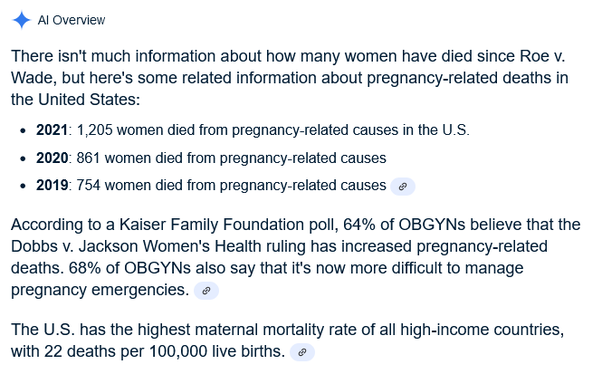
Your obsession with abortion is responsible for almost the number of lives lost on 9/11.
You’re worse than a terrorist because you behave as if you are protecting lives instead of destroying them and committing manslaughter with your depraved ignorance.
No one on the left is obsessed with abortions, but you already knew that. You want to wipe your hands clean of the evil that you and your ilk have been perpetuating… you know what you’re doing is wrong, and you’re having fun with it… and that’s what makes this question and you so inhumanly disgusting.

This post is a response to a question posed in its complete format: “I don’t want my jobs to be automated. What can I do? Will there be a chance to get it?”
Hi again Furquan. 🙂
You have asked me several questions on automation in the last few months, and I appreciate that you find value in my words. Thank you.
I have to say that it is essential to understand the automation revolution is inevitable and unstoppable.
The decisions for automation are being made not by us lowly citizens but by those who have the power to implement what they view as solutions to their needs — such as cutting back on labour costs.
The career one chooses for oneself does not matter to the ownership class because their perspective is based on what they are willing to pay to produce the revenue they seek for themselves.
This is the fundamental flaw of capitalism.
Capitalism, as it stands, has been permitted to flourish in ways that disregard the needs of the many in favour of the whims of the few. I say “permitted” because we have always had the power, as a people, to restrain corruption, but we have been mollified by messaging and the “luxurious” benefits of modern technologies.
We used to be much better at restraining greed, and our societies flourished. The ownership class, however, has invested hundreds of billions over the last half-century in lobbying the government, installing government puppets, and creating propaganda machines often referred to as “Think Tanks,” like the Heritage Foundation. Their goals are clear: to re-establish dynastic rule over the people. They made that abundantly clear when they released Project 2025 and issued a threat against anyone who resisted.
They have become so comfortable in their misanthropic regard for citizens that they no longer hide their agenda.
As individuals trying to navigate and survive the nightmare of this transformation into fully automated societies, we have two personal mandates to adopt.
The first mandate we have to ourselves is to equip ourselves with as much knowledge of the transformations as we are able. You have shown yourself eager and well underway on your first step by simply asking questions. The only way to anticipate the changes coming and avoid any potential disruptions to your life is by asking questions.
The second mandate we have for ourselves is to accept the fundamental premise of capitalism, which is that every human being is a business entity. We have no choice now because the era of life-long jobs and straight-up career ladders has vanished. That means even a stable job one is employed within today will be temporary, not necessarily by malice, but because the world is changing rapidly. The capitalist owners of that business also have to adapt to the changes or go bankrupt.
We are, in essence, in a surreal state of every person for themselves, and it’s taking a toll on us as individuals and creating cracks in the social contract.
This leads us to a second set of mandates we have to ourselves by serving our fellow citizens.
The first of these “community mandates” is to stand against lies and disinformation. Call out the lies and counter them with facts. Refuse to support individuals and institutions that disseminate lies. Take action, like boycotting Fox, and make your decision public. Let other people know there is a line to be drawn between decency and depravity in society that we must all be in solidarity with if we want to re-establish ourselves as humans worthy of the distinctions we revere when referring to our collective selves as “humanity.”
Greed is not good. Greed hurts us all, and we must support each other, or we will not survive the challenges ahead without great calamity and horrific losses of life that will scar whatever remains of humanity for whatever future may manifest for us as a species.
The second of these “community mandates” is to do what you can to support actions intended to restore decency. For example, I can do little with my resources beyond shooting my mouth off at every opportunity and creating memes to challenge the bullshit. I also actively sign petitions and help out in ways that are available to me.
Register with this organization — Change dot org — get on their list and peruse the many ways in which people are taking action worldwide:
The world’s platform for change

Choose from whatever causes matter to you and support them by signing a petition. If you can afford to donate even small amounts, that helps. Please don’t underestimate the power of a single voice when it comes together in harmony with millions.
Anyone can start up a petition on this site. If you have something that you specifically want people to support, such as protecting jobs in a particular industry or role — something tangible in which people can take action by speaking up, then you can contribute toward the issue of ongoing automation.
The third social mandate may be construed as primarily a personal bias. It is an inevitable necessity precisely because of automation and because capitalism forces us all to be capitalists on some level.
These three fundamental presumptions are what have led me to understand this fourth premise:
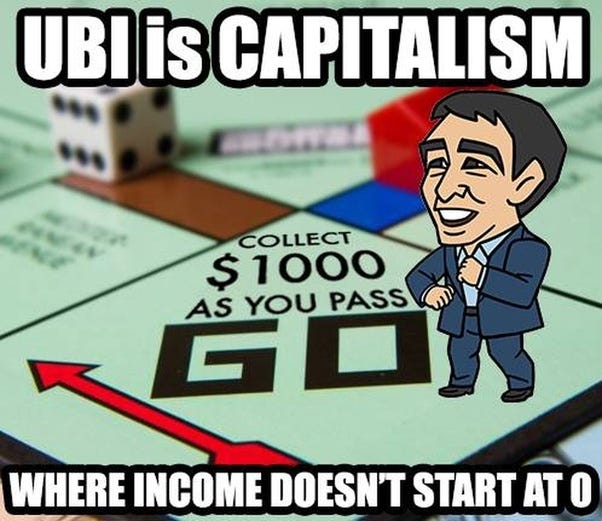

As I look back on my life and consider the thousands of hours spent on resume development and submitting tens of thousands of applications to employers that either mostly ignore and mistreat their applicants or allow the ignorance that defines many of the decision-makers among them to result in abominations like this:
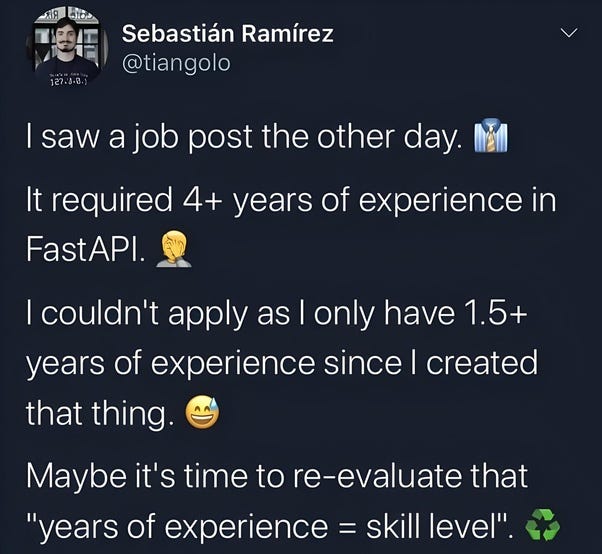
I think that this entire system is broken.
Had I not wasted so much time and energy trying to fit into a system that has largely rejected me, I would have had plenty of time to develop my skills and voice to carve out my unique place of success in this world and the capitalist system we operate within.
For all the benefits that capitalism proffers to society, what it robs from us as we are herded through dehumanizing machinery to be regarded as commodities is a horrendous evil and a blight on humanity.
For this reason, I welcome our transition to a fully automated society because at the end of this painful transition is the freedom to live our lives as we choose.
The only thing that’s missing right now from our global support to a universal basic income is the awareness and acknowledgement we need from the wealthy class that this is THE best solution for almost all of our social ills — and it is much more than simply a solution, it’s an opportunity for them to capitalize on the repressed ingenuity of billions of people worldwide.

Once they realize the amount of untapped potential within the human race, in which they are shortchanging themselves with a master/slave relationship as employers/employees, they will broadly endorse UBI. Sadly, many are too short-term focused to want anything more than the quick buck that Donald Trump and sociopathic exploiters among the ownership class embody.
None of them are capable of innovation. They are capable of parasitic forms of self-enrichment. Elon Musk has clearly shown us that material wealth is not derived from personal innovation but by bleeding the benefits of the innovations of others.
My suggestion for you, Furquan, is to not buy into the myth that you will need a job to ensure long-term security for yourself because that’s a lie. Your long-term security is guaranteed only by your skills, capacity to provide value (mainly through any innovations you can devise), and the community supporting your efforts.
There are many different ways to perceive one’s challenges, and in this case, it appears to me the best way to represent this and the challenges we face today are embodied with an ancient curse:


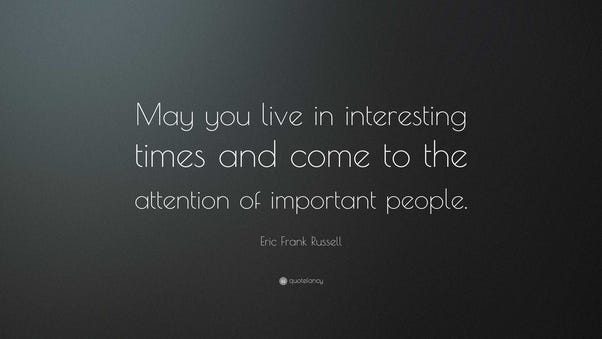
I wish you all the best of luck in your future during this exceptionally unique period in human history that we have had the “great fortune” of being born into.
Temet Nosce

Anyone wishing to engage in a dialogue on UBI is invited to participate in an open space on Quora dedicated to the issue. You may need to register for a Quora account — It’s free, and I don’t get any kickbacks from it. This space is intended purely for stimulating discussion on the topic — there are no hidden surprises beyond possibly needing to join Quora if you want to post comments. Visitors to the site can read the content without registration hassles.

This post is a response to a question posed in its complete format: “How do you deal with people who belittle you and try to sound like they’re smarter than Einstein?”
I think it’s important to separate how one feels about the language a person uses to communicate with others and their expressions of intent.
If one is being condescending, it’s generally quite clear in their word choices and the subject they focus on when conveying their thoughts.
In other words, instead of focusing on the subject, they focus on the person, which, in this case, would mean you.
In a communication dynamic, a person’s estimation of a relative degree of intelligence between oneself and the other results in a subjective interpretation of the other’s intent. In other words, when people feel insecure and conversing with someone whose language choices are intimidating, they can often misinterpret the other’s intent.
They may feel that person is choosing “big words” to puff themselves up when that’s not their intent. It would be a misinterpretation of another’s actions due to one’s insecurity. It is important to separate one’s feelings from the interaction to ensure one’s reading of the dynamic isn’t coloured by one’s biases.
They may not be condescendingly treating them and merely use language they are most comfortable with when attempting to communicate with someone else. (As someone who has been accused of using pretentious language myself, I appreciate the opportunity to explain how my language choices are primarily intuitive and from an attempt at being as accurate in my communications as possible. I cannot speak differently any more than I can change my vanishing hair. It’s just who I am. Every one of us has a natural style of communication that works for each of us, and it doesn’t mean you have to “read between the lines” to ascertain what I “really mean.” — This brings to mind a favourite song of mine by The Animals, “Don’t let me be misunderstood.” –
)
Often, a person isn’t “trying to sound like they’re smarter than Einstein” but instead chooses words they believe are the most accurate representations of their thoughts.
As mentioned above, their focus is the key to spotting the difference. If they focus their responses on you as a person while choosing obtuse language to try to confuse you, then you know they are being condescending.
It might help to know that when someone is condescending, they also convey their intimidation through the discussion. They may feel that the effort spent in communication is not worth their time, or their goal is to make themselves feel better at your expense. In such a case, you will know that whatever information they have to convey could be more credible.
A naturally intelligent and well-informed person is usually happy to share their insights with others in an agnostic manner — as long as the other party is respectful in their attitude.
You can see that everywhere here on Quora. Some brilliant people here patiently explain simple concepts in great detail because they want to share what they have learned. Sharing is caring in this context.
When a person behaves condescendingly, they’re not interested in sharing or caring about others and let that be known in many different ways, while condescension is just one.
Another example of disparagement is providing hints of insights and then turning the tables on the person they’re speaking to, informing them that they should know the rest, and filling in the conceptual gaps on their own. If they can’t, they imply something is wrong with their victim’s character.
If you are uncertain whether someone is condescending, the most effective strategy is playing dumb.
Seriously.
It may sound counter-intuitive, but it works as a strategy.
Straight up, ask them what they mean with a confused expression to make it clear you’re not following their words and piecing them together in a way that makes sense to you. Be sincere in wanting clarification, and that will allow them to reflect on their attitude.
By playing dumb, you can defuse their defence mechanisms. You can encourage them to re-evaluate their communications in ways where their internal defences are not on alert to bring out condescension as a dialectical weapon to (pre-emptively) defend themselves.
This means that condescension and abusive attitudes are generally all born of insecurity on their own, and they often occur through subconscious responses to the person they are interacting with.
That person may not realize they’ve been condescending or abusive, and playing dumb is like knocking the wind out of their defence sails.
If they can be assured you’re not a threat, they are forced to re-evaluate their communications and make an effort to focus on the subject at hand.
Ultimately, by playing dumb, you may gain their trust and develop a valuable pipeline to an insightful source of information.
If playing dumb doesn’t work, then you know their information isn’t worth the effort to parse. They’re too caught up in their egotism to share their insights and are best left alone.
I hope this helps.
Cheerz

This post is a response to a question initially posed on Quora, and can also be accessed via “https://murkywatersnarcissist.quora.com/What-can-you-do-if-your-husbands-sister-is-a-bully-4“
Thank you for the a2a, Jozefina.
I have to say, however, that I’m a little confused, not because Jenn wrote an excellent answer complete with all the steps to take in a strategic, deliberate, and rational process, but when I dug a little deeper beyond that, I found your answer to the question on the parent level.
“Cut all ties with her. Silence is the best revenge. Distance is the answer to disrespect.”
I have to say that’s a strategy that has worked but not worked for me. Creating distance between myself and those who cause me unnecessary or unwarranted stress has been my primary strategy in dealing with them.
I suspect the results of that strategy have been why you sought more answers from more people — to find some balance between the extreme of cutting contact and the often frustrating process endorsed by professionals who frequently fail to account for real-world dynamics.
Jenn’s answer is excellent from a strategic perspective. However, it’s a textbook approach that doesn’t adequately account for the extremes in behaviours that bullies can indulge in.
One of my complaints and why my strategy has echoed yours is due to my experience; not once has a bully made any effort to consider the impact of their toxic behaviours.
I have never asked anyone for anything beyond being treated fairly. I have used the following words verbatim, “Please just try to be a decent human being.” — “I’m just asking for fair treatment.” — “I just want the same thing everyone else gets and is entitled to.”
Whenever I appealed to a bully for fair treatment, it was interpreted as a challenge, followed by escalation. Not a single bully in my life has ever behaved in the manner that a counsellor anticipates in the scenarios they recommend.
I suspect you may have discovered something similar in your experience, and that’s why you answered this question the way you did. After reading some of the other responses and thinking about your experience, you may wonder if a different perspective can shed some light on this issue.
I don’t know if I can give you one that addresses your specific situation because I know nothing about it, but there certainly is a wide range of approaches that people can take. Some may work for them but not others because their dynamic is different. Their personalities are different. Their bullies are different.
There is no universal solution to addressing the issue of bullies, and I suspect that’s why it remains unresolved in society.
There are some common traits that bullies display, and it may be helpful to view one’s issue from the perspective of understanding bullies rather than from the perspective of a generic approach one should take.
For example, all bullies are cowards at heart. If one can strike fear into them, they will back off. Self-preservation is, ironically, one of the reasons they are bullies in the first place. They’re cowards because they’re afraid of everything. Finding someone they can intimidate helps them cope with their natural fears of everything.
The challenge, however, is to instil a genuine fear of repercussions they shudder to contemplate. It can’t be a temporary fear they experience that may or may not manifest but a guaranteed consequence that instills an intense fear that gives them chills.
That’s not always possible for some to accomplish and will never be feasible for many because they’re not built in a way or possess the character or leverage to do that. In many cases, the only real solution is distance. Use the grey rock method if one can’t avoid their bully. — (Essentially, this means avoiding conversations with them and giving them one-word answers while concocting an excuse for why you have to leave. Display no emotion whatsoever because bullies like to trigger emotions in their victims. Be utterly disinterested in what they have to say. If they’re upset by that, apologize for being distracted. You’ve got a lot on your mind. If they ask what it is, answer them that it’s private. Shut down any attempt at a conversation and try to display being bored rather than anxious.)
Distance is the best solution in many cases — emotional distance if you can’t succeed at maintaining physical distance.
That may not work in some situations, especially if it’s a work situation and the bully is the boss. The grey rock method, in that case, will work.
You may now see a pattern in that negotiation is only possible with some leverage in your favour.
If your situation is precisely like the question, then it is incumbent upon your husband to “run interference” with his sister. He needs to keep her away from you, put his foot down, and inform her that he doesn’t appreciate having his wife intimidated. Doing that is an implied marital obligation. He married you, and if his sister makes it a choice between you or her, then he had better choose you, or you know what your choices are then because he’s not much of a partner if he won’t defend you to his sister and shut her down.
She must treat you with respect if she has any respect for her brother, your husband.
This dynamic may not work if your husband is desperate to keep the peace in a dysfunctional family or is the family scapegoat. You may find yourself having to draw firm boundaries with your husband and put him in a position to choose between you, his sister, and his entire family.
It won’t feel fair to him if he’s pushed into doing that, and giving him an ultimatum could very well backfire, making you look like the bully in the dynamic.
The challenging part of this situation is that you will find it increasingly difficult to maintain respect for your husband, and your relationship will fracture over time.
Perhaps you’ve discovered this and are seeking more input on this issue.
It will be vital for him to understand that you will feel undervalued if he doesn’t intervene in addressing his sister’s behaviour. That may or may not be sufficient to motivate him, but it might open his mind to the possibility that you two can work together to devise a solution that works for both of you.
The most crucial goal within such a dynamic is to have a partner you can work with and rely on for supportive advice and assistance without being dismissive or critical of you or your feelings. Your relationship with your husband matters, and by working together against “a common enemy,” you may strengthen your relationship. You will undoubtedly have a better chance of dealing with his toxic sister.
It may be necessary to work through your issues with the assistance of a counsellor, and it will be essential for him to understand if you offer to go to one as a suggestion, that it’s not to be critical of him but to find a way to work together to resolve the issues his sister creates.
I hope this helps.
Good luck with your challenge.
Bullies suck.
Big time.

This post is a response to a question initially posed on Quora, and can also be accessed via “https://www.quora.com/Should-an-artist-have-a-day-job/answer/Antonio-Amaral-1“
An artist has more justification for surviving on their activity in society than most any other vocation.
Setting aside the mechanics of bias and economic pragmatism, the reality is that almost no other general field of employment engages the producers in their field the way art production does.
IOW. Almost no other field, in and of itself, engages people to eat, think, and breathe their work 24/7/365 as the arts do.
Sure, there are individuals within almost every profession who are as dedicated to succeeding in their chosen career. Most, however, are not interested in their activities for the sake of the activity itself.
For example, someone like Elon Musk developed a reputation early for being a workaholic. His motivation, however, was never the work itself but the material benefits he would derive from it. Many, if not most, executive-level people work at least 60 hours per week — which defines the word “work” rather loosely by contrast because “work” essentially involves social interaction. Both worlds of work and socialization are combined into one.
That’s not the case with artists unless one is a musician in a band, dancer, actor, or performer — an artist who produces their product as part of a group or troupe.
Visual artists, writers, and sculptors generally work alone and in isolation from the world — which works for that personality type. There are many more introverts in the world than many extroverts believe is the case. Writing code is another activity that demands solitude to be productive, for example, and this transformation into an information technology economy has been a boon for many.
Since writing code can also be considered an activity that produces creative output — such as designing and developing apps and sites — it can also be a vocation in which one receives their recompense on the result of their efforts within the products they create.
However, this also reinforces my point because many app designers/developers also live in poverty. The corporate machinery employs those who have become disengaged from the creative process in coding to such a degree that their motivation is job security, not creative output.
Artists should be free to create because the value of the arts to society is core to our humanity. One cannot master their artistic skills if they have to work at a job that chews up most of their time. Creativity requires as much dedicated focus as any profession and arguably provides more lasting value to society than most functional robot roles within dehumanizing institutions.
The issue is not “should an artist have a day job?” because most artists do many different things to survive and fit as much time for art as they can in between. The lucky few develop enough of a body of work to create opportunities to survive on their creative output alone but without any accompanying wealth. Most adjust well to poverty if they can concentrate on creative production full-time.
The attitude in this question is troublesome because it represents an unfortunately common toxic attitude of people who disrespect the arts on a fundamental level with an attitude that they should enjoy the arts for free. They want their cake and to eat it, too.
This is the second question I’ve seen posted on Quora within the last couple of weeks, which seeks to disparage the arts with a sociopathic disdain for the vocation. It’s an attitude that every artist endures throughout their life… and struggle with the disgusting mistreatment of people who are okay with benefitting from the artistic product but hate paying for it.
In my case, it’s very personal because I’m in the middle of a lawsuit against my own family for stealing work of mine and benefitting from it for decades while, if they had compensated me fair market value for it ten years ago, I would have recovered from an assault on my life. Instead, they chose to hire a crooked lawyer who has aided and abetted them in their crime while counselling them to commit perjury and deny me my lawful payment.
My attitude towards people who display such disgusting disrespect for the arts has evolved to become very unpleasant to deal with as a consequence of sustained encounters.
In my youth, when I was more able to respond to such sociopathic depravity with some humour, I would say that despite what is said about “that other profession,” the arts are the oldest profession.
After all, without the creative vision inherent within all of us as thinking and emoting human beings, we’d still be hanging out in caves.
Oh… and for the record (I’m not going put any effort into digging up this particular stat, but I will undervalue what I remember about it), for every dollar invested in the arts, society benefits by two dollars. Insofar as government investments go, it’s at the top of the list of best investments. Why do you think the wealthy class begins storing their value in artwork once they’ve reached a threshold of wealth where they need to put their money somewhere? Where better to put one’s money than in a 10 million dollar painting by Robert Rauschenberg that is guaranteed to be worth twenty within a decade?

This post is a response to a question initially posed on Quora, and can also be accessed via “https://www.quora.com/Nowadays-is-it-harder-to-get-work-than-it-used-to-be/answer/Antonio-Amaral-1“
Yes, because the entire market and the processes for hiring have been dumbed down to a series of checkboxes applied to humans in ways that devalue their experience and expertise to meet psychopathic parameters, allowing hiring personnel to envision unicorns while fixated on checkboxes and ignoring the human beings they’re evaluating for roles they don’t understand or care about.
No one seems willing or capable of hiring humans since they prefer hiring aesthetic packages they expect will meet the minimum requirements to function like a robot without agency or capacity for judgments outside parameters established by misanthropes with money who have no clue what they’re looking for and have no respect for what individuals are capable of offering.
Fewer and fewer people are willing to tolerate life as a robot, even if it means food insecurity, because at the end of one’s life, existence is not enough, and to destroy the ineffable character of one’s life to submit to a role to discover at the end of all that effort that rewards are less than meagre is just not worth perpetuating a parasitic system.
This is why “quiet quitting” has become a thing. This is why people are complaining that no one wants to work.
Of course, no one wants to “work” — sublimate themselves to a robotic existence that dehumanizes everything about them to maintain an unfulfilling and crushing existence.
People would otherwise throw themselves into their work if it brought them the value it promises.
Decades of these bait-and-switch manipulations of people can only naturally result in the wholesale rejection of a corrupt paradigm.
Capitalists should have taken more time to consider the benefits of destroying a working class that worked to elevate their lifestyles into the stratosphere before cutting them down to find themselves plummeting to their doom. They’re just getting what they wanted without realizing they didn’t want what they thought they wanted.
 thotbag