This post is a response to a question posed in its complete format: “Why is there so much misogyny or misandry online? Is it because of the internet being filled with socially outcasted people?”
What you see online doesn’t exist because of the Internet. It has always existed as “normal” and without being challenged throughout society.
Imagine what the Internet would be like if it existed before the Civil Rights movement. There would be “Whites Only” and “ Coloureds Only” websites. Facebook would be racially segregated, and so would genders. Any woman visiting an auto servicing site would be banned. They would be allowed only at sites that promoted the expectation of their role of being barefoot and pregnant in the kitchen. People would be penalized for visiting sites that violated segregation laws, and all those “wonderful sensibilities” from yore would permeate the virtual world in far greater degrees of hatred and bigotry than we see now… because they would be considered acceptable by the majority.
The virtual world has only allowed those “old sentiments” that we have deluded ourselves into believing we have grown past to remind us they still exist. They’re just not considered acceptable by the mainstream.
That’s why those attitudes stand out.
The upside, however, is that we can and do push back on that toxicity while social media enables us to talk about it directly.
We can confront racists and bigots directly now when, in real life, we would bite our tongues and walk away to let them believe there’s nothing wrong with them or their attitudes.
Complaining about the prevalence of such ugliness results from a naive view of the world and a Disneyesque vision of humanity through rose-coloured glasses.
In real life, you can associate with people you agree with and avoid those you find toxic, but it’s not easy to do online.
That’s a good thing because pretending this horror doesn’t exist is how it continues.
Over 5 billion people are online, so you can’t single out portions of the population you don’t like and pretend the Internet is a magnet for a small subsection of humanity. These attitudes are prevalent everywhere.
The online world is the only safe space to resolve them. We would otherwise find ourselves either trying to ignore them to let them metastasize and grow worse or joining along because of being pressured into it, like being pushed into a cult for fear of one’s life.
Use your voice online and speak out against the ugliness. Challenge the bigots you encounter. Make them accountable for their hatreds.
That’s the only way to deal with the horror. That’s the only way to make our species heal.
You have an obligation to yourself, your sanity, and the future of our species now that you have been empowered with a platform to fight back against what’s broken with humanity. If we don’t, we won’t have a human civilization by the end of this century. We’ll have a shattered smattering of primitive tribes struggling to survive a planet that has become hostile to human life.
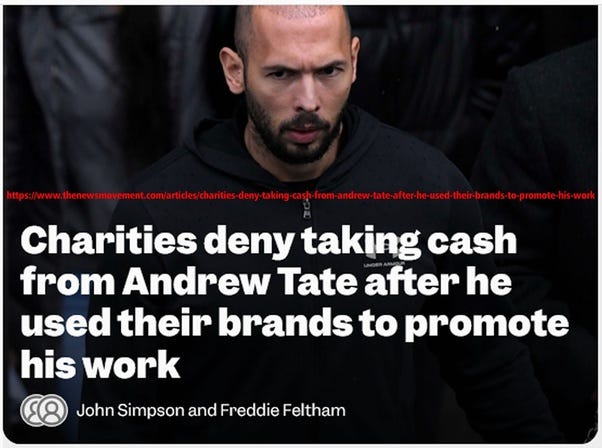
I had to double-take on this question. “Tate Pledge”? … WTF? Is this a reference to Andrew Tate? Sure enough… it is!
Holy 30 Pieces of Silver, Batman!!!
I want to ignore this question from this querent because I already feel slimy. However, I think it would be a disservice to those who still can’t understand the difference between an authentic human being and the lowest of predatory and parasitic scum.
It breaks my heart that people can see this:
… and yet, NOT see it for what it is.
The branding alone screams it’s a scam. For someone desperate to repair their reputation on the level of optics, even if he doesn’t care about substance, he’s being quite moronic to dress up like a pimp-gangster and peddle himself as a caring member of a community he earnestly wishes to contribute positively toward.
Take a moment to reflect upon the title, “The Pledge of the Tate.” That’s like someone speaking about themselves in the third person while elevating their image of that person to mythical status. He’s not “just Andrew Tate,” one of the dozens of other “Andrew Tates on the planet,” but “THE TATE.” There is no need for “Andrew” because that softens the hammer of the single vowel “TATE” a bit too much for his ego to consider it worthy of inclusion in his pledge title. He is a legend in his imagination — even after being busted for sex trafficking — for dehumanizing women as vessels for his amusement.
This egotistically bloated idiot is so full of himself that he has no clue that his presentation already turns off anyone who isn’t a naive gumba incel with machismo wannabe fantasies.
What’s worse is the amount of digging to determine the legitimacy of this scam requires a whole bunch of seconds that almost add up to one full minute of research effort to dig up how much he’s willing to sink into the depths of inhuman psychopathy.
Since you asked me what I think of this, then this is what I think of this:
These are examples of psychopathic predators in our society whose aspirations for justifying their pampered existence rely on the parasitic strategy of bottom-feeding by preying on the naive sentiments of the most vulnerable in society.
These monsters should be rotting behind bars, not roaming free to wreak more havoc while destroying lives in their wake.
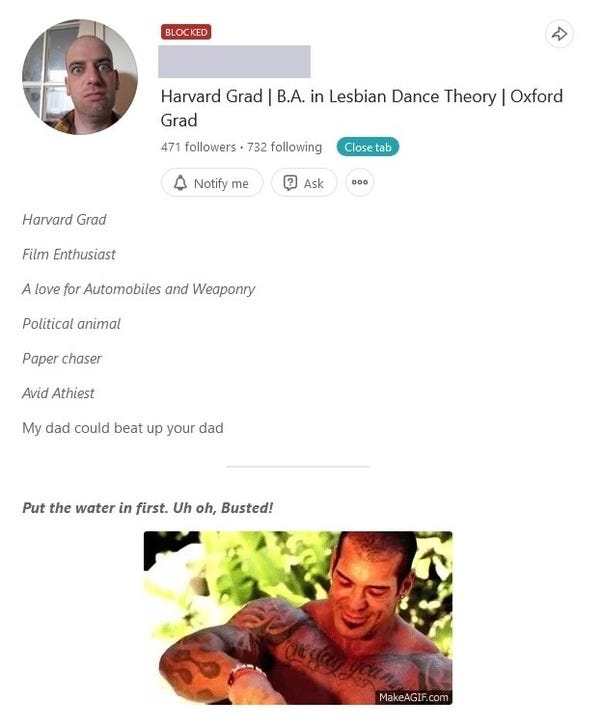
After having a look at your profile, Keith, it seems rather clear from a cursory glance why you might be interested in following the antics of a disgusting example of the worst of humanity, but that’s because you present yourself as someone desperate to assert your individuality without actually developing the critical thinking skills to understand what that means enough to make it manifest.
You seem drawn toward stereotypes of masculinity to promote your image, and I’m sure that works within a limited demographic, but that’s also why you’re doomed to perpetual bottom-feeding for the rest of your life.
This mindset is built upon the cynical quicksand of a misanthropic take on fellow humans with whom one wishes to engage in a profit-generating venture. There is no motivation for a real connection being sought, nor solutions or assistance offered that benefits others. It’s an egocentric view of the world that regards relationships as forgettably transactional on the most superficial levels: “Pay attention to meeeee!!!! — and give me money while you’re at it.”
This leads me to one of my biggest complaints with our currently toxic and religious-like fervour of regard toward the economic system we call “Capitalism.”
Our capitalist system of today breeds misanthropy in a race to the bottom while celebrating the most superficial of parasitic characteristics of humanity.
We were warned at the outset by great thinkers from history that we would be struggling through the late stages of a corrupted system and have now arrived at their predicted destination.
What we once championed as the fertile ground of innovation has become a stale mockery within a puerile homogeneity.
What matters is expedience over substance. The why of what we do with our lives has been distilled into achieving above minimal survival at the expense of relationship depth and community.
The sad consequence of prioritizing expedience over substance is that we breed out the requisite sensitivities toward nuance that would immediately understand that orange abomination of a homepage with Rush Limpballs overtones is a front for yet another scam by an, at best, ethically challenged sociopath.
Lacking the cultivated sensitivity required to interpret nuance correctly exposes people to con artists who capitalize on personal insecurities that have been conditioned to revere toxic role models in a sub-culture characterized by Stockholm Syndrome cases.
The odds are excellent that anyone who can interpret anything positive within the embodiment of toxic masculinity has been a victim of it their entire lives and was broken by it in childhood.
Your profile screams that you’ve been more of a victim of it than a perpetrator, but you can’t seem to extricate yourself from this toxic cognitive prison. I can see that you believe humour is how you view your access to success, and I commend you for trying to be charismatic in such a way.
Making an impression in this world is tough, primarily if one seeks to be liked, if not admired. We need that kind of reinforcement to survive. It’s an essential component within Maslow’s Hierarchy of Needs.
Belongingness is right up there and wedged between basic physical and psychological survival. The trouble is the choice of role models one makes in one’s efforts to achieve what one aspires to.
It’s easy to see from your profile that you’re not a troll so broken as to define your existence through childish provocation, and I suppose that’s why I felt compelled to provide an in-depth answer to your question. You seem to be trying, and you deserve credit for that.
Questions like this one I’ve been answering and this one below:
…indicate to me that you’re picking your ideas from sources who are, at best, kludges, who cannot help but become toxic influences in your thinking processes. I’m not going to advocate dropping these idiots from your radar because you need to understand better where they’re coming from so that you can better triangulate your position in society. I highly recommend expanding your horizons by adding more nuanced and evolved thinkers to your information consumption efforts.
It’s easy to see by the rest of your questions that you have a sincere curiosity about the world and are not obsessed with toxic role models. I suppose that’s what gives me hope that you will rise above being swayed by or taken in by despicable monsters who present a fraudulent image of themselves to appeal to a toxic set of presumptions about personal identity that were cultivated within you by a dysfunctional society.
I wish you all the best of luck in your journey through this madhouse. I hope you improve your abilities to discern between substance and fraudulence while continuing to challenge yourself to rise above the antics of superficial idiots.
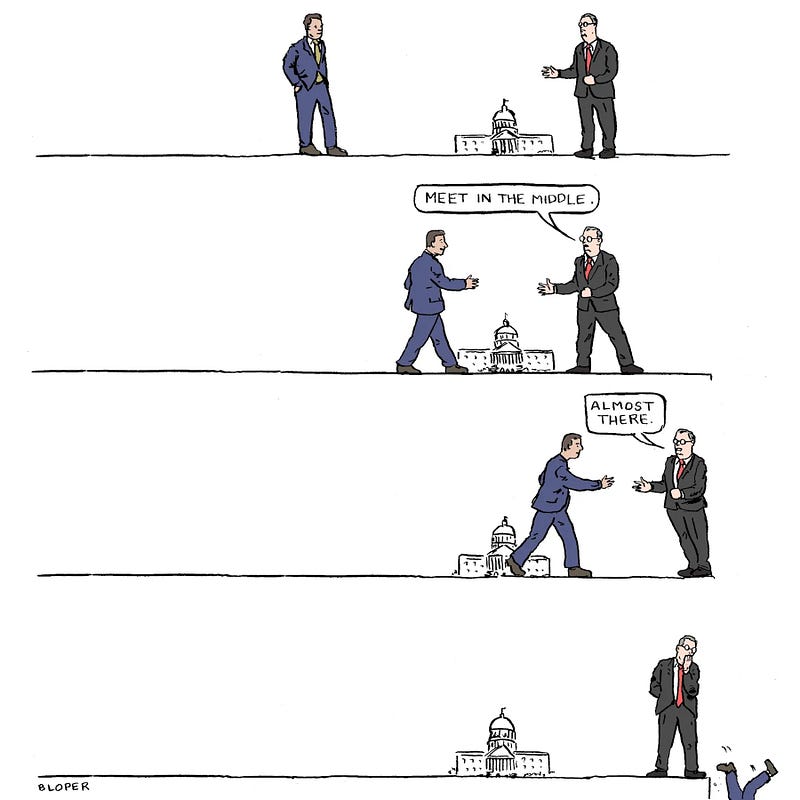
You’ve been watching it in action for a couple of decades now.
Whatever one party initiates, the other dismantles.
The fine arts of negotiation and compromise no longer exist because one party views that as submission while the other regards that zero-sum game attitude toward cooperation as toxic and prone to counterproductive and even destructive initiatives that create problems without solving any.
For example, there is no rational justification for abortion restrictions. The entire issue is a non-issue stoked up to an irrationally unhinged fervour based on two misanthropic lies, that abortions are a lazy excuse for birth control by whores, and that they are acts of murdering babies. Neither perception resembles anything remotely true or anywhere near accurate renditions of reality.
They are lies stoked for the simple reason of creating political alignments on the vector of hating one’s fellow citizens. Since about 80% of the population is against abortion legislation, it’s been hijacked by the tyranny of a minority and leveraged as a power grab for a political party. The overblown abortion issue is a political wedge and a fundamental betrayal of a democratic system. This would not be possible in a multiparty system.
A two-party system is a recipe for conflict. In contrast, multiparty systems have been denigrated as being incapable of progress. The reality is that multiparty systems encourage negotiation and compromise among varying ideologies that more accurately reflect the expressions of individual beliefs than the aggregated pools of power occurring within a duopoly.
Another major disadvantage of a two-party system is that it limits the spread of investments the ownership class requires while choosing campaigns to finance. It’s a win-win system for them because it’s the cheapest way to hedge their bets. They can’t afford to spread their campaign investments to many parties in a multiparty system. So, their influence in politics is significantly diluted, and the will of the people is much more accurately represented by the diversity of ideological voices in Congress.
A further, much more subtle, and arguably the most profound impact on society is the homogenization of public thinking through aggregating issues into bundles. All nuance is bred out of each issue as it becomes incorporated into a party package to be accepted wholesale — like a cable deal where you can’t opt for individual strategies or solutions. It’s an all-or-nothing approach to addressing political issues that pressures the electorate to reduce the political process to the level of cheering for one’s party, like a sports team.
A two-party system cannot but lead a nation toward escalating internal strife as party positions become increasingly polarized. One party may successfully drag the other party into its ideology. However, that flexibility and willingness to accommodate the other can only go so far before the opposing party must run backwards in the opposite direction. That’s where the DNC is now, after decades of capitulating to a fascist rightwing leadership banking the complete corruption of a democratic system on the corruptibility of their opposition.
I remember someone I once trusted approaching me for relationship advice.
I don’t remember the specific complaints registered against him by his then-recent ex, but I remember how he tried to convince her that he had changed overnight.
The next day after she ended her relationship, he returned to her and claimed he had changed.
After relating that to me, I tried to explain to him that’s not how change works. One doesn’t change oneself like they change their clothes, most certainly not overnight.
That wasn’t my best approach to helping him overcome his anxiety. He outright rejected what I tried to get him to understand. I believe that was the last conversation he and I ever had.
However, His attitude toward change stuck with me as I struggled to understand that thinking. I thought of it as chillingly superficial and worse as it appears to be an attitude which fits within the mindset that justifies telling people what they want to hear.
Everything about how a certain mindset perceives the world around them is based entirely on optics, and their behaviours are mere performances designed to elicit desired responses from their audience.
It left me feeling cold, and I’ve learned to understand how severe a red flag that is. I wish I hadn’t been such a slow learner in this regard because I could have saved myself a world of hurt if I had fully considered the implications of that behaviour then.
At any rate, the notion of undergoing a transformative experience had always intrigued me as I deliberately sought paths and methodologies for transcending limiting ways of being. From a very young age, I was aware that I was conditioned into being what I conceptually rejected but required something tangible to transform my desire for change into actual change.
Symbolically, the notion of being “reborn” is a ritualized performance in which people present themselves as if they had changed from committing to a belief system and being “remade” by that commitment itself.
People who have undergone such a ritual sincerely think they have transformed into a better version of themselves. Their exclamations, however, have more often been expressions of hopeful anticipation rather than observable reality.
Their subsequent behaviours and fundamental attitudes remain the same. From an outsider’s perspective, the only change visible was the compass setting they prioritized.
Although some stick with their new compass setting over the long haul, many returned to being who they always were while dismissing a temporary compass setting as one they outgrew and was no longer relevant to them.
Some remained within their faith but regarded it with their “old eyes” and treated their entire relationship with their beliefs and community as a game of optics. Others moved on as they acknowledged their experience as helpful but not enough to commit to it for a lifetime. I found this latter group more authentic in their journey of discovery. The clarity of direction or need they expressed as they described their choices through fogs of confusion they struggled to dispel always made them feel more human to me. In contrast, I found those who appeared to skim through emotional turmoil somewhat confusing. I didn’t know how to interpret their responses to emotional struggles. I must have envied them as I could never respond to my own in similar ways and often wished I could have. It seemed to make life easier for them.
These “performers at life” always made me feel cold, though, and it’s taken me a long time to understand why.
Understanding how a proportion of our population lives through a shallow lens may be conceptually easy to grasp superficially, but that’s not a satisfying apprehension of the phenomenon. One inevitably finds oneself mystified by its manifestations while wondering why they feel put off in ways they don’t quite understand. It can be a harrowing journey to fully grasp the implications of such a life on a visceral level for those whose feelings run deep.
Another example was an individual who had been married for about six years and who I had gotten to know as a close couple who seemingly shared everything. Conversations with either always involved extolling the virtues of the other and never was an unkind or critical word shared. I thought they were a remarkable example of a successful couple until the husband informed me they were getting divorced.
Their separation appeared as if life sped forward at super-speed for them because it all took place within a couple of weeks — from agreement to the formalized documentation of divorce. There was no emotional turmoil I could detect in the husband, as the ex-wife had already left, and I had no means of gauging her condition. In his case, however, I was more shocked at his ability to move on than I was at their separation.
For him, it was as if nothing of note had happened in his life. I couldn’t fathom that, particularly after having endured my periods of extended angst over far shorter and more superficial commitments. I remember envying his ability to rebound from what would have been at least a year or two of turmoil for me.
I didn’t realize until later that his personality was characterized by subtle paranoia and mistrust toward others on mostly innocuous levels. I first noticed that aspect of his character after he described a business venture I found myself intrigued by and expressed how much I liked it. His response became immediately cold and protective of it. He clarified that I had no place in his venture even though I had not expressed such desire or intent.
I remember switching the conversation at that point and inquiring about his ex-wife, and I was curious to know if she was doing well. His response was mainly dismissive, but he let the cat out of the bag by indicating that the reason for their divorce was his unfaithfulness.
The ability to move on quickly from a profoundly emotional experience had often been a source of admiration for me. That was before I understood the costs of such a state of being — to both themselves and those they inevitably victimize.
I don’t think he was ever capable of connecting deeply with anyone, and I didn’t understand, even then, how profound that was. I knew it was essential for me, and I accepted how that might not be for others. I didn’t think of it as a toxic dysfunctionality — even though I should have known better after having experienced it with many others so often throughout my life.
From a ritualistic perspective, there can be some benefit to undergoing a formalized process that symbolically represents change and, more importantly, a desire for change. However, it’s all done for optics more than acknowledging the necessity of change and its role in one’s personal growth.
I always have felt this way, but I never understood how that attitude itself, on my behalf, was present even as a child when I underwent my first confession. It wasn’t conducted in a booth but in an empty classroom on a chair across from the minister. We were in full view of each other without obstruction, and he asked me to speak.
I struggled to find words while suppressing a broad smile as I found the experience entirely superficial. After all, how could I possibly be exonerated of guilt over actions I may have taken that were considered sinful by simply uttering them to this stranger? At the age of eleven, the most egregious sin I could think of was masturbation, and I suppose that might have been why I struggled to suppress a broad smile.
Within a belief system that purports to provide adherents with pathways for growth, I can understand and support the prescriptive manner of formalizing rituals to celebrate that growth. The shortfall in converting subjective experience into an objectively procedural system is that it fails to account for individual differences. It is a process that cannot account for or mitigate abusive misuse.
Much like the reporting systems across all social media, the symbolic ritual of change is a tool that can be weaponized for personal gain. The emphasis on optics is a form of corrupt thinking which overlooks the critically ineffable in favour of supporting shallow expedience.
The concept of “being born again” is just a formalized process of stripping profundity from life in favour of optics because we do not, as a whole, value depth in a world that has industrialized human existence and reduced the human condition to the level of a disposable commodity.
We have evolved into an increasingly dehumanized existence while being led by institutions that claim to represent higher states of being. Our only hope for reclaiming our existence as human beings capable of achieving our potential is completing our transformation into a fully automated society. It will only be once we cross this threshold that human beings will be free of the superficial trappings of optics made necessary by the industrialized herding of our species. The function of symbolic optics is an inherent limit to our potential as individual beings within what we refer to as “civilized society.”
I believe the concept of “being born again” should be viewed with great suspicion and mistrust because it reflects nothing of an individual’s inner world or the foundation of their character.
It can, however, be a practical means of applying a metric for identifying differences between that standard and one’s words and deeds to triangulate a more accurate picture of one’s internal world.
“Humanity” is from the late 14th century and derived from the Latin word “humanitatem” or “humanitas” for “human nature, humankind, life on Earth, the human race, mankind,” and Old French “humanité, umanité.” “Humanity” includes all humans but can also refer to the feelings of “kindness, graciousness, politeness, consideration for others,” which humans often have for each other.
Variations of the term, such as the adjective “humane,” which arose in the mid-15th century, refer to the ineffable qualities of being human rather than the physical characteristics of human existence. By the early 18th century, it evolved from meaning “courteous, friendly, civil, and obliging” into “tenderness, compassion, and a disposition to treat others kindly” and evoke “kindness” within the sphere of the human condition.
By the 1700s, the plural of humanity — “humanities” was adopted as a description of the study of “human culture” through the literature branches of rhetoric and poetry and from a secular perspective rather than religious via “literae divinae.”
“Humanism” emerged from that evolution in meaning from the Latin “humanitas” or “education benefitting a cultivated man” while supporting the notion of humanity as symbolic of the best qualities of our species.
Much of this evolution in meaning is derived from a history stretching long before prehistory to a time when our survival as a species was contingent upon working together to feed and clothe ourselves as we hunted in packs.
Successful interdependence requires supporting one another; thus, empathy was given rich soil to grow.
I suspect, however, that none of this constitutes new information for you even though your question misses the point altogether — and to such a degree it screams severe psychopathy, even as an entertainment-seeking provocation.
From initially reading it in my notifications for questions I’ve been asked to answer, my first thought was that it’s an apparent provocation from a misanthrope and most likely a troll. What I discovered upon encountering your profile is something far more insidious.
Let’s begin with the presumption in this question, “Why should I feel it?” etcetera.
There is no “should” in that you are not “obligated to feel” anything. That’s not how emotions work. You appear somewhat educated — or at least literate — based on the number of publications you’ve written and have posted on Amazon.
Somehow, though, a fundamental comprehension of oneself as an “intelligent” member of an interdependent species escapes your notice. You rely on others to feed, clothe, and house yourself through literary endeavours and can’t acknowledge how you already “feel it, need it, and want it.”
Even this provocation attempts to cater to those basic needs by identifying people who can respond in ways that support egotistically defined goals.
Most literate people develop a basic comprehension of emotions and the atavistic precursors making them manifest. On my behalf, this could be a flawed presumption, but I’m pretty sure you’re no stranger to “darker” emotions such as fear and anger, and you have no misapprehension about their manifestations within you. The sarcasm in your writing indicates your preference for wallowing in those emotions and is consistent with the attitude displayed within your provocation disguised as a question.
The problem you struggle with is that you hate your interdependence and deny that it exists within you — most likely due to having found yourself disappointed and hurt repeatedly by people who failed to live up to your expectations from a very young age.
Sadly, in a world where a whopping majority 70%-80% of the population is raised within a dysfunctional family unit, your experience is far from being a minority. Unlike some lucky few who can cope with their pain to the degree that can transcend it on levels that allow them to minimize the transmission of a toxic mentality characterized by misanthropy, you have chosen to embrace the cynical view that humanity is beyond hope.
Whether or not that’s true is irrelevant to me because my biased perspective shudders at the prospect of living in a world where one broadly hates all of humanity to such a degree they fail to see or experience the gestalt of existence within each of us.
To live a life without comprehending the value of joy is the equivalent of living a life deprived of meaning. It’s like a walking death. Even if one’s life circumstances necessitate a deprivation of joy, knowing it exists can often be enough to overcome the most painful hurdles.
Even the briefest taste of love in a fleeting life characterized by its absence or a prevalence of fraudulent forms of love is enough to sustain one’s spirit for a lifetime.
That’s the power of living on the side of light those who wallow in the dark fail to comprehend.
Once one understands that power, one no longer feels pushed into seeking something out of conceptual reasons but from an atavistic need to partake in as much as one can, like struggling for breath while deprived of oxygen because of a plastic bag covering one’s head.
Sadly, you’ve never tasted it, or you would know why you are drawn to it while feigning a disinterested rejection. As much as your ploy may feel like a shield protecting you from further disappointment, it’s a cry for help heard echoing its way around the world, crying out in pain.
If nothing else, in your case, it merely reveals you as a product of a wholly dysfunctional era in which we exist today as a species suffering from generation upon generation of transmissible trauma.
In other words, you asked this question because, on some level, you realize your struggle. Although it may be easy to peg you as a statistic identified as part of “the one in five” visible sufferers of a mental health condition in society, you’re not. Instead, the psychopathic dysphoria you struggle with is made invisible by its type of dysfunctionality and how it fits within the accepted definition of a psychologically well-adjusted individual within a maladaptive system (by which I mean our environment and economies are not suitable for cultivating the best of humanity).
As unhealthy as your expressions are, their implications exist outside the boundaries of what the psychological sciences deem unhealthy because you seem capable of functioning at a high enough level to adapt to the rigours of your day. In my view and statistically speaking, of the remaining four in five who do not display visible signs of an inability to adapt, three of those four are still victims suffering from degrees of stress that remain invisible to a triage mentality characterizing the state of our species today.
Your wallowing in cynicism is not your fault. You’re a victim of an entirely dysfunctional world. You happen to be smarter than the average bear, making a positive adaptation to a broken world much harder.
If you’re lucky and can make yourself willing and available to receive the cream of humanity, you’ll feel the answer you seek that words alone cannot give you.
Out of curiosity, do you not find it odd that Donald Trump is focused on this issue?
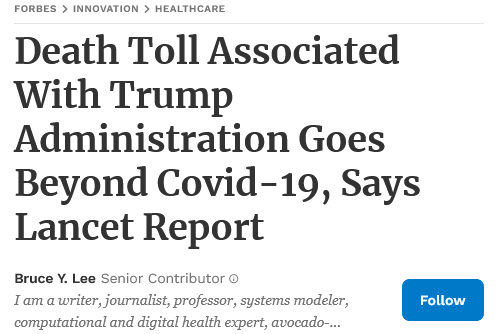
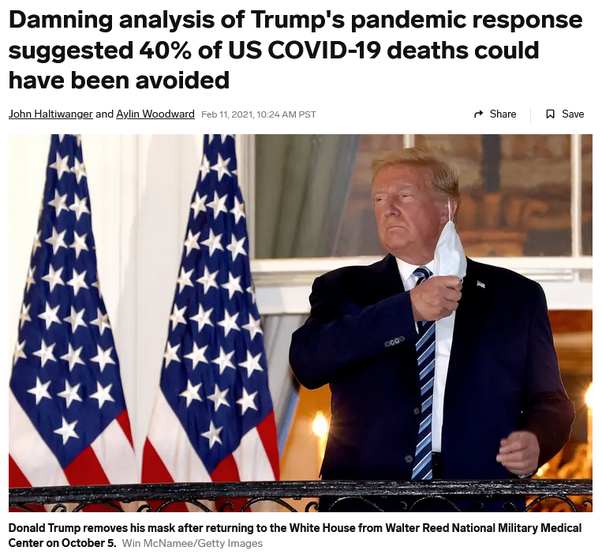
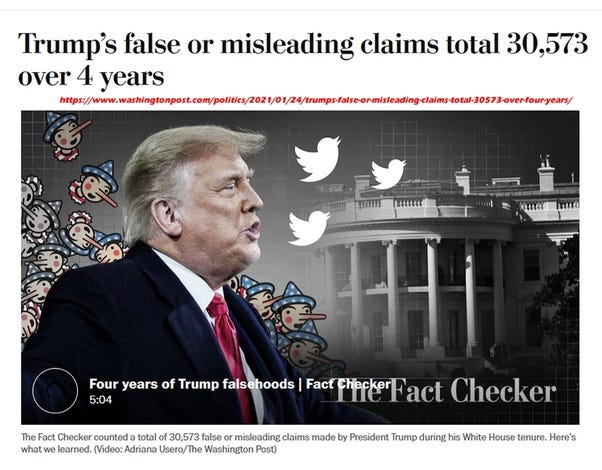
He is someone who has become well-known for breaking records for lying about so many things, ranging from relatively benign self-aggrandizement to malignant acts of manslaughter during a pandemic while encouraging people to dismiss the severity of a virus that killed millions worldwide.
His lies while in office killed hundreds of thousands of people, while his continued lies threaten even more lives.
Stack all of this up with one statement Kamala Harris has made about her experience as a teenager — a widespread experience for teenagers everywhere. A LOT of teenagers enter the world of work through the fast food industry. (Full disclosure — I worked for two years in a McDonalds restaurant from 15–16.)
It’s beyond a common experience and is the kind of experience that contributes absolutely nothing political toward one’s future beyond whatever one learns from the experience and money one earns. It may open some doors to other employment as a youth or young adult, but it contributes almost nothing tangible toward a long-term professional career — much less to politics.
Her claim is a one-off comment that shows how she can connect with average people living average lives. That’s about the extent of the impact that claim has.
“I’m normal. I’m like almost everyone else. I’m not weird like some people are.”
That’s the extent of the impact of her statement.
Meanwhile, Donald Trump tries to capitalize on his doubt that she had a “normal upbringing” without the privilege he’s benefited from his birth lottery. Nothing about her somewhat average background is a mystery to the public. Still, somehow, she’s being challenged, not only by Trump on this claim but also by his army of supporters who somehow believe this invalidates her candidacy.
Meanwhile, he tries to pass off a lie that he cares about ordinary, working-class people while selling cheap running shoes at horribly inflated prices or $100,000.00 watches that his contract says he has no obligation to deliver on. How exactly does that serve ordinary, working-class people? It doesn’t. It’s a money laundering scheme in which his buddy Vladimir can dump millions into his campaign war chest without tracing his collusion back to an enemy nation.
How exactly does the claim by Kamala Harris, even if it were a lie, stack up with lies told by a lifelong grifter hated by so many people worldwide for his destructive behaviour that he has stacked up a record number of lawsuits against him?
He brags about ripping people off, and somehow, people want to believe that Kamala Harris’ claim of working at McDonald’s as a teenager is enough to disqualify her as a candidate for a job in which the current administration she has been a part of has shown itself beyond capable of fixing the mess that Donald Trump left behind that will take decades to repair.
Ask yourself why people would care even if she did lie. It isn’t because such a lie is something they can’t tolerate because they tolerate life-destroying lies, so why would a benign lie like this matter in the least to people?
The problem here has nothing to do with Kamala Harris and everything to do with people who pretend to be patriots while behaving in the most treasonously hateful manner toward their fellow citizens every day.
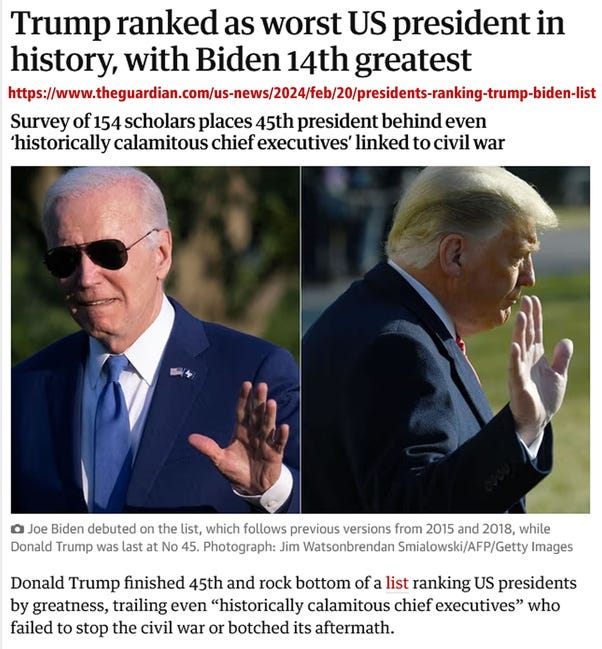
Kamala Harris does not need to “prove” anything because she has already proven herself well beyond more capable than a lying grifter who has been deemed the worst president in American history.
What should be happening right now, if Americans have any self-respect and pride in their history and their status on the world stage, is for Donald Trump to be laughed off every stage he stands on instead of being entertained like drunk, old Uncle Fogarty. This embarrassing idiot decides, at a town hall, to play multiple versions of Ava Maria for 40 minutes instead of answering questions.
After all of this, how can whatever job Kamala Harris did or did not do as a kid matter to anyone in the least?
The truth is that it doesn’t matter to anyone. They have to make a stink about something because the corrupt nature of politics today is that although it’s supposed to be about solving common problems, a significant proportion of the population treats politics as a war game against one’s fellow citizens.
Until (some) people learn to work together with their fellow citizens (as diverse and different from themselves as they may be) instead of demonizing their “honourable opposition,” the only direction the nation will head toward is another civil war.
I’m sure even these guys don’t want to be in a literal war with their fellow citizens.
The first place to start is to give up the notion that being “right” or “wrong” matters more than being accurate, informed, and knowledgeable.
“Right” and “wrong” are egotistical expressions that either stroke one’s sense of self or dismantle one’s self-confidence. Neither is helpful to oneself, others, or the issues at play.
As I often find myself checking out profiles to gain context into the querent’s mind, I did so with yours and am pleased to discover that you’re already on the right track.
Fundamentally, we’re all fumbling about in the dark and clueless, even about things we think we know. The worst thing we can do is believe we are “right” because that perspective contributes nothing to one’s growth and kills one’s ability to explore beyond that point.
No matter how “right” we might feel about something or how complete we think our knowledge of something, there is always something to learn about it that will be new to us. There is always a different perspective on that thing that we have not yet encountered.
If we could all adopt the perspective of being clueless, our world would experience far fewer conflicts because people would be more open to the perspectives of others.
Unfortunately, we live in a world built upon the foundation of exploiting insecurity at all levels throughout society — whether selling hair products or climbing corporate ladders. Insecurity has been weaponized as a tool of manipulation for personal gain over and above benefiting society as a whole.
We have never been more fortunate than we are today when confronted by the limits of our knowledge and understanding. Solving the problem of being unsure about one’s position means simply whipping out one’s means of accessing a comprehensive knowledge base to conduct basic research to verify if one’s position contradicts facts.
There is no real point in engaging with others to determine if one’s compass setting on knowledge is on true north by triangulating it with the settings of others because one is just engaging in an egotistical fencing match at that point. Online “debates” are often more about egotistical masturbation than they are about deriving an objective apprehension of issues to determine pragmatic resolutions.
Sharing information obtained through research efforts is far more rewarding and less prone to conflict over subjectively defined notions of being “right” or “wrong.”
One can still certainly derive flawed conclusions on matters, but that’s also a function of incomplete information that may be deemed “wrong.” Adding to one’s information base is less about determining “right” or “wrong” and more about ensuring the completeness of knowledge in a subject domain.
Knowing the difference in a dynamic with someone else on this level is essentially determined by whether or not the critic of one’s knowledge adds to one’s information base or disparages one’s person as a reaction to the information conveyed.
To directly answer your question, after all the verbiage I packed into this long-winded answer, is that you will know by the content of your critics’ arguments.
You can always deem yourself “not wrong” if the other party adds nothing to your position. If they can add valuable information to expand your knowledge base, you can still consider yourself “not wrong” while learning to be “more right” by their contribution.
This is how you can preserve your superior perspective of evolved humility by remaining confident in being clueless.
Congratulations on achieving a higher level of awareness than most of us monkeys ever attain throughout our very challenging lives.
You may think similarly to many others. You may like similar things. You may do similar things. You may believe similar things. You may be so similar in so many ways that it’s hard to differentiate your identity from the group identity you are affiliated with, but you are different.
You don’t have any choice in the matter because you see through your own eyes, hear through your ears, think with your mind, and have different experiences, even if your experiences are defined by strict adherence to a group protocol.
You are different because no one else can live your life. Your experiences, thoughts, and feelings are irreplaceable, making you a unique and significant individual.
You can share as many details of your life, thoughts, beliefs, ideas, and dreams as you want, as much as anyone else is willing to tolerate, but they will never know life through your eyes.
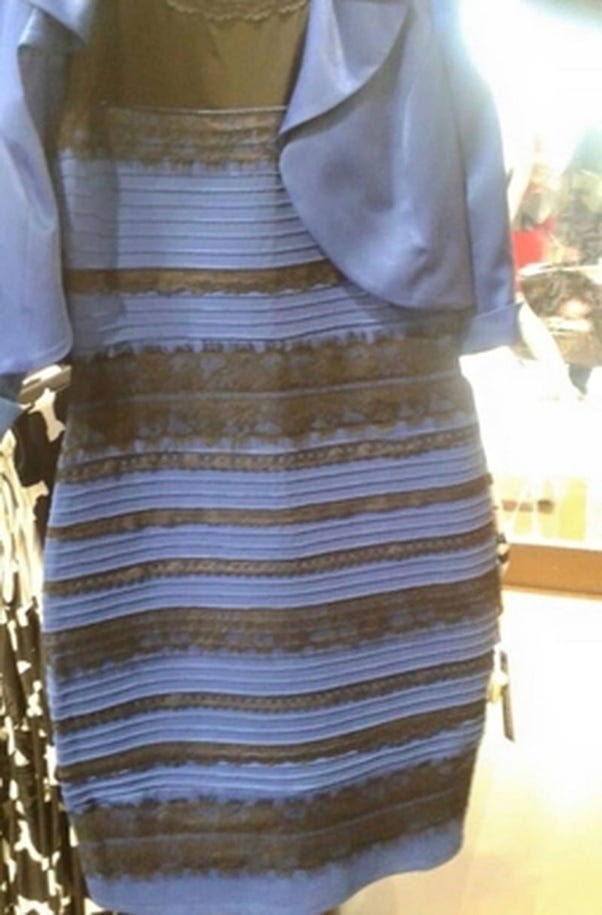
Here is an example of how different individual perspectives are through an issue that went viral about a decade ago. It was a photograph of a dress which, dependent upon the context of one’s biological composition of rods and cones in their eyes, their state of mind, and the lighting in the room at the time of examining this photo, people would see either a black and blue dress or a white and gold dress.
Physically, psychologically, geographically, and within the context of your environment, you ARE different. You cannot help but be different.
You should acknowledge and embrace that fact about yourself and the human condition before deciding how much you might want to be like everyone else.
Wanting to be like everyone else is a generally healthy desire to feel like one belongs somewhere, that they have a place in this world, a community, and a family that supports their existence and accepts them for who they are as they are.
Belongingness is a crucial component of a healthy psychology. Belongingness is a fundamental need we all share in different ways.
We have survived and prospered as a species because we are interdependent beings. We rely on our community bonds to achieve our potential. When we work together, we can accomplish miracles through a force multiplier called “synergy.”
To this degree, wanting to be like “everyone else” can be a healthy motivator to fit in with one’s community and explore one’s unique contributions to achieve one’s potential through support from one’s community.
The downside to being “like everyone else” is to subsume one’s identity to the group and lose one’s sense of identity. The negative consequences are many, varied, and often horrifying, as we have been exposed to numerous nightmares arising out of toxic conformism to a group’s identity and mandates.
Ranging from the inculcated fears of communism that hyper-capitalists invoke as their favourite boogeyman of doom to the cyanide-infused Flavour-Aid victims of cult conditioning, we have all been exposed to the inherent danger of toxic conformism.
Human societies and groups have all evolved along a vector resulting from the conflicts we’ve experienced between two oppositional poles in our thinking about which is the preferred option for a social contract — independence versus conformity.
Neither in their pure form is healthy for any society or group.
The major problem with wanting to be like everyone else is that you can’t be like everyone else precisely because you can’t know what everyone is like beyond the superficial characteristics you identify that make them appear similar to your perceptions.
Your unique perspective identifies similarities unique to your viewpoint. All your efforts to be like everyone else are attempts to be what you imagine everyone else in your group is like.
It’s a subjective approximation of what you perceive as reality, not an objective representation. It can’t be because everyone is just as unique as you.
No matter how hard you try to be like everyone else, you will fail because there is no “everyone else” outside the confines of your imagination. You may even associate yourself with large groups where everyone agrees that everyone else is like them. The reality is that they’re just agreeing with themselves and validating their bias with people who validate their own by acknowledging others who express a similar bias.
It’s a rabbit hole of agreement in which the similarities are no more profound than wearing similar clothing.
The worst part of all of the effort to be like what one imagines of everyone else is that one loses sight of one’s own identity, unique nature, unique path in life, and the unique nature of one’s potential contributions to the world.
It’s almost a paradox in which the more solidarity humanity can achieve, the more we all benefit from the synergy of united effort. At the same time, the more homogenized we become as individuals, subsuming ourselves into a group, the more exposed we are to decay and threat by systemic collapse.
As in all things, the answer to your question is that it is much better to consider this:
There is light within dark and dark within light. While acknowledging this, one arrives at the most crucial understanding of the nature of dichotomies: neither one nor the other is superior — or can even exist without the other because they both exist as a dynamic.
In essence, the best way to be okay is by finding a balance between the two that work best for your unique you.
This post is a response to a question posed in its complete format: “Is it ethical for employers to pay workers at the market rate even if it constitutes wage slavery and lets them barely survive?”
If you’re getting paid the market rate for a position you’re filling, that’s the highest level of ethics you should expect from an employer.
I worked for a government-related agency (part of the government Stewardship program of pseudo-outsourcing) for almost five years and was paid 40% below the market rate. I was stuck with that for reasons that will take this answer in an entirely different and unrelated direction. Suffice it to say that my options were radically reduced due to another arm of government choosing malfeasance to manipulate politically based optics in their favour at my expense.
At any rate, I found myself in this environment in a less-than-challenging role, which worked for me for a time as I had suffered a severe degree of trauma and needed mental space to learn how to cope with a new reality.
When I began working in this operation, management was so pleased with my performance and capability that they wrote an entirely new job description and offered me a full-time position within my first three weeks as a temp. Since my engagement before this one involved physically hauling 16 metric tons daily (at 52 years old) at an hourly rate less than one-quarter of what I had been used to as a professional, I jumped at an opportunity to function in a leadership capacity.
As much as I was surprised to enjoy the role and the people I worked alongside, I was shocked to discover that my rate was below the least-paid staff who reported to me. I was told I had to prove myself when I expressed my dissatisfaction. I responded that I already had, or they would not have created a new position for me. That changed nothing for the better for me, and I continued working there because I was more concerned with struggling through an ugly state of mind at the time and in no shape to be successful in professional interviews. I had already been bombing the ones I managed to get during that period.
During the first company Christmas event hosted by that employer, I had an opportunity to meet the Finance VP. I first witnessed him in his speech, declaring everyone was family. I was later introduced to him by an exceptionally proud supervisor and manager. The VP’s initially positive reaction indicated he had heard abundant good news about my performance.
He smiled and asked me a question. I managed six words before he turned around like I didn’t exist and walked away in another direction. I thought his behaviour was rude, which ended my thoughts on the matter as I continued to enjoy the event. As it turned out, that was my first indication of a sustained round of abuse I was to endure from him.
For the next five years, he played a game of “You look familiar, but I don’t know your name” with me. He enlisted his HR executive in his game as they behaved like they didn’t know me each time they visited the facility, averaging about twice yearly. His HR sidekick seemed to enjoy the game as she furrowed her brow each time she was introduced to the staff when she showed up on average once per year.
Throughout that period, I found myself constantly mitigating the incompetence of the leadership in the facility and saving thousands of dollars in lost productivity per week. I remember being given a production design assignment the manager couldn’t resolve, causing him great stress. The number of errors generated by his inability to deploy an effective production system seemed to stress him to the breaking point, and he thought I would make an appropriate scapegoat.
He offloaded responsibility for his job onto me under threat of losing my job if I couldn’t resolve his problem for him. It was pretty laughable in retrospect because I already had plenty of experience designing more complex production flows within a technical environment, so the system I devised resulted in a complete turnaround and a successful production flow that everyone appreciated, as stress levels among production staff also significantly dropped.
The short of this is that although I routinely exceeded expectations far beyond the role I was paid to fulfill, beyond management-level functions, and well into director-level functions, I could not find myself being paid the market rate for the job I had on paper. I was being paid 40% less than the market rate. I remember quoting that figure to a different HR personnel, and her response was an expression of surprise: “How did you know that?” I was more shocked by her question than I think she was about my knowledge of the market. It’s pretty easy to find out what the market pays for roles. However, the standing directive from company leadership was that discussing salaries was strongly frowned upon.
This environment had all the hallmarks of a highly incompetent and corrupt environment, and I’ve barely scratched the surface of examples I can provide. Do keep in mind, after all of this, that this environment represents government by proxy and the degree of corruption displayed was criminal. My constitutional rights were violated, and I had no recourse beyond the court system in which I could not afford to participate. I did, however, file a suit against them, so that’s on record if I can finally afford to take them to court.
After eventually receiving an agreement that I would have my income adjusted to near market rates, I experienced a gradual moving of the goalposts where my expectations degraded from an agreement they made to a realization they had negotiated in bad faith. My attitude degraded over time, and I stopped offering extra-curricular solutions to issues I had worked on during my off-work hours. I stopped stepping forward to volunteer for tasks above the role I was hired for, and the response was an attitude that I was being derelict in my job.
They eventually decided to terminate my position by claiming they were going in a different direction. This is an “at will” environment, and they were within their legal rights to terminate me at their discretion. I was entitled to six months of severance and received only four.
Workers have no protections in the modern workplace without the strength of union membership and the resources it provides.
Ethics is a matter of individual character; the shame is that ethics are not a universally held standard of conduct. The primary reason for people quitting their jobs is due to abusive environments. That means that most work environments are unethical, which aligns with my experience as an independent professional who has been stiffed by many people who hired my services to extoll their satisfaction with what they received and then denied me my compensation.
A LOT of employers and people who hire other people to work for them are entitled assholes who will screw over anyone they can get away with. It might be the case that I just had shitty luck, but it was far and above more than half of the people I encountered who lacked ethics.
This is only one reason that when people like Donald Trump or Elon Musk brag about stiffing their contractors, I see red. None of those people would want to brag about such horrid behaviour around me because, after a lifetime of enduring it, I doubt I could restrain myself. I would rather avoid a prison sentence for losing my shit over some psychopath’s gloating over how they screwed someone over.
If you’re looking for ethical behaviour from your employers, good luck because if you do find an ethical employer, hang onto them like they’re a prized treasure. They’re just as rare.
Getting paid at a market rate is at least better than getting paid less than the market rate and being expected to perform at higher levels of responsibility than those who get paid more to supervise your work. They don’t set the market rate, while most employers deliberately seek young and inexperienced people because they don’t want to pay the market rate.
A LOT of jobs I see posted indicate an upper limit of experience precisely because older workers know when they’re being ripped off or manipulated by an unethical employer.
This post is a response to a question posed in its complete format: “Considering you’ll die without a job, why is being employed not a right? Can society really just ensure someone dies by refusing to hire them anywhere?”
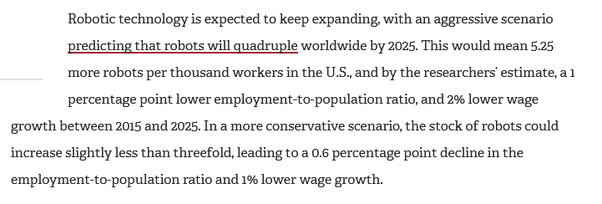
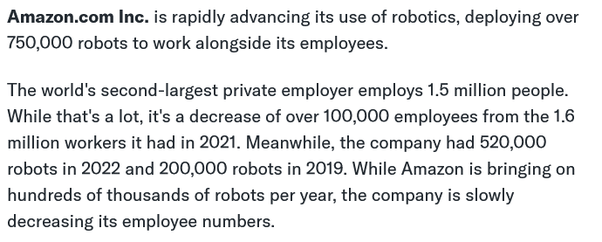
As the world of work becomes increasingly automated, the workplace dehumanization issue rapidly grows into a sociopathic dismissal of our essential qualities as living, breathing, thinking, and evolving beings. This pressing concern will affect more and more people in the future with increasing rapidity as workplace automation continues to adopt and incorporate an increasing rate of technological advancements into their operations.
Meet the Humanoid Robot Working at a Spanx Factory (18 minutes)
To be clear, the dehumanization of the workforce isn’t a consequence of automation but of aggregation into ever larger corporate entities now spanning the globe in their operational reach. Automation is merely a step toward increased efficiency and reduced operating costs. Automation is simply the formalized acknowledgement of transforming labour into a dehumanized function that benefits capital-infused decision-makers chasing profit. What was once an entity supporting community development within the “Mom-and-Pop entrepreneurial environment” has become industrialized economics.
Entrepreneurs of today are the artists of yesteryear who sought out patrons to support their initiatives and receive benefits in return for their support in a parasitic relationship that both drains value from the creative individual and shapes their creative output in their narrowly defined image to fit an increasingly homogenized production system.
The dehumanization of the workforce began when people became deemed commodities, and “Human Resources” departments were created as legal defence linebackers to protect corporations from the consequences of exposed liabilities.
The world of employment has become less about identifying skills and more about choosing appealing aesthetics and fetishes. One is no longer in a position of being hired to function in a role with an expected standard of performance in fulfilling the requirements of that role inasmuch as they’re selected like an attractive product on a shelf that will complement the rest of the pieces on a mantle.
The disconnect between the function one is intended to fulfill, the decision-maker determining the need, the department composing the requirements list, and the agency tasked to identify appropriate candidates has become so much of a production line that they cannot help but to regard all their people as narrowly defined replaceable cogs with limited capacity and range in an expense paradigm rather than as an investment and a partner in the enterprise. The only success an individual can contribute to a dehumanized function is to meet predetermined expectations in a static environment with an expected and finite lifespan.
Corporations may be deemed people, but they’re more machine than human. Unlike humans, they can only change course and be adaptive to evolution when the small number of myopically focused humans operating them can implement global changes that often involve complete retooling and rebranding or being incorporated into another corporate system.
Once that occurs, however, whatever unique nature or personality that may have existed in the original entity is subsumed into the more enormous beast.
The issue of jobs and employment is a critical metric only for those whose role in society is to diagnose the overall health of the “super beast” referred to as “the economy.” Individuals are irrelevant to their equations. Humans are no longer humans but cattle to be herded in a dehumanizing system that renders everyone only as valuable as accords the desirability of their functionality in a narrowly defined capacity within an inhuman entity.
One’s value as a human in society is determined only by the nature of the type of cog they can function as within the parameters of an acknowledged entity that deems them suitable for its overall operation.
Society doesn’t “ensure” anything because society is a collection of humans operating within a cultural framework. The corporate culture we have endorsed for society has, in return for our loyalties, suffused society with an apathetic disinterest in the human condition and the plights of individual humans.
UBI is the only path available to regain our humanity and create an economy that serves humans rather than modern dynasties comprised of a small handful of monarch-like beings. Without it, system-wide collapse is inevitable.






















 thotbag