This post is a response to a question posed in its complete format: “Question for all you Trump-haters — Can you at least admit that Donald Trump’s multi-million dollar personal donation to hurricane relief efforts, and the $7 million raised through his and Jason Aldean’s joint effort, are a good thing?”
I have a better question. How can you possibly believe anything he claims?
He taught his kids how to steal money from kids dying from cancer.
He claimed to forgo his salary as President and spent over $100 million of taxpayer dollars on golfing. The annual wage of a US president is $400 thousand. He spent more than four times the salary he allegedly claimed to reject in four years.
He profited from charging taxpayers for the residency of Secret Service at Mara Lago because he refused to stay in the Whitehouse to the tune of $2 million taxpayer dollars. He insisted they stay at his residence and charged them for being there to protect him. Taxpayers paid not only for their salaries but for the profits he made, which constitute the total amount of the four years his salary as POTUS cost taxpayers.
He claims to be a billionaire when trying to impress people but sells over-priced junk products to the poor people he claims to be in support of.
He’s a convicted felon in a world where charges alone are enough for most people to convict the recipient of charges who automatically believe everything they say is a lie. People still believe Johnny Depp lied and Amber Heard was an innocent waif — even after learning she defecated on his bed. He was convicted on 34 counts and should be rotting behind bars right now, and you believe his words at face value.
The Washington Post has a 3-year-old article on Trump making 30,573 false or misleading claims during his tenure in office. https://www.washingtonpost.com/politics/2021/01/24/trumps-false-or-misleading-claims-total-30573-over-four-years/ I understand how easy it might be for you to wave your hand and call it fake news as if they pulled that number out of a hat, but that’s not the case at all. Those incidents are verified by various fact-checking organizations that have taken the time to tally all his lies. Anyone like Trump can lie as often as he wants but never backs up those lies with evidence. Meanwhile, evidence of over 30 thousand statements by Trump has been presented.
With such a horrendous tally of lies, I could go on for hours regurgitating examples of Trump’s lies, but that would be pointless. The fact that you can overlook all this publicly available information and then come on here and declare another lie is proof positive that there is no reason to hate someone responsible for more American deaths than Osama Bin Laden is proof on its own that you have serious mental health issues to deal with. You’re even giving Trump credit for an effort that was mostly Aldean’s work.
Do you have even the slightest clue what that kind of thinking indicates?
Here’s a photo of what your question represents:
One of those bodies is you.
That’s what you represent.
A cult member who insists the drinks being served will bring everyone closer to God.
The sad thing is that you’re telling the truth while your Reverend lies his ass off and is planning his escape like Jim Jones tried to, while your body lies rotting on the ground.
Which brings me back to my original question as a response to your question: How can you believe anything he says, even worse, without asking for a receipt to verify he did what he said he would do?
Before you answer that question, here’s another: Did you accept or reject the proof of Obama’s birth in both his short and long-form birth certificates? If not, then why not?
Why would you accept the word of someone who breaks records for lying (and is motivated to lie to you because if he doesn’t, he’ll end up in prison) and reject the proof of Obama’s birth?
Do you not see a double standard in all of this?
You can’t be that disconnected from reality, can you?
You know you need help but are too afraid to do the right thing.
Cowards always are.
Do the right thing for a change before you regret getting what you’re asking for.
So, you’re trying to separate “anti-Trump” voters from “pro-Harris” voters as if that bears any relevance to this election.
You’re doing that because it’s easier for you to write off people with your go-to dismissal of “Trump Derangement Syndrome.”
Do you recall how conservatives did the same thing with Bush when he lied to the American people and the world at large to justify invading Iraq and embroiling the nation in two costly wars?
“Bush Derangement Syndrome” was your go-to dismissal then.
That’s what conservatives do: invent a fake disease and accuse people of suffering from that “disease” to avoid having to deal with the very valid criticisms they have over the leaders you bend over backwards to protect. You don’t care in the least about examining, much less acknowledging, how utterly corrupt the actions or how incompetent the people you defend are.
For you, loyalty is everything… and you’re proud of your loyalty to such a degree you cannot fathom, much less accept how it’s precisely that sentiment being played against you.
You’ve been conditioned since childhood to value loyalty above all else and beyond reason.
This is not to say that your loyalty isn’t a precious sentiment. It is. It’s an essential ingredient for maintaining community cohesion. It isn’t, however, anything but a tool for people like this.
They don’t respect your loyalty or value it beyond how they can use it to benefit themselves.
The worst thing is that you don’t directly view your loyalty as loyalty to a convicted felon. You have convinced yourself to believe your loyalty is to your country. Why do you think he indulges in performative kisses of the flag if not to tweak your loyalty and use it against you?
The sad thing about your unwavering loyalty to this disloyal monster is that you’re the girlfriend in the stereotypical scenario played out by millions of teens throughout the decades.
You’re the girlfriend who’s being lied to so that he can get in your pants.
Once he’s done with you and decides there’s nothing more he can extract from you, then you’re his ex, and he treats you like he treats the memory of his ex-wife and mother of his children.
This is what you mean to him, yet you have convinced yourself that he won’t do the same thing to you. Do you know how many teenage girls follow that rationale to learn a powerful lesson in regret? Countless.
You’re so loyal that you’re willing to overlook the deaths of your fellow citizens while he generously shares equipment that would save American lives with the leader of an enemy nation.
… and while overlooking this betrayal of the American people, you still want to think of yourself as a loyal patriot of the nation you love.
You’re so lost in your team spirit haze that you want to believe the only reason he might lose the election is because your fellow citizens are suffering from an imaginary mental condition.
You have to think that way because the alternative is frightening.
If you can’t believe that “Trump Derangement Syndrome” is real, then you have to admit to yourself that you’ve been wrong about this monster for years.
You fell into a trap in which you liked what he had to say because he hates the same people you have struggled with that piss you off every day. After all, they don’t seem to respect what’s important to you.
The trouble is that they do, but they do so equally for everyone, not just the insiders or fellow team members. That’s what makes you struggle with being loyal to your team. You can’t ignore all your many reasons for doubting this man’s integrity. It nags at you from the back of your mind like a splinter.
He’s just given you too many reasons to wonder if maybe… just maybe, he doesn’t intend to deliver an America that serves your needs. He intends to deliver you like a pig on a roast to the nation’s enemies and destroy the Republic you believe yourself a patriot of.
You know what the truth is.
Everyone voting for Kamala is anti-Trump. It doesn’t matter if that’s the only reason to support her because that’s enough of a reason for millions of people who also think of themselves as patriots. You know they think of themselves as loyal patriots, too… right? Except they’re not loyal to a person but a country, a constitution, and the spirit upon which the nation was founded. Your brand of loyalty is called a “cult of personality.”
If your suspicions are correct, someone besides Trump would mean fewer votes for Kamala and a better chance for your team to win. Those anti-Trump people who can switch sides based on the quality of character representing the candidates are more loyal patriots than you are because they are patriots loyal to the country and not the personality.
Your loyalty is a fraud. It’s the same type of “loyalty” a teenage girl who is desperate to be loved will show the people they hope will love them back. Like you, she’s willing to believe anything a charming young boy with promise for a future will tell her.
Ask yourself this question: If Trump could return your loyalty, why has he done nothing to help the people who are in prison today on his behalf? Why did he not do something for the family of the supporter who was shot and killed during his first assassination attempt? Why did he not even contact the family to pass on his condolences if their loyalty meant anything to him?
The sad reality is that you’re just a box of Kleenex to him.
Once he’s done wiping himself with your sacrifice, then you’re just garbage.
Is your loyalty worth that little?
Do you know who gets a greater reward for that kind of sacrifice?
That’s right… Islamic suicide bombers get better treatment for their sacrifice than Trump’s loyal supporters.
Are you okay with being treated with less respect than an Islamic suicide bomber?
Is your sacrifice worth the cost of destroying the nation you want to think of yourself as a patriot of?
Here’s another thought: The loyal patriots who hated what the Republicans did to embroil the U.S. in two pointless wars weren’t just temporarily reacting for the sake of team performance. They weren’t suffering from some temporary mania called “Bush Derangement Syndrome.” They believed strongly then and still believe those who sent the nation into that hellscape should be held accountable for their actions — even if they switch sides and cheer for the same team. They’re not let off the hook for the damage they did to the nation. To them, being loyal to principles matters more than team loyalty.
Loyalty to a country means holding monsters accountable for their actions, no matter how they switch gears later.
Dick Cheney announces support for Kamal Harris
That’s the difference between genuinely patriotic loyalty to a country and misguided loyalty to someone who’s using you like a teenage boy eager to get in your pants.
To be completely honest within this context, one must also be honest with one’s motivations for “being honest” in the first place.
“Being honest” does not necessitate conveying any messages to anyone else. There is always a motivation for the information one shares. To “be honest,” one must be aware of why they are compelled to share that information and what they seek to accomplish by sharing that information.
For example, to “be honest” about telling someone they’re fat and ugly isn’t actually “being honest” beyond informing the other person of what one’s personal biases are. Delivering information in a callously insensitive manner implies that the honesty of their intent is emotional manipulation.
To be completely and transparently honest within such a context, one should qualify their opinion by being honest about their biases. “I’m very biased toward a person’s aesthetics and react viscerally to the condition someone of being overweight due to unresolved personal issues, and because I’ve been conditioned to define beauty within a shallow, commercialized, sanitized, and two-dimensional context, therefore I interpret your physicality as fat and ugly.”
No one ever goes to such lengths to explain their biases. Most people who indulge in the “honest” expressions of their biases just cut to the conclusion, and that’s much more hurtful to the feelings of others. The consequence of “failing to care” about the emotions of others in such a context demonstrates one does care about the other person’s feelings, not in a productive or supportive way but rather in a destructive way. They intend to create harm deliberately, which implies “caring” about other’s feelings.
They are not sharing their honest opinion in such a context but conveying information to hurt the feelings of others. Within such a context, “being honest” necessitates being forthcoming about the nature of their opinion and why they share it. In either case, one does not escape “caring” about other’s feelings while implying they care more about escaping the consequences of their impact on that person’s feelings.
I don’t think I’ve ever heard anyone declare, “I’ve got personal issues to resolve; therefore, I’m going to use you as my vessel for working them out to make myself feel better by making you feel worse about yourself.”
That would be an example of a bully “being honest” (for a change).
Cases outside the context of an abuser/victim dynamic can have a significant impact on the feelings of others, such as informing someone of the passing of a loved one. No matter how one delivers that information, the other person’s feelings will be impacted.
One’s intentions are just as crucial to sharing information within this context as in the previous example.
To be honest with one’s intentions, in this case, means understanding how one’s information is delivered impacts the receiver’s ability to parse that information fully and accurately. Ensuring the other party successfully understands the message conveyed within its complete context, some level of awareness and sensitivity to their emotions is crucial to the success of their information delivery efforts.
Failing to consider the emotional impact of the information conveyed implies that one’s intentions are less focused on knowledge transfer than on impacting the recipient’s emotional state.
In both cases, these are examples in which one does not escape the consequences of their regard toward the feelings of others in the information-sharing process.
Emotion is a component within an information-sharing context, even in benign situations such as small talk. “It’s a beautiful day today.” This may superficially seem like an unemotional example of innocuous small talk, but the reactions it can engender carry an emotional component within it. The emotions are not as pronounced as in the previous examples, but they exist. One feels better by being reminded of a pleasant experience, just as they would feel something if the day were not beautiful (which, in and of itself, is an emotionally charged word due to its subjective nature).
Further stripping emotion from the dynamic of information-sharing by limiting interaction to a functional level, such as a transaction, still contains an emotional element because humans are emotional beings. For example, “Your McSappy Meal is $5.99” can engender an emotion in the recipient who feels overcharged.
“One plus one equals two.” — “Can you prove that?” or “Do you think I’m too stupid to know that?” or “I’m not a friggin’ child in elementary school. Can’t you provide a better analogy?”
Being honest means being honest about the nature of the care demonstrated toward the feelings of the person with whom they share their information. To care about the feelings of others often implies enough sensitivity toward their emotional state to minimize a potential disturbance, but that’s not the complete spectrum of caring about the feelings of others. Far too many people “care” so much about how others feel that they devote significant energy toward ensuring others feel worse than they do.
Some people “care” so much about other’s feelings that they make a point of being utterly dishonest with themselves while sharing information intended to create harm or incite conflict while escaping the consequences of doing so through a mask of innocence they can declare as “being honest.”
All information shared between people implies an emotional dynamic within its conveyance, either strictly by the content or when augmented by the messenger’s intentions. There is no escape from feelings in communication, while “being honest” includes acknowledging the emotional component of their messages and the impact on the receiver.
I’ve never encountered “femsplaining” before this question. It sounds like it was made up for this question to make it appear more egalitarian.
“Mansplaining” became a prominent description of misogynistic behaviours and attitudes in situations where men behaved in condescending ways toward women.
Misogyny is widespread in our patriarchy because men often have no clue how to handle equality. Men have been conditioned from a young age to view themselves as superior to women. Men are also subjected to conditioning, which causes them to interpret life as a power game.
Combining those two characteristics of a typical male upbringing with toxic competitiveness breeding fragile egos results in a prevalence of poisonous masculinity throughout society that we’ve grown to know and love.
The consequence of their conditioning has resulted in a high frequency of example scenarios where men condescend toward women on a wide variety of levels in a diversity of conditions.
One of the most stereotypical examples is an auto repair shop where the statistics show that women are often overcharged for repairs while being condescended to when discussing those repairs.
The standing bias of a significant proportion of men is that they understand automotives better than women and often resort to condescension as a means of gaslighting a victim to get away with taking advantage of their perceived naivety.
This dynamic of condescension isn’t limited to gender interactions and occurs everywhere a power game exists.
Everyone experiences it repeatedly throughout their lives, usually when someone attempts to convince them of nonsense.
At any rate, since men have been conditioned to think of themselves as superior within a gender power dynamic, they more often resort to condescension when manipulating women. It happens so frequently while men victimize women that the term mansplaining was invented to introduce humour into a problematic situation of discrimination as a means of raising awareness of the problem in society.
We employ similar awareness-raising tactics in situations where power dynamics are statistically significant.
I just answered another question before this about the slogan “Black Lives Matter.”
It’s not quite as humorous as “mansplaining,” The goal of the expression is the same: to raise awareness of a severe issue of discrimination in a society that renders an entire demographic as victims so often that it can’t be ignored and must be addressed.
This strategy for raising awareness is why gay pride parades exist.
It’s a way of restoring balance to an unequal power dynamic.
The term “femsplaining” is a reaction to the effectiveness of “mansplaining” and is a defensive reaction to that success. This is how “All Lives Matter” was conceived as well.
Those who are used to being in a dominant position of power begin to feel insecure enough about equality that they interpret it as oppression. Since they struggle with admitting to the abuse they condone, they react defensively by appropriating an effective strategy to convert it into a counter-weapon against the strategy responsible for their disempowerment.
There is no such thing as “femsplaining” for that reason, and misandry may exist but only as a reaction to extensive abuse by men.
Men become misogynistic by conditioning that teaches them to adopt socially acceptable aggression toward women, while women become misandrist by being victimized.
Even though the terms are intended to reflect equal and opposite conditions, they are not the same.
When a woman condescends toward someone, and they happen to be male, that’s a coincidence, not a stereotype.
Every government imposed on a country has been authoritarian.
Marx’s vision for communism has never been implemented and was never realistically possible to implement in the manner he envisioned.
His view was that socialism (which he often used interchangeably with communism) was an intermediary step to communism. For the people to own the means of production implies a democratic form of ownership, which has never been the case with socialist systems in an authoritarian framework.
His definition of communism was based on the principle, “From each according to his ability, to each according to his needs.” — it is, by definition, a meritocracy (which, in itself, is problematic). The problem, however, is that no system is possible — at least at this stage of human development — without some hierarchy of authority.
Every implementation of what has been popularly viewed as communism has never been communism as Marx envisioned it (while he accurately predicted the flaws in Capitalism would lead to the situation we are suffering from today) and failed precisely because they have been authoritarian systems based upon a centralized authority.
Today’s capitalism can be argued to be an authoritarian system imposed upon the people, entirely consistent with the historical failures of the implementations/impositions of pseudo-communism. (Particularly since the U.S. is on the brink of transforming into a fully-fledged fascist state stripped of its last vestige of Democracy by Drumpf’s promise to end elections. The state of corporatocracy that the U.S. has today has arguably been imposed upon a people without their knowledge or consent. A corporate infrastructure is a totalitarian style of monarchic rule as an operating system of administration… and precisely why corporations are anachronistic holdovers from a medieval era that cannot help but evolve into a threat to democratic governments.)
Marx’s vision of communism can be argued that it was intended to be an organically evolved system, which, by today’s measure, means a form of advanced direct democracy.
To contradict the presumption in this question, Lenin did not impose his brand of communism on the country. He won the support of a majority of the people against the Provisional Government in place at the time. The people who endorsed his program supported his confiscation of land to nationalize it and divide it among the peasants.
This is eerily much like where the U.S. is at with the potential installation of an Orange Nazi Turd who should be rotting behind bars like every other convicted felon instead of roaming about free to campaign on a platform of destroying 243 years of American democracy.
The real problem we have is dialectical and a propensity for oversimplification.
Even authoritative sources like Britannica fail to offer clarity in defining governmental systems. As far as that source is concerned, there are five countries it identifies communism as an “official form of government”: China, North Korea, Laos, Cuba, and Vietnam.
Meanwhile, descriptions of each nation contradict that statement:
Vietnam — The politics of Vietnam is dominated by a single party under an authoritarian system, the Communist Party of Vietnam (CPV).
North Korea — A totalitarian dictatorship with a comprehensive cult of personality around the Kim family.
Laos — Lao People’s Democratic Republic (commonly known as Laos) takes place in the framework of a one-party parliamentary socialist republic.
Cuba — Cuba has had a socialist political system since 1961 based on the “one state — one party” principle. Cuba is constitutionally defined as a single-party Marxist–Leninist socialist republic with semi-presidential powers.
China — The Chinese constitution describes China’s system of government as a people’s democratic dictatorship. The CCP has also used other terms to officially describe China’s system of government, including “socialist consultative democracy”, and whole-process people’s democracy.
(This post was an answer to a Question posed on Quora — where all my posts on Medium have originated; hence the personal response indicated within this article. — https://www.quora.com/profile/Antonio-Amaral-1/ )
I believe it’s less rare than cynical minds might think.
Too many people can’t see past their biases to know the difference between a politician’s words and their internal recreations of the meaning of their words.
Too many people, for example, will repeatedly utter how Joe Biden destroyed the economy while professional economists across the board praised it as one of the most successful economies in decades.
Too many people are still incapable of acknowledging the reality of the last election being one of modern history’s most secure and scrutinized elections. They will still adamantly insist that the election was stolen.
They will hang onto the words of a convicted felon who should be rotting behind bars and overlook his public money laundering schemes for overpriced watches and sincerely believe he has the best interests of the struggling class in mind.
They don’t even care how badly he bloated the debt by redistributing wealth to the plutocrats who are steadily taking over the global economy.
They would rather demonize their political opposition as “globalists” while doing the job of playing defence for the actual globalists.
None of them will stop to pause and consider the rationale of their position within any objective perspective.
Everything about their position hinges on tribal identity, and they can’t be wrong about their beliefs because it would mean the criticisms about their toxicity are truthful and correct. They desperately need mental health assistance in the same way that most people who have undergone interventions by their loved ones were deemed in desperate need of professional help.
The problem of corruption in politics is not and never has been a problem with the politicians themselves in a democratic nation where the people vote for who they entrust to manage their affairs on their behalf properly.
The evidence is beyond evident in distinguishing between politicians who at least try to truly represent their best interests and those who parasitically drain their constituents of their value while sending them deep into a pit of poverty.
I don’t even need to post a comparison between states that shows which politicians and parties best represent the needs of the people. It would be pointless to do so because their mental filters will dismiss all evidence as “fake news.”
The problem is not that politicians are dishonest but that the people who elect them cannot discern between honesty and dishonesty. That means that a significant proportion of the population is fundamentally dishonest.
If we are sincere in our desire to fix a perceived problem with dishonesty in politics, then we must be earnest in fixing our problems with being dishonest people at heart.
If we don’t don’t want dishonest politicians, we must stop being dishonest ourselves.
This post is a response to a question posed in its complete format: “If Darwin’s theory is correct, then there is always fierce competition within each species in which only a few survive. Why is the human population increasing?”
This question is an example of someone reading something about what someone else proposes, not to learn from them or to understand what they mean by what they write or say, but to find reasons to be critical and dismissive.
This behaviour is quite common on social media and in communication dynamics everywhere.
The attitude displayed within this question is an example of an attitude governed by catering to one’s ego. The Dunning-Kruger arrogance would be astounding if it were not so prevalent among humans so entirely subservient to their egotistical compulsions.
The audacity of ignorance reeks throughout this question, beginning with “If Darwin’s theory is correct.”
Darwin’s Theory of Natural Selection has transformed the world through a deeper understanding of the mechanics of life. It has not only stood the test of time but spawned innumerable initiatives and several new branches of science. Yet, some under-educated schmuck on social media declares their suspicions of its value while providing a badly butchered rendition of a god-awful misinterpretation of it on a fundamental level.
This attitude is why many believers are often considered abusively ignorant.
This attitude demonstrated by so many people in many contexts is why conflicts occur between people.
If you’re going to cite Darwin’s theory, then at least try to understand it correctly on the most basic level.
Others have gently corrected this arrogance of misinterpretation and have convincingly explained how and why it’s a disservice to scientific progress. I want to focus my venting on this arrogance so often displayed by people who assume their juvenile grasp of something they haven’t understood is magically superior to a mind that has transformed human society on such a fundamental level in such a dramatic fashion.
This style of ignorance is why we struggle everywhere in every endeavour, whether scientific or political, as human society gets bogged down by idiocrats.
This isn’t even close to the worst example of a Dunning-Kruger level of arrogance, but the timing was fluky, and so, lucky you.
I have no idea what the communication dynamics within a high school environment are these days. I can, however, easily recall how the arrogance displayed by this question by students would often be met with a comeuppance of some sort by the instructor.
If you were a scientist yourself, never mind that you would not have concocted such a butchered misinterpretation, you would still not present yourself with the kind of arrogance displayed within this question.
There would be some respect in your tone for the work done by someone so significant to human history and the evolution of our society. You would be aware of the benefits you have been living with as a consequence of his work, if not on a detailed level, but on a level that shows some appreciation for its value.
Your lack of knowledge of his work is not justification for your arrogance. It does, however, scream your ignorance to the world, and that should be an embarrassment to you while it isn’t, nor is it for all the many who barf up similar expressions of unearned arrogance.
Over and over again, and every day, a believer pulls out their cynically dismissive arrogance gun to shoot themselves in the foot in the same way you have.
Here’s a clue for you, though… in case you want to demonstrate some respect in future for someone who outclasses you from beyond the grave, this is how you would broach your confusion over what you don’t understand with a modicum of humility and respect for the work of a significant contributor to humanity’s progress:
Instead of huffing your ego like this,
“If Darwin’s theory is correct, then there is always fierce competition within each species in which only a few survive. Why is the human population increasing?”
I’d recommend reigning it in with something demonstrating a little more awareness of the limits of your knowledge with something like this:
“Why is the human population increasing if there is always fierce competition within each species and in which only a few survive?”
Do you notice the difference, or is it too subtle for you? Is this response to your question an example of being too sensitive over something that doesn’t matter to you? — If that’s how you feel, you sorely misunderstand why the world is always in conflict. The difference between the two examples of word choices can be between reaching an agreement within a sensitive negotiation and going to war against a new enemy.
In this case, the subject is not critical to resolving anything. It is, however, an example of how often cynically dismissive arrogance pushes people past their tolerance limits.
In essence, this answer isn’t even so much for your benefit as it is for every other believer who decides they can dismiss 165 years of scientific progress based on being too lazy to educate themselves properly on a subject they believe their cartoon degree of self-assuredness compensates for their lack of interest in doing their homework.
It would be best if you could manage some gratitude for so many people who gave you polite answers while entertaining your somewhat mild rudeness in this case. Like Chinese water torture, however, enough of it eventually breaks people’s ability to be polite in the face of self-serving delusions like believing your gut feelings trump the hard work of countless professionals who have dedicated their lives to improving all of ours.
Eventually, you will run into a pushy someone like me who will call you out on your disrespect because that seems to be the “skill god gave me.” I’m sure you might feel it’s not a pleasant experience to find yourself confronted by this kind of venting… truth be told, I wish I weren’t triggered into a need to vent in this manner, but that’s the world we live in.
C’est la vie.
I feel better now, and I’m sorry if you don’t. I hope you pass on this message if you read it to understand it rather than look for reasons to dismiss it.
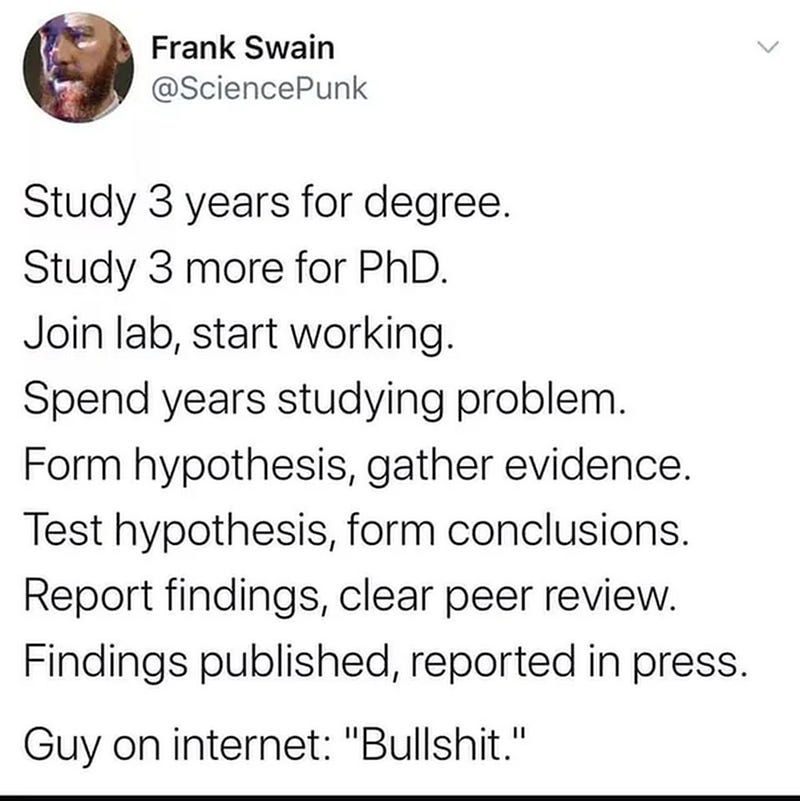
Another way to word this question would be, “Why do people not share the nothing they have to share?”
How does that work out for you?
It sounds kind of silly, doesn’t it?
It probably makes no sense to you that it’s your question in different words. That would be because you don’t understand how atheism is literally nothing.
Atheism is the disbelief of the claim that “God exists” or “God is real.”
This atheist is perfectly happy if you’re happy believing whatever it is that you believe — anything which helps you live your life peacefully and productively is positive.
There is no need to hear how or why that belief works for you because it’s your belief, and no one would truly understand how or why that belief works for you. Even other believers who hold beliefs similar to yours would have their reasons and find unique benefits to their beliefs that will differ on some levels, even if they appear the same on others.
Humans are all unique, no matter how alike they may be. That’s the function of individual perception and cognitive features of life, such as an ego.
Good for you. You’re happy.
That’s all this atheist cares about.
The details you may want to share are generally too alien for me to appreciate, so your efforts merely contribute to a divide between us rather than building a bridge.
The reason for that is when people share their beliefs, they’re also sharing their insecurities with those beliefs, and sharing is a way of harvesting validation.
By sharing your beliefs, you are merely showing this atheist that you don’t really believe what you claimed to believe while demonstrating an expectation of me adopting a paternalistic response, patting you on the head, and telling you what a good person you are.
I would have already assumed that about you before you began speaking. This atheist prefers to think of people as good by default until they prove otherwise.
Starting with a cynical form of misanthropy is just an unhealthy way to live.
At any rate, if you were to ask me what I believe, I would have to choose from among a gazillion slides running through my mind to pick one and talk about that one microscopic portion of what comprises things I believe and why I believe what I believe. I would have to do that because most such questions don’t seek in-depth insight but a soundbite answer like, “Yep. It sure is a nice day today.”
That’s not a discussion about beliefs. That’s just chit-chat — small talk.
Serious discussions about beliefs should last hours at minimum, or they’re not serious discussions about beliefs. They’re idle chatter and empty noise to fill silent moments that often make many uncomfortable.
Silence can be far more golden when simply sharing space with someone without requiring temperature checks to ensure no overheating is occurring underneath one’s notice.
At any rate, disbelief in a god creature is nothing by contrast to something that comprises an affirmative belief in the existence of a god creature.
That’s what makes your question appear silly.
What is the point of telling people one lacks belief in a god creature, particularly when so many believers find that so offensive they spend all of their free time demonizing non-believers?
This atheist sees no value in telling people things in person that would add stress to their day.
I’m okay with openly expressing my views online because no one’s day is interrupted by my words. People choose to read them.
Topping matters off to make your question appear even more silly is that a government employee is responsible for serving all citizens, regardless of their faith or beliefs. If they were to share their personal beliefs openly, they would inevitably offend someone.
I am sure you are well aware of the bloody conflicts that have been occurring non-stop around the world for centuries between people of different belief systems. For a government employee to openly share their beliefs with the random people they serve would be doing a disservice in general to the public they are supposed to be serving as a representative of a nation with a secular umbrella welcoming all faiths.
This all boils down to the fact that no one is trying to keep anything away from anyone as a government employee. They are performing their duties as expected by not imposing their views on others.
Government employees who step outside their role as representatives of a government that welcomes and protects all beliefs are being derelict in their duties and should get fired for doing so.
Some even face legal battles for insisting their beliefs dictate how they are to perform their duties, and that is how it all should be for people who want to live free.
This post is a response to a question posed in its full format as follows: “As clever as humanity considers itself to be, has it only just began to scratch the surface of a true understanding of the fundamental nature of reality?”
This question reminds me of the Epistemology course I took at a local university over a summer off from art school. I was accepted into a third-year program without prior university-level philosophy course experience. I successfully leveraged my art school experience toward my application.
This was my introduction to understanding how language can be utilized with the same disciplined approach toward meaning as mathematics. The course material I read felt more like I was interpreting algebraic formulae than English text.
During this period, I realized access to new knowledge domains began with mastering the grammar that defined a domain.
At first, I read and reread sentences until the language made sense. I plodded slowly through the material and expanded beyond spending upwards of half an hour reading sentences to over an hour reading paragraphs and several hours reading entire pages to ensure I had developed what felt like an adequate understanding of what I had read.
This was not my first time having such an experience. Many would be surprised to discover the art world is also filled with jargon and concepts that require an equal measure of effort at the outset to comprehend the information conveyed. However, the grammar defining the art world can be even more complicated and confusing than intermediate philosophy.
Unlike the disciplined rigour of mathematical precision found in the language of philosophy, art world jargon is often subjectively defined and expressed through abstractions rather than through concrete concepts based in a material world. It makes for mixed messaging among instructors, where one adopts interpretations of concepts based on interpersonal dynamics rather than objectively defined definitions of concepts. I remember often tripping over the concept of chiaroscuro because it seemed no matter how I interpreted what is arguably one of the objective terms in art, every instructor had a different definition. I chose to favour the art history instructor’s definition over the conflicting definitions offered by my painting instructors.
At any rate, my painstaking journey through reading my philosophy assignments left me tired enough at the end of the day to sleep soundly at night and wake up feeling like I was prepared for the class discussion of what we had all read. I would attend class feeling confident that I understood the material — until the class discussions began and the instructor interjected with dialectical curveballs to illustrate limitations on some of the arguments forwarded by students.
About halfway through the class, I felt utterly overwhelmed, as if I had no idea what I had read. I felt like my confidence was entirely misplaced and that I should have started my formal training in philosophy at a more junior level.
Then it happened — the discussion veered back onto the topic I thought I had read. I couldn’t fathom how the conversation took a journey to an alternate dimension, but I was happy to see it return to the reality I was most familiar with.
By the end of the class, I was dumbfounded to discover that I was correct about understanding the material at the outset before becoming completely confused. I expressed my frustration publicly. My instructor’s response to my confusion was to say simply, “Yes, but now you know it better.”
This was a lesson for me to understand that knowing what I know is merely a product of my confidence in believing I know what I know, while what I know constitutes only the tip of an iceberg of what is possible to know about what we think we know.
For a real-world example, I still recall my experience in an interview with a recruiter who seemed impressed with me when he remarked, “Wow. You quoted Voltaire. I’ve never heard anyone quote Voltaire in an interview before.” He presented his surprise in a way that made me feel he would be in my corner and support my candidacy. As it turned out, that was the moment he decided I was disqualified as a candidate. He ghosted me after that, and I never got another opportunity presented to me through that agency.
It took me a while to figure out what had happened, but when I did, I connected that experience with a much earlier one in which I was on the phone with someone about a temporary labour assignment. I remember asking specifically, “What does the job entail?” The response I got was a very dry, “Welllll…. it entaaaaaaaails moving stuff.” I lost out on that opportunity, and the memory of that experience lingers as a reminder of my language choices and their impact on others.
I’ve had to learn to become very aware of how my natural self is interpreted from a young age when I deliberately chose to use the shortened form of my name to fit in. As a kid who became fat to gain approval from an abusive mother, I had to become aware of responses to my natural state of being from a very young age.
I know that my language choices can be offputting for some. I know that when some stranger uses the short form of my name to address me, it’s a form of disparagement that speaks volumes about their attitude. I’m pretty aware of subtleties many miss, even if I don’t catch them immediately — mainly because I’m not naturally focused on the underlying cynicism many naturally wallow in, so it can take me some time to tune myself into their frequency.
I’m using myself as an example to answer this question because I know I’m pretty self-aware and more than most, but it doesn’t matter how much I know about myself; I’m still discovering new things about myself. This isn’t to say that I’m primarily interested in myself for the sake of knowing myself, but knowing myself is a conduit to a better understanding of the world I live in — for several reasons.
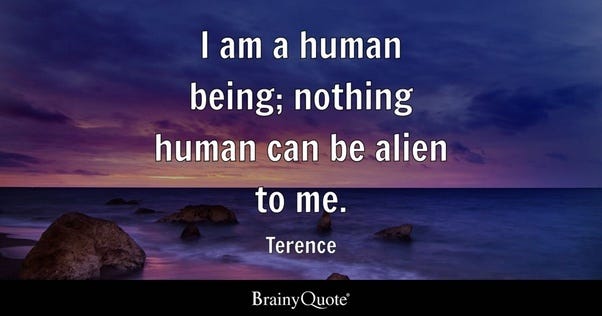
One of those reasons is inspired by an expression I’ve been primarily familiar with as an attribution to Voltaire — yes, precisely the quote I referenced above:
After being inspired by this quote for about thirty years, I discovered it wasn’t a quote by Voltaire. These are words from someone far earlier in history, Publius Terentius Afer, a Roman playwright otherwise more popularly known as Terence.
“Homo sum, humani nihil a me alienum puto.”
These are words from a play entitled “Heauton Timorumenos” (The Self-Tormentor) — Act 1, scene 1, line 77, written in 165 B.C.
I had lived with these words, inspiring my pursuit of knowledge of the world through the understanding of self for more than half my life before learning the truth of their origins. I’m still learning new things about it — even though I deeply value what they imply — to me.
This brings me to another quote I treasure by Picasso that he uttered in his 60s after already transforming the art world with his visions, “I am only just learning how to paint.”
I loved these words the moment I encountered them because they confirmed that I was on the right track in wanting to become an artist in this world and this life. I understood that what one does to find fulfillment in one’s life is contingent upon loving what one does. The fact that there was no end to learning within art, as expressed by a historical giant, inspired me.
I would never get bored by being an artist. I would never find myself outgrowing what exceeded my grasp, and I could give myself wholeheartedly to its exploration — infinitely — or at least within the context of a finite life.
There was no way I could become complacent and detached from life by choosing a vocation of exploration of life itself. The fact that I would never learn all there could be to know wasn’t a deterrent but an inspiration and a challenge to motivate me to learn as much as possible within the finiteness of time available to me in this life.
Within this microscopic pool of choice available to me as an individual, I found enough inspiration to carry me through a life of discovery. When I imagine the vastness of a universe, we have no clue how large it is or what there may be to discover, and it seems to me that the human species can find millions, if not billions, of years of motivation for discovery.
We have certainly learned a lot about the nature of reality, from a psychological to a physiological to a physical and materialist nature, and beyond, while exploring reality on a quantum level. The fundamental characteristic of learning is that with each answer to a question answered, many more questions emerge. Answers to questions about the nature of reality appear like fractal algorithms that can spawn infinite questions.
No matter how long or how well we succeed in surviving — mostly the challenges posed by our hubris, we’ll never run out of room for discovery.
This, to me, defines the very core of the most basic lesson in life: it’s not the destination which matters; it’s the journey.
This post is a response to a question posed in its full format as follows: “Is Elon Musk evil or corrupt? I tend to admire people that take their money and build something of value.”
Elon Musk is a typical human born into a life of privilege and who happened to be smart enough to leverage that privilege into such a degree of wealth that it allowed him to free up restraints on the ego that drove him to that wealth.
This phenomenon occurs because humanity has no overarching vision that unites us and that we all consciously strive toward in everything we do.
Far too many are still at the toddler stage of “I’ve got mine, eff you,” and our culture of wealth worshipping exaggerates the sort of narcissism we see running rampant everywhere.
Musk, Bezos, and an appalling list of etceteras got wealthy because that’s what they valued, not because they dreamed of using that wealth to better humanity. The people working on the betterment of society are mainly working on shoestring budgets while relying on closely-knit relationships with others who believe in the potential of what they’re doing.
Those are the invisible creators throughout society that people with privilege — the sharks among us love to feed on and claim credit for their creation. It is like a pattern Musk’s fanboys should be able to spot now due to their knowledge of him, but they somehow fail to see the obvious.
The consequence of this worship mentality is that we no longer view the wealthy as we view other human beings. The rich and powerful acquire, along with their materiality, a perception of superiority as a human who magically transcends human failings.
They don’t, but we see evidence of an analogy that money is like salt for food; it magnifies what was already there.
We haven’t come to grips with the implications for us as a species because of this particular blind spot we have cultivated through millennia of worshipping imaginary super/extra/meta humanoid beings as paternalistic avatars for our species.
We are groomed from childhood to worship, which comes naturally through trust between a parent and child. That depth of connection between humans is what defines humanity. For a species that has arisen from a history of barbarism, it’s not surprising to see relics of that bonding psychology in play to serve as the uniting vision for a culture we lack as a species.
This blind spot we have and this compulsion to worship wealth and power have been coming at a cost that nowhere near enough of us can yet see. Those who do are freaking out because of the eerie similarities the fawning behaviour he receives has with cult members. Being a fan is one thing, but abandoning all reason to avoid critical analysis and engage in a blind defence of antics that are blatantly self-serving nonsense only shows that it’s not Musk that’s a problem; it’s us.
We still haven’t gotten to that stage where we understand the meaning of “power corrupts, and absolute power corrupts absolutely.” — however, if we don’t get our environmental issues under control, we won’t have a choice but to believe unlimited wealth in the hands of too few is too much of a threat to the future of our species to allow it to continue without ensuring it halts immediately via guillotine.
Those who still don’t get it should ponder the wisdom of establishing an entirely new industry catering to the wealthy that will be responsible for the most significant environmental damage from a single human activity than all others, and that’s the amount of carbon pumped into our atmosphere to lift a ship into our outer atmosphere for ego boosting junkets for the pampered class.
They’re already responsible for the lion’s share of lifestyle contributions to our environmental issues, and no one is crying foul about their latest space penis ventures.
They’re not necessarily “evil” (even though Bezos does a tremendous job of being convincing in that area); they’re just self-serving adults with power who have the emotional development of children.
The consequences of failing to restrain power will undoubtedly be considered “evil,” but all of us will evenly share the blame.





















 thotbag