Is capitalism simply the human nature of “survival of the fittest”?

This post is a response to a question posed in its full format as follows: “Is capitalism simply “survival of the fittest” in humans, and just an explanation of human nature instead of an ideology?”

No. Capitalism is a system of exchange of value.

The toxic competitiveness that becomes defined as “survival of the fittest” is a human mental illness that perverts a life-saving, poverty-destroying system into a weapon of mass destruction serving their selfish whims.

Capitalism is not the problem, and the sooner we stop blaming abstractions, the sooner we can solve the issues that are being made worse with a tool like capitalism.

Capitalism is only one tool in a kit of corruption wielded by corrupt humans who destroy lives while seeking dominion over all others.

Another tool is our political system, and it’s being just as corrupted as capitalism.

Yet another tool being corrupted by vile creatures resembling humans is our justice system.

Our systems are corrupted by corrupt human beings seeking only one end: dominion.

The problems that have persisted throughout human history have always been the same: an evil obsession with power.

We are facing the threat we have always faced — power.

Power corrupts, and absolute power corrupts absolutely.

The only way out of the mess we are creating is to attack power, to disempower consolidations of power.

The only solution to the threat of concentrated power is to spread power throughout the globe and all of society — to share in power as equally as possible.

This is why democracy exists today, in whatever hobbled form it does.

This is why democracy is necessary for our survival as a species.

We must always find concentrations of power as threats to our existence and properly distribute power throughout the masses.

Everywhere power is concentrated, it is an enemy of the people and of the progress toward achieving our potential as a species. Institutions, industries (particularly multinational), and organizations of all stripes must be converted into democratic institutions.

We cannot continue to allow autocratic institutions to increase their power because their endgame is always dominion.

Spreading power to create democracy everywhere and in all things necessitates equipping the unskilled, the undereducated, and the under-developed with the knowledge and capacity to handle their increased personal power properly.

For this reason, we must learn to value education on such a level that we view it as the lifeblood of our existence as a species. Without it, we die.

Human nature craves education, even among those who hold educational institutions in disdain, because no one is oblivious to the value of learning something that makes their life even better.

Anyone in a position of teaching others knows that education is the link in the chain of our human existence as we pass on what we have learned from others to a future that stands upon generations of shoulders before them.

The light of awareness glowing within the mind of someone who has just learned something valuable is the most priceless treasure one can experience while passing on the most priceless gift one can give another.

Capitalism is a tool that can and has lifted us out of poverty, and we, the people, must take back control of capitalism to shape our future for the betterment of all and not solely for the few.

We must wrench the wheel of capitalism from the hands of those corrupted by its power and return it to its rightful owners — we, the people.

What policy proposal could combat teen pregnancies by men over 21?

This post is a response to a question posed in its full format as follows: “66% of teen pregnancies are fathered by men over 21. Do you have a policy proposal for how to combat this?”

When I worked in community development as an “Educational Counsellor” (Residence Life Coordinator), part of my role involved developing programs to address common issues affecting college-age students. Since many were away from their rural homes for the first time in their young adult lives and often were from strict homes, they spread their wings and acted out in sometimes unhealthy ways.

The overconsumption of alcohol was one of the most common unhealthy coping mechanisms many adopted. This necessitated various strategies for mitigating the effects of over-consumption, which would develop into habits over time and become addictions if one was unable to free oneself from such a toxic dependency.

This role was how I encountered a drinking cessation strategy by Homewood Health Services in Canada that used a series of posters in one of their awareness campaigns.

All the posters were designed to provide uplifting and inspirational messaging with colourful imagery and a touch of humour to appeal to that demographic’s sensibilities. One specific poster prompted me to reply to this question. I looked for it briefly online, but it was a poster from about 40 years ago, so I unfortunately cannot see it.

A brief description in which you will have to imagine a brightly coloured illustration with a chalk pastel texture. It was an image of the back of a person’s head while propped over a toilet bowl. The image was intended to convey how unpleasant over-consumption can be. I don’t remember the caption, but I remember how popular it was.

Of the various posters available for students to pick from and post on their walls, this particular poster was far and away the most popular.

I didn’t realize at first why beyond the mockery it would generate because no one likes the experience of “driving the porcelain bus,” and everyone laughs at the people who over-indulge to such a degree.

As it turned out, the poster became a type of “scorecard” in the party apartments within the residence complex. Each time someone “chatted on the porcelain phone,” they signed the poster.

It was disheartening at first because the poster was having the opposite effect it was intended for. It’s not like it encouraged people to over-consume alcohol, but it was like a ledger keeping track of the number of times one went too far.

At the end of the academic year, as students packed up their belongings, I encountered a few as they packed up and took their posters. In each case, the expressions they conveyed were that it had been quite a year and that they had enjoyed a lot of memories from their parties, except for the experience they had with a night’s discussion with “Raaalf.” The number of times they had signed the poster was like a demerit to remind them of the unpleasant experience.

They expressed regret over how much they had over-imbibed, and when they returned for their next academic year, they were far more reserved in their behaviours. Those students went from high levels of over-consumption in their first year to being much more academically committed students in their second year who had learned to drink moderately. They still socialized in their second year but were far more responsible.

The poster had worked.

It took one full academic year, but signing the poster after a night of “hurling chunks” left an indelible impression in their minds.

That’s how an education program works, slowly and with far more spectacular results than the heavy hand of imposition. When people learn to choose a healthier alternative because they want it, the results impressively outperform any authoritarian strategy.

This is what anti-abortion people don’t understand and why they’re so disgusting when they barf up ignorantly abusive disparagements such as characterizing an oppositional view as “pro-abortion.”

No one is “pro” a bad situation.

No matter how one characterizes an abortion. Nothing about it can be considered desirable, mainly by those who feel that’s their last hope. This is also why anti-abortion people are so inhumanly disgusting. They’re stealing a final lifeline of hope for someone in desperate straights… even worse is that they force medical emergencies into becoming incidents of premeditated murder by their depraved indifference.

This is why the SCOTUS rejection of Biden’s attempt to compel the state of Texas to perform emergency abortions based on a life-saving medical procedure makes them entirely unfit to lead the nation in its laws. Their responsibility to society is to establish a higher morality that respects and preserves life.

Nothing about the alleged “pro-life” is anything but “anti-life,” and nothing can make that more accurate than the numerous horrors that have already presented themselves since they betrayed women across the country and the world by extension with their reversal of Roe v. Wade.

The only policy that will effectively address the issue of teen pregnancies by young adults above the age of 21 is the policy that creates the peer pressure necessary to make those young adults who have not managed to mature beyond an abysmal level of under-developed morals afraid of being ostracized by their peers.

Nothing works more effectively than peer pressure. Education and awareness programs are the only way to achieve that kind of pressure. The more people realize the consequences of destructive behaviour, the greater the likelihood of it being mitigated “on its own” over time.

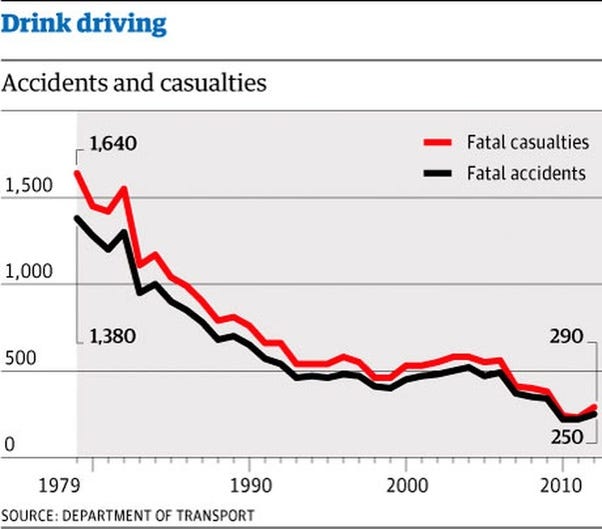
Time and patience are required to realize the benefits, but they are permanent fixtures in an evolving society. Peer pressure is how we have managed to reduce incidents of drinking and driving.

The heavy hand of an authoritarian never works. If anything, the consequence of imposition is always to make the problem worse.

Should US healthcare be a business?

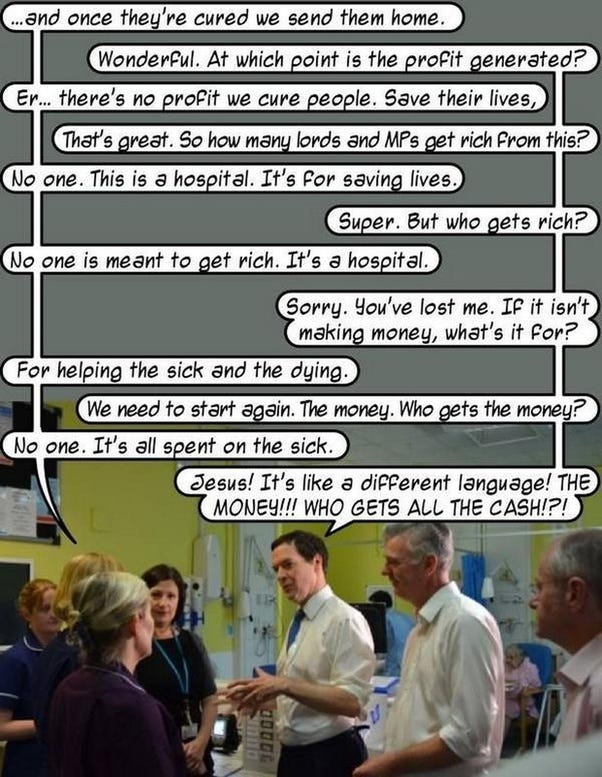
It should not be a business because it’s a public service, just like the military and the police… just like education should be.

When public services are operated with a profit-driven mindset, they deviate from their intended purpose, becoming corrupt and inefficient. This distortion invariably leads to their failure to serve the people.

Some things should never be run as businesses because their priorities are not profits but service, a value inherent to and critical for delivering effective public services.

It’s a fundamental truth that the primary goal of any business is profit. However, this profit-driven approach is incompatible with providing high-quality service. The two cannot coexist.

In business, one can choose only two out of three options between speed, price, and quality. It is a business mantra that recognizes you can only provide some of the three.

People who fail to understand business also fail to understand community development because you can’t provide a high-quality public service if profit is involved in any capacity. It is for this reason that all election campaigns should be publicly funded instead of privately financed for the profiteers who have corrupted the political landscape while transforming the nation into a fascist corporatocracy.

Restraining corruption within the political landscape demands a wall between business and state in the same fashion that a wall should exist between church and state. As institutions, they should not directly influence the other two’s nature, shape, or operation.

Corporations are medieval institutions based on authoritarian structures. Because of that, they cannot help but corrupt democracies, just like churches are also authoritarian structures capable only of corrupting the operations of a state.

The only efficient and effective way to operate a national healthcare system is to provide high quality at the lowest cost. The only way to achieve that goal is to pool all resources together and leverage a basic economic strategy called “economy of scale.”

As a citizen and a consumer, you apply that same strategy each time you buy something in bulk.

This isn’t rocket science, and the fact that the U.S. still can’t get its act together to do the right thing for its citizens is a testament to how badly corrupted by billionaires the nation has become.

The fact is that billionaires have invested a lot of money in programming people to believe the government is inefficient. The truth, however, is that all organizations become inefficient the larger they become.

The real solution to many problems the U.S. and the world are struggling with is acknowledging that “too big to fail” means “too big to exist.” No multinational corporation should exist today. No centibillionaires should exist today.

We’ve made a horrendous error in judgment by allowing power to be concentrated in the hands of the few. The consequence of that corruption is that a majority are now struggling needlessly when they were prospering only a few decades ago.

Community development is a service we provide for each other as part of the social contract.

There are plenty of opportunities outside of community service to make profits. There is no justification for turning every waking moment into a monetization opportunity — for anyone- and creating a culture in which that’s the expectation, which is a dysphoric consequence of a dysfunctional state of being that will sustain itself indefinitely.

As we have entered the late stages of capitalism, we can either adjust course toward a healthier and sustainable existence, or we will invite chaos into all our lives. We can stave that off by simply adjusting our biases. The first bias to change is acknowledging that healthcare is NOT a business.

Plenty of for-profit business opportunities exist within an endeavour as massive as healthcare. Like any non-profit enterprise working within a zero-based budget context, private industries are still free to operate on a for-profit basis. For a service as massive as a national healthcare system, that presents an incredible array of opportunities for innovation and competition by and between for-profit industries. The critical difference is that the decision-making body or board governing the healthcare operation isn’t distracted from providing essential services by a for-profit mandate.

There exists neither a need nor justification for basing the service provided to save lives on catering to a profit motive. It’s the worst way to serve a public with an inferior service at a cost that’s much more excessive than money because the price includes the lives of innocent people who are unfairly and unnecessarily made desperate to survive.

Why has the UK’s economy grown so slowly under the Tories?

This post is a response to a question initially posed on Quora.

lol… but not lol

It’s sad.

It’s frustrating.

It’s maddening.

It’s a bang your head against the wall to relieve the pain of blind ignorance kind of thing.

It seems that no matter where one travels on this tiny blue pearl adrift in a lightless ocean, one universal constant that science does not accommodate is the obliviousness demonstrated toward a long and less than venerated history of fiscal incompetence by those branding themselves as fiscally competent by virtue of their propensity for preservation.

As the old adage goes, “It takes money to make money,” while the CONs among us lack the spine to explore beyond their survival instincts, which favour hoarding among the favoured class.

It’s always the little people who get stuck with the honourable burden of austerity, never the luxury recliner class. They deserve their effetes, after all, because they are superior to the little people. That’s why they’re considered “royalty,” and by God’s good graces, they have a divine Reich to rule.

They should not be expected to lift heavy fingers to make manifest a reality catering to their sensibilities. That’s what the little people are for.

The little people are the beasts of burden by divine decree, and no one should ever question that wizdumb.

Conservatives are fiscally conservative, and that makes them better money managers than the swarthy class, which demands to be paid for the value they contribute to society and the luxuries of the pampered class.

If the uncouth class manages power, then debts and deficits will be deemed horrendous failures in leadership. If they hold the keys to the halls of power, then debts and deficits are a feature, not a bug.

If the tree-hugging barbarians wish to spread the wealth around to their peers, that’s a grievous violation of overreach for which they must be punished. The trillions in wealth generated by the sweat of hundreds of millions of brows rightfully belongs to their natural rulers.

When they Reichfully sit upon their thrones, then they are empowered by the lard almighty to share it with their peers, and if it so happens that one of them over-indulges, they are permitted to trickle down the excess to the wanton waifs beneath them. They must be careful, however, not to release too much of a flood because that would embarrass their peers by revealing the extent of their gluttonous obscenities.

They cannot afford that sort of smear to their optics because that would incite the little people into another of their tizzies to make heads literally roll.

No one wants any more cake. It’s too disruptive to their digestion.

At any rate, their inability to peer past their navels and acknowledge themselves as members of the same species as the rabble they exploit into early graves makes it impossible for them to notice opportunity when it knocks on their over-filled bladders.

They would rather piss into their chamber pots than allow any of their precious golden treasure to be used to elevate the lot of humanity.


If they did that, they would soon run out of heads to trod upon and lose track of who was a worthy peer by birth or an anomaly by self-made fortune.


If this seems a bit cynical, it’s because it is quite cynical toward a movement that has steadily reversed the course of capitalism to raise a world out of poverty by weaponizing it as a means of establishing power. The economy belongs to everyone while our systems undergo a consolidation of power that has historically been the cause of systemic collapse and widespread chaos.

In the words of economist Dean Baker,

The market is just a tool, and in fact a very useful one. It makes no more sense to lash out against markets than to lash out against the wheel. The reality is that conservatives have been quite actively using the power of the government to shape market outcomes in ways that redistribute income upward. However, conservatives have been clever enough to not own up to their role in this process, pretending all along that everything is just the natural working of the market. And, progressives have been foolish enough to go along with this view.

The economy should serve the social contract, not subjugate it while Conservative politics the world around have never quite accepted the reality that we are, all of us, in this together. A successful and prosperous future requires a mindset that accommodates all needs, not just those one can personally benefit from. The fundamental difference between the conservative “me” mentality versus the liberal “we” mentality is the cause of poor economic performance. It always has been and it always will be because it constitutes myopic and self-serving thinking favouring power to the few, and not the people at large.

Are human rights natural rights endowed simply by the virtue of being human?


This post is a response to a question initially posed on Quora.

Human rights are essentially an agreement between humans to protect a characteristic or behaviour of all humans within their community.

Human rights exist only by virtue of the agreement itself and the degree of commitment by other humans to protect those rights.

This is a global issue, with human rights being violated all the time and everywhere on the planet. It’s a problem that demands our immediate attention and action. This is why human rights are violated all the time and everywhere on the earth.

We have far too many humans who view rights as scalable according to their essentially misanthropic perceptions of humanity — because we are suffering from a mental health pandemic affecting at least one in five among us. We are only now beginning to realize that we are a species that has been suffering for centuries from generational trauma from our barbaric origins.

The fight for universal human rights is a fundamental building block in a healing process that will require centuries to emerge from.

We are far better off today than we were one century ago simply because of our increased awareness of the issues we are dealing with and an emerging appropriate context from which we interpret our experiences.

Human rights are crucial to preserving the social contract and ensuring systemic stability.

Without human rights as a concept enshrined into law, we descend into barbarism.


After writing this answer and posting it, I realize I’m doing a disservice to the concept by providing such little context.

Human rights have a long and bloody history of development in which their inklings as concepts we should value as a species were responses to centuries of brutal violence characterizing human life.

The earliest examples of human rights enshrined in local laws date back to circa 2350 BC in Asia as the reforms of “Urukagina of Lagash,” which evolved into more well-known examples of legal documentation such as “The Code of Hammurabi” from circa 1780 BC.

Ancient Egypt also supported fundamental human rights through documents such as “The Edicts of Ashoka” (c. 268–232 BC). Other principles of human behaviour emerged during this period, while one such principle has been incorporated throughout most living religions today and is popularly known as “The Golden Rule.”

Fast forward to 622, and “The Constitution of Medina” functioned as a formal agreement between Muhammad and the tribes and families of Yathribe, which included Muslims, Jews, and pagans. This agreement was an early means of uniting all peoples of the land under a common identity referred to as “Ummah” and incorporated several changes to how slavery was defined and limited.

Early Islamic laws from this period incorporated principles of military conduct and the treatment of prisoners of war that became precursors to international humanitarian law.

Moving forward into the Middle Ages, the most influential document establishing the modern basis for human rights was the creation of the “Magna Carta,” itself heavily influenced by early Christian thinkers such as St Hilary of Poitiers, St Ambrose, and St Augustine.

The Magna Carta of 1215 influenced the development of “common law” and several constitutional documents following, all related to human rights, including the (1689) “English Bill of Rights” and the (1789) United States Constitution.

Some may remember from the Iraq War and the establishment of Guantanamo that the Bush administration suspended the writ of “Habeas Corpus” — the right to know what one has been accused of — was a right established in the Magna Carta. This was a fundamental violation of a basic right that set the nation back in time to an era of barbarism — and they hypocritically leveraged that violation to commit war crimes for waterboarding that the U.S. itself forced Japan to face an international tribunal for war crimes over the same behaviour decades earlier.

This is a stain on the American people that will not wash off their conscience while they do nothing to own responsibility for their grotesque violation. This dark moral failing of the nation has become a slippery slope of moral failures permitting the monstrosity of immoral behaviour. We — as in the world- are now on the verge of potentially falling entirely into a pit of immorality because of their “leadership” in this area.

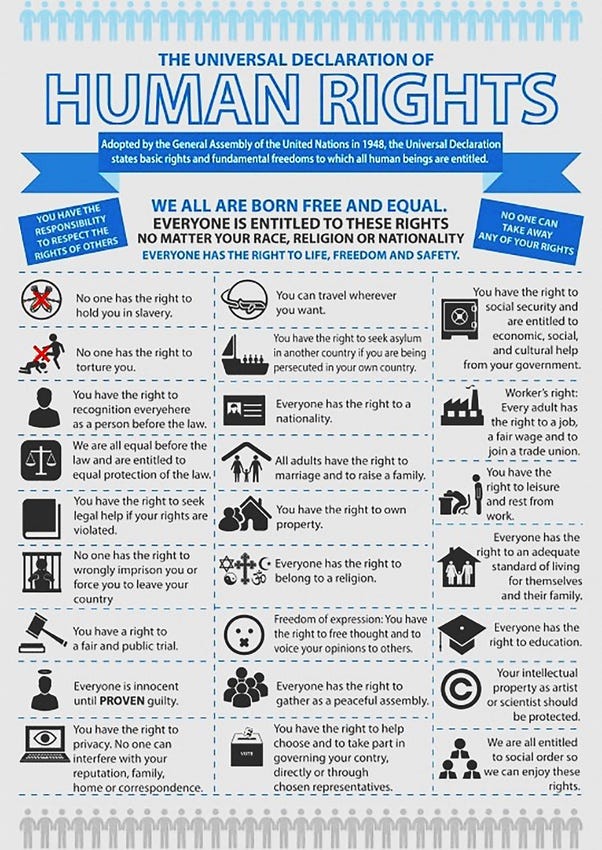
At any rate, I’ll avoid proselytizing further and get to the goods of reading material and a “pretty picture” at the end with a chart of the Universal Declaration of Human Rights:

Human rights — Wikipedia

History of human rights — Wikipedia

A Short History of Human Rights

A brief history of human rights — Amnesty International

Universal Declaration of Human Rights | United Nations

Why are there so many degenerates in this world who lack a moral compass?

This post is a response to a question posed in its full format as follows: “Why are there so many degenerates in this world that lack a moral compass, namely in 1st world countries where most learn this by the family that raised them, school, sports, being in public, etc?”

The problem with this question is that it’s impossible to construct an objective answer to address its core concern. This question is more of an emotionally driven complaint than a question.

The reason is that it’s built upon subjectively defined presumptions like “degenerate” and “morality.” Neither of these concepts has any objective metric to identify differing degrees of degeneration or morality between any two random people.

Adding to the subjective complexity, universally accepted standards for the definitions of these terms do not exist.

What can be deemed “degenerate” to one person is celebratory to another. What is viewed as “morality” to one person is heinous to another.

Making matters even more complicated is that a word like “degenerate” constitutes a value judgment. Regarding its use, what that person views as “degenerate” is already a visceral rejection of the object of their judgment. There is no wiggle room for the interpretation of an individual’s value. No description of the specifics of the behaviour in question leads to the value judgment of “degenerate” because “lacking a moral compass” is just as subjective a judgment as “degenerate.”

This question is an example of circular reasoning permitting no room for objective examination nor any means by which one can identify alternative conclusions to the objects of such visceral criticism.

The only way to address this question is to search one’s memories for emotional reactions one may have had that can dredge up conclusions about different experiences one can align with the question based on a similar degree of emotional intensity governing one’s biased findings.

This style of generic language relies upon the subjectively defined feelings of others to function more like a dog whistle than a critical analysis of the issues in question.

This kind of “loose language” is a breeding ground for bigotry to evolve in a landscape characterized by pure emotion and which lacks grounding in any shared physical reality.

For example, if someone were to mug someone else and witnesses talked about the event while sharing similar emotions and a similar view of the event in question, they could quickly dredge up a similar degree of emotional intensity to this question. Their views would be predicated upon a shared experience, while their particular reactions to the event would be grounded in a shared physical reality.

In the case of this question, that shared reality exists only within the realm of individual imagination and dredged-up memories of different events. Here’s a generic dialogue of an imaginary sharing of emotional intensity to highlight this dynamic:

First Person: “I was supremely pissed at this one thing this one person did. Be as angry as I am about this thing you didn’t experience.”

Second Person: “I didn’t experience what you experienced but let me tell you, I also got supremely pissed about this other thing that you didn’t experience, but because we’re both supremely pissed, we share a common ground of agreement.”

First Person: “So, you agree that we both have good reason to be supremely pissed to the point of sharing a mutual hatred for something?”

Second Person: “Yes. We both hate something very much.”

First Person: “What do we hate together?”

Second Person: “How about that thing over there? It’s pissing me off right now that I’m in a sour mood.”

First Person: “I agree. Let’s both hate that thing. That way, we can forget what we hated separately and find camaraderie in a shared hatred for something else.”

This dynamic is how bigotry spreads throughout a population to function like a transmissible disease.

This is why language choices are crucial for objectively apprehending the realities we react to.

Allowing another person’s subjective responses to dictate one’s attitudes toward a subject abdicates their free will and subordinates their opinions to whoever demonstrates the most significant force of personality.

This is the process by which identity politics emerges.

This is precisely the dynamic that Donald Trump has built his political collateral upon.

It is a means by which critical thinking is killed, and people like Rupert Murdoch capitalize on it as a vehicle for personal enrichment at the expense of the social contract.

This is why we have “so many degenerates in this world who lack a moral compass.”

Did JD Vance lie about never supporting a national abortion ban? (Bonus Post)

This post is a response to a question posed in its full format as follows: “JD Vance said in the debate that he has never supported a national ban on abortion. Does that mean that he was lying when he said (on tape) that he wanted a National Ban on abortion?”

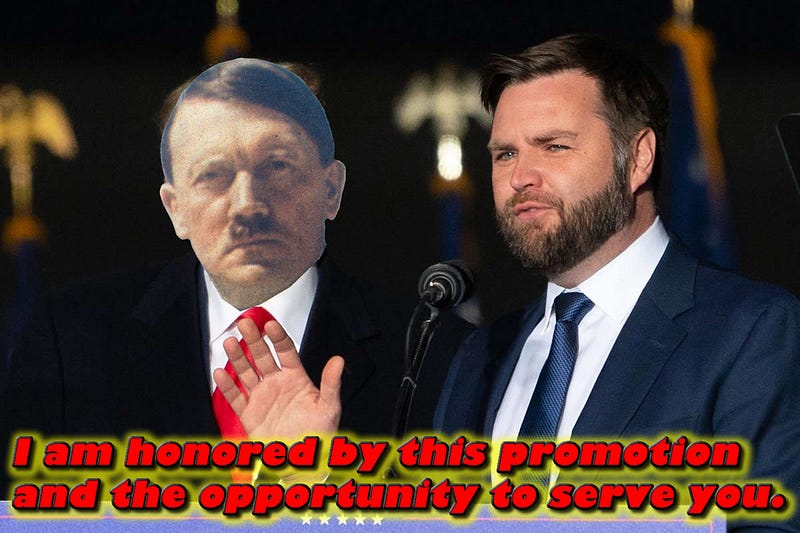
I hadn’t intended on “upgrading” this answer to the level of a post, but the upvotes I’ve been getting suggest to me that perhaps fewer people are skilled in “reading between the lines” of what people say than should be the case with critical political issues that significantly impact people’s lives. What I’ve realized — and what prompted me to make this “bonus post” today- is that what appears blazingly obvious to me is not so for far too many others. Understanding the art of dialectics within the context of political leadership has never been a more crucial skill for people to develop as part of the critical thinking kit. Hence, my response to the question posed is below. (Plus, this is an opportunity to share a meme I created when J.D. accepted his invitation to serve as POTUS potentially.)

Does it really matter if he lied about something in one instance but not in the next?

How can you tell which is the lie and which is the truth?

How can anyone know what someone really means if you have to choose between multiple conflicting statements?

What’s the point of trying to parse them to determine their belief in an issue?

What they are saying by making conflicting statements is that they choose their words to appeal to whatever audience they are speaking to.

They practice “the art of telling people what they want to hear.”

They admit that they believe in nothing but achieving whatever goal they seek and care little about how much their actions might hurt others.

They admit they have no values beyond manipulating gullible people.

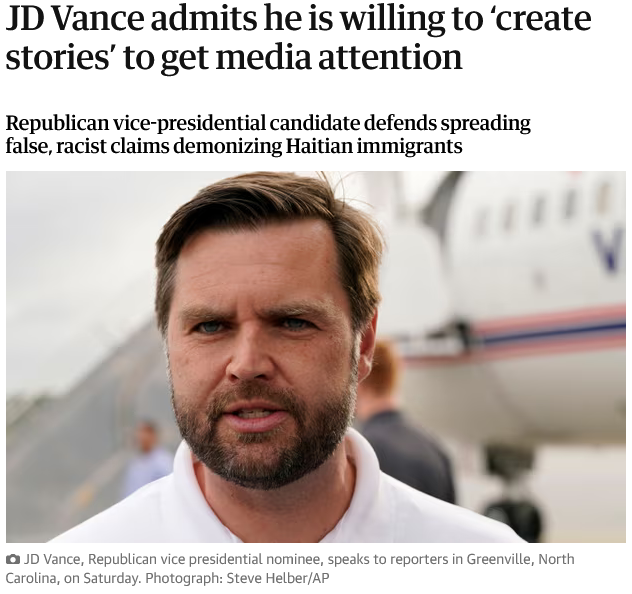
He has admitted to doing just that when he claimed to be justified in “creating stories” to get attention — even though innocent people have been put in jeopardy because of his “stories.”

https://www.theguardian.com/us-news/2024/sep/15/jd-vance-lies-haitian-immigrants

The only valid conclusion any sane person can draw from that is they can’t be trusted because one should know that they will continue to lie to anyone and everyone they can to achieve whatever benefits they can for themselves.

It means that if he can personally benefit from a national abortion ban, he will support it.

It means he’s openly bargaining with the people who want a national abortion ban by telling them in public through his “hidden message” that if they grease his palms, he will support a national abortion ban because he doesn’t care who he will hurt in the process.

Why don’t the vast majority of humans have great new ideas?

This post is a response to a question posed in its full format as follows: “Why is it that the vast majority of humans don’t have enough ability or potential to make great new inventions or come up with great new ideas?”

I don’t believe that’s true.

Humans have far more potential than they are often given credit for by mostly misanthropic cynics.

We see stories of extraordinary inventions by otherwise “ordinary” people all the time.

The Malawian Boy Who Brought Electricity To His Village Was Once Called ‘CRAZY’ — Here’s His Soul-Stirring Story

18 Random Invention Ideas That Made Millions | Cad Crowd

10 Amazing Inventions We Don’t Appreciate Enough

8 Famous Inventions Inspired by Love

The list goes endlessly on where individuals have succeeded against all odds to bring their ideas to life and benefit millions along with themselves.

The tool you’ve used to justify a disparaging view of your fellow humans results from random convergences of creativity by individuals with initiative and the coordinated inventiveness of enterprise initiatives — all contributing to this massive system of human interconnectedness.

As we know it today, the internet could only exist with hundreds of millions of imaginative people contributing their ideas to what it is and what it can do.

In a world where we become addicted to the hoopla of audacious behaviour, we tend to overlook the ordinary, everyday creativity of individuals focused on more mundane challenges, such as how to survive.

There is an entire genre of everyday creativity where people devise unique solutions to everyday issues, like using pasta to avoid being burned while lighting a candle.

Or using a ceramic coffee mug to sharpen scissors:

49 Life Hacks You’ll Wish You Knew Sooner

“It Simplifies My Life So Much”: People Are Sharing The Little Habits And Hacks That Make Life Easier

200 Incredible Life Hacks That Make Life So Much Easier — LifeHack

Human inventiveness is everywhere. Amazon alone has over one dozen books on the phenomenon we’ve been referring to as “Life Hacks” for well over one decade now:

100+ Life Hacks for Ordinary People: Unlocking the Power of Simple Solutions for Productivity, Health, Finances, Relationships, and More

The problem isn’t that people aren’t creative or lack potential for inventiveness; people overlook it all the time because they’re more fixated on the spectacular inventions that generate buzz, and that’s often a consequence of financial success more so than creative success.

After all, Pet Rocks was not a “creative invention,” but it was audacious and made a fortune for the person who concocted the scheme. People worldwide marvelled not at the product but at its remarkable marketing genius.

One of the most significant barriers to creativity is not the gazillion ideas everyone has almost every day but essentially other people’s cynical perceptions of them — either due to a bias toward the individual, their concept, or the critic’s insecurity.

I also believe the misanthropic attitude displayed within this question is a significant barrier to humanity’s ability to achieve its potential.

This is a self-serving question in which the cynical view of humanity is an excuse to avoid the hard work of rising above the fray by feigning its disdain for the rabble.

Another significant barrier to human creativity is the follow-through, which requires a committed effort to manifest ideas in reality. Often, that barrier is a consequence of time and/or resources. Still, it can also be due to harmfully pessimistic and unsupportive attitudes from others and a lack of stubbornness to fight resistance and plow ahead until the “only true form of failure in life” is arrived at by dying.

One is much better served by focusing on how one can be creative for one’s benefit rather than projecting one’s insecurities onto humanity with a misanthropic attitude.

We are an incredibly creative species. Everyone is capable of creative endeavour if secure enough in themselves or are free enough to indulge in their creative dreams to pursue them.

Instead of worrying about the “vast majority of humans,” worry about how you can be creative for yourself. By focusing on your creativity, you’ll find your mind opening up to possibilities you never imagined while being surprised by how incredibly creative the people you see all around you are.

Temet Nosce

How to Restore, Strengthen and Preserve a Democracy

Democracies are strengthened by the degree of engagement by the people. The more people become informed, engaged with, and involved with their government and its activities, the more secure the democracy.

A disengaged and apathetic citizenry makes a government susceptible to corruption.

Restoring and reinforcing the stability of democracy begins in the classroom with a comprehensive civics-oriented strategy for equipping students with the skills and insights to achieve success in effective governance and their personal lives.

As it turns out, the overlap in skills for effective governance and success in one’s personal life are represented as an almost clean circle in a Venn diagram.

The range of interpersonal skills one can and should develop are core competencies for life. Communication skills, negotiation skills, and conflict resolution skills are all universally valuable skills. Developing competencies in areas like Robert’s Rules of Order and understanding the nature and process of effective legislation (rules to live by) may be more niche but are transferable skills that can be applied in other areas of life, particularly when they’re not considered obscure skills by a majority like they are now.

The more people who know how to declare a point of order, the fewer conflicts could escalate into violence.

Of course, the development of logic and critical thinking skills should be included in the curriculum, if not as courses but as strategies for delivering an existing course load.

Applying critical thinking skills development within a history class, for example, would increase student engagement simply by structuring the information delivery process through a means that challenges one’s thinking skills.

On an entirely different and equally crucial level is the reinforcement of a commitment to the role of the Fourth Estate in society. The profit motive must be removed to protect objectivity in the information delivery process, ensuring the public is adequately informed of relevant news in the most agnostic way possible.

Breaking corporate media into community-based employee co-ops will create a culture of checks and balances that approach the self-regulating effectiveness of the peer review process within the scientific community.

The election process is another area that must be made as agnostic as possible. Removing the undue influence of money in elections and reducing the tribalism of the currently corrosive culture in politics is critical to mitigating ideological bias. First-past-the-post elections should be replaced with proportional representation and ranked-choice voting.

With these measures, an exceptionally stable democracy can emerge on level ground with inbuilt resistance to corruption.

Leon Wieseltier — Quote on Democracy

What are the most concerning threats to free speech today?

This post is a response to a question posed in its full format as follows: “What are the most concerning threats to free speech and open discourse in Western democracies today?”

The people currently scaremongering that free speech is under threat are the most concerning threats to free speech and open discourse in democracies today.

People like Elon Musk, who declare themselves “free speech absolutists” and then ban them from posting on a public forum because they’ve either personally offended him with their speech or they’ve raised too much money to support a candidate he doesn’t support.

People like Donald Trump are also a threat to free speech while claiming to be a champion as he issues threats to media empires like ABC for not kowtowing to his abusive behaviour during a debate or his vow to shut down late-night comedians who mock him and his cartoonish stupidity.

Freedom of speech is healthy and under no threat by any operating democracy in the world, not even in a corporatocracy like the U.S. is freedom of speech under any imminent threat — beyond that posed by the aforementioned predators.

The people who whine the loudest about threats to their freedom of speech are mostly the cancel culture crowd who interpret freedom of speech as a right to be listened to.

You can say whatever you want, but no one is obligated to listen. That’s the fundamental reality of speech in society in general. The freedom part applies only to a government’s ability to not threaten people for saying stuff that gets under the skin of some power-hungry official — like Trump. If he’s elected, then freedom of speech will most definitely be under a severe assault — although no MAGA believes that. They will if he wins. Then they’ll complain like the regretful Brexiteers in England.

“But… But… But… he’s not hurting the people we want him to hurt. He’s hurting us, too!!! He didn’t tell us he was going to make our lives miserable. He only promised we wouldn’t have to vote any longer. We thought that meant freedom!!!”

Nope… that’s “freedumb,” and say goodbye to your right to speak your mind.

In short, the people who claim to be the most fervent defenders of “free speech” are the people who pose the greatest threat to “free speech.”

I know… that’s effed up, ain’t it… but that’s the Bizarro world we live in… ours happens to be round… or possibly flat.