Why don’t you believe God exists?

This post is a response to a question initially posed on Quora, and can also be accessed via “https://caseforatheism.quora.com/Why-dont-you-believe-God-exists-16

Your question is entirely backwards.

Atheists don’t need to justify why they don’t believe God exists.

You don’t need to justify why you don’t believe the Sun turns pink at night and shoots golden sprinkles throughout the night to create stars that fairies light up with their magic dust.

Believers do, however, need to justify why anyone should believe their claim that a God exists.

You don’t have to justify anything you do or don’t believe to anyone until you try to convince them to accept your belief.

Atheism is the absence of a belief in the existence of a God. That disbelief technically means atheism is the same as nothing. Atheists have no motivation to share the nothing that comprises disbelief with anyone. Atheists generally don’t care what believers believe or disbelieve until they make it their business to convince atheists to think the same as they do.

Your question is like expecting someone to justify why they don’t believe snakes have wheels hidden in their scales that we can’t see, but they secretly use them to speed their way along the ground when no one is looking.

This atheist could write a novel explaining the journey taken from early indoctrination as a child and the early doubts about that indoctrination, which grew over time as more and more questions remained unanswered while more and more contradictions to the claims of the existence of a God appeared ever more undeniable, but none of that matters.

The only answer to your question that you deserve is that Atheists do not believe in the existence of a God. The only fact relevant to that answer is that atheists paid attention to reality and asked questions about reality in ways that made unjustifiable beliefs unsustainable.

There is no point in adhering to a belief when reality contradicts it.

There is no point in believing that Santa Claus exists as an adult because only children wake up on Christmas day to find a mystery of gifts deposited under a tree awaiting them.

Adults know there is no magical entity depositing gifts, so there’s no point in believing Santa Claus exists. Most adults would consider it quite delusional for an adult to think Santa Claus exists. I’m sure you’re one of them.

Meanwhile, atheists who deal with questions like this are left wondering when believers will wake up and start asking themselves why and how adult believers can still believe in fantasy figures granting magical wishes.

Why do you believe some supernatural Father Cosmos lives in some Quantum realm (instead of the clouds or mountaintop that used to be thought of as God’s home)? Why do you believe your fantasy father figure magically created billions of light years of space and trillions of galaxies, suns and planetary systems to place you at the centre of creation as his special child that he watches over? Do you watch over your eyelash mites? Do you communicate with your gut bacteria? Why do you believe your God looks like you?

If you can stop to think about your question, you’ll realize that it is backwards because it’s not about what atheists don’t believe, but why you do believe a God exists.

You would not otherwise pose your question to atheists if you weren’t already experiencing some shred of doubt in your belief. Instead of exploring that, though, you seek some form of justification from atheists because you’re afraid of losing your faith.

If you think about that for a while, you will realize that your fear was deliberately cultivated within you to keep you in line with your belief system, as it was designed to control your mind.

Instead of wondering why others think differently from you, try to think about why you believe the way you do.

You’ll get better answers that way, and they’ll be answers that get you further in life. The only answers you can get from others on this score are explanations of their personal views. Meanwhile, the entire point of being on Earth and living your personal life while experiencing growth and change as an individual is to learn your answers for yourself.

That’s the essential difference you’re struggling to identify with your question — why atheists are different than you.

The truth is that your beliefs are yours to develop in a personal journey through life. Your religious indoctrination has taught you to think that process is a “personal relationship with God.” The sooner you can rid yourself of an imaginary intermediary in your quest for knowledge, the sooner you will develop a clarity of mind in which you can understand on your terms why atheists don’t believe in the existence of the God you’ve been taught to believe in.

Otherwise, you will never truly understand any answer any atheist will give you to your question.


What would be some hallmarks of a Utopian civilization?


This post is a response to a question posed in its complete format: “If you lived in an advanced-utopian civilization, what would likely be some of the hallmarks of said thriving and freedom loving society?”

On my way to where I am now to undergo a first-time experience that I’m not looking forward to, I had the opportunity to observe a passenger on the bus who prompted me to think about the environment I grew up in.

This person, who appeared somewhat masculine in his maleness, was adorned with a few piercings that were never seen in the backwoods troglodyte village of toxic masculinity I grew up in, but that was not what caught my eye. I’ve seen enough piercings, tattoos and a variety of body decorations now that most of it goes unnoticed.

In this case, his nails first caught my attention, and the colour he had painted on them appeared an aesthetically pleasing burgundy. That’s what prompted me to notice the rest of his presentation.
My cultivated biases assumed unimportant superficial characteristics about this person. Still, upon further glances, I felt them melt away because, beyond the decorations, he appeared like a typical CIS male to me.

I wondered how much of that approach to aesthetics I would have adopted had I been raised in a “more modern” setting.

I never experienced more than passing thoughts about getting an ear pierced or getting some tattoos that I never found the courage to do. Still, I would have if it were not for the rather conservative upbringing I experienced in a low education and highly biased environment that has left me with a lingering self-consciousness of doing so.

Then I arrived at my destination, and while patiently waiting for an appointment (that would consume most of my day but won’t begin for another hour, even though I was expected to arrive two hours before admission), I encountered this question on my notifications feed.

My first thought went to the person I observed and how social expectations would be far less regimented and myopic in a Utopian environment.

Another characteristic I would expect is that my waiting experience to perform a standard procedure would be done at home with far less discomforting advanced prep and greater expediency.

I also read, on my bus trip here, that the UK has been making “anti-cancer injections” available to the public for addressing about fifteen common varieties of cancer. It’s a treatment that appears to function like a vaccine by boosting a body’s immune system and training it to recognize cancer cells, to remove them naturally in their early stages. The article was, however, rather skimpy on detail, so I will research it further in depth when I get home.


(Here we go — my appointment was far shorter than I feared.):

Cancer patients in England to be first in Europe to be offered immunotherapy jab

NHS England » NHS Cancer Vaccine Launch Pad


I think simple remedies for complex medical challenges that we struggle with today would also be another feature of a utopian environment.

Other features of an advanced society to me would include, along with many technological advances for assisting with biological issues, transportation, and the provisioning of various resources like education and access to community administration processes for public engagement, would include access to resources permitting one’s development of a meaningful vocation without being distracted by meeting basic survival challenges.

Whatever interests a person might have would be easy for them to explore without encountering numerous barriers preventing them from developing their interests in ways that engage and benefit the public.

For example, I read about an eleven-year-old girl developing a means of testing for lead contamination in water.

While we can celebrate the innovation and ingenuity demonstrated by a remarkable youngster, we often overlook how such a child would have required access to supports not common to most to have been privileged enough to pursue an interest to such a degree that their idea can save lives.

One of the most destructive limitations we place on human potential is the misanthropic attitude many people display, cultivated by an economic system distorted by toxic competitiveness.

A utopic society would have cleansed our collective psychologies of the many mental health maladies that we’ve inherited from centuries of generational CPTSD. The most potent form of utopic boost to our potential as a species is our ability to support one another while possessing the courage to address the psychological dysfunctionalities that hamper our development.

A utopia would be a humanity free from the burden of many of the toxic aspects of human psychology that are the cause of so much pain and suffering on levels that would be considered outlandish in fiction and a bloody horror show of sociopathic stupidity in real life.

This kind of shit, for example, would not exist in a Utopia because we would have matured enough to acknowledge, first and foremost that this is a treatable medical condition that should disqualify these people from operating in any position of authority. This kind of broken mentality should be considered a socially destructive mental health issue in which the effects are severe enough to warrant mandates for compulsory treatment before being allowed to participate in activities that could be harmful to others.

A Utopia would not be suffering from a mental health pandemic affecting one in five people and resulting in a whopping majority (70%-80%) of families being dysfunctional.

Until we can deal with our mental health issues, however, any form of utopia will remain a pipe dream as we allow our species to be consumed by the chaos created by our psychological dysfunctionalities.

When I witness casual examples of people breaking stereotypes, however, such as a male with burgundy nails, I think that although we may be dragging our asses into maturity as a species, at least we can see some subtle signs of progress.

What makes people elect corrupt candidates?

This post is a response to a question posed in its complete format: “What makes people elect candidates for influential government positions while knowing them to be corrupt?”

Sadly, corrupt agents in government and media have succeeded in appealing to cynical minds enough for a significant proportion of people to believe everyone is corrupt, that there is no difference between parties or people in each party.

Misanthropic cynicism has always existed, but it began to define politics when Ronald Reagan claimed the government was the enemy.

It was a half-truth which appealed to enough people to begin choosing political leaders based less on who they supported and more on who they disliked.

As our societies have evolved from primitive states, most people have consistently found themselves at odds with those wielding the most powerful in society. Before arriving at our current state of global reach by a handful of centibillionaires and multinational corporations, the most powerful in society were always represented by the governing body of a society.

It has been relatively easy to convince people that the most powerful enemy in their lives is the government they comprise as individuals in a system of democracy. It is nearly impossible for people to grasp how a lone individual with a global reach can pull the levers of many governments worldwide. Even though this has been happening for decades now, we have been fortunate to have been given a glimpse behind the curtain when news of Musk’s meddling in the affairs of multiple nations around the globe reached our attention.

On a “quieter level,” Canadians have been experiencing the corruptive influence of oil billionaires such as the Kochs, which has resulted in the creation of an almost national crisis with a separatist movement in Canada originating within the province of Alberta.

Canada is not the first, but only one among many nations around the globe that have been assaulted by mostly American billionaires seeking to extend their reach and control the resources of other countries.

Example upon example of this corruption endorsed by the most powerful among us who transcend governments and destroy governments can be found almost everywhere, from Venezuela, to Iran, Iraq, Panama, and Vietnam.

Understanding how democracy is a system of the people remains challenging for a significant proportion of the population, who also remain susceptible to propaganda through their ignorance of governance today.

Many people still think of government as a ruling authority rather than a servant of the people.

The complexity of the dynamic and its layers throughout society, such as the distinctions between federal, municipal, and state/provincial governments, create barriers to understanding. Meanwhile, our corporate environments have grown to such degrees of influence that they, more than governments, shape our daily lives.

They have, since being permitted to rule by corporations supporting right-wingers throughout the world, defined life for all of us, and that has meant stealing the necessary time, resources, and education the people need to understand how our world functions.

The harsh reality of electing puppets to enable the corruption of the powerful among us is as simple as participating in an auction to establish ownership of a politician who wins their election primarily based on how much funding they get.

When 80 %+ of election winners win because they raise more money than their competitors, we create a feedback loop of corruption in our electoral systems. If winning a cushy job that one can leverage to become a millionaire is as simple as catering to billionaire whims, then we are inviting the most corruptible citizens among us to benefit from screwing us all over.

This dynamic, in turn, reinforces the perception that all candidates are corrupt.

By creating a two-party dynamic, the wealthy and powerful billionaires among us establish a see-sawing dynamic of opposites in our elections that makes it easier to manipulate the people while creating a horse race for their entertainment as they compete among themselves instead of allowing the people to exercise their democratic rights to self-governance.

Their deliberate manipulations of electoral dynamics turn political gamesmanship into a sporting event where those lacking the time, education, and energy to be vigilant dominate the political landscape. This leaves us all to be led by the whims of the most cynical, undereducated, and emotionally unhinged mental health patients among us.

Unless we change this dynamic on a fundamental level by eliminating the influence of the powerful among us, we will continue a trajectory of increasing conflicts, such that we will no longer be able to ignore the widespread destruction of modern society.

We are on a path to chaos, and the people standing in our way are the people we must retrain, but won’t because too many among us envy their wealth and power to such a degree that they fantasize about acquiring such wealth for themselves to empower them in acts of retribution toward their neighbours.

How do Europeans avoid giving poor people something for nothing with universal health coverage?

This post is a response to a question posed in its complete format: “One of the arguments against universal health coverage in America is that we are giving poor people something for nothing. So how are European countries able to avoid this while offering universal health coverage?”

They don’t avoid that, but those who argue against universal healthcare are more fixated on hating the poor than they are on understanding how “giving the poor something for nothing” results in superior healthcare at half the cost for themselves.

The cost-based mentality is surprisingly dumb when they can’t comprehend how much they can save when considering expenditures as investments rather than losses.

It is precisely this thinking that Donald Trump has been leveraging to send the nation into a recession.

Conservative thinking tends to be so very short-sighted that when they claim to be fiscally responsible, all they’re doing is showing the world they’re incapable of stimulating growth.

Conservative thinking about healthcare epitomizes their fiscal incompetence.

Fiscal issues are entirely based on a revenue versus costs model, but conservatives seem capable of understanding only one column on their balance sheet.

The capacity for creativity is why liberals excel in the revenue generation side of the balance sheet. Conservatives could learn some valuable lessons about fiscal competence from liberals if they weren’t so close-minded and filled with hateful bigotry.

Caring for the poor is how we bring out the best for everyone at the lowest cost.

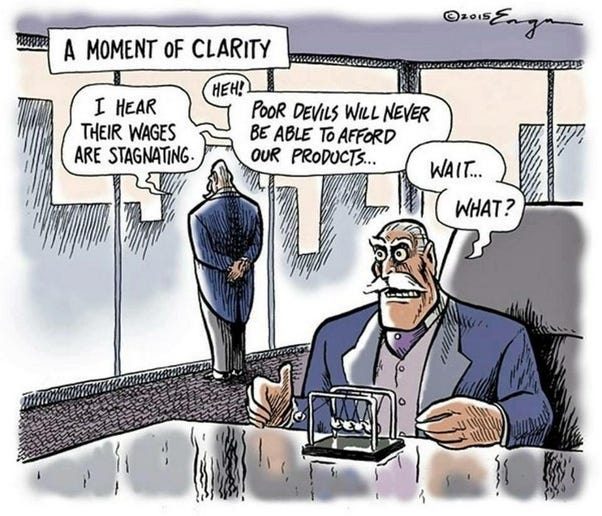
If the top one percent create jobs, does money drip down?


This post is a response to a question posed in its complete format: “If the top one percent create jobs aka businesses, then without the everyday worker it would only be pipe dream right? Does money drip down not bottom up?”

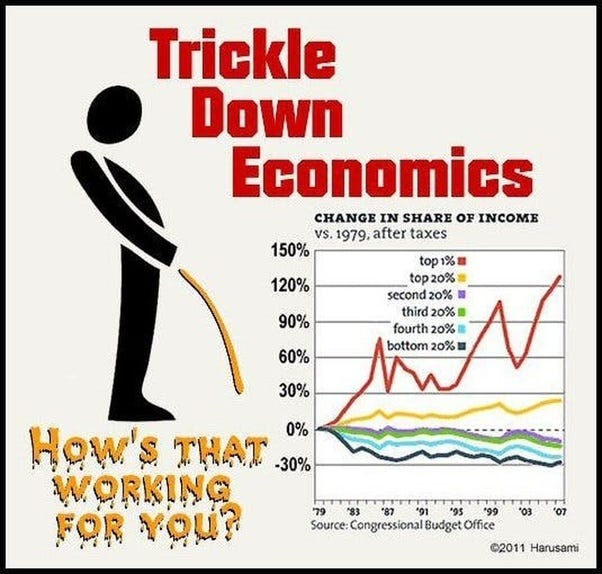
That certainly is the myth perpetrated by the one percenters, but that’s just a narrative they have invested millions in convincing the gullible to support their hoard-growing efforts.

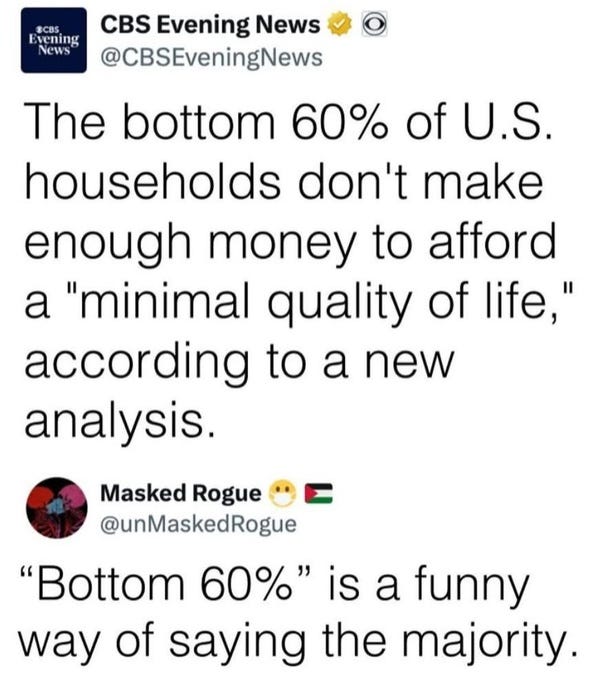
Anyone who spends even just minutes thinking about how the working class is the engine of the economy knows that’s just bunk — simply due to numbers and how no business can survive without market demand, because you can’t force people to buy your product, no matter how much Elon Musk wishes it were the case.

The job creators in society are the mass of consumers who create enough demand within any market niche, which justifies hiring staff to meet demand.

Making matters worse has been how the one percent have perverted the capitalist system to reduce their tax burden and eliminate laws that would prevent them from indulging in job-killing initiatives like stock-buybacks that they then distribute to shareholders, board members, and executives.

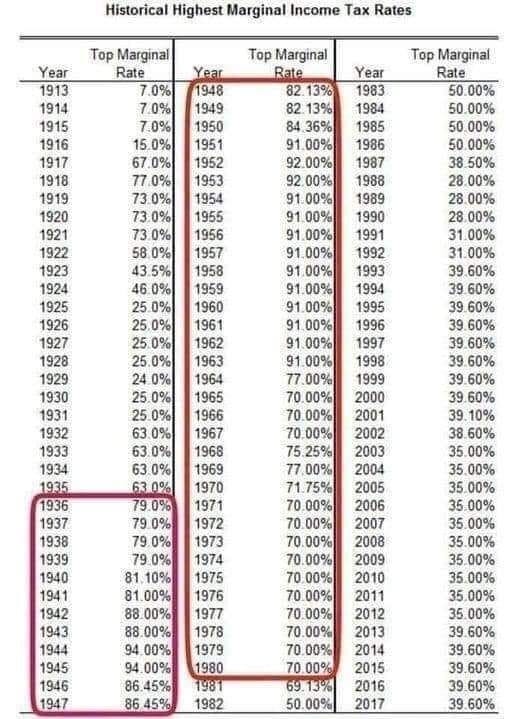
Fifty years ago, under a system of higher taxes and greater regulations limiting corruption, the one percent were incentivized to hire more people to reduce their tax burden. Further to all of that, and before the one percent went on massive “union-killing sprees” with corrupt “Right to Work” laws, the middle class had disposable incomes that they then reinvested back into the economy at greater proportions of their total wealth than the one percent ever have to create the most significant economic growth this world has ever seen.

When the middle class had disposable income, they would also have resources to create businesses and employ more people than is possible today. In today’s corporatist world, the only real employers of note are corporate employers who, when they have a bad quarter, make minor budget cuts that force hundreds to thousands at a time onto the unemployment line.

Fifty years ago, a business could fail, and fewer than one hundred people would be unemployed, with the economy easily absorbing that without a downturn. There was also enough diversity and opportunity for the recently unemployed to find new employment within one or two weeks.

In today’s world, corrupted by the one percent’s greed, people going years without finding suitable employment is not unheard of.

Money in the hands of the gluttonous never drips down. It collects in hoards to cater to sociopathic egos who regard those less fortunate with the same disdain many today consider the poor and homeless.

An economy is like a garden that relies on a strong root structure before flowering.

Economies grow from the bottom up.

Supply-side economics is a wealth redistribution scam responsible for putting the middle class on life support and making home ownership an unattainable dream, fifty years after Reagan betrayed the working class and changed the direction of the ship of state to become a tool of the oppressive class of one percenters.

Economies grow from demand.

No flower can survive without roots, just like no economy can be sustained without demand.


Update:

Why does the Justice Department clear homeless camps?

This post is a response to a question posed in its complete format: “What do you think of the Justice Department planning to clear homeless camps and involuntarily hospitalize the mentally ill on the streets?”

This sounds very much like a typical MAGAt CONservative brain child. It’s precisely what Pierre Poilievre suggests as a solution for Canadian tent cities.

Poilievre promises to let police break up tent cities, arrest occupants

It’s precisely the mindset of MAGAt CONservatives everywhere:

The irony in this thinking is so dense it generates a gravitational field.

“To fix a government failure, we’ll sweep it out of sight so that you don’t have to be visually confronted by government failure. You can wait until it escalates into increasing crime waves that we can use to leverage your fear and elect us to solve the problem we created.”

It is precisely this mindset that births abominations like hostile architecture.

It’s always the same heavy hand that creates problems to give them excuses to indulge in their misanthropic treatment of the vulnerable people they victimize into early graves.

No example of this kind of monstrous thinking is an attempt to solve a problem. It’s an excuse to get off on perverted Machiavellian desires.

Conservative plan to tackle tent cities looks like ‘political theatre,’ experts say

If they could legalize fights to the death among the homeless, they would.

If they could legally implement a Squid Game television show, they would.

Within the misanthropically short-sighted mindset of reactive thinking that MAGAt CONservatives wallow in, the idea is to pretend to solve a non-problem by punishing the victims of systemic problems they create, creating the non-problem.

I am deliberately describing tent cities as a “non-problem” because they’re not the problem, but a symptom of the problem.

To solve problems, one must look to their causes and address those issues before the symptoms of those problems can ever be addressed.

It’s like affixing a bandage on an open wound while expecting to stem the internal bleeding of a patient.

Making matters even more surreal in the incompetence driving these problems is how the MAGAt CONservative mindset fixates on scapegoats that are part of a comprehensive solution, the non-problems they create with their short-sighted and misanthropic thinking.

In this case, PP blames the “lax liberal drug laws” while completely ignoring how their draconian attitudes toward drugs in society have resulted in an entire host of expensive and socially destructive problems, including punishing the victims of horrible policy while creating an underground growth network for criminal enterprises.

One would think decades of failure in an old problem created by the same thinking which made the same criminal incentivizing problems with alcohol bootlegging about 100 years ago would result in some lightbulbs going off within the dimmest of minds. Still, they seem completely inured against learning from their mistakes.

The kind of self-destructive stupidity that CONservatives perpetually indulge in is like a never-ending nightmare of a Groundhog Day repetition.

The MAGAt flavour of CONservatives wonder why their opposition thinks of them as stupid, and they never stop to look in the mirror and ask themselves why they choose reactionary and destructive approaches toward problems in society. It’s not like the information is unavailable or that educating oneself on issues is impossible. They can’t work through their biases to question their logic.

The mentally ill on the streets has been a problem created by CONservatives to begin with, when Reagan shut down institutions and forced them onto the streets. The homeless issue has grown because people who work full-time can no longer afford to house themselves. At the same time, the billionaire class buys up residential property and inflates prices as their government lackeys continue to refuse to raise minimum wage.

Then they whine that reduced birth rates are an existential threat without putting two and two together to realize they created that dynamic with their misanthropic policies.

The self-destructive stupidity is beyond mind-boggling.

MAGAt CONservatives don’t seem to care about solving problems as much as they prefer to focus on destroying the most vulnerable humans on the planet. Ironically, they often cite how much more money Conservatives donate to charities as they indulge in the same overcompensating behaviours that criminals indulge in when they create laws to ban gay marriages or abortions.

The CONservative mindset seems far more driven by hatred of one’s fellow humans than by working together to build a better society for all.

One day, we might be lucky enough to realize that the mentally ill are not those coping with life on the streets, but are those who walk among us, spreading hatred and voting to destroy lives, only to find the consequences mean destroying their lives as well.

How will factory jobs of the future work?

This post is a response to a question posed in its complete format: “Are factory jobs the jobs of the future in the United States? How would that work?”

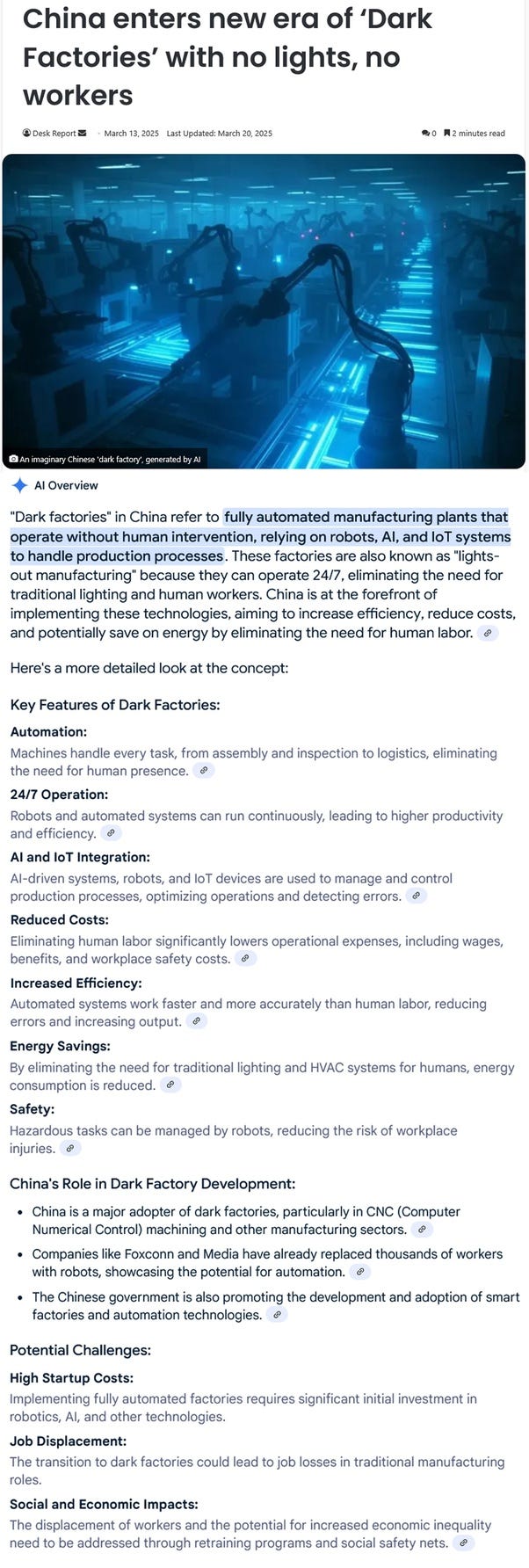
Factory jobs will mostly go the way of blacksmith jobs worldwide as “Dark factories” become the norm.

Here’s a video introduction to a massive change that is already transforming the factory landscape on an enormous scale to displace over 10 million factory workers in China alone:

Below this bit of my two cents is a long assessment by AI that will give you an overview of the reasons driving this transformation.

How that affects us as individuals is another issue altogether.

Much of what we can do as individuals is determined by our resources. As individuals or small groups of friends, we can focus our resources on investing in small business ventures that can generate profits by producing custom solutions, services and/or products that will still be in demand.

Almost all mass-produced products in society will be handled by automated systems with minimal human oversight.

Smaller markets will emerge, however, as 3D manufacturing matures enough to create local production facilities for customized products. As 3D matures, we will likely see growth in creative design areas where people will buy product designs or templates rather than products, which they then print with their in-home 3D printers. These will, of course, be limited in their capacity as they become more available to consumers, as laser printers have, which will create cottage industries for a higher production level.

In essence, I can envision three levels of production: large-scale factories producing for a global market, local factories producing for local municipalities (which begs the question of raw materials like PLA, along with a radical evolution of printable materials to expand production choices made on a global level), and home-based production.

Factory jobs and jobs where people go to every day by the hundreds or thousands to perform functions for a large organization’s profits are disappearing. That type of work dynamic is vanishing, particularly on a production floor.

We may see organizations grow out of opportunities for innovation, where, instead of going to a job to perform mechanical functions in a production process, we will see large groups emerge in an innovation-driven enterprise model. Hundreds of scientists, engineers, electricians, programmers, etc., will collaborate on new technologies for space exploration, for example, or medical advancements.

Companies specializing in material sciences will emerge to create new printable materials to advance 3D printing technologies, for example.

At any rate, here’s the screen grab of an AI overview of dark factories:

Here’s another bonus video on the Future of Tech:

How did you determine that your nontheistic worldview is true?

This post is a response to a question posed in its complete format: “Nontheists OFTEN ask theists for proof that their particular theistic worldview is true (ie: Christianity, Islam, etc). So surely reversing the question for once is legitimate: How did you determine your particular non-theistic worldview is true?”

Following a simple process of elimination to divest oneself of flawed and blatantly wrong-headed presumptions clears one’s mind of emotionally-based conclusions responsible for blurring the distinction between fact and fiction.

The flawed presumption you base your question on and use to justify avoiding your responsibility to yourself to ensure you are not living a lie is that you have confused absence with presence.

There is no such thing as a “non-theistic worldview,” but it is interesting to see how you feel compelled to replace “atheism” with “non-theistic.” It’s a dialectical choice which serves as evidence of your flawed presumption that a “non-thing” (an absence) is equivalent to a “thing” (a presence), and that you find a lack of a belief system you have been conditioned to adhere to is threatening.

As usual, it is neither legitimate nor rare when believers often attempt to flip the script as you have. Theists employ this most common form of disingenuous dialectical tactic when trying to dodge responsibility for supporting their claim that the product of their imagination is a fact, not a fiction.

The harsh reality you seek to avoid as you hope to mine justification for hanging on to a delusion you doubt, that has made no effort to determine your worldview. You opened your mind like a baby bird opened their mouth and willingly received your worldview like a series of instructions you memorized out of fear of what would happen if you failed to follow them.

Atheists don’t “often ask for proof” because they’re not compelled to proselytize anything. Conversely, believers are conditioned to believe that their recruitment efforts will garner them afterlife rewards. Any successes they may experience in promoting their worldview serve as validation for their beliefs and quell their struggles with cognitive dissonance.

The more you question why you adhere to instructions you’ve been programmed to interpret as beliefs, the more you free yourself from the effects of your brainwashing.

This is why believers are taught to fear non-believers.

You need to keep up with your conditioning to ensure you don’t stray, and that’s why your beliefs have many rituals and icons to reaffirm your commitment to your belief system.

Stop to think about it for a moment. You will eventually realize how none of that addresses how to rationalize your worldview because it is entirely based on submission to ignorance.

So, while you ask atheists how they determine their worldview, you are admitting that you have never made that determination yourself about your worldview.

Isn’t it essential to have presidents with morals?

This post is a response to a question posed in its complete format: “Isn’t it important, and even necessary to have presidents with morals? Regardless of party affiliation, or none, religion, or none, can an ethical America ever be restored if truthful leaders, and humane officials are elected?”

People will elect leaders who echo their standards, and that leader will validate those standards. That dynamic becomes a feedback loop that pushes a society to evolve in a particular direction.

A political duopoly creates a dynamic of competing standards that pulls a society in opposite directions.

In the case of the U.S., and the emergence of a Neo-Liberal sensibility, the nation’s standards toward the accrual of material wealth put the oppositions in alignment, and the consequence has been a nation that has become increasingly sociopathic over the decades.

Since both Republicans and Democrats embraced power through wealth, there was no room for any competing morality to maintain any semblance of a compassionate society.

This dynamic is how they managed to create such moral abominations as instituting privatized prison systems, blocking universal healthcare, and eliminating the right to claim bankruptcy on student loans.

The U.S. morality has evolved completely around the veneration of wealth and the worship of greed. Due to that perversion of humanity, they have evolved into a corporatocracy to become a kleptocracy on the way to becoming a full-blown fascist state whose national character is defined by gluttony and an attitude of entitled expansionism.

“Greed is good” is the morality that the U.S. has embraced and the character that its leaders cultivate within the people.

The morality they have embraced throughout the decades since Ronald Reagan has put them on a path of becoming a nation defined by a narcissistic character, and that makes them an enemy to the world. Even their current “friends” aren’t actual friends but fellow sociopaths who will exploit them for their benefit.

The record-breaking “gift” of a $400 million plane that would require up to $1 billion to inspect and convert into an appropriate means of air travel for the nation’s leader is a manipulation tactic by those the current American leader views through envious eyes.

Although this question presumes “morality” to describe a state of being beneficial to all citizens, that’s not the case with what the word means. People do vote for and elect a president with morals. Those morals, however, are entirely self-serving for the current American president and would make people consider him “amoral” or “immoral,” but that’s because the nation has lost track of which morals they value.

Currently, the opposition to the extraordinarily corrupt Republicans who enable and empower the malignant narcissist in charge is also struggling with the same form of corrupt morality as they deny the truth of being lulled by their failure to represent an opposition to a materialistic morality adequately.

The DNC’s old guard is as responsible for the monstrously corrupt morality ruling the nation as the RNC for installing Trump as their party leader. The DNC continues to show that they have not learned their lessons, and because they’re not as willing to “join the dark side” as the RNC, they suffer internal struggles which turn their supporters away.

At the moment, there exists a younger sensibility of opposition toward established morality within the DNC, and the old guard seeks to excise what they view as a threat rather than a necessary evolution for their party to survive.

Had they not been so corrupted as a party, they would not have prevented Bernie Sanders from having his opportunity to lead the nation back from the brink of a sociopathic morality. They have not yet learned their lessons and seem to presume their Neo-Liberal beliefs are still sustainable in a world that crumbles around them.

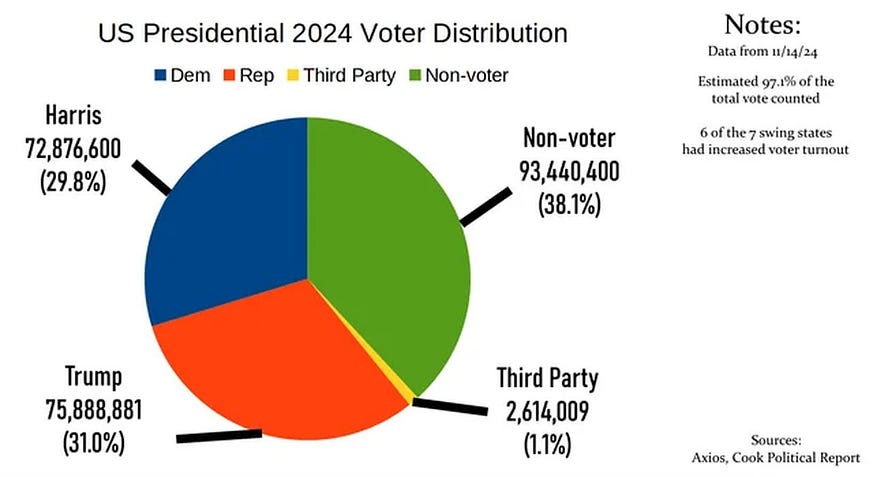
One-third of the electorate stayed home and abstained from voting because they saw no difference between the RNC and the DNC. To some extent, that’s very much true because both parties continue to embrace a materialistic morality that has been responsible for the destruction of the middle class throughout the last several decades.

Many people have reasoned that if both parties are the same, the only solution is widespread chaos that causes their society to crumble. By refusing to vote, many voted for the current state of protesting nationwide in every city every day until the problems they see being ignored begin to be addressed.

The DNC is undergoing internal strife, and the more the old guard resists giving way to the new who fight for a morality that represents the people, the more that party will become fractured and ineffectual against the trajectory of a nation becoming a full-fledged fascist state or autocratic rulership.

People like Chuck Schumer need to be pushed out of the party, and the DNC must start paying attention to the goals that David Hogg has been promoting. They desperately need a cleansing of the morality that fully characterizes their opposition’s morality of being sycophants to the wealthy in society if they want to preserve some form of dignity as a party that can install leaders who have enough backbone to lead the nation out of a dark morality and toward an enlightened one.

The notion of a “dark enlightenment” currently characterizing the RNC and Conservatives worldwide is a morality of misanthropic cynicism which embodies an Ouroboros that ultimately consumes itself. Adherents of this worldview of rulers and serfs are so primitive and barbaric in their thinking that they cannot fathom a world not characterized by a zero-sum game of winners and losers.

We are all responsible for allowing this sensibility to become a threat to the world order because we have worshipped the wealthy to such a degree that when the term “centibillionaire” was first coined, we celebrated it instead of becoming horrified by the abomination we allowed to come into being.

In short, having presidents with morals is neither essential nor necessary because they all have some form of morality, even if it’s considered an “anti-morality” or destructive morality. What matters is selecting leaders whose moral fibre is such that they place the good of all people above the whims of the few.

The morality we all desperately need now to lead us out of our darkness is the morality that acknowledges the necessity of placing upper limits on wealth and power. The morality we must embrace to restore sanity to this world is to recognize how, if someone possesses the wealth of a small nation and can afford to buy themselves a private army, they are a clear and present danger to society.

We must establish a rational and community-based view of social engineering rather than allow a chaotic approach toward our social evolution. We cannot afford to continue allowing the wealthy to shape our morals as a people while empowering the most psychopathic among us to define our character as human beings.

If we want an ethical society to re-emerge as our guiding vision for humanity, we must cleanse the misanthropic darkness clouding our sight.

Do political parties work to improve the well-being of citizens?

This post is a response to a question posed in its complete format: “Are there any political parties in this world, who not only defend their country, work to improve social and material wellbeing of citizens, but also aim to improve spiritual wellbeing of citizens?”

Any political party that focuses on the material well-being of the citizens while acknowledging how industry is intended to serve, not rule them, is a party that defends their country and works to improve their overall well-being.

No political party can “improve the spiritual well-being of citizens” because that’s a responsibility each citizen holds for themselves. Governments are administrative bodies that regulate the pragmatic activities of a society.

“Spiritual matters” are neither pragmatic nor quantifiable in any way that any administrative body can directly address. However, by facilitating the development of a socially and economically stable and harmonious environment, a government frees the people up to address their personal “spiritual” issues.

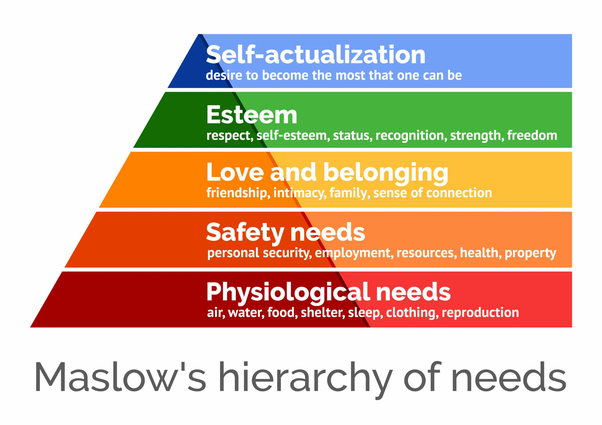
In this case, Maslow’s Hierarchy of Needs can illustrate these parameters for a government’s responsibility to its citizens.

Governments are responsible for ensuring the first two tiers of needs are accessible to all citizens. By addressing these basic needs, the community can adequately address the following two tiers of needs. When a government provides the stability of the two bottom tiers, then a community can become stable and supportive of its members, which then encourages each member of that community to pursue matters at the top of their hierarchy of needs.,

When the bottom of the pyramid begins crumbling, like it is now with extreme income inequity, the entire edifice of meeting needs crumbles and civilized society is then lost. We are seeing the cracks throughout governments worldwide as widespread disinformation by toxic parties disrupts our systems around the globe while they vie for power.

If we want to avoid system-wide collapse, then we must each reaffirm our commitment to the social contract while recognizing we are all in this together, and only by working together within the context of mutual respect, can we resolve the problems arising from the chasms we have been creating between us to sow division around the globe.

Either we learn to “voluntarily see the light” and choose better for ourselves, or we continue to allow the toxic members of society to direct our species toward a systemic collapse. If we fail to resolve our political issues, future existence on this planet will be threatened by our ecologically destructive activities. Our environmental irresponsibility will catch up to us and cull our species at rates exceeding hundreds of millions per year until the Earth can reestablish a new “normal” for itself.

Governments worldwide must reassert their commitment to ensuring the bottom two tiers of Maslow’s Hierarchy of Needs are adequately addressed if we are to restore global stability and secure our future. Individuals’ “spiritual needs” will naturally be addressed if we can accomplish that.