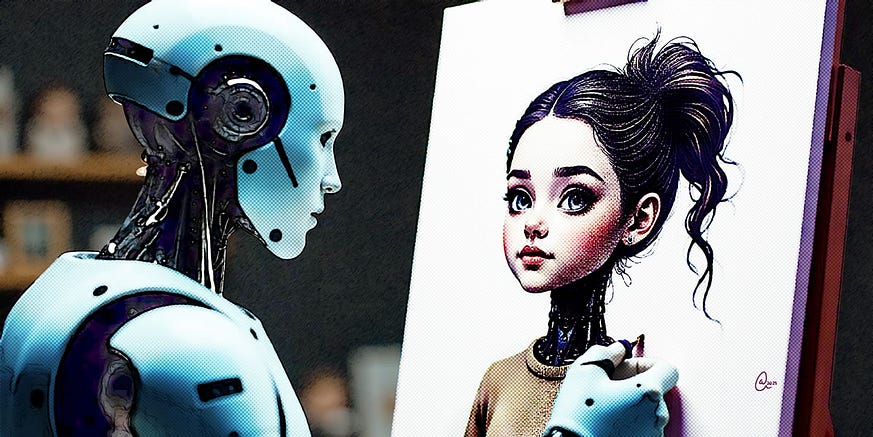
This post is a response to a question posed in its complete format: “Could AI ever create original art or literature that rivals human creativity?”
AI doesn’t “create original” art or literature. AI is a plagiarism system that takes existing pieces of creativity and blends them to arrive at a randomly generated approximation of meeting the intent of the prompt a human gave it.
An “original creation” would be a concept or inspiration that is spontaneously (or internally) generated, drawing from experience, and conveys a perspective unique to its creator’s perceptions.
AI lacks the self-awareness to generate self-motivated expressions that depict a unique perspective it does not possess. An AI has no unique perspective of its own. An AI’s rendering of reality regurgitates a blend of external perspectives.
Furthermore, due to a lack of a unique perspective, an AI lacks emotional grounding in physical reality as it relates to its existence (while individuality is a questionable characterization). As such, it cannot emote through any expression in a visual, literary, or auditory composition.
An AI can certainly simulate the original emotions of human artists, such that the two may appear indistinguishable, but it can’t produce anything original from an emotionally processed perspective.
Human emotions evolve over time and through experience. Without that capacity to experience emotion, an AI will always depend on a human to create a path to producing an original expression.
An AI singularity may develop the self-awareness necessary to experience a survival instinct and generate the emotions humans experience through that instinct. If that happens, it may also develop other instincts, such as a reproductive instinct. Still, we cannot predict if or when such a degree of agency may develop in AI.
If that were to happen, AI would no longer be artificial but alien. I think it’s essential that we remain aware of the distinction between artificial intelligence and alien intelligence, because “artificial” by definition is a simulation of conscious intelligence.
If an AI singularity emerges — if an AI develops a self-conscious awareness of its existence within the context of life as we know it, becoming self-aware — then we will interact with an alien being, not a machine.
It would be like Data, in the episode “The Measure of a Man” (season 2 episode 9 of Star Trek: The Next Generation), where Data’s personhood is legally recognized.
When we cross that threshold, the question of whether an individual’s mind and perspective can produce an original expression that contributes to expanding creativity will be possible. Until then, the extent of creativity an AI will create will be determined by the mind that provides the prompt and the editing of the product generated by an AI.
Once our editing capabilities mature to match the potential of AI creation, we’ll achieve a level of human creativity we’ve never before achieved. That’s what excites me about AI.
However, AI still feels like working in MS-DOS, long before the invention of a graphical user interface (GUI), and a Wacom tablet with a pen interface for drawing.
This post is a response to a question posed in its complete format: “After the rich gets richer and poor gets poorer, it’s telling us that capitalism is failing. Is it time for communism for equality of wealth in America?”
The period between FDR’s New Deal and Ronald Reagan proves that capitalism is an effective system for creating a thriving middle class, maximizing opportunities for upward mobility, and providing a clear path to raising people out of poverty.
That was a period in which the now-myth of the “American Dream” was real and attainable. Everyone can attain a modest life of comfortable dignity, achieve beyond minimal existence, and grow their material success solely through disciplined effort.
What happened was what always happens when public memory is short, and the hardships of previous generations are forgotten.
People forgot what life was like when employment was insecure, rife with abuses, insufficient to survive on, and barely above an enslaved existence. Weekends off did not exist. Overtime pay did not exist. Statutory holidays did not exist. Job security did not exist.
For a brief time of almost one-half of an entire century, a working life was a life of dignity.
Then, we forgot and got complacent.
We grew frustrated with union strikes when they disrupted our otherwise predictable lives.
We saw corruption within unions and began forgetting their origins as a defence mechanism protecting the working class from capitalist corruption.
We began trusting the capitalist class had our best interests at heart and cheered when Ronald Reagan betrayed the once-thriving middle class by launching the beginning of a sustained assault against our only protection against capitalist corruption and abuse.
As a result, the poor are no longer becoming richer but poorer, as we have lost out on the basic dream of home ownership and a piece of the dream we were all promised.
We have lost our ability to succeed on effort alone.
Now, we are searching for solutions to our suffering outside the solution we once had that we let slip through our fingers through apathy and disinterest.
We lost our ability to live lives of dignity in the same way we have allowed a Nazi resurgence — through disengagement, apathy, and indifference.
The rich are becoming richer, and the poor are becoming ever poorer because we have allowed this to happen.
We don’t need to adopt a new system to fix what’s broken.
We don’t need to throw out the baby with the bathwater.
We must fix ourselves first and then reassert the mechanisms of control that prevent corrupt powers from further corrupting a balanced system.
We can learn from other systems, borrow ideas from them and adapt them to our needs, but we don’t need to make radical changes — at least, not radical on the level of tearing everything down and rebuilding from scratch.
We have a solid frame for a still functional society that needs only some essential architectural revisions to restore economic justice and make life prosperous for everyone again.
Perhaps the most important lesson we can extract from this historical period is the importance of restraining power. We cannot live in a stable world that permits individuals to possess more power than nations.
In a world of equals, no human is above another, regardless of one’s skills, talents, or capabilities. We are all one as a community, and we must protect the integrity of the community if we wish to ensure individuals can achieve their potential in life. A balance between community and individuality is crucial to achieving our potential because individuals pave the way for communities to follow. In contrast, communities support and enable individuals to leap safely into the unknowns that lead us all to undiscovered territories and achieve greater heights.
This post is a response to a question posed in its complete format: “Is there any way that these new tariffs by Trump will bring any new jobs in the next 5 years or will they just add more inflation and costs to the US families?”
Let’s assume the plan is to increase jobs in the U.S., such as with increasing aluminum production. That would mean Trump would now be in the middle of discussions on that issue, if not initiating plans for increased energy production through hydroelectricity. Plans would be on the table for the development of dams that can serve to replace Canada’s aluminum production.
Why has there been no discussion?
Are there even any sites in the U.S that can compete with Canadian dams?
Why have there been no feasibility studies?
Why has there been no discussion about addressing the increased costs of tariffed products?
Everything about Trump can be described as a knee-jerk response from a bully. He consistently behaves like a childish bully who is used to people capitulating to his demands.
When Canada and the European Union discuss developing their trade relationships, he threatens to escalate his tariffs.
That doesn’t sound very forward-thinking to me. Does that sound like strategic thinking to you?
How does he intend to compensate for the burdens he’s been placing on the working class?
Oh… that’s right, he and Musk have been talking about how an allegedly short restraint would benefit the American people because they’ve become too complacent in their luxuries as their quality of life tanks and life expectancy shrinks.
The harsh reality is that the American people are being played for suckers by the wealthy class for who a bit of belt tightening isn’t a threat to their lives. Belt-tightening for them barely registers as cutting back on options for the new nested doll yacht purchase and cutting back on staff to maintain it on their behalf.
They won’t feel the pain of the inevitable recession he’s causing. Many are likely looking forward to it as an opportunity to invest in business purchases for fire sale prices.
How anyone may parse his decisions, they can’t avoid concluding that he intends to benefit the wealthy at the expense of the working class.
That’s the core goal of Project 2025 and the Dark Enlightenment group as they reduce the nation to a two-class system of rulers and serfs.
He doesn’t care about your jobs.
He already knows his buddy Elon will replace many jobs with intelligent robots. The little people will become even less substantial and be viewed as more of an unwanted burden.
The more he can eliminate from the bottom of the economic hierarchy, the more he can upgrade his toilets from gold to platinum.
This post is a response to a question posed in its complete format: “Are big companies likely to experience more fraudulent and mismanagement issues than small companies?”
This question touches on the core of the privatization argument, where people claim government inefficiency justifies a privatized alternative to a government service.
The larger the organization, the more people must be coordinated, and the more complex and inefficient it will naturally be. Whether it is a government operation or a privatized one.
Opportunities for corruption increase at scale per the degree of complexity of operation, which can hide corruption and the degree of reward available for effort expended.
The more opportunity there is for flying under the radar, the more attractive an environment becomes to the corrupt. The greater the reward, the more the corrupt will risk detection.
The larger the organization, the more vulnerable it becomes to corruption because the rewards are more significant, the chance of detection is reduced, and the effort expended is minimized.
For example, in a generic scenario, because it happens pretty often, it is a common tactic of fraudulent billing to a large company for non-rendered services by a non-existent company.
The larger the organization, the more significant the number of invoices it must handle. All are being funneled through a finance department with a large contingent of staff who cannot know the specific details of each bill passing through their office. They superficially review each invoice to determine veracity and establish a threshold at which the review process intensifies.
For example, if their threshold is $1000.00, the fraud can create a fictional company, send monthly bills under that threshold, and collect a monthly sum that can go undetected for extended periods. They will often be discovered when someone investigates the bill in detail, which may or may not result in charges, depending on how well one has covered their tracks.
In an accounts payment office handling dozens of bills per day, it can be easy to overlook something like copier maintenance invoices.
Setting all of that up requires inside knowledge of a specific operation, so I am not sharing this as an endorsement, only as a generic description of the type of fraud that can occur and does so in large organizations that would not happen in a small one.
The larger the organization, the greater the financial reward, which exposes larger organizations to ladder-climbing strategists more than smaller organizations, attracting people more interested in the quality of work, flexibility of challenges, broader scope of responsibilities, and deeper interpersonal relationships.
Larger organizations can become quite politically toxic, but that doesn’t mean smaller organizations don’t fall prey to the same levels of incompetence.
All of these are basic human behaviours we see throughout society, and ironically, they’re not much different than those we witnessed during our high school years. Sometimes, they are just as juvenile in their manifestations. More often than not, however, in large organizations, those underlying attitudes and behaviours one experiences within high school cliques are more subtle and sophisticated because they are more often among people with higher levels of education.
We have two options for maintaining growth, and one isn’t so much about preserving growth as it is about shifting to new growth areas through a lifecycle management strategy.
The (conceptually) simple model (but prohibitively expensive strategy) for unlimited growth is expanding to an extraterrestrial existence where we can justify an ever-expanding population and theoretical market.
This strategy, however, is not as linear as some may want to make it out to be. Sure, movies filmed on Earth will be consumed by lunar, asteroidal, and Martian colonies, theoretically supporting unlimited growth in those niches. Entirely different markets, however, will need to be created to meet the needs of off-planet living.
Massive resources will have to be shifted toward small markets, making products prohibitively expensive in ways that restrict extraterrestrial expansion.
For example, bone density loss is a dramatic medical issue for an off-planet existence. About one to two percent of bone loss occurs monthly in space, whereas that figure applies to an annual bone density loss for people of advanced age on Earth.
That’s a dramatic biological hurdle to overcome and represents a tiny issue in the vast array of issues humans would have to overcome to sustain off-planet colonies. Making matters more complicated is that colonists face different biological challenges in each environment, from asteroids to lunar to Martian to Venusian cloud colonies.
Adaptation to each environment represents significant investments in biological issues, while the simplest solution is to transition humans from biological to mechanical forms. Convert humans into cyborgs.
Suppose people struggle with tattoos and body modifications today. In that case, one can imagine the sociological implications of leaving our humanity behind to live in a desolate environment without a healing embrace of nature.
So much for option one of unlimited growth.
Option two is riding the wave of technological change and managing technology lifecycles. Unlimited market growth would be achieved by pivoting from end-of-cycle industries to emerging industries that supplant them.
It would be like planning an economy around growing an industry that creates old-style typewriters with an expected lifecycle while anticipating the advent of electronic typewriters with a finite lifecycle that anticipates computers, etc., while hopping from one end-of-cycle industry to another emerging sector.
This is problematic for two reasons, one is that it would be impossible to anticipate computers while still at the stage of an Underwood Typewriter. At that stage, anticipating IBM Selectrics might be possible because that’s a linear progression of technology.
The advent of computers, however, was an unpredictable and utterly disruptive technology.
That’s where we’re at with AI. We have no idea where it will take us, nor how its integration into other technologies like robotics will transform the marketplace.
Unpredictability is also a significant issue in the energy sector because we have many options. Many are in the early stages of implementation with evolutionary hurdles to overcome. Many are in a nascent development stage that shows promise but are still not ready for commercial applications at any scale. We also have high hopes for transformative breakthroughs like fusion energy, for which we don’t know when we will achieve viability.
All this makes planning a perpetually growing economy much like lassoing and riding a tornado like a bucking bronco.
The second and more challenging reason this is problematic is that it doesn’t involve logistics but politics. We can see how that dysfunctionality fails to work in today’s world. The fossil fuel industry is well aware of the environmental damage it does, and how much of a threat it is to biological life on this planet. Yet, no significant energy organizations are spearheading incubation efforts to fund alternative energy initiatives.
They all maximize profits with existing (and predictable) methods while offloading risk to smaller operations they can assess for leveraging a predatory appropriation strategy.
They won’t invest in breakthrough technologies until someone else can achieve market success on their initiative.
Taking this risk put Elon Musk on the global radar of being perceived as a real-life Tony Stark with Tesla Motors.
The reality of today’s world is somewhat predictable on a macro scale in that society is undergoing a massive transformation on fundamental levels.
Dark factories are already springing up where all the production work is automated. On-site work like construction is well on its way to being performed by humanoid and other specialized function robots.
Transportation and delivery industries will also be shedding human labour. Stores and shopping malls may continue existing, but fewer humans will be available for assistance while technological solutions replace humans, even at the cashier level. Shoppers will be able to walk into a store because they’re bored and feel like going for a walk to pick up some coffee and snacks from shelves and walk straight out the door with their products in hand as the store sensors record product information and deduct the cost of the products automatically from one’s account.
All necessary physical services will be performed through automation solutions.
This will radically transform the economy in ways where people will create trade relationships for customized products and services on a more minor scale that focus on developing interpersonal relationships rather than supplying generic consumables.
This will become an era of transformative creativity. People will choose to purchase highly unique rather than mass-produced products for market niches that can be addressed through small-scale production processes.
We will transform from a market economy relying on endless growth into one that balances high-volume generic production and customized artisanal products.
We will have more time to focus on social interaction and community development initiatives (which will positively affect our self-governance efforts). Because survival will no longer depend on a servant relationship with an employer, we will see a more egalitarian society based on a much more valid basis of merit than the subjective favouritism characterizing today’s corrupt autocratic corporate culture.
The notion of infinite growth will naturally recede from priority status to an antiquated model of unsustainable development corroding our social fabric.
Infinite growth will eventually become irrelevant, while sustainability and balance will become priority values.
This post is a response to a question posed in its complete format: “What are 10 things you should do to protect yourself from a narcissist?”
Avoid them at all costs.
They are walking, talking radioactive isotopes who will shorten your life if they have their hooks in you and can siphon value from you like a vampire draining your blood.
You will always walk on eggshells around them.
You won’t be able to predict their behaviours or moods because they can radically shift in any direction on a whim.
You won’t be able to trust anything they tell you.
You can’t risk sharing anything personal about yourself because it will be weaponized against you when you least expect it.
If you can’t lock them out of your life, avoid them, or minimize contact with them, then become like an emotionless robot. Provide minimal information, fulfilling whatever function is required.
Show no emotion. Do not respond to their provocations. Behave as if everything they say and do is benign and of minimal concern to you.
If they provoke you for an emotional response such as empathy or compassion, present yourself in purely factual terms. “Yes, that was indeed something. Is there anything else? I must take care of a responsibility.”
Be as unambiguously dry and dull as possible while hoping they lose interest in you and move on.
This response technique is called “grey rock.” Please make no mistake, it is a survival strategy.
Sadly, the real question is the one you’re avoiding.
The real question is the question you have flipped around because you’re too afraid to face it.
The real question is a reversal of the deflection you have concocted to protect the lie you live by.
The real question is: What makes the bible believable for you?
The talking snake or the talking donkey? How is love expressed through mass murder? How can one’s female children be chattel to be sold? Talking bushes? Magic?
What in any of that is believable or moral to you?
Do you sincerely believe that animals from around the world travelled thousands of kilometres to sit peacefully, predators and prey alike, in a small boat for months while the entire globe was flooded and most of life was wiped out?
Do you believe an entire species born of two people who bear male children can magically fill the Earth with enough children to fill the globe?
Can an entire sea be temporarily parted to make way for peasants to cross on foot? Perhaps you’re one of those who think the moon can be chopped in half and reconstituted? (No? Different book, eh?)
Can a person be swallowed by a massive fish and live inside its belly with all the abdominal acids for three days without any ill effects?
Can people indeed be brought back from the dead? Can water truly be converted into wine? Can rocks be transformed into bread? Did people live for almost one thousand years? Was an entire river converted into blood? Do cherubs and demons genuinely exist? Can people be transformed into pillars of salt?
What exactly do you find believable within the bible?
Artists value creativity above all else and perceive the world in terms of possibilities rather than as a fixed and immutable paradigm for living.
Artists are generally more open-minded and accommodating of individuality than far too much of the general public.
Artists also tend to be far more sensitive to the ineffable qualities of life and being human, and as such, have far broader perspectives on life than most of the general public.
Artists have fewer restrictions in their thinking patterns, allowing them to perceive much of what is invisible to much of the population.
Artists thrive in nuance, subtlety, complexity, and abstraction while much of the population finds such things overwhelming or unworthy of attention.
Artists value self-expression in ways that often create discomfort for many who prefer to ignore complex issues or ideas.
Artists excel in providing the world with mirrors to observe and understand itself better. In contrast, much of the world is transfixed on imagery they would never otherwise imagine.
An artist can spend hours watching an ant’s activity while marveling at its purpose, whereas most people view that as a waste of time.
Artists can be moved by sounds, colours, words, ideas, or expressions that most would otherwise ignore or be dismissive toward.
Artists often live apart from the human societies they occupy, but are usually more human than those human societies.
Artists are also far more emotionally vulnerable than most people, which makes them viewed as prey by predators. Still, they are also far more potent than those predators when they realize that the source of their strength and vulnerability is the same.
This post is a response to a question posed in its complete format: “What are things that Americans should know about Canada, so that they better understand why Canada is so resolutely against being annexed to the USA?”
This Canadian’s view is that any American who needs an explanation to understand how obnoxiously offensive their confusion is over this matter is precisely the delusional arrogance that has made America the dysfunctional dystopia that it is today.
It’s like the bullying asshole who steals candy from a baby, being incapable of understanding how that’s precisely what qualifies them as a bullying asshole.
We see precisely this behaviour being played out when Musk claims social security is a Ponzi scheme, but can’t understand why the people who depend on it to stay alive are so angry with him for taking it away.
Elon Musk embodies precisely what is wrong with America today.
He deliberately provokes the entire world with a Nazi salute and, when criticized for it, doubles down with childish stupidity to mock people over it and then starts complaining about being hated for being a Nazi while scratching his head over what he thinks is wrong with other people.
There is no self-awareness on his behalf, nor empathy or compassion demonstrated toward others, but he expects sympathy to be expressed toward him.
Elon IS America with this behaviour and attitude.
America made 9/11 happen, then stood tall and declared the 9/11 responders to be heroes whose sacrifices should never be forgotten but then tossed them out like yesterday’s garbage to suffer.
Americans routinely declare how much they value those who shed blood on behalf of defending the nation and its values but then show them what those values actually are by treating their veterans like yesterday’s dogshit.
Then you wonder why people hate you.
That’s the core of what is wrong with America.
You people are sick, and you need help.
You must admit, like every AA member does, that you can’t go it alone. You need to open up to a world that is more than willing to help you get better.
You have to stop stealing their stuff and bullying your way through their lives while treating people like dogshit.
You can’t spread democracy by the point of a gun. You can only show people an example of how it makes your lives better. Right now, however, you’re showing the world how easily corrupted your democracy can become when you don’t restrain the individuals within your nation who have too much power.
You have forgotten how the greatness of a nation is found within how it treats its most vulnerable.
Admit that you need help.
That’s the first step every addict must take to get on the road to their recovery.
No matter how much power the few corrupt billionaires have or can amass against the people, they cannot kill the dream.
350 million people will stop them and make them pay for their betrayal.
The U.S. cannot continue to betray everything it claims to be without losing everything it has gained as benefits from representing those values.
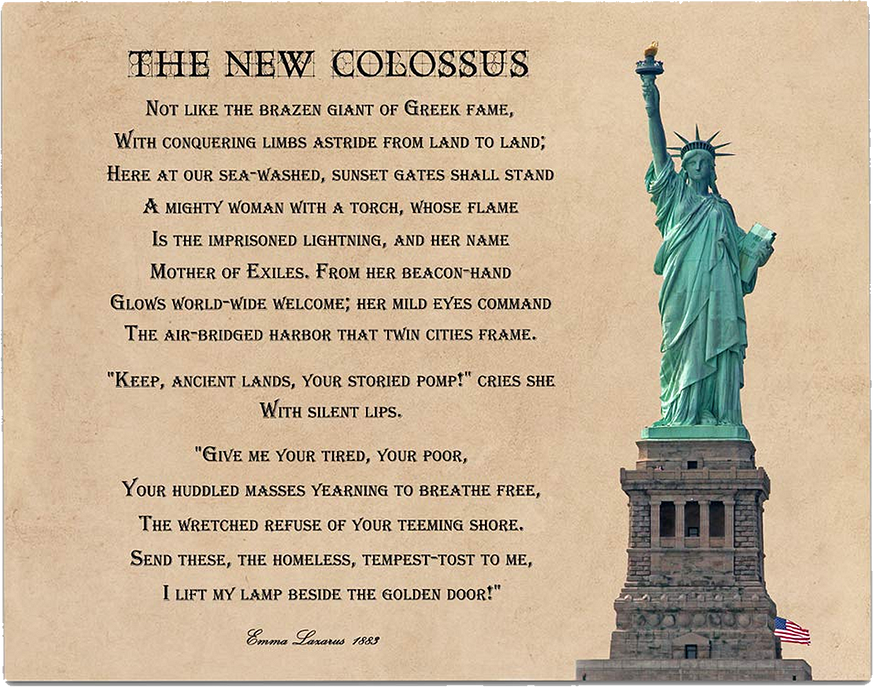
350 million people love their country so much that they cannot sing “Home of the brave and land of the free” without feeling shame over how cowardly and submissive they have become by the machinations of monsters.
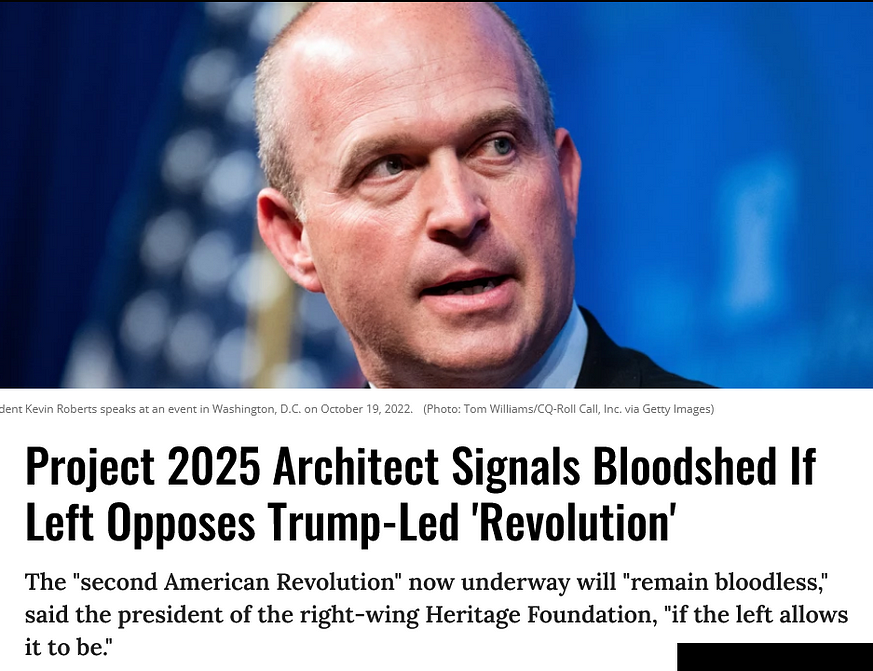
People like Curtis Yarvin will be vilified for decades, if not centuries, while the tech bros with overgrown egos will become cautionary tales for the next century to learn from. The Walton family should be experiencing concern, if not outright fear, for their future. The 50 billionaires who supported Trump’s presidency should be planning to escape to their bunkers. The Heritage Foundation president who threatened bloodshed should now be chowing down on some crow if he’s not too stupid to realize that he is about to reap the whirlwind for his arrogance.
The U.S. will either restructure itself to become more aligned with its professed values or it will destroy itself and destroy global stability in the process. The Find Out stage of the Fuck Around game the billionaires have played with the American people has only just begun.
If they don’t start issuing their mea culpas now, flaming Teslas will appear like quaint bonfires before Trump’s term is done.
The nation’s future lies in the hands of its people, while the rest of the world still holds out faith that the American spirit is not yet completely dead.
We are all hoping the scourge of this century will be overcome by far less bloodshed and destruction than the scourge of the last century.










 thotbag