This post is a response to a question posed in its complete format: “How can we ensure AI enhances human potential rather than just automating jobs?”
We don’t need to worry about AI’s promise of enhancing human potential. AI is a multicapacity tool with an endless array of potential applications — most of which we haven’t even begun identifying.
Humans are a creative species populated by people who invent imaginative ways to utilize tools in applications beyond their original design.
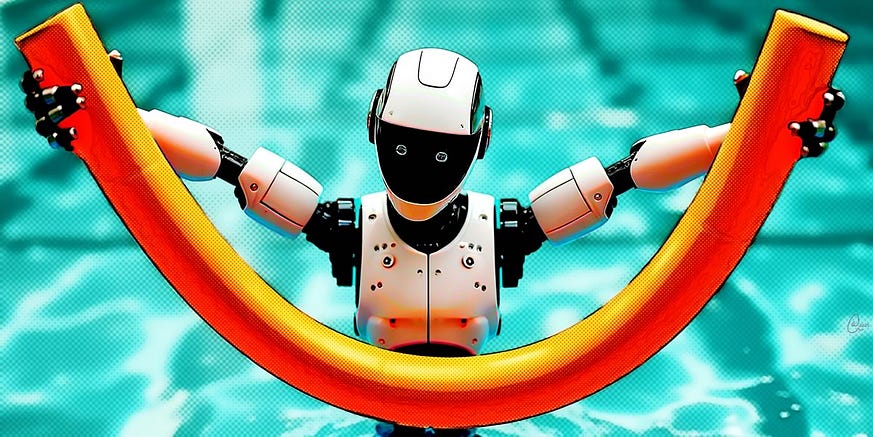
Here’s an example of a floatation device designed for a specific range of purposes:
It’s called a “pool noodle.”
From Wikipedia: “A pool noodle is a cylindrical piece of flexible, buoyant polyethylene foam. Pool noodles are used by people of all ages while swimming. Pool noodles are useful when learning to swim, for floating, rescue reaching, in various forms of water play, and aquatic exercise.”
It was designed to fulfill a particular niche and for a minimal purpose. Yet, when the product was released to the market, it took off at a level of popularity that well exceeded its intended use.
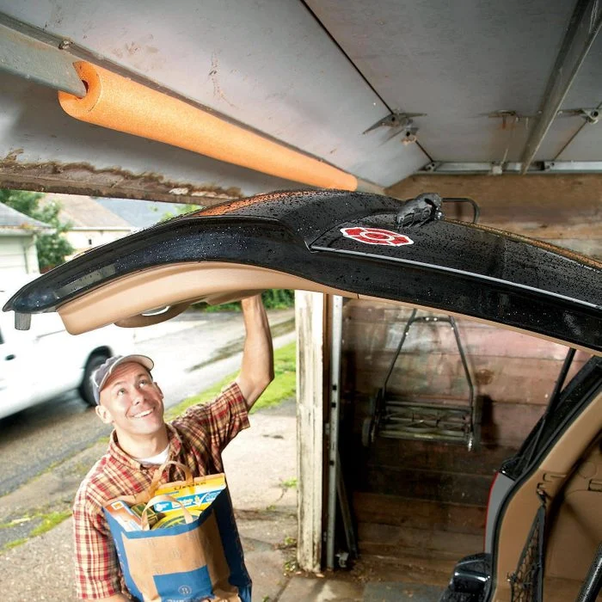
Pool noodles have hundreds of applications invented by users who have applied some creative thinking to problems they encounter in daily living.
At the time of its design, a simple floatation device could not be imagined to fulfill other needs. It was designed for one purpose that it fulfilled so well that people became familiar with it and began applying its potential toward solving different problems.
We cannot possibly predict how AI enhances human potential without giving it over to humans to invent ways to achieve that potential under their initiative. To refer to AI in such limiting terms as a means of “just automating jobs” is a severe underestimation of its potential and an admission of an utter lack of imagination.
Don’t be too concerned about a failure of imagination, though, because no one can possibly imagine all the uses for which AI will be applied. It’s too big, too broad, and too adaptable to too many use cases for anyone to predict.
AI will enhance human potential; giving humans access is the best way to achieve that.
However, AI’s ability to enhance human potential is as much a threat as a strength. It’s like giving a loaded weapon to a child.
Much more than ensuring AI will enhance human potential, we must ensure that humans have the cognitive skills, emotional development, and psychological stability to utilize AI for beneficial rather than malignant purposes.
AI needs guardrails, but less so around it as a technological tool and more around how humans utilize it.
We should focus significant resources on AI’s development in areas that can improve human development while addressing a severe deficiency in our psychological health. Our state of mental health as a species is our most significant threat, while AI’s ability to enhance that potential is like distributing nuclear weapons throughout a population of children.
This post is a response to a question posed in its complete format: “Are people taking Chat GPT answers and posting them on Quora? It seems there are many answers all with the same format every time, and sometimes people post the same answer twice. It is very annoying. How can this be stopped?”
There appears to be less of that behaviour today than about a year ago when ChatGPT became a public sensation.
AI-generated content has generally been easy to spot, and I’ve blocked several accounts where people have tried passing off AI content as their own. It may be for that reason I see less of it.
People may also have become more discerning with their inclusions of AI-generated text — by removing obvious clues and editing the content before posting it. ChatGPT has also evolved and become more sophisticated and less easy to spot.
I use Grammarly to speed up my writing and clean up errors, but I still struggle with its structure as it “suggests” changes that are not natural expressions to me.
My experience with it has affected my writing by improving it and relenting on choices I would not have made. I’m unsure how I feel about that beyond feeling a bit dirty in accepting a suggestion out of expedience rather than rewriting an entire paragraph to make it acceptable.
I will fight more vigorously against Grammarly on my desktop than on my phone because typing — especially editing- can be a pain.
Grammarly can generate content from existing text by rewriting it in a more grammatically acceptable (not always correct) format. This makes it somewhat different than the content generated by ChatGPT and other AI LLMs used for content generation.
There also exists AI systems that are designed to spot AI-generated content, of which I am sure many are included within academic budgets. I noticed recently, however, that new AI systems are emerging that claim to be capable of passing muster on being scrutinized by AI detection systems.
Whether those are effective or not, I don’t know. Still, I suspect this will continue to be an evolving issue where it will become impossible to differentiate between human-generated and AI-generated content.
For my part, it seems like I’m being encouraged to cuss more frequently to ensure people understand that they are reading words produced by a human mind over that of a “robot,” but that may be an excuse with a limited shelf life.
This post is a response to a question posed in its complete format: “To which extent do novels, or manga, conveying deep idea, or talking about social issues, relate to them given global awards, or high global popularity, to which extent does this depend on how smart the creator is, why only few reach to this level?”
Popularity and recognition are primarily not determined by intelligence, creativity, or any value generally associated with degrees of quality, skill, or craftsmanship but by timing and resonance.
The kind of popularity attributed to intelligence and creativity is recognized only through endurance throughout the ages. It is the rarest form of popularity that remains consistently in the shadow of most other forms of popularity. It does receive the occasional boost because it can garner enough of a niche following to emerge on the populist stage for a time. Still, it then retreats to becoming a niche once again.
A book like “Fifty Shades of Grey” was a literary mess on every level, from the writing to the butchered subject matter to the horrid values it sensationalized.
It was a massive success because it appealed to a repressed and widespread imagination responding to an increasingly darkening reality by retreating into dark fantasies that most would not have the courage to explore in real life.
I’m certainly not claiming that I would or have the courage or the slightest interest in exploring this area of the human condition for myself. Still, I am at least aware enough of the dynamics to understand how the story itself represents more of an expression of a mind suffering from Stockholm Syndrome indulging in titillation rather than providing realistic insights into the dynamic it attempts to portray. It’s more of a study of mental health in society than a literary masterpiece.
This leads me to my point that, as a people, we have been enduring a staggering decrease in the quality of our lives over the last several decades, shocking most of us. A piece of schlock like this validates feelings shared by a large audience and titillates the imagination through sensationalized imagery.
It became popular, not because of any enduring qualities but because it fulfilled a need for an outlet.
“The Secret” is another example of appealing to repressed sentiment, but instead of validating the repressive darkness people have been suffering through, it capitalized on a need to restore hope.
Ultimately, both literary productions created more harm than good in the same way that trolls undermine the social contract.
Once materials like these run their course, they begin to resemble porn in that a temporary titillation is an insufficient mitigation for addressing underlying causes, and like cocaine, once it’s run its course through one’s body, one is left feeling drained and hungry for more of that emotion that gave them a temporary boost in life.
There is, sadly, no real cure to this phenomenon of populism beyond two different strategies. The first strategy is the sanest, but it is also the most long-term and invisible strategy for addressing this need to bottom feed while racing toward an ever-receding bottom. It’s a strategy that will make many eyes roll once I write it as a one-word summary: education.
Education is the “magic pill” that will mitigate most of humanity’s ills — at least, it will once we address the economic roots of humanity’s ills.
It won’t ever be a cure because there is no final state to education. There is no finishing an education. Only lifelong learning exists for our species if we wish to survive anywhere near as long as the dinosaurs did.
The alternative to education is our current self-destructive trajectory, which risks the end of human civilization and, quite possibly, our species if our rock bottom is deep enough.
The alternative track to education we are on is to continue our descent into worshipping the superficially constructed Holy Grail of attention for the sake of attention. We will continue to behave like addicts drawn toward the chaos of feeding an insatiable hunger until we consume all of what we value through superficial titillations that temporarily distract us from an otherwise horrifying existence.
Surviving the nightmare ahead of us means our future progeny will have slim pickings to choose from as representations of the best human potential to pick out from the forgettable detritus of populism. The future will be as we experience it today when looking back on history and forgetting how Leonardo DaVinci had many contemporaries competing for the same artisanal benefits he remains remembered for.
We don’t remember the easily forgotten mass, but we do remember the outliers, and that’s the broad lesson of history.
If we exist as a species and civilization in another two hundred years, no one will know who or what a Kardashian is. They will note, however, how rampant superficiality characterizes this primitive and barbaric state in which we live.
No one will remember any of the Harry Potter books or the trans-hating hypocrite who fraudulently represented hope within her discardable stories. They will, however, continue to be influenced by Tolkien.
No one will remember much of anything notable about the products of this era beyond the horrid worship of excess.
Not one talking head from Fox will be given a nod of acknowledgement for their contributions to society. Rupert Murdoch might earn a passing reference as a key player in corrupting human civilization. Even he will be regarded as a side note contributing to corruption. At the same time, his success at making it so widespread will be considered a global failure in ethics that permitted monstrosities like centibillionaires to exist.
Donald Trump will be remembered as this century’s Hitler, no matter how many may find that offensive today. It’s just where we are as a species, and history has given us enough hindsight information to make such predictions with great confidence.
Those who may be offended by this prediction would do well to consider how that’s an optimistic outcome to the trajectory we are on right now because if he succeeds in achieving the maximum potential of his efforts, then we may not have much left of humanity to be capable of studying the history we make today in any way resembling our current capacity for exploring our history from yesterday.
Suppose we don’t rein in society’s current excesses of distorted power. In that case, we will be lucky to exist in any state resembling anything other than a primitive existence at the mercy of nature.
This post is a response to a question posed in its complete format: “How did the internet reach a point of legitimately being something that no one knows how to shut off in the event of an emergency? Do you think there’s any reason it should have a way of being done?
I’m struggling to think what sort of emergency could possibly warrant shutting off a global environment of interconnected devices while I’m watching the run of Terminator movies.
If Skynet were to become a global threat, then shutting down the entire globe of interconnected machines could not occur quickly enough to defuse such a fictional threat.
Local isolation areas could occur through coordination with service providers, which might be sufficient to limit Skynet’s reach, but doubtfully, because that imaginary AI with a vengeance streak would not make itself so obviously a threat before it’s too late to do anything about it.
Next, a more realistic threat could be a sophisticated virus that propagates throughout the Internet and is likely undetected until triggered into action. Any coordinated shutdown of internet trunks and backbones would still not stop it.
All efforts to mitigate the effects of such a virus would have to be applied locally to billions of connected devices.
It is likely advantageous to maintain internet connectivity to deliver an antiviral payload.
Again… I’m at a loss to identify what possible threat could warrant shutting down or blocking all connectivity between devices.
If such a feature were possible, it would constitute a more significant threat that bad actors could exploit.
Shutting down significant connections could disrupt vast swaths of many economies, making nations vulnerable to extortion.
In this light, such a feature seems more of a threat than any imaginary one, justifying exposing global connectivity to such a weakness.
The primary strength of the Internet is its vast array of redundancies that we will need to rely on to save our asses with increasing climate emergencies ahead.
Your question is born from a mindset where you imagine a coordinated rollout of connecting technology applied uniformly to billions of devices.
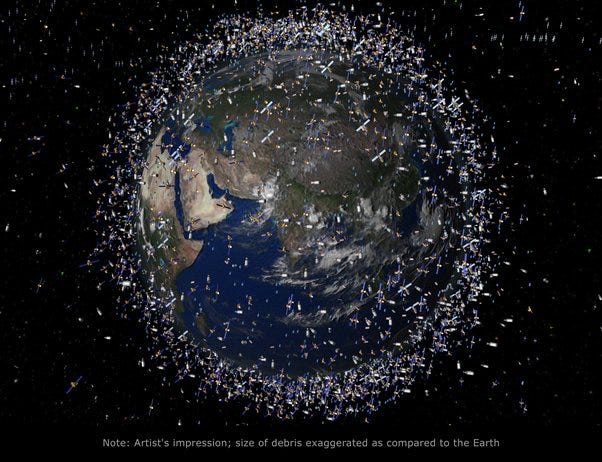
That’s not how the Internet came about and grew into a state of global coverage created by an array of trunk lines floating in the ocean and satellites in orbit.
The Internet began small (like everything massive typically does) by hardwiring two computers to each other and developing protocols that permit information exchange.
From there, it grew into supporting military and scientific needs for coordinated information-sharing. From there, tech nerds at the forefront of computer technology shared information on virtual public bulletin boards.
From there and at the beginning of the 1990s, Timothy Berners-Lee wrote protocols for assigning unique identifiers to devices that would allow information to be directed to intended devices in a chaotic system of signal transmissions. He also invented a “Hyper Text Markup Language” that converted computer code into “human-readable pages.”
He is widely known as the “Father of the Internet.”
The Internet grew by quantum leaps year by year as businesses, schools, and homes adopted computers that could connect.
Private companies launched satellites and installed trunk lines while laying down millions of miles worth of cable into a spiderweb of interconnectivity — hence the term “World Wide Web” — the “www” following “http” (hypertext transfer protocol).
While posting a message on my Facebook page asking Mark Zuckerberg to improve blocking on Facebook, I looked up the total number of users, and its numbers were 2.9 billion people on Facebook alone.
All of this has been as far from a coordinated strategy of development as could be the case.
There has never been a perceived need to hamper the primary strength of an always-on internet connection. When failures occur on a localized basis, that entire affected area is in disarray from the disruption.
There exists no means to quickly shut down such a chaotic arrangement of interconnected devices because that’s antithetical to the purpose of the Internet in the first place. At most, an EMP pulse could disrupt a localized area quickly, but that’s about the extent to which a rapid shutdown is possible.
UPDATE:
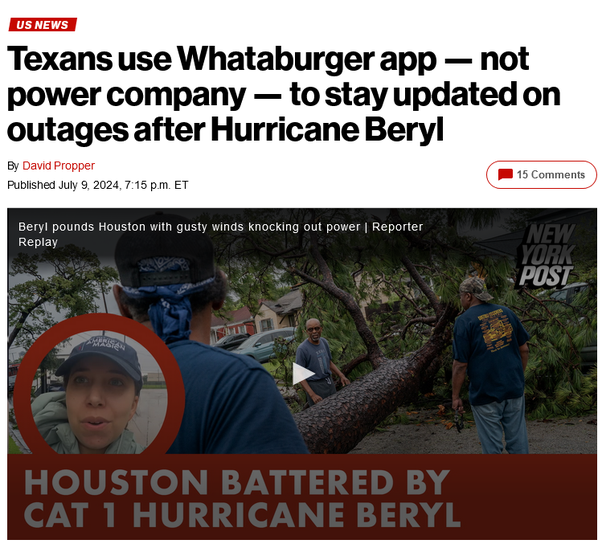
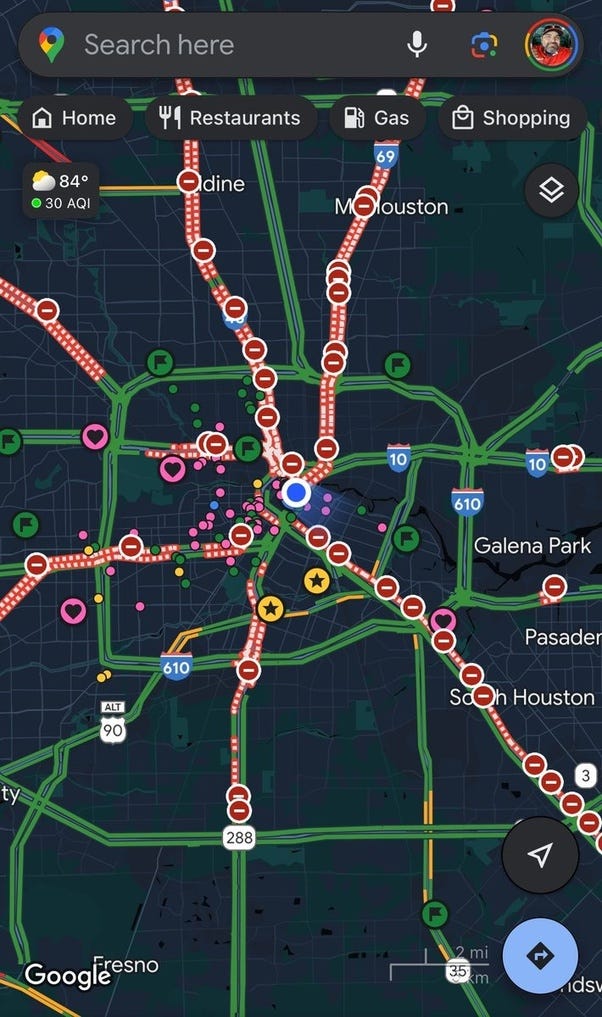
As it turns out, one of the benefits of redundancy is when a privatized corporation tasked with the responsibility of helping citizens survive and navigate an environmental emergency fails to live up to its commitment, another corporation with an app to sell burgers ironically fills in the life-saving service gap to assist people and ostensibly fill their bellies with burgers and fries.
This post is a response to a question posed in its complete format: “How come people ignore the mathematical proof of God, even when it is so obvious? How did humanity convince itself that the One cannot be proved mathematically?”
A general rule of thumb is when something seems “so obvious” to you, but the rest of the world fails to see what you see, it is incumbent upon you to do what you can to make what is evident to you obvious to others.
You may understand something so thoroughly that it’s evident to you, but you should have no difficulty explaining your observations in ways that will help others see them as you do.
There is one caveat, however, that sometimes things appear apparent only within the context of a misinformed and misperceived delusion.
For example, it may seem obvious that the world is flat because you see a horizon, but your conclusion would be flawed because you haven’t availed yourself of all the evidence that disproves a conclusion you formed in ignorance.
I say this to you because the entire world, believers and non-believers alike, have searched for evidence for thousands of years, yet no one has found any. To make such a claim as to consider obvious the proof that only you see is also to claim you’re more intelligent than most of humanity throughout the centuries. That’s a tall order of intelligence. Your claim of the proof you see as obvious also means you’re claiming to be more intelligent than Plato, Aristotle, Da Vinci, Kant, Socrates, Locke, Aquinas, Nietzsche, Descartes, Newton, Einstein, Galilei, Sartre, Copernicus, Lao Tzu, and thousands of other massive intellects throughout history.
You’re either a supremely knowledgeable human capable of solving numerous issues for humanity, or you’re just being arrogantly delusional.
Consider that whenever you stake a claim on understanding something that no one else does.
If you were that intelligent, you wouldn’t waste your energy making fantastical claims on social media. You would have already been recognized as a keen intellect through whatever writings you composed that show your intellect.
If you were that intelligent, you would already have the answer to your question.
The general rule of thumb for people online encountering such fantastical claims as what you pretend to have great insight into is that you’re a crackpot and will be considered a crackpot until you can prove otherwise.
Considering all of this, it might help you (and possibly others) avoid the public embarrassment one would experience when they soil themselves.
Your claim of the “mathematical proof being so obvious” is roughly the equivalent of peeing your pants in public and claiming it’s liquid gold.
This post is a response to a question posed in its complete format: “What effects do you think AI will have on society? Realistically, are people overreacting who say they’ll take all the jobs and run the world?”
Realistically, machines can’t “take jobs away” from people. Organizations and the capitalists who fund them while demanding optimal revenue generation at the lowest cost possible are choosing automated solutions to the labour cost.
This trend, of course, does displace workers as technologies have always done. Unlike previous generations of technological advancement, however, the displacement is not limited to specialized functions.
For example, armies of people sawing logs by hand were not entirely displaced by the introduction of sawmills. Labour was reallocated and redefined. Instead of pushing a saw back and forth, labour became a process of pushing buttons.
Of course, fewer people needed to produce the same volume of lumber, but there was also enough demand to scale production and create employment opportunities further up the production line.
At the height of the technological transition to a digital age, we saw many jobs displaced, but new categories of employment at much higher levels of complexity emerged. Secretaries who transcribed letters were replaced by administrative assistants who functioned in a data entry capacity. At the same time, executives eventually learned it was more efficient and pleasurable to directly type their thoughts into word processors rather than proofread changes multiple times over in an often frustratingly long process.
Network technicians, web designers, database developers, and an entire class of Information Technology workers sprung up almost overnight — by contrast to how the labour demographic had evolved since the dawn of the Industrial Age.
That’s no longer the case in today’s dynamic.
The AI revolution will not spawn demand for new labour beyond the minimal replacement of armies of people pushing saws with one person pushing buttons.
Before this current stage of technological evolution, it was easily argued that displacement versus the creation of new jobs approximated a one-to-one exchange. The hundreds of thousands of trucking jobs replaced by self-driving vehicles will not result in new jobs created to transport goods globally. Self-navigating cargo vessels will not create 15 to 30 new jobs per ship when intelligent robots replace workers.
Hundreds of millions of jobs worldwide will be transitioned to an automation model.
This brutal inevitability ignores issues used as political footballs and bypasses all the fearmongering over demanding higher wages. Automation will displace jobs, but not because automation “takes those jobs.” Technological innovation has always been and always will be a more efficient way of doing business.
Although the transition to an automated society is often viewed as a technological transformation, it is primarily a social transformation. People are going to have to stop thinking about “getting jobs” and starting about how to generate revenue for themselves by leveraging services as independent entrepreneurs. This view of capitalism has always been at the heart of the capitalist vision, and it was cemented in our psychology when business was granted personhood status.
The primary challenge within this transition is to provide the means to pursue one’s independent revenue-generating efforts with the necessary resources to succeed as an independent business owner.
We are inundated with exposure to the results of resources transforming our world by creating new classes of the wealthy whose net worth far exceeds previous generations — even after accounting for inflation. Henry Ford, for example, was a highly successful industrialist, but his net worth and reach don’t come close to Elon Musk’s status as a centibillionaire. It can be argued, of course, that such a disparity is a consequence of a corrupted tax burden. Still, those factors don’t fully explain the difference in dollar value between Ford’s millions and Musk’s centibillions.
The profit potential has never been more significant simply because the markets that once comprised a few million consumers now stretch across the globe, with a population approaching eight billion potential consumers. This global reach is why it is often argued that it’s easier today to become wealthy than before.
The reality, however, is that just like yesteryear, resources are required as seed funding to support the creation of tomorrow’s industry giants.
We cannot continue to rely on dynasties to dominate the innovation engine because they are not naturally innovative. They are conservative and often repressive by nature because they are risk-avoidant.
The heart of capitalism beats to the tune of innovation. There is no more significant potential for innovation than the eight billion people mostly trying to carve out a living while engaged in activities they value. The handful of billionaires and centibillionaires cannot compete with that innovative potential. By allowing our species to be directed by such a small number of individuals, we are limiting our potential as a species while granting too much power to people who are so grossly corrupted by it that they have become a threat to our future survival.
We must level the playing field and empower the little people who can put to great shame the illusion that the powerful in society are so far above the rest of us that we can’t survive without their direction.
Not only can we survive without them, but we can prosper in ways currently impossible under their thumbs.
We need UBI to release humanity from the yoke of our oppressors and fully embrace our creative potential through the innovative possibilities unlocked to us all through a fully automated society.
This post is a response to a question posed in its complete format: “Will money and economies still exist, if all jobs get automated? If all jobs are automated, what will people work to earn money? If all jobs are automated, will people receive everything they want and need, for free, without having to work?”
Within a fully automated society, people will have their needs taken care of.
Wants are an entirely different beast.
If you want money to travel around the globe, you’ll still need to earn money to afford that.
If you want to buy a sportscar instead of using public transit, you’ll still need to earn money to afford that.
How you make money will be more a choice for you rather than a necessity made of compromise by a perpetual lowering of your expectations.
You won’t be forced to take a job you hate because you’re afraid of being made homeless. You’ll be able to hold out until you find a vocation you like and that brings meaning to you and your life.
You’ll have many more options for being self-employed than now in ways only emerging today as viable systems to help you bring your imagination to life.
I’ve recently discovered an entirely new concept for doing just that. Check it out:
The site is called “Makeship.” What makes it unique is that you can design your character, and if your design is accepted, it will be made into a plush toy that you can sell for a profit. They handle all the “heavy lifting” from converting your design into a 3D plush toy, its production process, and, to a large extent, a lot of your marketing through crowd-funded campaigns.
Many new initiatives are sprouting up everywhere that approach manufacturing, sales, and distribution from a service-oriented perspective.
You’ve probably already heard about dropshipping, where you can essentially choose products from a distribution catalogue and assemble them in a store where you handle all the sales for those products. They handle all the packaging and shipping for you.
This is just the beginning of the new world of automation.
Large entities will capitalize on individual ingenuity, innovation, and effort by empowering the little people to go out and carve their niches in the commercial world.
With the assistance of AI, we’ll be able to produce full-scale movies for distribution simply by the prompts and tweaks we make to flesh out our creative visions in ways that others would want to consume.
Life won’t cater to people without ambition or desire to work, but it will become a panoply of options and opportunities everyone can exploit.
With these tools at our disposal, we’ll finally enter an age where merit is not lip service disguising favouritism. Whatever you imagine will stand or fall on the strength of your effort without being buffeted about by the day’s politics.
Instead of fearing automation, we should be learning to embrace it and leaning into it to begin pushing our governments to adapt to a new world without waiting for widespread suffering through the transition process to compel them to solve problems that can be avoided.
UBI will save millions of lives if we begin implementing it now. If we wait until millions of jobs are lost, then we will lose a lot more than millions of lives, and we’ll end up coping with the daily chaos of ongoing riots and widespread destruction of property.
Fewer people will indeed be hand-writing tens of thousands of lines of code. However, someone still has to identify use cases for an application, design the application, develop the application, evaluate and tweak the code for the application, test the application, deploy the application, and evaluate the application.
Whoever does that will need to understand code, code architecture, and coding techniques and be able to identify potential exploits within the codebase.
Despite the changes, the role of programmers will remain crucial in the future of coding. Their numbers may even increase. However, they will not be as prone to developing carpal tunnel syndrome or relying on eye-strain remedies as they do now, thanks to the evolving nature of coding.
Coding will become a much more accessible activity, just like creating polished and professional-looking graphics, which are much more accessible today to people without art training.
We will eventually see the end of multi-thousand-employee enterprises and an explosion of small businesses that can match punches with today’s big players.
In another couple of decades, you and half a dozen buddies will get together to operate a business that can serve the globe with a unique product or service that each of you has some expertise in to create a successful enterprise that currently requires employing a few hundred people.
As I’ve pointed out in other answers, this transition period will be excruciating for many people. Lives will be lost, and we can only mitigate the widespread destruction that will eventually be resolved by instituting a universal basic income.
We are already seeing the beginning of a new infrastructure emerging in primitive forms with entrepreneurial solutions such as drop-shipping and outsourced manufacturing to dedicated manufacturers that don’t sell any product they design but rather provide a manufacturing service for designers.
Once it’s completed, the most significant upside of the transition is that we will all have the opportunity to create revenue for ourselves based on our ingenuity. At the same time, all the grunt work that people toil on today while wondering when they can escape their hell will be handled through automation.
People will be ever more reliant on their knowledge and creativity to create success for themselves while being free of toil.
It’s a bloody scary time right now — and primarily because it’s defined by the greed epitomized by eight people owning half of the world, but once we cross that finish line, people will be cheering because we will all finally be free of the treadmill wearing our lives down to dust.
It certainly is scary as hell right now, but if we survive our greed and environmental stupidity, we’ll arrive at the closest we have ever been to a Star Trek utopia.
I highly recommend watching Geordi LaForge or Tom Paris devising engineering solutions or Janeway programming the Holodeck to see how they issue verbal commands and make adjustments.
Watching Tony Stark work on his 3D table is exciting, and it is exciting to imagine what will happen in the real world because we are heading in that direction of usability.
I remember getting a good laugh with a friend when I joked about being in our senior years and reminiscing about how we used to kill ourselves by being on our knees and feeding miles of cable through small tunnels. Now, we’ve got wireless that kicks the old wired solutions’ ass.
Anyone wishing to engage in a dialogue on UBI is invited to participate in an open space on Quora dedicated to the issue. You may need to register for a Quora account — It’s free, and I don’t get any kickbacks from it. This space is intended purely for stimulating discussion on the topic — there are no hidden surprises beyond possibly needing to join Quora if you want to post comments. Visitors to the site can read the content without registration hassles.
This post is a response to a question posed in its complete format: “Why do people opt for get rich schemes when they could just turn a hobby into a business by doing something they actually like doing?”
Hobbies take time to develop into viable businesses.
People often overlook how much time, effort, and resources are required to make a new business break into a new market before it begins turning a profit.
Massive enterprises like the social media giants were roundly criticized in their early years for operating without turning a profit for years before they became viable and self-sustaining entities.
People often fail to comprehend how much of an investment is required, from manpower to infrastructure to market development, to go from concept to generating revenue on a break-even basis.
When people are struggling to make ends meet every month, their choices become limited and long-term endeavours are sacrificed to fill their hungry bellies today.
This is the worst consequence of the historic levels of income inequity we are experiencing today. This is, by far, the worst consequence of the $60 trillion stolen from the working class in the U.S. in the last several decades alone.
We have had our opportunities stripped from us while being thrown into the middle of an ocean and told to dog paddle for our survival while getting thrown plastic-laden chum to feed on until we drown and being mocked for our inability to survive the challenges created for us by the exploitative class.
A person who has time, energy, and resources to capitalize on a hobby they love can succeed based on privileges denied to a majority who struggle with inescapable poverty for life.
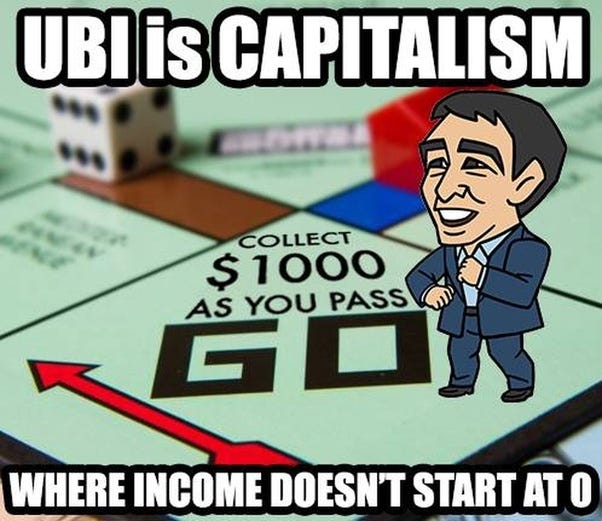
This is why we need UBI.
When people are free to pursue what they love, they stop chasing wild geese and become less prone to falling for grifters and making bad decisions out of desperation.
Eliminating the threat of homelessness and destitution frees people up to achieve their potential, but even more so, it’s an insurance against being victimized by one’s desperation that otherwise translates into numerous costs to society, ranging from crime to toxic coping mechanisms and domestic disruptions.
UBI both saves on social costs and grants a massive boost to economic growth through individual motivations, contributing innovative solutions that carry the potential of becoming massive engines of economic growth.
Anyone wishing to engage in a dialogue on UBI is invited to participate in an open space on Quora dedicated to the issue. You may need to register for a Quora account — It’s free, and I don’t get any kickbacks from it. This space is intended purely for stimulating discussion on the topic — there are no hidden surprises beyond possibly needing to join Quora if you want to post comments. Visitors to the site can read the content without registration hassles.
This post is a response to a question posed in its complete format: “I don’t want my jobs to be automated. What can I do? Will there be a chance to get it?”
Hi again Furquan. 🙂
You have asked me several questions on automation in the last few months, and I appreciate that you find value in my words. Thank you.
I have to say that it is essential to understand the automation revolution is inevitable and unstoppable.
The decisions for automation are being made not by us lowly citizens but by those who have the power to implement what they view as solutions to their needs — such as cutting back on labour costs.
The career one chooses for oneself does not matter to the ownership class because their perspective is based on what they are willing to pay to produce the revenue they seek for themselves.
This is the fundamental flaw of capitalism.
Capitalism, as it stands, has been permitted to flourish in ways that disregard the needs of the many in favour of the whims of the few. I say “permitted” because we have always had the power, as a people, to restrain corruption, but we have been mollified by messaging and the “luxurious” benefits of modern technologies.
We used to be much better at restraining greed, and our societies flourished. The ownership class, however, has invested hundreds of billions over the last half-century in lobbying the government, installing government puppets, and creating propaganda machines often referred to as “Think Tanks,” like the Heritage Foundation. Their goals are clear: to re-establish dynastic rule over the people. They made that abundantly clear when they released Project 2025 and issued a threat against anyone who resisted.
They have become so comfortable in their misanthropic regard for citizens that they no longer hide their agenda.
As individuals trying to navigate and survive the nightmare of this transformation into fully automated societies, we have two personal mandates to adopt.
The first mandate we have to ourselves is to equip ourselves with as much knowledge of the transformations as we are able. You have shown yourself eager and well underway on your first step by simply asking questions. The only way to anticipate the changes coming and avoid any potential disruptions to your life is by asking questions.
The second mandate we have for ourselves is to accept the fundamental premise of capitalism, which is that every human being is a business entity. We have no choice now because the era of life-long jobs and straight-up career ladders has vanished. That means even a stable job one is employed within today will be temporary, not necessarily by malice, but because the world is changing rapidly. The capitalist owners of that business also have to adapt to the changes or go bankrupt.
We are, in essence, in a surreal state of every person for themselves, and it’s taking a toll on us as individuals and creating cracks in the social contract.
This leads us to a second set of mandates we have to ourselves by serving our fellow citizens.
The first of these “community mandates” is to stand against lies and disinformation. Call out the lies and counter them with facts. Refuse to support individuals and institutions that disseminate lies. Take action, like boycotting Fox, and make your decision public. Let other people know there is a line to be drawn between decency and depravity in society that we must all be in solidarity with if we want to re-establish ourselves as humans worthy of the distinctions we revere when referring to our collective selves as “humanity.”
Greed is not good. Greed hurts us all, and we must support each other, or we will not survive the challenges ahead without great calamity and horrific losses of life that will scar whatever remains of humanity for whatever future may manifest for us as a species.
The second of these “community mandates” is to do what you can to support actions intended to restore decency. For example, I can do little with my resources beyond shooting my mouth off at every opportunity and creating memes to challenge the bullshit. I also actively sign petitions and help out in ways that are available to me.
Register with this organization — Change dot org — get on their list and peruse the many ways in which people are taking action worldwide:
Choose from whatever causes matter to you and support them by signing a petition. If you can afford to donate even small amounts, that helps. Please don’t underestimate the power of a single voice when it comes together in harmony with millions.
Anyone can start up a petition on this site. If you have something that you specifically want people to support, such as protecting jobs in a particular industry or role — something tangible in which people can take action by speaking up, then you can contribute toward the issue of ongoing automation.
The third social mandate may be construed as primarily a personal bias. It is an inevitable necessity precisely because of automation and because capitalism forces us all to be capitalists on some level.
Each of us needs some support to survive the challenges of meeting our basic needs.
Society, as a whole, produces more than our basic needs.
The success of capitalism is predicated upon innovation and productivity.
These three fundamental presumptions are what have led me to understand this fourth premise:
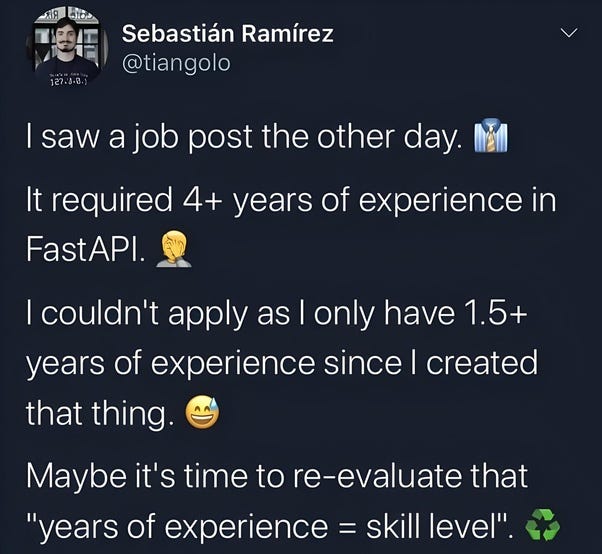
As I look back on my life and consider the thousands of hours spent on resume development and submitting tens of thousands of applications to employers that either mostly ignore and mistreat their applicants or allow the ignorance that defines many of the decision-makers among them to result in abominations like this:
I think that this entire system is broken.
Had I not wasted so much time and energy trying to fit into a system that has largely rejected me, I would have had plenty of time to develop my skills and voice to carve out my unique place of success in this world and the capitalist system we operate within.
For all the benefits that capitalism proffers to society, what it robs from us as we are herded through dehumanizing machinery to be regarded as commodities is a horrendous evil and a blight on humanity.
For this reason, I welcome our transition to a fully automated society because at the end of this painful transition is the freedom to live our lives as we choose.
The only thing that’s missing right now from our global support to a universal basic income is the awareness and acknowledgement we need from the wealthy class that this is THE best solution for almost all of our social ills — and it is much more than simply a solution, it’s an opportunity for them to capitalize on the repressed ingenuity of billions of people worldwide.
Once they realize the amount of untapped potential within the human race, in which they are shortchanging themselves with a master/slave relationship as employers/employees, they will broadly endorse UBI. Sadly, many are too short-term focused to want anything more than the quick buck that Donald Trump and sociopathic exploiters among the ownership class embody.
None of them are capable of innovation. They are capable of parasitic forms of self-enrichment. Elon Musk has clearly shown us that material wealth is not derived from personal innovation but by bleeding the benefits of the innovations of others.
My suggestion for you, Furquan, is to not buy into the myth that you will need a job to ensure long-term security for yourself because that’s a lie. Your long-term security is guaranteed only by your skills, capacity to provide value (mainly through any innovations you can devise), and the community supporting your efforts.
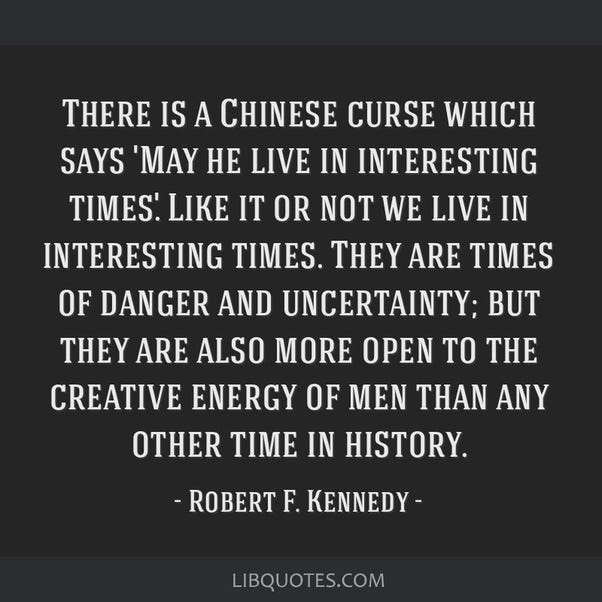
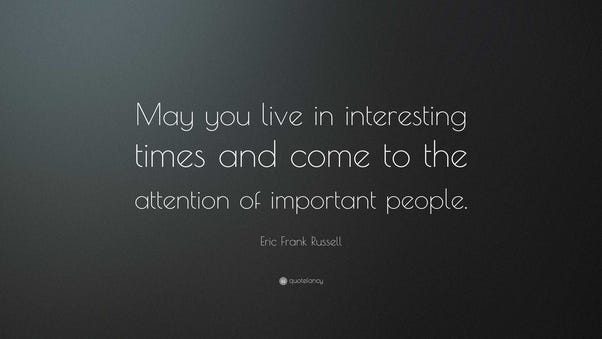
There are many different ways to perceive one’s challenges, and in this case, it appears to me the best way to represent this and the challenges we face today are embodied with an ancient curse:
I wish you all the best of luck in your future during this exceptionally unique period in human history that we have had the “great fortune” of being born into.
Anyone wishing to engage in a dialogue on UBI is invited to participate in an open space on Quora dedicated to the issue. You may need to register for a Quora account — It’s free, and I don’t get any kickbacks from it. This space is intended purely for stimulating discussion on the topic — there are no hidden surprises beyond possibly needing to join Quora if you want to post comments. Visitors to the site can read the content without registration hassles.























 thotbag