Should an artist have a day job?

This post is a response to a question initially posed on Quora, and can also be accessed via “https://www.quora.com/Should-an-artist-have-a-day-job/answer/Antonio-Amaral-1

An artist has more justification for surviving on their activity in society than most any other vocation.

Setting aside the mechanics of bias and economic pragmatism, the reality is that almost no other general field of employment engages the producers in their field the way art production does.

IOW. Almost no other field, in and of itself, engages people to eat, think, and breathe their work 24/7/365 as the arts do.

Sure, there are individuals within almost every profession who are as dedicated to succeeding in their chosen career. Most, however, are not interested in their activities for the sake of the activity itself.

For example, someone like Elon Musk developed a reputation early for being a workaholic. His motivation, however, was never the work itself but the material benefits he would derive from it. Many, if not most, executive-level people work at least 60 hours per week — which defines the word “work” rather loosely by contrast because “work” essentially involves social interaction. Both worlds of work and socialization are combined into one.

That’s not the case with artists unless one is a musician in a band, dancer, actor, or performer — an artist who produces their product as part of a group or troupe.

Visual artists, writers, and sculptors generally work alone and in isolation from the world — which works for that personality type. There are many more introverts in the world than many extroverts believe is the case. Writing code is another activity that demands solitude to be productive, for example, and this transformation into an information technology economy has been a boon for many.

Since writing code can also be considered an activity that produces creative output — such as designing and developing apps and sites — it can also be a vocation in which one receives their recompense on the result of their efforts within the products they create.

However, this also reinforces my point because many app designers/developers also live in poverty. The corporate machinery employs those who have become disengaged from the creative process in coding to such a degree that their motivation is job security, not creative output.

Artists should be free to create because the value of the arts to society is core to our humanity. One cannot master their artistic skills if they have to work at a job that chews up most of their time. Creativity requires as much dedicated focus as any profession and arguably provides more lasting value to society than most functional robot roles within dehumanizing institutions.

The issue is not “should an artist have a day job?” because most artists do many different things to survive and fit as much time for art as they can in between. The lucky few develop enough of a body of work to create opportunities to survive on their creative output alone but without any accompanying wealth. Most adjust well to poverty if they can concentrate on creative production full-time.

The attitude in this question is troublesome because it represents an unfortunately common toxic attitude of people who disrespect the arts on a fundamental level with an attitude that they should enjoy the arts for free. They want their cake and to eat it, too.

This is the second question I’ve seen posted on Quora within the last couple of weeks, which seeks to disparage the arts with a sociopathic disdain for the vocation. It’s an attitude that every artist endures throughout their life… and struggle with the disgusting mistreatment of people who are okay with benefitting from the artistic product but hate paying for it.

In my case, it’s very personal because I’m in the middle of a lawsuit against my own family for stealing work of mine and benefitting from it for decades while, if they had compensated me fair market value for it ten years ago, I would have recovered from an assault on my life. Instead, they chose to hire a crooked lawyer who has aided and abetted them in their crime while counselling them to commit perjury and deny me my lawful payment.

My attitude towards people who display such disgusting disrespect for the arts has evolved to become very unpleasant to deal with as a consequence of sustained encounters.

In my youth, when I was more able to respond to such sociopathic depravity with some humour, I would say that despite what is said about “that other profession,” the arts are the oldest profession.

After all, without the creative vision inherent within all of us as thinking and emoting human beings, we’d still be hanging out in caves.

Oh… and for the record (I’m not going put any effort into digging up this particular stat, but I will undervalue what I remember about it), for every dollar invested in the arts, society benefits by two dollars. Insofar as government investments go, it’s at the top of the list of best investments. Why do you think the wealthy class begins storing their value in artwork once they’ve reached a threshold of wealth where they need to put their money somewhere? Where better to put one’s money than in a 10 million dollar painting by Robert Rauschenberg that is guaranteed to be worth twenty within a decade?

Is paying at the market rate ethical even if it constitutes poverty?

This post is a response to a question posed in its complete format: “Is it ethical for employers to pay workers at the market rate even if it constitutes wage slavery and lets them barely survive?”

If you’re getting paid the market rate for a position you’re filling, that’s the highest level of ethics you should expect from an employer.

I worked for a government-related agency (part of the government Stewardship program of pseudo-outsourcing) for almost five years and was paid 40% below the market rate. I was stuck with that for reasons that will take this answer in an entirely different and unrelated direction. Suffice it to say that my options were radically reduced due to another arm of government choosing malfeasance to manipulate politically based optics in their favour at my expense.

At any rate, I found myself in this environment in a less-than-challenging role, which worked for me for a time as I had suffered a severe degree of trauma and needed mental space to learn how to cope with a new reality.

When I began working in this operation, management was so pleased with my performance and capability that they wrote an entirely new job description and offered me a full-time position within my first three weeks as a temp. Since my engagement before this one involved physically hauling 16 metric tons daily (at 52 years old) at an hourly rate less than one-quarter of what I had been used to as a professional, I jumped at an opportunity to function in a leadership capacity.

As much as I was surprised to enjoy the role and the people I worked alongside, I was shocked to discover that my rate was below the least-paid staff who reported to me. I was told I had to prove myself when I expressed my dissatisfaction. I responded that I already had, or they would not have created a new position for me. That changed nothing for the better for me, and I continued working there because I was more concerned with struggling through an ugly state of mind at the time and in no shape to be successful in professional interviews. I had already been bombing the ones I managed to get during that period.

During the first company Christmas event hosted by that employer, I had an opportunity to meet the Finance VP. I first witnessed him in his speech, declaring everyone was family. I was later introduced to him by an exceptionally proud supervisor and manager. The VP’s initially positive reaction indicated he had heard abundant good news about my performance.

He smiled and asked me a question. I managed six words before he turned around like I didn’t exist and walked away in another direction. I thought his behaviour was rude, which ended my thoughts on the matter as I continued to enjoy the event. As it turned out, that was my first indication of a sustained round of abuse I was to endure from him.

For the next five years, he played a game of “You look familiar, but I don’t know your name” with me. He enlisted his HR executive in his game as they behaved like they didn’t know me each time they visited the facility, averaging about twice yearly. His HR sidekick seemed to enjoy the game as she furrowed her brow each time she was introduced to the staff when she showed up on average once per year.

Throughout that period, I found myself constantly mitigating the incompetence of the leadership in the facility and saving thousands of dollars in lost productivity per week. I remember being given a production design assignment the manager couldn’t resolve, causing him great stress. The number of errors generated by his inability to deploy an effective production system seemed to stress him to the breaking point, and he thought I would make an appropriate scapegoat.

He offloaded responsibility for his job onto me under threat of losing my job if I couldn’t resolve his problem for him. It was pretty laughable in retrospect because I already had plenty of experience designing more complex production flows within a technical environment, so the system I devised resulted in a complete turnaround and a successful production flow that everyone appreciated, as stress levels among production staff also significantly dropped.

The short of this is that although I routinely exceeded expectations far beyond the role I was paid to fulfill, beyond management-level functions, and well into director-level functions, I could not find myself being paid the market rate for the job I had on paper. I was being paid 40% less than the market rate. I remember quoting that figure to a different HR personnel, and her response was an expression of surprise: “How did you know that?” I was more shocked by her question than I think she was about my knowledge of the market. It’s pretty easy to find out what the market pays for roles. However, the standing directive from company leadership was that discussing salaries was strongly frowned upon.

This environment had all the hallmarks of a highly incompetent and corrupt environment, and I’ve barely scratched the surface of examples I can provide. Do keep in mind, after all of this, that this environment represents government by proxy and the degree of corruption displayed was criminal. My constitutional rights were violated, and I had no recourse beyond the court system in which I could not afford to participate. I did, however, file a suit against them, so that’s on record if I can finally afford to take them to court.

After eventually receiving an agreement that I would have my income adjusted to near market rates, I experienced a gradual moving of the goalposts where my expectations degraded from an agreement they made to a realization they had negotiated in bad faith. My attitude degraded over time, and I stopped offering extra-curricular solutions to issues I had worked on during my off-work hours. I stopped stepping forward to volunteer for tasks above the role I was hired for, and the response was an attitude that I was being derelict in my job.

They eventually decided to terminate my position by claiming they were going in a different direction. This is an “at will” environment, and they were within their legal rights to terminate me at their discretion. I was entitled to six months of severance and received only four.

Workers have no protections in the modern workplace without the strength of union membership and the resources it provides.

Ethics is a matter of individual character; the shame is that ethics are not a universally held standard of conduct. The primary reason for people quitting their jobs is due to abusive environments. That means that most work environments are unethical, which aligns with my experience as an independent professional who has been stiffed by many people who hired my services to extoll their satisfaction with what they received and then denied me my compensation.

A LOT of employers and people who hire other people to work for them are entitled assholes who will screw over anyone they can get away with. It might be the case that I just had shitty luck, but it was far and above more than half of the people I encountered who lacked ethics.

This is only one reason that when people like Donald Trump or Elon Musk brag about stiffing their contractors, I see red. None of those people would want to brag about such horrid behaviour around me because, after a lifetime of enduring it, I doubt I could restrain myself. I would rather avoid a prison sentence for losing my shit over some psychopath’s gloating over how they screwed someone over.

If you’re looking for ethical behaviour from your employers, good luck because if you do find an ethical employer, hang onto them like they’re a prized treasure. They’re just as rare.

Getting paid at a market rate is at least better than getting paid less than the market rate and being expected to perform at higher levels of responsibility than those who get paid more to supervise your work. They don’t set the market rate, while most employers deliberately seek young and inexperienced people because they don’t want to pay the market rate.

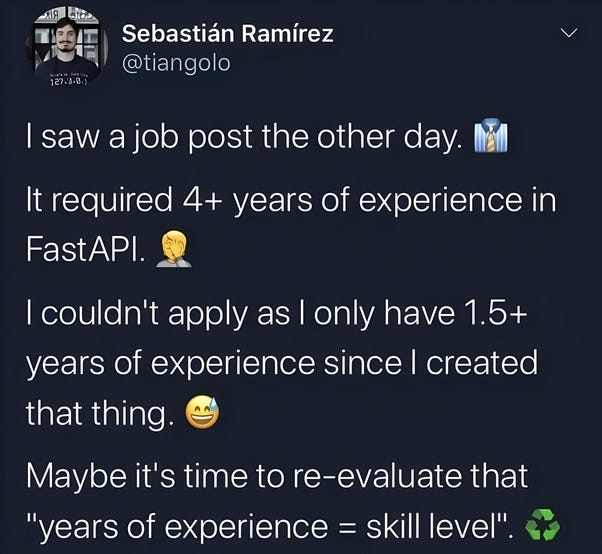
A LOT of jobs I see posted indicate an upper limit of experience precisely because older workers know when they’re being ripped off or manipulated by an unethical employer.

Why is being employed not a right?

This post is a response to a question posed in its complete format: “Considering you’ll die without a job, why is being employed not a right? Can society really just ensure someone dies by refusing to hire them anywhere?”

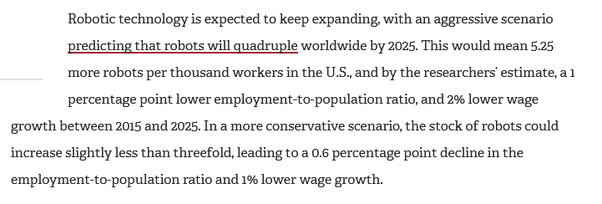
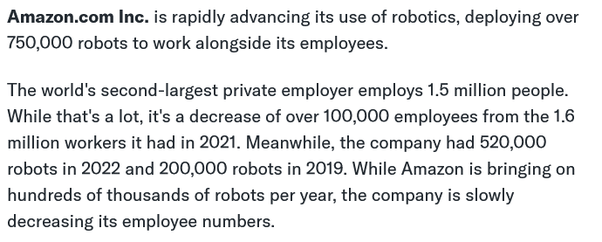
As the world of work becomes increasingly automated, the workplace dehumanization issue rapidly grows into a sociopathic dismissal of our essential qualities as living, breathing, thinking, and evolving beings. This pressing concern will affect more and more people in the future with increasing rapidity as workplace automation continues to adopt and incorporate an increasing rate of technological advancements into their operations.

A new study measures the actual impact of robots on jobs. It’s significant. | MIT Sloan

Amazon Grows To Over 750,000 Robots As World’s Second-Largest Private Employer Replaces Over 100,000 Humans

Meet the Humanoid Robot Working at a Spanx Factory (18 minutes)

To be clear, the dehumanization of the workforce isn’t a consequence of automation but of aggregation into ever larger corporate entities now spanning the globe in their operational reach. Automation is merely a step toward increased efficiency and reduced operating costs. Automation is simply the formalized acknowledgement of transforming labour into a dehumanized function that benefits capital-infused decision-makers chasing profit. What was once an entity supporting community development within the “Mom-and-Pop entrepreneurial environment” has become industrialized economics.

Entrepreneurs of today are the artists of yesteryear who sought out patrons to support their initiatives and receive benefits in return for their support in a parasitic relationship that both drains value from the creative individual and shapes their creative output in their narrowly defined image to fit an increasingly homogenized production system.

The dehumanization of the workforce began when people became deemed commodities, and “Human Resources” departments were created as legal defence linebackers to protect corporations from the consequences of exposed liabilities.

The world of employment has become less about identifying skills and more about choosing appealing aesthetics and fetishes. One is no longer in a position of being hired to function in a role with an expected standard of performance in fulfilling the requirements of that role inasmuch as they’re selected like an attractive product on a shelf that will complement the rest of the pieces on a mantle.

The disconnect between the function one is intended to fulfill, the decision-maker determining the need, the department composing the requirements list, and the agency tasked to identify appropriate candidates has become so much of a production line that they cannot help but to regard all their people as narrowly defined replaceable cogs with limited capacity and range in an expense paradigm rather than as an investment and a partner in the enterprise. The only success an individual can contribute to a dehumanized function is to meet predetermined expectations in a static environment with an expected and finite lifespan.

Corporations may be deemed people, but they’re more machine than human. Unlike humans, they can only change course and be adaptive to evolution when the small number of myopically focused humans operating them can implement global changes that often involve complete retooling and rebranding or being incorporated into another corporate system.

Once that occurs, however, whatever unique nature or personality that may have existed in the original entity is subsumed into the more enormous beast.

The issue of jobs and employment is a critical metric only for those whose role in society is to diagnose the overall health of the “super beast” referred to as “the economy.” Individuals are irrelevant to their equations. Humans are no longer humans but cattle to be herded in a dehumanizing system that renders everyone only as valuable as accords the desirability of their functionality in a narrowly defined capacity within an inhuman entity.

One’s value as a human in society is determined only by the nature of the type of cog they can function as within the parameters of an acknowledged entity that deems them suitable for its overall operation.

Society doesn’t “ensure” anything because society is a collection of humans operating within a cultural framework. The corporate culture we have endorsed for society has, in return for our loyalties, suffused society with an apathetic disinterest in the human condition and the plights of individual humans.

UBI is the only path available to regain our humanity and create an economy that serves humans rather than modern dynasties comprised of a small handful of monarch-like beings. Without it, system-wide collapse is inevitable.

Has humanity only just begun to scratch the surface understanding of the fundamental nature of reality?

This post is a response to a question posed in its full format as follows: “As clever as humanity considers itself to be, has it only just began to scratch the surface of a true understanding of the fundamental nature of reality?”

This question reminds me of the Epistemology course I took at a local university over a summer off from art school. I was accepted into a third-year program without prior university-level philosophy course experience. I successfully leveraged my art school experience toward my application.

This was my introduction to understanding how language can be utilized with the same disciplined approach toward meaning as mathematics. The course material I read felt more like I was interpreting algebraic formulae than English text.

During this period, I realized access to new knowledge domains began with mastering the grammar that defined a domain.

At first, I read and reread sentences until the language made sense. I plodded slowly through the material and expanded beyond spending upwards of half an hour reading sentences to over an hour reading paragraphs and several hours reading entire pages to ensure I had developed what felt like an adequate understanding of what I had read.

This was not my first time having such an experience. Many would be surprised to discover the art world is also filled with jargon and concepts that require an equal measure of effort at the outset to comprehend the information conveyed. However, the grammar defining the art world can be even more complicated and confusing than intermediate philosophy.

Unlike the disciplined rigour of mathematical precision found in the language of philosophy, art world jargon is often subjectively defined and expressed through abstractions rather than through concrete concepts based in a material world. It makes for mixed messaging among instructors, where one adopts interpretations of concepts based on interpersonal dynamics rather than objectively defined definitions of concepts. I remember often tripping over the concept of chiaroscuro because it seemed no matter how I interpreted what is arguably one of the objective terms in art, every instructor had a different definition. I chose to favour the art history instructor’s definition over the conflicting definitions offered by my painting instructors.

At any rate, my painstaking journey through reading my philosophy assignments left me tired enough at the end of the day to sleep soundly at night and wake up feeling like I was prepared for the class discussion of what we had all read. I would attend class feeling confident that I understood the material — until the class discussions began and the instructor interjected with dialectical curveballs to illustrate limitations on some of the arguments forwarded by students.

About halfway through the class, I felt utterly overwhelmed, as if I had no idea what I had read. I felt like my confidence was entirely misplaced and that I should have started my formal training in philosophy at a more junior level.

Then it happened — the discussion veered back onto the topic I thought I had read. I couldn’t fathom how the conversation took a journey to an alternate dimension, but I was happy to see it return to the reality I was most familiar with.

By the end of the class, I was dumbfounded to discover that I was correct about understanding the material at the outset before becoming completely confused. I expressed my frustration publicly. My instructor’s response to my confusion was to say simply, “Yes, but now you know it better.”

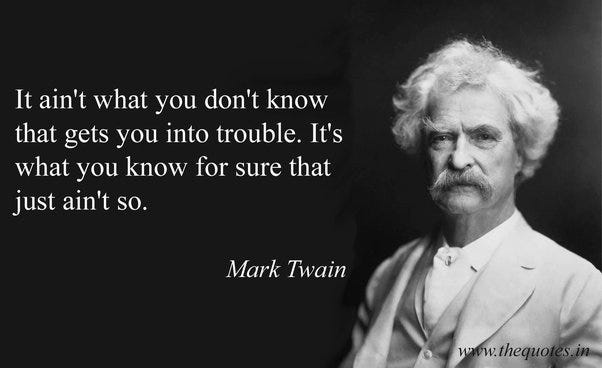
This was a lesson for me to understand that knowing what I know is merely a product of my confidence in believing I know what I know, while what I know constitutes only the tip of an iceberg of what is possible to know about what we think we know.

For a real-world example, I still recall my experience in an interview with a recruiter who seemed impressed with me when he remarked, “Wow. You quoted Voltaire. I’ve never heard anyone quote Voltaire in an interview before.” He presented his surprise in a way that made me feel he would be in my corner and support my candidacy. As it turned out, that was the moment he decided I was disqualified as a candidate. He ghosted me after that, and I never got another opportunity presented to me through that agency.

It took me a while to figure out what had happened, but when I did, I connected that experience with a much earlier one in which I was on the phone with someone about a temporary labour assignment. I remember asking specifically, “What does the job entail?” The response I got was a very dry, “Welllll…. it entaaaaaaaails moving stuff.” I lost out on that opportunity, and the memory of that experience lingers as a reminder of my language choices and their impact on others.

I’ve had to learn to become very aware of how my natural self is interpreted from a young age when I deliberately chose to use the shortened form of my name to fit in. As a kid who became fat to gain approval from an abusive mother, I had to become aware of responses to my natural state of being from a very young age.

I know that my language choices can be offputting for some. I know that when some stranger uses the short form of my name to address me, it’s a form of disparagement that speaks volumes about their attitude. I’m pretty aware of subtleties many miss, even if I don’t catch them immediately — mainly because I’m not naturally focused on the underlying cynicism many naturally wallow in, so it can take me some time to tune myself into their frequency.

I’m using myself as an example to answer this question because I know I’m pretty self-aware and more than most, but it doesn’t matter how much I know about myself; I’m still discovering new things about myself. This isn’t to say that I’m primarily interested in myself for the sake of knowing myself, but knowing myself is a conduit to a better understanding of the world I live in — for several reasons.

One of those reasons is inspired by an expression I’ve been primarily familiar with as an attribution to Voltaire — yes, precisely the quote I referenced above:

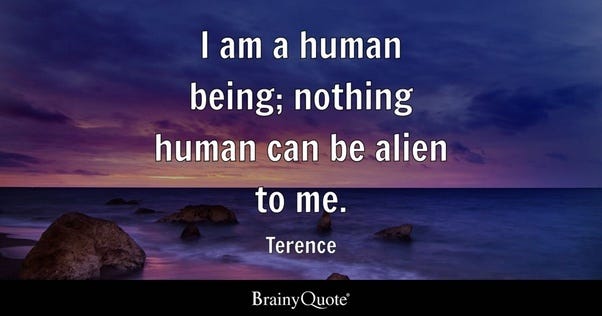
After being inspired by this quote for about thirty years, I discovered it wasn’t a quote by Voltaire. These are words from someone far earlier in history, Publius Terentius Afer, a Roman playwright otherwise more popularly known as Terence.

“Homo sum, humani nihil a me alienum puto.”

These are words from a play entitled “Heauton Timorumenos” (The Self-Tormentor) — Act 1, scene 1, line 77, written in 165 B.C.

The Wisdom of a Former Slave

I had lived with these words, inspiring my pursuit of knowledge of the world through the understanding of self for more than half my life before learning the truth of their origins. I’m still learning new things about it — even though I deeply value what they imply — to me.

This brings me to another quote I treasure by Picasso that he uttered in his 60s after already transforming the art world with his visions, “I am only just learning how to paint.

I loved these words the moment I encountered them because they confirmed that I was on the right track in wanting to become an artist in this world and this life. I understood that what one does to find fulfillment in one’s life is contingent upon loving what one does. The fact that there was no end to learning within art, as expressed by a historical giant, inspired me.

I would never get bored by being an artist. I would never find myself outgrowing what exceeded my grasp, and I could give myself wholeheartedly to its exploration — infinitely — or at least within the context of a finite life.

There was no way I could become complacent and detached from life by choosing a vocation of exploration of life itself. The fact that I would never learn all there could be to know wasn’t a deterrent but an inspiration and a challenge to motivate me to learn as much as possible within the finiteness of time available to me in this life.

Within this microscopic pool of choice available to me as an individual, I found enough inspiration to carry me through a life of discovery. When I imagine the vastness of a universe, we have no clue how large it is or what there may be to discover, and it seems to me that the human species can find millions, if not billions, of years of motivation for discovery.

We have certainly learned a lot about the nature of reality, from a psychological to a physiological to a physical and materialist nature, and beyond, while exploring reality on a quantum level. The fundamental characteristic of learning is that with each answer to a question answered, many more questions emerge. Answers to questions about the nature of reality appear like fractal algorithms that can spawn infinite questions.

No matter how long or how well we succeed in surviving — mostly the challenges posed by our hubris, we’ll never run out of room for discovery.

This, to me, defines the very core of the most basic lesson in life: it’s not the destination which matters; it’s the journey.

Temet Nosce

Is Elon Musk evil or corrupt?

This post is a response to a question posed in its full format as follows: “Is Elon Musk evil or corrupt? I tend to admire people that take their money and build something of value.”

Elon Musk is a typical human born into a life of privilege and who happened to be smart enough to leverage that privilege into such a degree of wealth that it allowed him to free up restraints on the ego that drove him to that wealth.

This phenomenon occurs because humanity has no overarching vision that unites us and that we all consciously strive toward in everything we do.

Far too many are still at the toddler stage of “I’ve got mine, eff you,” and our culture of wealth worshipping exaggerates the sort of narcissism we see running rampant everywhere.

Musk, Bezos, and an appalling list of etceteras got wealthy because that’s what they valued, not because they dreamed of using that wealth to better humanity. The people working on the betterment of society are mainly working on shoestring budgets while relying on closely-knit relationships with others who believe in the potential of what they’re doing.

Those are the invisible creators throughout society that people with privilege — the sharks among us love to feed on and claim credit for their creation. It is like a pattern Musk’s fanboys should be able to spot now due to their knowledge of him, but they somehow fail to see the obvious.

The consequence of this worship mentality is that we no longer view the wealthy as we view other human beings. The rich and powerful acquire, along with their materiality, a perception of superiority as a human who magically transcends human failings.

They don’t, but we see evidence of an analogy that money is like salt for food; it magnifies what was already there.

We haven’t come to grips with the implications for us as a species because of this particular blind spot we have cultivated through millennia of worshipping imaginary super/extra/meta humanoid beings as paternalistic avatars for our species.

We are groomed from childhood to worship, which comes naturally through trust between a parent and child. That depth of connection between humans is what defines humanity. For a species that has arisen from a history of barbarism, it’s not surprising to see relics of that bonding psychology in play to serve as the uniting vision for a culture we lack as a species.

This blind spot we have and this compulsion to worship wealth and power have been coming at a cost that nowhere near enough of us can yet see. Those who do are freaking out because of the eerie similarities the fawning behaviour he receives has with cult members. Being a fan is one thing, but abandoning all reason to avoid critical analysis and engage in a blind defence of antics that are blatantly self-serving nonsense only shows that it’s not Musk that’s a problem; it’s us.

We still haven’t gotten to that stage where we understand the meaning of “power corrupts, and absolute power corrupts absolutely.” — however, if we don’t get our environmental issues under control, we won’t have a choice but to believe unlimited wealth in the hands of too few is too much of a threat to the future of our species to allow it to continue without ensuring it halts immediately via guillotine.

Those who still don’t get it should ponder the wisdom of establishing an entirely new industry catering to the wealthy that will be responsible for the most significant environmental damage from a single human activity than all others, and that’s the amount of carbon pumped into our atmosphere to lift a ship into our outer atmosphere for ego boosting junkets for the pampered class.

They’re already responsible for the lion’s share of lifestyle contributions to our environmental issues, and no one is crying foul about their latest space penis ventures.

They’re not necessarily “evil” (even though Bezos does a tremendous job of being convincing in that area); they’re just self-serving adults with power who have the emotional development of children.

The consequences of failing to restrain power will undoubtedly be considered “evil,” but all of us will evenly share the blame.

Can Devin AI replace human developers entirely?


This question was originally answered on Quora and written as is.

I’m not familiar with Devin per se, but I don’t see AI “replacing people” in any capacity it is developed to function within — and I use that description with a caveat because AI IS replacing hundreds of thousands of jobs — if not millions worldwide.

https://preview.devin.ai/

AI has the potential to liberate humans from mundane tasks. It can free up time that would otherwise be spent on repetitive, clearly defined functions while still relying on humans to make decisions and set the parameters for these tasks.

Tasks that require creativity, judgment, and understanding of context will continue to be the domain of humans. These include quality control analyses, determining the scope and context of tasks, and designing the application for which a task is intended.

This is where the waters become muddy because most jobs are mostly drudge work.

Millions of labour hours are spent every year on tasks that can be automated.

Capitalists know how much they can save by eliminating humans from repetitive and clearly defined tasks.

Many may be arrogant enough to believe they can supplant human creativity and intuitive judgment with an artificial solution. Companies like Disney, however, are butting up against an immovable wall in this regard and getting their noses bloody because of their sociopathic disregard for the human equation in the capitalist environment.

We will see many psychopathic capitalists decide they can do without the most expensive of their labouring monkeys, and they will fail because of it.

We are likely to witness a significant loss of jobs due to AI. This is a reality that few people doubt, and those who do will be in for a rude awakening when the replacement rate reaches a critical level.

Yes and no, but yes, jobs will be lost. Developers with initiative, resources, and creativity to imagine solutions will also be empowered to create their own software enterprises. New jobs will be created, and we’ll see an explosion of “individual corporations” replacing a landscape of monolithic enterprises that employ hundreds of thousands, which will be much healthier for our economy in the long run. This change in our corporate landscape will reintroduce the stability we once had before the middle class came under assault in the 80s and eviscerated our unions.

Right now, when a monolithic corporation makes a minor cut in its costs, thousands of jobs are lost. The economy is stunted as a result of a minor bookkeeping adjustment or on the whims of a sociopath who decides they no longer need to pay half of the staff of the enterprise they just purchased and sends them off packing.

In an environment populated mainly by independent entrepreneurs and small “mom-and-pop shops,” any single endeavour can fail, and its failure has no discernable impact on the economy or society at large.

The biggest, most disruptive, and potentially destructive challenge is arriving at this newly recovered and economically defined demographic dynamic through a smoothly managed transition.

The most crucial step to reduce the negative impact and the widespread hardship resulting from the transition to an automated society is to build a solid base upon which people are free to live and pursue the motivations arising from their imaginations and inventiveness.

We must improve liquidity throughout our economic systems, which requires a two-fold process. While the first is to ensure everyone’s basic living needs are met through a universal income floor, the second requires freeing up capitalization for entrepreneurial initiatives.

This second step will be the most difficult to implement because it will require the most powerful among us to relinquish their power. That will happen through reasoned measures or due to entrenched and narcissistic arrogance that will lead us all to widespread chaos.

Hopefully, most will be able to identify entirely new vistas of opportunity for themselves in which they can benefit from the changing landscape in ways that are becoming less and less possible by reaching a saturation level where the only room left for growth is a takeover of smaller enterprises.

As individuals, their creative capacities and economic potential are far more reliant on the support and inspiration they receive from the collaboration synergies than on armies of sycophants telling them what they want to hear.

Some will be wise enough to leverage a massive transition in human society in their favour because they understand and value human ingenuity. Others will fail because their misanthropic disdain toward their servants leads their economic inventiveness to an empty silo devoid of value in the marketplace. If we are to go by the statistics which indicate the prevalence of psychopaths at the boardroom level matches the density of a prison population, I would expect about 20 percent of our plutocrat dynasties will not survive the transition and humanity as a whole will be the beneficiaries of such a surgical culling of our economic dynamics.


Cognition Labs — The developers of Devin AI — LinkedIn Profile:
https://www.linkedin.com/company/cognition-ai-labs/

They can be followed on X via @cognition_labs

Below is a screen of current AI initiatives underway for augmenting the software development process — 24 AI projects for software development alone as of September 2024:

Since deciding which option might be best to explore for one’s projects, here is some further reading on AI tools for software development:

Top 10 AI Tools for Developers in 2024
https://code.pieces.app/blog/top-10-ai-tools-for-developers

13 AI Tools for Developers
https://www.wearedevelopers.com/magazine/ai-tools-for-developers

Best AI Tools for Programmers: An In-Depth Analysis
https://medium.com/@kaushikvikas/various-ai-tools-for-programmers-an-in-depth-analysis-e4ddc1cde88d

Top 15 AI software development tools to use in 2024
https://decode.agency/article/ai-software-development-tools/

9 of the Best AI Tools for Software Developers in 2024
https://www.stepsize.com/blog/best-ai-tools-for-software-developers