How do we stay hopeful when fascism is on the rise?

This post is a response to a question posed in its complete format: “How do leftists stay hopeful/resilient in times like these where fascism is on the rise and history is repeating itself?”

History has shown us that fascism always gets beaten back when the public realizes how much less they like fascism than the chaos of democracy. Every time and after enduring a period of suffering under the rule of despots, voter turnout makes a strong comeback as fascism encourages the apathetic non-voters to rethink their strategy of staying home.

Think of fascism as a lesson in consequences where people need to suffer enough to realize just how precious the delicate balance of freedom is in society and how vital the sausage-making process is, no matter how boring and dry it may otherwise seem.

People eventually learn they prefer to get off the couch and go to the polling stations to cast their votes for people they want to trust to represent their best interests. They also eventually learn that no matter how much the fascists want to paint their opposition as being identical to them, they’re not. The fascists inevitably piss off the people enough to go to war against them, and that’s precisely what Trump and Musk are inviting from the world.

They’re poking a tiger, and they’re going to get burned while they set the world aflame.

The only real question left on the table is, Just how much more pain will the people endure before the riots break out?

This isn’t even about being hopeful because we already know, just like everyone who’s been pushed past their limits, that once the anger takes over, there’s no stopping it. That neighbour who’s been pissing you off with their loud music invariably gets an earful that may embarrass you afterward. Still, it’s an emotional explosion that can’t be controlled during its moment of emotional release.

My guess is that if Luigi Mangione gets the death penalty, that might be the final trigger before all hell breaks loose. It’s hard to tell because Americans seem able to tolerate incredible horrors without doing anything substantial about them.

I know that if I was living in Flint, Michigan, for example, and I had a kid who died from the poisoned water, I would have pulled a Luigi myself. If a kid of mine were gunned down in a school while my local representative did nothing to institute sensible measures to prevent this from happening again, I’d lose my shit.

As it stands right now, from what I’ve been put through on a personal level, I’m already doing everything I can to keep from doing something stupid while attempting to resolve an issue in the most civilized manner possible. As it stands, the bullies responsible for destroying my life are behaving as if they’re going to walk away without suffering any consequences for their actions as they tell me to shut up and die quietly.

I know I’m not the only person at the end of their rope, and all it will take is the right match to set this nightmarish dystopia ablaze.

People like Musk will have to come around or beef up their security because it’s only a matter of time before their arrogance blows back like a nuclear bomb in their faces.

“Those who make peaceful evolution impossible make violent revolution necessary.”

The trouble with this dynamic is that millions of people have to be pushed to their breaking point before they realize how much less pain there is in risking death in a revolution than to continue enduring a walking death in slow motion toward oblivion.

This is all just history repeating itself.

It’s not new by any stretch of the imagination.

Those who refuse to learn from history force us all to replay it, and we all get uglier about it each time we must endure the stupidity of people who refuse to read the writing on the wall.

The only salient aspect of hope in this mess is that we can avoid the worst chaos before returning to sanity.

Do laws, traditions, and social edicts introduce/produce more or less freedom?


This post is a response to a question initially posed on Quora, and can also be accessed via “https://www.quora.com/Do-laws-traditions-social-edicts-introduce-produce-more-or-less-freedom/answer/Antonio-Amaral-1

This is a leading question. Lumping all “social expectations” into a “freedom bag” produces only “freedumb” — the inability to distinguish between regulating destructive behaviour and encouraging positive behaviour to support the social contract.

Laws against murder can conceivably be considered restrictions on freedom, but they’re also a means of protecting freedom for the victims of predators in society.

There is no universal single-size-fits-all means of parsing this question. It’s just a nonsense question designed to appeal to those who already perceive society as children complaining about having to clean their rooms.

Here’s a counter-intuitive example for people who don’t quite understand the nuances of laws and social expectations.

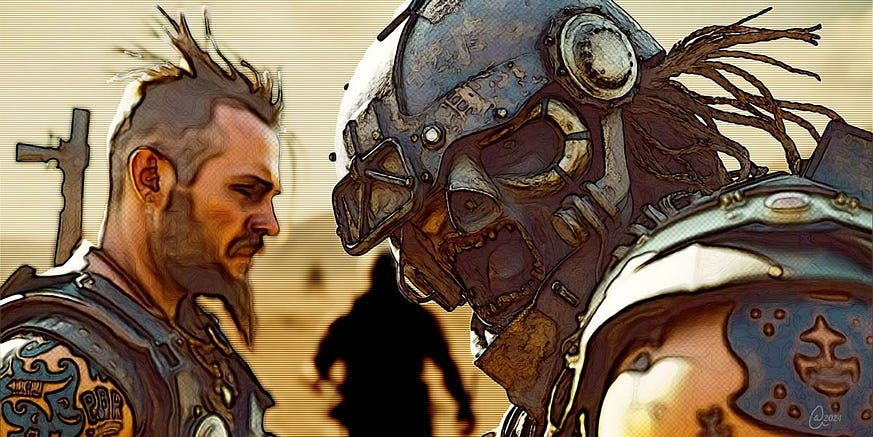
It can be argued that in a Mad Max dystopia, one has the greatest “amount of freedom” possible because there are no such “restrictions” (parameters) as those in a world where anything goes. The harsh reality in such a case is that what constitutes freedom for some (the powerful) constitutes enslavement for the rest of “society” to a persistent fear of having one’s life snuffed out on a whim.

Sometimes, restrictions produce greater freedoms than would otherwise be the case.

In the art world, for example, the greatest creativity can be produced simply by putting parameters on one’s work and approach to doing one’s work. In a personal case, I restricted my palette to black and white for about half of a semester after being told by an instructor that my colours looked like Disney had barfed them up and onto my canvas.

I struggled with colour and all the many nuances of colour, so I had not developed the nuance of understanding how colours work in balance, just as shapes do in a composition. Removing colour from my palette allowed me to focus on developing harmonies between shapes and finding ways to establish compositional balance without the added complexity of colour as a dimension to throw me off.

That restriction allowed me to understand my work from an entirely different and much more free perspective. I discovered freedoms I did not know existed before my self-imposed colour restrictions.

Society is much like that because it has become so complex it’s difficult to parse which aspect is beneficial and which is toxic. We can no longer live with the simplistic view of the world we once nurtured through symbologies like a difference between white hats and black hats. We live in a world of anti-heroes, and that makes demands on our ability to apprehend nuance through developing critical thinking skills. We must learn to be capable of adequately parsing subtle distinctions that can threaten to transform freedom into subjugation within the slimmest of margins.

People find the freedom to be themselves within their tribal associations but can also find their freedoms stripped by the dogmatic application of tribal expectations.

Another example I’ll take from Isaac Asimov’s Foundation series (which I applied — or interpreted as Japan in the 1980s) was the planet Terminus. Hari Seldon’s group was consigned to a planet that was slim on resources to mitigate the potentiality of becoming a threat. Instead, what happened was that scarcity of resources encouraged their creativity such that over time, they produced faster and more powerful ships that were smaller than the Empire’s massive vehicles.

This means that freedom cannot be measured by its constraints but by the results of the limitations (or parameters) placed upon a society. Those constraints can facilitate freedom when they are balanced between the needs of the many and the individual’s desires.

The mythological free society in a harmonious state of anarchy is a pipe dream founded upon a delusional presumption that all humans value the social good above one’s benefit.

The U.S. is a case study for the ages over just how toxic extreme individualism is. For a nation that pretends to value freedom, its privatized prison population screams to the world how subjugated and servile its society is. The U.S. is so “free” that they allow children to be gunned down in schools, not just once but repeatedly. The U.S. is so “free” that people are killed for profit.

A football game with rules is a dynamic tension that draws engagement from an audience, while football without rules, for example, becomes a chaotic bloodbath that disperses an audience.

This question is a testament to how badly butchered the concept of freedom has become within this modern dystopia.

Perhaps this question should be reworded as “What is freedom?”


Bonus Question and Answer: To regulate and control human behaviour, what do you understand by that?

I understand that too many people think a valid strategy for accomplishing this is imposition and subordination to power under the threat of subjugation.

The positive, proactive, and ultimately democratic means of accomplishing the goals of regulation and control are through the development of a human capacity for self-regulation by encouraging the improvement of emotional management skills bolstered by critical thinking skills while addressing fundamental threats to personhood such as living insecurities and forms of persecution through the repression of rights and freedoms.

Showing people how to achieve their potential is a far more effective means of proactive regulation than the barbarism of reactionary punitive measures. This approach also leads to far more long-term stability in society and a much more engaged citizenry actively working toward supporting the social contract by choice.

We can achieve our potential as a species only by helping all of us to be better rather than forcing conformity to myopic structures made vulnerable by their inflexibility and inability to adapt to an ever-changing universe.


Happy New Year! — Here’s hoping your 2025 is a good one. Thanks for reading.

Why would it be possible to live without the government?

This post is a response to a question initially posed on Quora and can also be accessed via “Why would it be possible for people to live without the government?”

It’s not.

Without government, we would barely survive while struggling with anarchy and doing our best to avoid the bullies among us who would have free reign to terrorize anyone they please.

Life would be cheaper than it is now. Justice would be non-existent, and perversions of it would be meted out by force and without any form of protection for anyone without the power to dominate others.

Virtually all scientific and technological progress would halt. If government ceased to exist from this point forward, we would be facing a nuclear holocaust through much of the world as centuries-long enemies would no longer be restrained from indulging in their worst fear impulses. The mid-East would essentially be vaporized and rendered uninhabitable for the next century. India and Pakistan would decimate each other. Much of Eastern Europe would be bombed into rubble. China would decimate its neighbours and indulge in its most significant expansion across the globe… or it could fall apart into factions ruled by powerful interests within the nation whose infighting would also collapse the country and leave it vulnerable to external aggressors seeking revenge.

Whatever may exist of what you call home would have to be protected by traps and a twenty-four-hour armed security detail. You would sleep in shifts.

Your environment would be like living in a perpetual purge. That would likely last until we’ve culled most of our species and our numbers shrink from eight billion to a few hundred million within a few years at the outset.

Once we’ve burned ourselves out from a pent-up violence orgy, we’d start seeing primitive tribal infrastructures negotiating arrangements to secure our survival as a species. At the same time, we would find ourselves living in an entirely hostile world as we experience ecological collapse all around us from our careless mismanagement of the environment ramped up into overdrive from global conflicts.

We would make the world of the Mad Max mythos manifest and find ourselves severely humbled as a species.

As much as people may hate government and as much as many criticisms are justifiable, we need government for the simple reason that the one in five who currently manifest the mental health pandemic we’re living with is a perpetual threat to human existence.

Once we succeed at reaching a point of optimal mental health where we have overcome our psychoses, human society may evolve to a degree where government is as much an automated system as the rest of the industrialized world promises to be.

Until then, our best bet is to become more engaged in our self-governance as a collection of democratic societies — which, at this point, means “taking our government’s back” — out of the hands of the few with too much power and back into the hands of all of us.

Humanity’s worst threats have always been the few with too much power victimizing the many with too little power. This is why democracy was born and has dominated the landscape over the last century.

Sadly, those with too much power in today’s world hate it and are actively undermining it to send us all back to a medieval state of existence as a two-class society of rulers and serfs.

As much as many people may wish to mock democracy as a fundamentally flawed system while pointing out the advantages of an autocratic system, the reality is that we have never truly committed to making democracy work. If we had, we would do the necessary thing — equip everyone with the education, skills, and insights required to make proper decisions reflecting what’s best for all of us.

This last American election showed us that people are still trapped within the paradigm of what’s best for them personally in a zero-sum game that necessitates the existence of losers to support the winners.

The solution to our problems is not eradicating what we struggle with but fixing where we fail to make it work. That means improving our education systems by learning to value education on a level as if our lives depend upon it because they do.