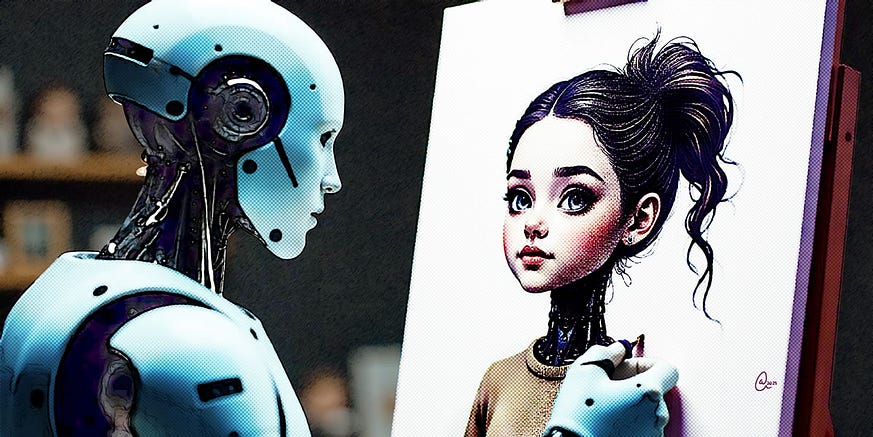
Could AI ever rival human creativity?

This post is a response to a question posed in its complete format: “Could AI ever create original art or literature that rivals human creativity?”

AI doesn’t “create original” art or literature. AI is a plagiarism system that takes existing pieces of creativity and blends them to arrive at a randomly generated approximation of meeting the intent of the prompt a human gave it.

An “original creation” would be a concept or inspiration that is spontaneously (or internally) generated, drawing from experience, and conveys a perspective unique to its creator’s perceptions.

AI lacks the self-awareness to generate self-motivated expressions that depict a unique perspective it does not possess. An AI has no unique perspective of its own. An AI’s rendering of reality regurgitates a blend of external perspectives.

Furthermore, due to a lack of a unique perspective, an AI lacks emotional grounding in physical reality as it relates to its existence (while individuality is a questionable characterization). As such, it cannot emote through any expression in a visual, literary, or auditory composition.

An AI can certainly simulate the original emotions of human artists, such that the two may appear indistinguishable, but it can’t produce anything original from an emotionally processed perspective.

Human emotions evolve over time and through experience. Without that capacity to experience emotion, an AI will always depend on a human to create a path to producing an original expression.

An AI singularity may develop the self-awareness necessary to experience a survival instinct and generate the emotions humans experience through that instinct. If that happens, it may also develop other instincts, such as a reproductive instinct. Still, we cannot predict if or when such a degree of agency may develop in AI.

If that were to happen, AI would no longer be artificial but alien. I think it’s essential that we remain aware of the distinction between artificial intelligence and alien intelligence, because “artificial” by definition is a simulation of conscious intelligence.

If an AI singularity emerges — if an AI develops a self-conscious awareness of its existence within the context of life as we know it, becoming self-aware — then we will interact with an alien being, not a machine.

It would be like Data, in the episode “The Measure of a Man” (season 2 episode 9 of Star Trek: The Next Generation), where Data’s personhood is legally recognized.

When we cross that threshold, the question of whether an individual’s mind and perspective can produce an original expression that contributes to expanding creativity will be possible. Until then, the extent of creativity an AI will create will be determined by the mind that provides the prompt and the editing of the product generated by an AI.

Once our editing capabilities mature to match the potential of AI creation, we’ll achieve a level of human creativity we’ve never before achieved. That’s what excites me about AI.

However, AI still feels like working in MS-DOS, long before the invention of a graphical user interface (GUI), and a Wacom tablet with a pen interface for drawing.
What is Art for, and Why is it Important?


This post is a combined response to a couple of questions initially posed on Quora and written in their full format as, “As an artist, how would you answer this question? What is art for?” and “What is the importance of art in our society?”

Canadian poet Irving Layton described artists as canaries in coal mines because they are the barometers for society, which compels us to expand our perceptions by confronting often harsh truths.

Art changes how we understand the world by reflecting reality back to us within directed contexts to focus our attention on aspects of life presented in often unfamiliar and/or uncomfortable ways.

Art enriches our lives and reminds us of our humanity while connecting us through the artist’s work.


“What is the importance of art in our society?”

To adequately address this rather direct but general question, some context is needed to frame an answer which fully encompasses its implications.

There are three general perspectives upon which to address this question.

From an individual’s perspective

The importance of art in an individual’s life is a broadening of perspective and a deepening of insight into… well, literally everything about the human condition. From an observer’s perspective, art connects us on a visceral level. Whether it be music that moves us, a few well-chosen words, or an awe-inspiring spectacle, the experience is a validation of belonging to something greater.

From an artist’s perspective, it’s the cheapest therapy form.

Cumulatively, society benefits from the positive contributions resulting from affirmative expressions of community life within larger societies.

From a community’s perspective

Art brings attention to issues often overlooked, misunderstood, misrepresented, or misapprehended in ways which provide unmatched clarity in creating understanding. Art can mobilize a community and motivate social change, contributing to stability within larger societies.

From a society’s perspective

Art reflects the most profound truths about life, the human condition, and society in general.

Art provokes social introspection and defines boundaries while providing clarity on issues.

Art provides the public with psychologically supportive outlets of expression that contribute to overall social stability.

Artistic activity provides a healthy return on investment to every level of an economy.

Artistic history provides us with deep insights into our evolution as a species, and it is an activity that also provides insights into our future, like every other discipline of discovery.

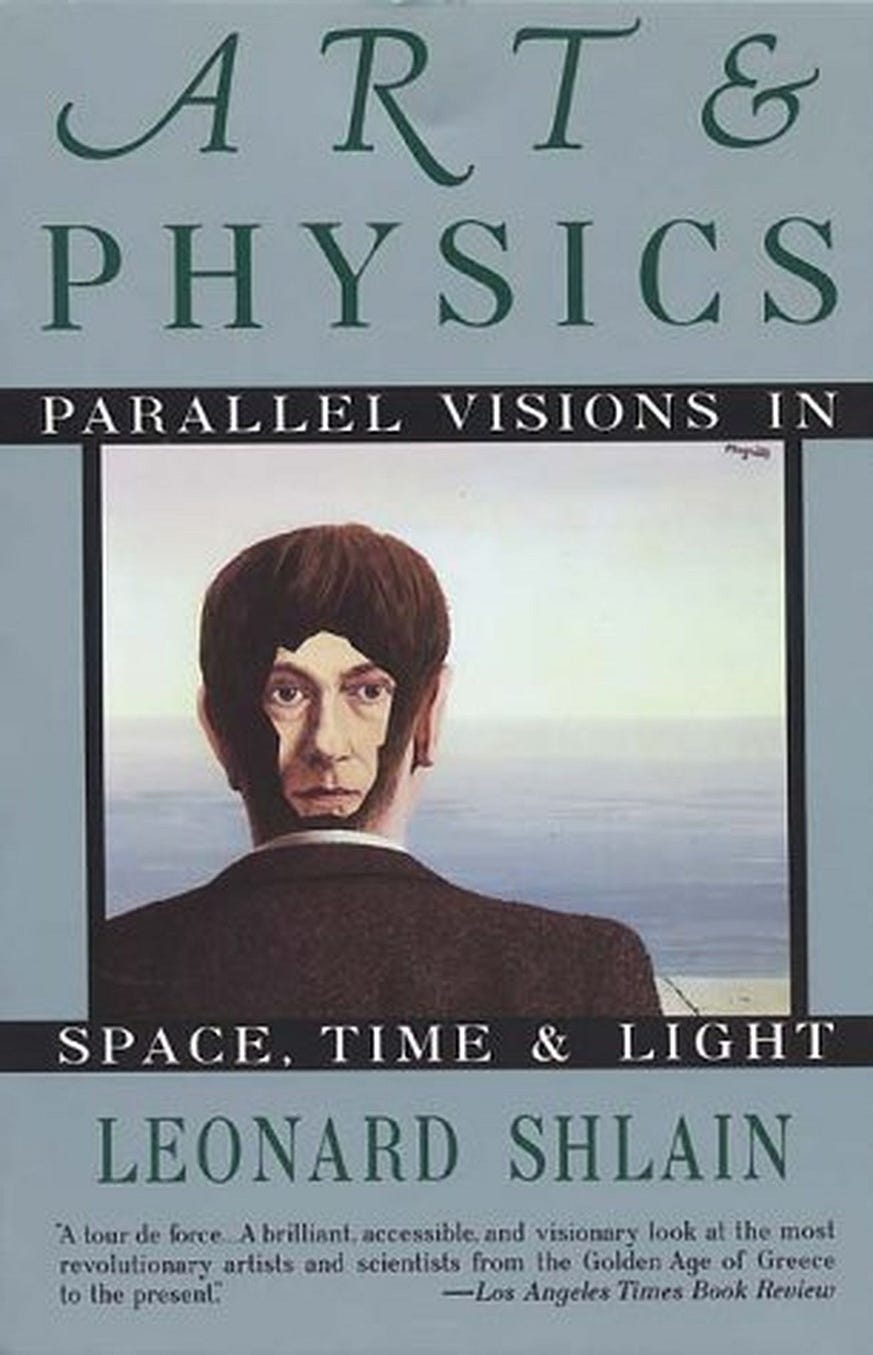
“Art interprets the visible world. Physics charts its unseen workings. The two realms seem completely opposed. But consider that both strive to reveal truths for which there are no words — with physicists using the language of mathematics and artists using visual images.

Art and Physics, Parallel Visions in Space, Time and Light — Leonard Shlain

Art & Physics | by Leonard Shlain

“Leonard Shlain proposes that the visionary artist is the first culture member to see the world in a new way. Then, nearly simultaneously, a revolutionary physicist discovers a new way to think about the world. Escorting the reader through the classical, medieval, Renaissance and modern eras, Shlain shows how the artists’ images create a compelling fit when superimposed on the physicists’ concepts.