Why are people reluctant to call out worthless art?


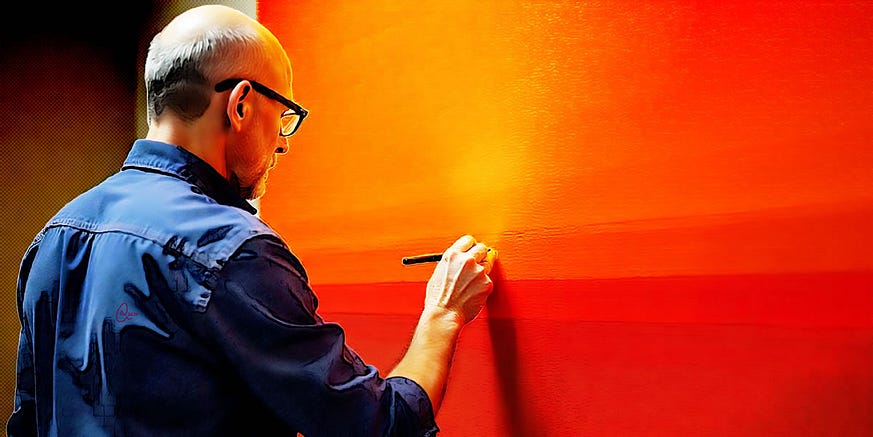
This post is a response to a question posed in its complete format: “Why are people so reluctant to call out “artists” like Mark Rothko for the sheer worthlessness of his ‘art’?”

“Art should comfort the disturbed and disturb the comfortable.”

This is a flawed presumption because people have no problem expressing their views on the arts they encounter.

Of all the vocations humans indulge in, none are exposed to as often to emotionally charged criticisms as the arts, much like how this question seeks validation.

The question is an admission of failing to understand numerous aspects they reject on a visceral level, while depriving oneself of an honest intellectual process of critical analysis.

This is a question ruled by pure bias in the same way all forms of intellectually stunted bigotries are concocted.

This question also reveals a mindset incapable of appreciating Gestalt and is more enamoured by puerile rather than reflective experiences.
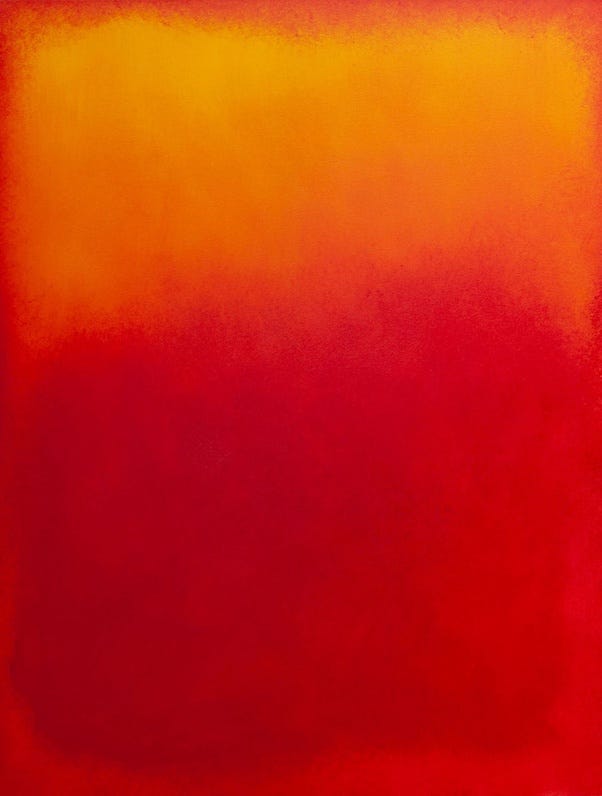
These paintings cannot be judged by their reproductions in a book or onscreen.

They must be experienced in person to apprehend their meaning.


As much as the question seeks to disparage and devalue the valid contribution of a life dedicated to the furtherance of one’s craft and vision — such that their work will be remembered for centuries, in contrast to this puerile critic who will be a long-forgotten example of a juvenile apprehension of what they are intimidated by.

The fact is that your subjective tastes in art do not serve as a universal metric of value. No single individual has that power.

Value is determined by a complex dynamic involving institutions and people with depths of historical awareness that far surpass the childish apprehension of what this question celebrates as a mindset.

One the first bits of wisdom I encountered as an Art student is as follows: “When people say, ‘I don’t know much about art, but I know what I like.’ they are actually saying, ‘I don’t know much about art, but I like what I know.’

This question is an admission of being out of your depth, and you’re freaking out about drowning in being touched by the ineffable. You can’t handle letting yourself go and float freely within the infinite.

This question screams “shallow-thinking and egotistical control freak” to me.

I’m sorry you are struggling with his work. Your question, however, indicates you need to engage with it until you can experience the revelation that will allow you to transcend your intuitively recognized intellectual limitations.

Your visceral reaction to his work is your intuition telling you to focus on something you have been avoiding and repressing within your psyche.

Take these words however you like but try not to ignore how easy it is to call out horseshit when one sees it.

No one has been “reluctant to call him out.” That’s nonsense because no other vocation is nearly as “called out” as an artist’s.

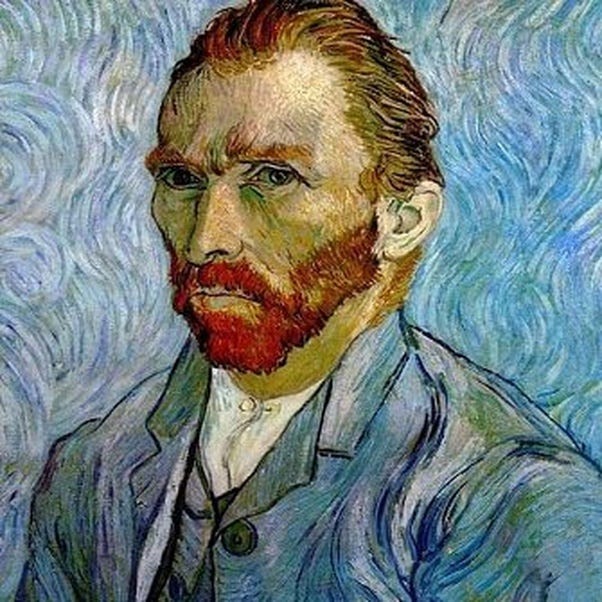
Mark Rothko’s work has not gone without intense criticism. However, it persists, and that persistence determines its value in the same way all artists throughout history have been rejected by their era. Countless artists throughout history have engendered emotional rejections to their work like yours, while a famous one most know of is Vincent Van Gogh.

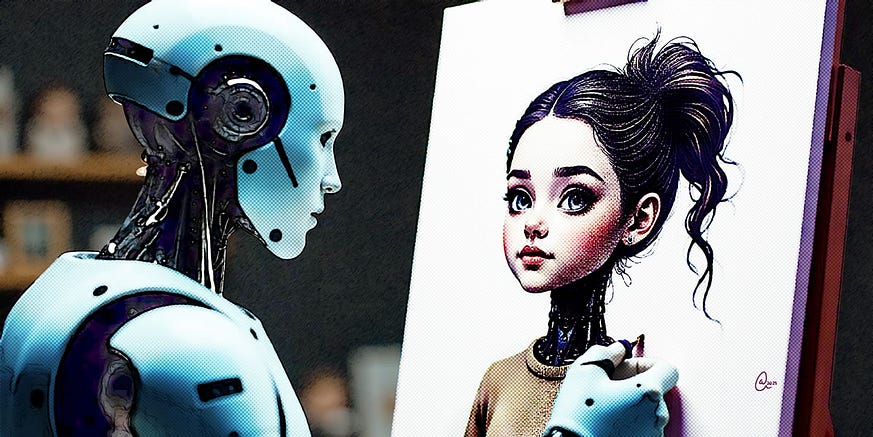
Could AI ever rival human creativity?

This post is a response to a question posed in its complete format: “Could AI ever create original art or literature that rivals human creativity?”

AI doesn’t “create original” art or literature. AI is a plagiarism system that takes existing pieces of creativity and blends them to arrive at a randomly generated approximation of meeting the intent of the prompt a human gave it.

An “original creation” would be a concept or inspiration that is spontaneously (or internally) generated, drawing from experience, and conveys a perspective unique to its creator’s perceptions.

AI lacks the self-awareness to generate self-motivated expressions that depict a unique perspective it does not possess. An AI has no unique perspective of its own. An AI’s rendering of reality regurgitates a blend of external perspectives.

Furthermore, due to a lack of a unique perspective, an AI lacks emotional grounding in physical reality as it relates to its existence (while individuality is a questionable characterization). As such, it cannot emote through any expression in a visual, literary, or auditory composition.

An AI can certainly simulate the original emotions of human artists, such that the two may appear indistinguishable, but it can’t produce anything original from an emotionally processed perspective.

Human emotions evolve over time and through experience. Without that capacity to experience emotion, an AI will always depend on a human to create a path to producing an original expression.

An AI singularity may develop the self-awareness necessary to experience a survival instinct and generate the emotions humans experience through that instinct. If that happens, it may also develop other instincts, such as a reproductive instinct. Still, we cannot predict if or when such a degree of agency may develop in AI.

If that were to happen, AI would no longer be artificial but alien. I think it’s essential that we remain aware of the distinction between artificial intelligence and alien intelligence, because “artificial” by definition is a simulation of conscious intelligence.

If an AI singularity emerges — if an AI develops a self-conscious awareness of its existence within the context of life as we know it, becoming self-aware — then we will interact with an alien being, not a machine.

It would be like Data, in the episode “The Measure of a Man” (season 2 episode 9 of Star Trek: The Next Generation), where Data’s personhood is legally recognized.

When we cross that threshold, the question of whether an individual’s mind and perspective can produce an original expression that contributes to expanding creativity will be possible. Until then, the extent of creativity an AI will create will be determined by the mind that provides the prompt and the editing of the product generated by an AI.

Once our editing capabilities mature to match the potential of AI creation, we’ll achieve a level of human creativity we’ve never before achieved. That’s what excites me about AI.

However, AI still feels like working in MS-DOS, long before the invention of a graphical user interface (GUI), and a Wacom tablet with a pen interface for drawing.

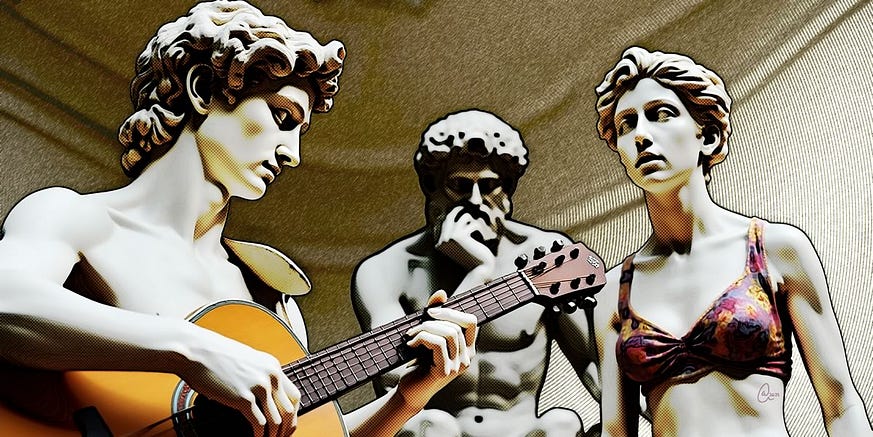
What is Art for, and Why is it Important?


This post is a combined response to a couple of questions initially posed on Quora and written in their full format as, “As an artist, how would you answer this question? What is art for?” and “What is the importance of art in our society?”

Canadian poet Irving Layton described artists as canaries in coal mines because they are the barometers for society, which compels us to expand our perceptions by confronting often harsh truths.

Art changes how we understand the world by reflecting reality back to us within directed contexts to focus our attention on aspects of life presented in often unfamiliar and/or uncomfortable ways.

Art enriches our lives and reminds us of our humanity while connecting us through the artist’s work.


“What is the importance of art in our society?”

To adequately address this rather direct but general question, some context is needed to frame an answer which fully encompasses its implications.

There are three general perspectives upon which to address this question.

From an individual’s perspective

The importance of art in an individual’s life is a broadening of perspective and a deepening of insight into… well, literally everything about the human condition. From an observer’s perspective, art connects us on a visceral level. Whether it be music that moves us, a few well-chosen words, or an awe-inspiring spectacle, the experience is a validation of belonging to something greater.

From an artist’s perspective, it’s the cheapest therapy form.

Cumulatively, society benefits from the positive contributions resulting from affirmative expressions of community life within larger societies.

From a community’s perspective

Art brings attention to issues often overlooked, misunderstood, misrepresented, or misapprehended in ways which provide unmatched clarity in creating understanding. Art can mobilize a community and motivate social change, contributing to stability within larger societies.

From a society’s perspective

Art reflects the most profound truths about life, the human condition, and society in general.

Art provokes social introspection and defines boundaries while providing clarity on issues.

Art provides the public with psychologically supportive outlets of expression that contribute to overall social stability.

Artistic activity provides a healthy return on investment to every level of an economy.

Artistic history provides us with deep insights into our evolution as a species, and it is an activity that also provides insights into our future, like every other discipline of discovery.

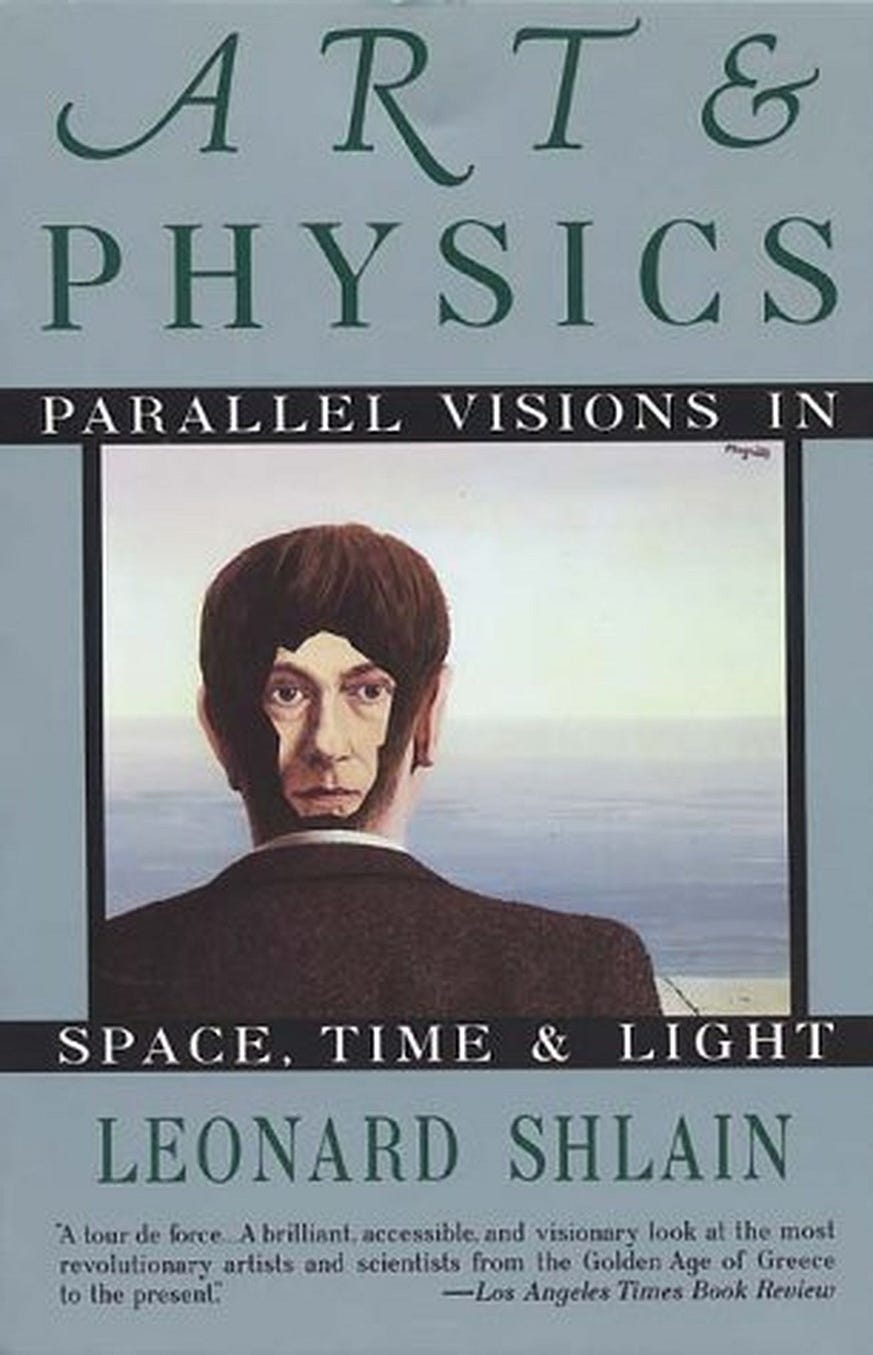
“Art interprets the visible world. Physics charts its unseen workings. The two realms seem completely opposed. But consider that both strive to reveal truths for which there are no words — with physicists using the language of mathematics and artists using visual images.

Art and Physics, Parallel Visions in Space, Time and Light — Leonard Shlain

Art & Physics | by Leonard Shlain

“Leonard Shlain proposes that the visionary artist is the first culture member to see the world in a new way. Then, nearly simultaneously, a revolutionary physicist discovers a new way to think about the world. Escorting the reader through the classical, medieval, Renaissance and modern eras, Shlain shows how the artists’ images create a compelling fit when superimposed on the physicists’ concepts.

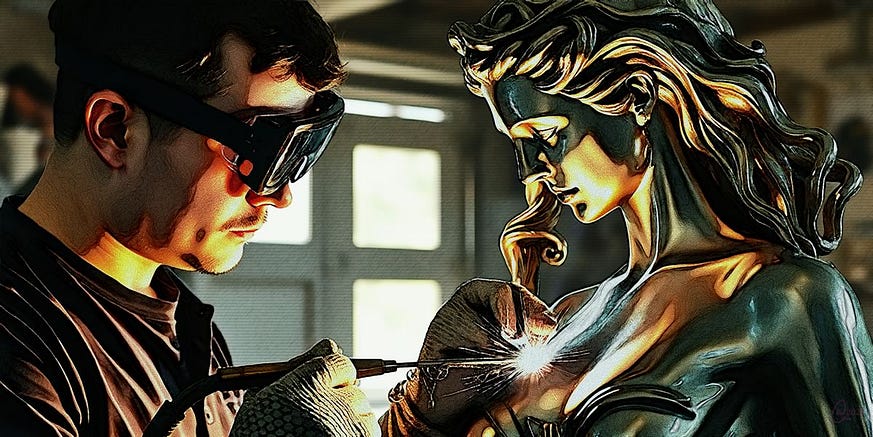
Do you trust the so-called “theories” in the arts?

This post is a response to a question posed in its complete format: “https://www.quora.com/Do-you-trust-the-so-called-theories-in-the-arts/answer/Antonio-Amaral-1

No, but I always trust my instincts when I encounter dripping cynicism applied to “high falutin’” concepts like “so-called theories.”

I don’t “have to trust” art theories since they are primarily subjective analyses of movements, stylistics, and socio-political contexts applied toward individuals, groups, or random associations between artists sharing aesthetic or subject matter concerns.

Theory in art differs from a science-based theory backed up by testable methods to determine an objective and consistently predictable outcome.

They’re not meant “to be trusted” but used as a lens or a filter to focus one’s surveying of a landscape.

In the art world, one learns to trust the analysis and the analyst based on the quality of their insight, depth of knowledge, and the strength of their observations.

Art theories are less critical to artists than academics like Art Historians, whose role in society is to contextualize the whole of art production into descriptions reflecting our social evolution through artistic expression.

Most artists could not care less where they fit into the grand scheme of artistic expression within the context of social evolution. They tend to be more concerned with matters that are important to them on a personal scale.

How one feels about issues they encounter is much more artistically motivating than an academic assessment of artistic context within the creative product.

My initial response to this question was, “What are you talking about?” and that turned out to be a good prompt for me to find a theory as a basis for answering this question.

I know art theories exist from my experience in art school, but I struggled to bring one to mind in any clear focus. Sure, various movements, styles, attitudes, and manifestos vaguely touched the surface of my conscious awareness, but I immediately rejected them as “theories” that relate to the context of this question.

I found this article to be an interesting and concise representation of “art theories” that distinguishes them from scientific theories to assist with making a point in my answer. After getting this far, I find it serves less as a function for contributing to my answer than as a helpful guide for a layperson to consider when assessing a piece.

The fact that I find this a novel summation for contextualizing one’s art-viewing experience reinforces how little concern I place on art theories when considering the pieces I produce.

https://might-could.com/essays/what-makes-good-art/#:~:text=There%20are%204%20main%20theories,ve%20never%20heard%20of%20them
Four Theories for Judging Art

https://might-could.com/essays/what-makes-good-art/#:~:text=There%20are%204%20main%20theories,ve%20never%20heard%20of%20them

For the most part, art production is a process of burying oneself in the fundamentals of artmaking more so than it is about where in the vast spectrum of historical context a piece should occupy. That is my bias, of course.

Art theories are a non-existent concern when working on a piece, whereas composition, shape, balance, colour, line, and tension are foremost in my mind.

All this leads me to ask, “What are you talking about?”

Your profile doesn’t provide much context, but it has several hallmarks for being a troll profile — such as being less than one month old and sparse in detail. Unlike my similar experiences with answering questions on Quora, I won’t mute and block you, but I’m sure I will remember the red flag this question left me with.

Perhaps you have been somewhat affected by a confluence of insecurity and psychological abuse by a pretentious asshole in the arts. Sadly, there are many, as this seems to be a field of endeavour that functions like a magnet for egotistical types.

I suggest focusing more on what moves you to create and less on what others might have to say because their input is often more about them than you or your work.

Good luck.