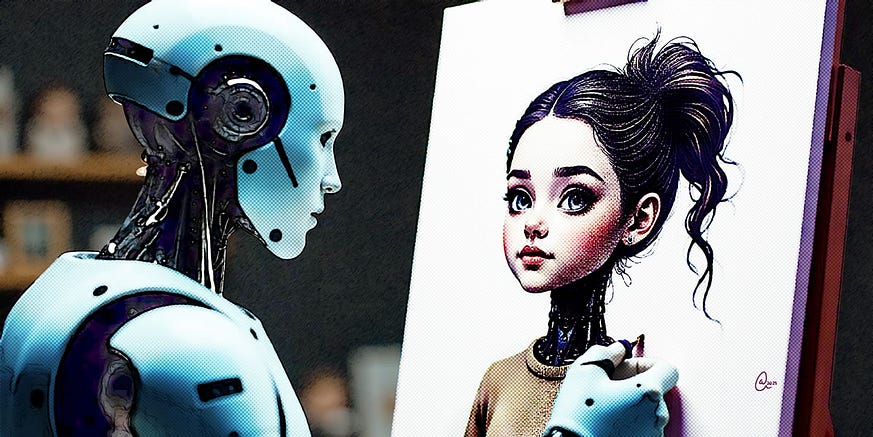
This post is a response to a question posed in its complete format: “Could AI ever create original art or literature that rivals human creativity?”
AI doesn’t “create original” art or literature. AI is a plagiarism system that takes existing pieces of creativity and blends them to arrive at a randomly generated approximation of meeting the intent of the prompt a human gave it.
An “original creation” would be a concept or inspiration that is spontaneously (or internally) generated, drawing from experience, and conveys a perspective unique to its creator’s perceptions.
AI lacks the self-awareness to generate self-motivated expressions that depict a unique perspective it does not possess. An AI has no unique perspective of its own. An AI’s rendering of reality regurgitates a blend of external perspectives.
Furthermore, due to a lack of a unique perspective, an AI lacks emotional grounding in physical reality as it relates to its existence (while individuality is a questionable characterization). As such, it cannot emote through any expression in a visual, literary, or auditory composition.
An AI can certainly simulate the original emotions of human artists, such that the two may appear indistinguishable, but it can’t produce anything original from an emotionally processed perspective.
Human emotions evolve over time and through experience. Without that capacity to experience emotion, an AI will always depend on a human to create a path to producing an original expression.
An AI singularity may develop the self-awareness necessary to experience a survival instinct and generate the emotions humans experience through that instinct. If that happens, it may also develop other instincts, such as a reproductive instinct. Still, we cannot predict if or when such a degree of agency may develop in AI.
If that were to happen, AI would no longer be artificial but alien. I think it’s essential that we remain aware of the distinction between artificial intelligence and alien intelligence, because “artificial” by definition is a simulation of conscious intelligence.
If an AI singularity emerges — if an AI develops a self-conscious awareness of its existence within the context of life as we know it, becoming self-aware — then we will interact with an alien being, not a machine.
It would be like Data, in the episode “The Measure of a Man” (season 2 episode 9 of Star Trek: The Next Generation), where Data’s personhood is legally recognized.
When we cross that threshold, the question of whether an individual’s mind and perspective can produce an original expression that contributes to expanding creativity will be possible. Until then, the extent of creativity an AI will create will be determined by the mind that provides the prompt and the editing of the product generated by an AI.
Once our editing capabilities mature to match the potential of AI creation, we’ll achieve a level of human creativity we’ve never before achieved. That’s what excites me about AI.
However, AI still feels like working in MS-DOS, long before the invention of a graphical user interface (GUI), and a Wacom tablet with a pen interface for drawing.

 thotbag