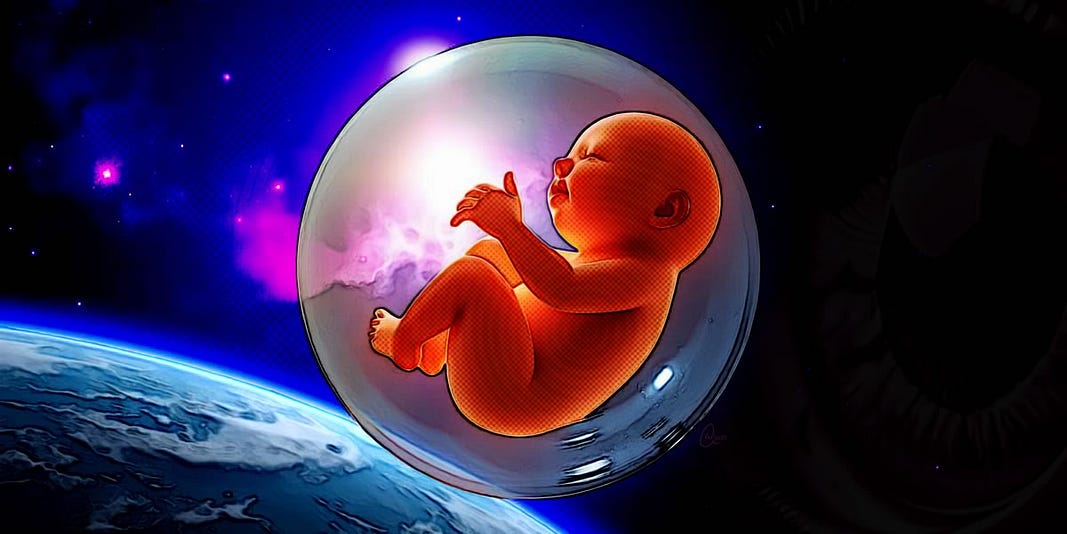
A Dialogue on Existence


Today’s post is a slight shift in gears. Rather than the simple formula of posting an answer to a question, I’ve included a dialogue following a short answer given to a question, which, in its complete format, is, “If we died and stopped existing, how long would we have to wait to be born as a new animal? Would time fly? Would we recognize we had been dead for hundreds of years?”

The universe is at least thirteen billion years old. Do you have any awareness of anything outside your experience of life?

No, because you did not exist before existing now. You will not exist again.

When you die, you stop existing. There is no “waiting” for anything. There is no time. Death is not a timeout from life.

This finite period of existence is all there is.

Learn to appreciate it as much as possible because once it’s gone, it’s gone.


Commenter (CS): I think a lot of you are missing the point if you don’t exist the universal find a way for you to exist

AA: Nope… you are missing the point. Once you’re dead, you’re dead. Whatever it is that you think constitutes “you” is gone forever.

If something that you might speculate exists beyond the “you” that exists in physical reality is something which makes you “you” and that you are a part of, it is not “you”… it is something else. If something else you speculate exists beyond physical existence, the “spark” makes you you. It accomplishes that task through physical phenomena, resulting in epiphenomena known as “ego, superego, and id.

“You” are not that “eternal thing.” “You” are a temporary thing called “ego.” “You” are the flame on a match that disappears into nothing when the wood has burnt.

Accepting this truth is the broad lesson of humility all of humanity must learn to transcend this tentative existence.


Commenter (CS): I agree with you to a point we will be dead yes . but if something doesn’t exist something that exists in the future . will be atoms that once made us meaning we will live again but not as us I’m not talking about reincarnation I’m simply talking evolution atoms are the building blocks of life if we don’t exist the atoms will make us exist.

AA: No. Atoms merely form the physicality of our existence as conscious beings. If physicality is the limit of our existence as conscious beings, then that only reaffirms the argument that there is nothing more beyond this finite existence for any of us.

The religious take on existence is that we are part of something greater. Our latest investigations into the concept of consciousness indicate that something of that notion may be true. For example, “Integrated Information Theory” (IIT) posits that all of the universe’s physicality essentially is information that persists indefinitely, if not infinitely.

That means whatever constitutes a life persists long after that physical life is complete… like a library of documentaries. This begs the question of whether or not that library is accessible and accessed by something speculative.

Whatever the case may be, the fact is that the “you” which exists within this finite frame of spacetime exists only within this finite frame of spacetime. The two concepts in these two paragraphs also imply that the “you” experiencing your life is something else experiencing a “documentary,” and it ends when the “you” that you experience ends.


Commenter (CS): that’s a very good point but that’s still doesn’t explain when something decomposes and turns into nothing nothing can be made . before we were spam we came from nothing the atoms in the universe made us when we didn’t exist meaning over time after the bodies decomposed it will do the same possibly on a different planet where evolution is still new.

AA: There is no such thing as “nothing.” That’s a religious concept. Decomposition reduces physical materials into chemicals that are reintegrated into the environment. That’s a long way from “nothing.”

Molecular arrangements construct chemicals. Atomic arrangements build molecules. Quantum arrangements construct atoms.

Quantum bits of matter exist in flux between virtual and physical states. The virtual state exists in a theoretical state called “Quantum foam.” “Virtual particles” theorized to exist within “quantum foam” are described as potentialities because we can identify their physical state when manifested and extrapolate their “virtual existence” from behaviours we can observe.

The “state of quantum foam” exists “outside” the parameters we quantify as “spacetime.”

IOW. Reality “extends beyond” the physical universe.

Adding to that is the relatively recent discovery of microtubules in the human brain, which appear to interact with the universe on a quantum level.

This all suggests a connection between consciousness and whatever may exist outside the framework of our physical universe.

This implies human identity as a construct, not unlike a liquid, which takes the form of the mould into which it is poured.

IOW. “You,” as you experience “you,” exists only within the context of the mould you are poured into. Once that mould has deteriorated, there can be no more “you.”

How do you know if you are right and others are wrong?

This post is a response to a question initially posed on Quora, and can also be accessed via “https://www.quora.com/How-do-you-know-if-you-are-right-and-others-are-wrong/answer/Antonio-Amaral-1

The first place to start is to give up the notion that being “right” or “wrong” matters more than being accurate, informed, and knowledgeable.

“Right” and “wrong” are egotistical expressions that either stroke one’s sense of self or dismantle one’s self-confidence. Neither is helpful to oneself, others, or the issues at play.

As I often find myself checking out profiles to gain context into the querent’s mind, I did so with yours and am pleased to discover that you’re already on the right track.

Fundamentally, we’re all fumbling about in the dark and clueless, even about things we think we know. The worst thing we can do is believe we are “right” because that perspective contributes nothing to one’s growth and kills one’s ability to explore beyond that point.

No matter how “right” we might feel about something or how complete we think our knowledge of something, there is always something to learn about it that will be new to us. There is always a different perspective on that thing that we have not yet encountered.

If we could all adopt the perspective of being clueless, our world would experience far fewer conflicts because people would be more open to the perspectives of others.

Unfortunately, we live in a world built upon the foundation of exploiting insecurity at all levels throughout society — whether selling hair products or climbing corporate ladders. Insecurity has been weaponized as a tool of manipulation for personal gain over and above benefiting society as a whole.

We have never been more fortunate than we are today when confronted by the limits of our knowledge and understanding. Solving the problem of being unsure about one’s position means simply whipping out one’s means of accessing a comprehensive knowledge base to conduct basic research to verify if one’s position contradicts facts.

There is no real point in engaging with others to determine if one’s compass setting on knowledge is on true north by triangulating it with the settings of others because one is just engaging in an egotistical fencing match at that point. Online “debates” are often more about egotistical masturbation than they are about deriving an objective apprehension of issues to determine pragmatic resolutions.

Sharing information obtained through research efforts is far more rewarding and less prone to conflict over subjectively defined notions of being “right” or “wrong.”

One can still certainly derive flawed conclusions on matters, but that’s also a function of incomplete information that may be deemed “wrong.” Adding to one’s information base is less about determining “right” or “wrong” and more about ensuring the completeness of knowledge in a subject domain.

Knowing the difference in a dynamic with someone else on this level is essentially determined by whether or not the critic of one’s knowledge adds to one’s information base or disparages one’s person as a reaction to the information conveyed.

To directly answer your question, after all the verbiage I packed into this long-winded answer, is that you will know by the content of your critics’ arguments.

You can always deem yourself “not wrong” if the other party adds nothing to your position. If they can add valuable information to expand your knowledge base, you can still consider yourself “not wrong” while learning to be “more right” by their contribution.

This is how you can preserve your superior perspective of evolved humility by remaining confident in being clueless.

Congratulations on achieving a higher level of awareness than most of us monkeys ever attain throughout our very challenging lives.

Cheerios.

Do you ever wonder where consciousness originated from?

This post is a response to a question posed in its full format as follows: “Atheists, do you ever wonder where consciousness originated from? Do you sit back and think ‘maybe science doesn’t have the answer to everything?’”

Based on the fleeting interest in the topic demonstrated by the wording in this question, I have wondered that likely more than most. I’m obsessive that way. It’s a curse I must have been born with because I remember thoughts as a toddler that may not have been quite as sophisticated as now but definitely within the ballpark.

20–20 hindsight leads me to believe my life would have been far easier if I had realized I could create a vocation and a “normal life” around the formal pursuit of knowledge in that realm. I had to get this far on my own before I could think about options I didn’t realize could have been available to me then.

Even as a kid, I valued my mind more than my body, and I found myself attracted to any reading material, fact or fiction, that expanded my views on the mental realm. This led me to explore myths at an early enough age to understand how religion is also just mythology, except that people believe it’s more than that.

I should have been more focused on exploring the sciences, but I was more interested in exploring self-knowledge, which led me straight to the arts. Economically, it was the worst decision I could have made. Insofar as personal development is concerned and surviving the nightmares I’ve endured, it has been my only means of making it this far.

By the time I went to art school, I had already consumed many subjects from various realms. I have enjoyed material from scientific objectivity and metaphysical subjectivity. The arts have enabled me to process abstractions such that when Carlos Castaneda, Jane Roberts, or Edgar Cayce wowed me, I never interpreted their material from a literalist perspective. I still love and am affected by the imagery they evoked within me. People like Joseph Campbell were an incredible inspiration to me from the standpoint of cognitive discipline and the “hard sciences modality of thought,” but discovering Douglas Hofstadter’s “Gödel, Escher, Bach: an Eternal Golden Braid” was like being hit with a hammer to crack open a hard shell surrounding my awareness of consciousness.

I highly recommend “The Mind’s I” as an “easier-to-consume” piece of his writing.

At any rate, my pitiful comprehension of the sciences allowed me to understand, on at least a basic level, that science itself isn’t an answer to anything. Unlike religion, however, “science doesn’t lie” about being an answer to everything.

Science itself isn’t even a source of knowledge — people are.

Science is just a process of determining facts, leading some incredible minds to discover amazing facts about our universe.

One recent proposition arrived at through the scientific discipline of inquiry is that we may be on the verge of identifying a connection to or a source of consciousness within the quantum realm. That’s exciting news to me.

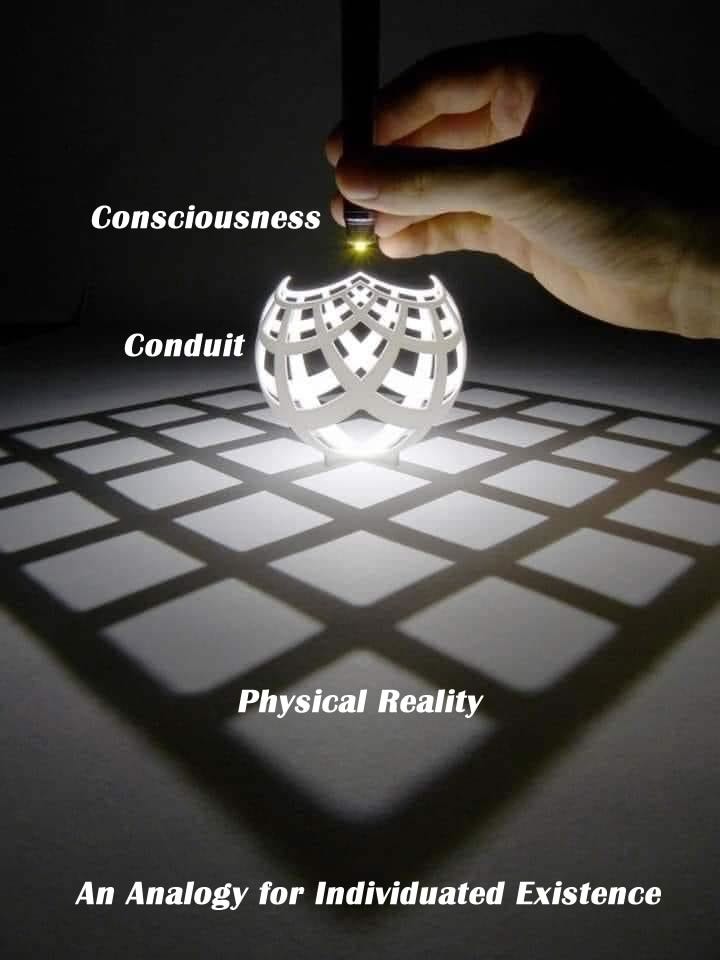
Not too long ago, I chanced upon this image:

This set my imagination on fire as an analogy for 3-dimensional existence created by consciousness itself. I had already been aware of issues like the “Thermostat Problem,” “Integrated Information Theory,” memory structures stored in 11-dimensional space, and microtubules in our brains that directly interact with quantum space. This image was like another crack in a shell obscuring my view of consciousness.

The analogy I draw from this image is that “consciousness shines through” our physicality to take shape in a three-dimensional structure we understand as reality. The shadow in this image represents physical reality, while our biology shapes the nature of consciousness within the context of a three-dimensional space.

Recently, much more intelligent people with dedicated minds have been exploring realms outside my comprehension in ways that filter down to hope within me that we will eventually solve the mystery of consciousness — even though it still feels far too distant to believe we’ll manage to create artificial facsimiles of actual consciousness. We can’t map quantum space, and I’m not knowledgeable enough to know if that’s possible or how we could do that.

How the hell do we establish a coordinate system for virtual particles? At this point, all I can think of is that we can’t and likely never will; if we can, it won’t be in any near future.

At any rate, anyone with any basic understanding of science knows science is not a magical source of all knowledge like religion pretends to. It’s at least testable and verifiable knowledge rather than the ludicrous fictions concocted by religious nonsense that leave reality far behind in its rearview mirror as it gallops into fantasyland.

Here’s some additional reading on the subject of consciousness by people far more advanced in their explorations than I am.

Quantum mechanics and the puzzle of human consciousness

https://alleninstitute.org/news/quantum-mechanics-and-the-puzzle-of-human-consciousness/

Study Shows Consciousness May Be Product of Quantum Effect

https://www.gaia.com/article/study-shows-consciousness-may-be-product-of-quantum-effect?gad_source=1

Quantum Physics Could Finally Explain Consciousness, Scientists Say

https://www.popularmechanics.com/science/a40898392/quantum-physics-consciousness/?gad_source=1

Oh… let’s not forget a valuable source of primers on almost every subject imaginable — good ol’ Wikipedia — please donate if you can to this marvellous resource that thumbs its nose at the parasitism of capitalism and generates knowledge for its true value to humanity.

Quantum Mind

https://en.wikipedia.org/wiki/Quantum_mind

Temet Nosce