Who created consciousness, according to atheists?

This post is a response to a question posed in its complete format: “As there is no evidence that consciousness emerged from unconscious matter, then who created consciousness, according to atheists?”

The people you should be asking this question are not atheists but specialists who have expertise in this subject.

Atheists understand that one of the most glaring fundamental flaws in the believer mentality is that you expect knowledge to be a one-stop shopping process where you don’t consult authorities who specialize in a knowledge domain.

Believers like yourself behave as if your knowledge authorities are shopping centres of expertise.

This is why you look to your priest, minister, or religious leader to answer all the big questions in life, even though they have no clue what the correct answers are. Most of them pull nonsense out of thin air, and you lap it up like it were gospel. This is why so many of you struggle with a simple definition of disbelief for atheism.

That’s why you struggle with mastering simple tasks like knowing how to get real answers to your questions.

It is this kind of intellectual laziness that destroys your critical thinking skills.

For example, you pose questions like these as if they’re effective “gotcha questions” that can score you a win against your theological enemies.

You don’t care to understand the answer because you’re more interested in embarrassing atheists so that you walk around like a cock on a block and brag to your insular friends.

It’s pretty sad because the simplest way to address your nonsense question is to ask how you think any “who” is involved in the answer or even matters in considering an answer.

You presume a “who” is involved without any justification beyond the conditioning you have been subjected to daily since first learning how to say “momma.”

No one but you claims consciousness emerged from unconscious matter because you don’t bother to educate yourself on what humanity has learned about consciousness, what it is or how little we know about it. You don’t have the slightest clue how little you know about consciousness, but you behave as if your pat answer of a “who” is your secret weapon to put atheists in their subordinate place.

That’s just sad.

I doubt you even understand that what you have concocted is a straw argument. You create a fiction in your mind of what you think atheists believe about consciousness. You behave as if being an atheist magically imbues a person with knowledge in the scientific domains of biology, neurology, physics, and psychology — to name only a few that have explored the subject of consciousness.

You make this grotesque mistake in judgment because you have been taught to believe the magic words “God did it” answers every important question in life.

That’s just sad, annoying, and frustrating when believer after believer repeats the same nonsense daily by the dozen on every social media site.

Because of that, we know you don’t care about learning, much less understanding the numerous answers to your oversimplified question. You don’t realize that your simple question hides many questions you have no real answers to beyond “God did it.”

For example, you can’t identify or define what you mean by “unconscious matter,” but it’s clear from your wording that you’re thinking about something as simple as a rock. In your mind, the difference between a rock and a thinking being is magic. Forget about prions or viruses that behave like living creatures but aren’t.

You expect atheists to answer your question with humming and hawing that you can interpret as a win in the same way that MAGAts get off on “stickin’ it to the libs.”

If you cared about the concept you invoked, your question would be more specific and up-to-date with what science has discovered.

You would be asking not atheists but a mycologist about consciousness in mushrooms and fungus. You would be fascinated with how trees can talk to each other, and you would be respectful enough of the people you ask your questions, not assuming every atheist you encounter has knowledge and expertise in these fields.

The simple answer to your simplistic question is that there is no “who” beyond the wishful thinking of a childlike mind.

The existence of consciousness is accepted as a fact, but we don’t know what it is, how it exists, nor even the limits or range of forms in which it exists.

What is believing in a higher power you don’t know?

This post is a response to a question posed in its complete format: “What is it called when you believe in a higher power but don’t know what it is?”

It is a paternalistic instinct we are born with and inculcated during childhood socialization, and is called “wishful thinking” for adults.

There are many “higher powers,” at least when contrasted against whatever “powers” a human being has.

None of those higher powers are a replacement for one’s parents, no matter how much one wishes theirs were not so toxic. The sad reality is that such wishful thinking is a byproduct of centuries of generational trauma.

If you’ve ever noticed how well-adjusted people are from loving families, you’d have realized how much natural self-confidence tempered by humility they exude. All that is required to develop that maturity is a parent who understands love and expresses it honestly, even when it’s most arduous and demands the most brutal honesty with oneself by admitting one’s shortcomings to one’s children.

This attitude and desire are biologically driven instincts with the essential elements guiding them. These are built into the brain’s hardwiring in the prefrontal cortex, from which a sense of justice and balance within the universe is derived.

“What is particularly interesting about these findings is that they suggest that the sense of justice is not something learned through experience or socialization but rather something built into the brain. This is consistent with the idea that certain moral principles are universal across different cultures and societies, such as the idea that it is wrong to harm others or that honesty is a virtue. These moral principles may be rooted in how the brain processes information about social interactions and relationships.”

Sense of justice discovered in the brain

Is it better to have faith or not?

This post is a response to a question posed in its complete format: “Dear Atheists, do you think its better to have faith, or no faith?”

Believers should learn to understand how various forms of faith exist that don’t require you to check your brain out of service to maintain them.

For example, one can have faith in all the other drivers on the road to mostly observe the rules of the road.

One can also have faith in the referee for your game who is sincerely interested in being objective.

One can also have faith that the person they hire for a job sincerely wants to succeed and contribute to your success.

None of these forms of faith are guarantees against misjudgment but are optimistic expectations that will generally pan out positively. The odds of a negative outcome are far fewer than a positive outcome.

These are forms of faith based on an awareness of the world and an objective understanding of how people generally behave.

We know there are outliers and sometimes disappointments, but for the most part, one’s faith in these conditions is met with positive results.

This is a justifiable form of faith.

What is not a justifiable form of faith that essentially amounts to wallowing in self-serving delusion is believing in the existence of a human-like entity endowed with magical powers seen nowhere else in the universe… particularly when assuming such an omnipotent being of galactic proportions will intervene in the life of something less than a speck of bacteria to it… and most especially in matters of convenience like one’s favourite team winning a ballgame or a parking spot opening up in a timely manner.

Otherwise, it is much better to have enough faith in oneself to ignore the naysayers in one’s life than not because one will never have any hope of realizing one’s goals or dreams without it.

What to say to an atheist.

This post is a response to a question posed in its complete format: “What are some things to say to an atheist that will make them think about their beliefs?”

This question is a sad indictment of believer conditioning.

Very few people think about their beliefs more than atheists, particularly those who have spent a lifetime detangling the nonsense crammed into their brains by the religious conditioning they received since childhood.

If believers want to know what to say to atheists, they must first learn to emulate the humble nature of their Christ and not assume they’re in greater possession of a deeper understanding of their own beliefs. You don’t understand your beliefs as well as you think you do. Your attitude in seeking a way to “make them think about their beliefs” shows you have very little depth of understanding of beliefs you inherited and have swallowed wholesale without putting any effort into understanding them beyond how you should submit to nonsense.

Every day on Quora alone, numerous believers pose questions demonstrating a very underdeveloped and even childlike apprehension of beliefs in general. At the same time, statistics show that atheists are generally better informed on religion than the religious themselves.

Yet… here you are, assuming you have unlocked the universe’s secrets because you submit your entire life to an illusion you can’t prove to yourself is real. You have accepted the words of other believers without questioning them and then have chosen to behave as if following instructions is the same as developing one’s beliefs about life and the universe we inhabit.

The arrogance you demonstrate with your question embodies the reason why religions incite conflict in this world. It is the blind arrogance you demonstrate with your question which shows you have no interest in understanding how others might arrive at their beliefs. You assume the instructions you were fed and followed like an obedient pet constitute a superior set of beliefs.

They don’t.

They demonstrate your incapacity to take ownership of your mind.

They show your willingness to give up everything of your natural identity to submit your entire life to a lie.

Your blind adherence to your instructions demonstrates no understanding of your beliefs but obedience. This is why believers betray their inability to understand what belief means daily on social media.

You should be embarrassed by your question, but you’re not because you sincerely believe you happened to be born into the right family to imbue your mind with the correct beliefs that make your inherited views superior to all other views on the planet.

That’s why religion is toxic. This is why religion is responsible for thousands of years of warfare. This is why religion is a cancer we must cure from human society if we wish to achieve our potential as a species.

If you insist on talking to atheists about their beliefs, then you should emulate the humility of your Christ and approach them with an open mind full of questions and a willingness to learn about your own beliefs. Otherwise, you’ll get the animosity you have already seen in the answers you’ve been given.

Is karma real?

This post is a response to a question posed in its complete format: “Do you believe in karma? Is karma real and happen to everyone whether they believe or don’t believe?”

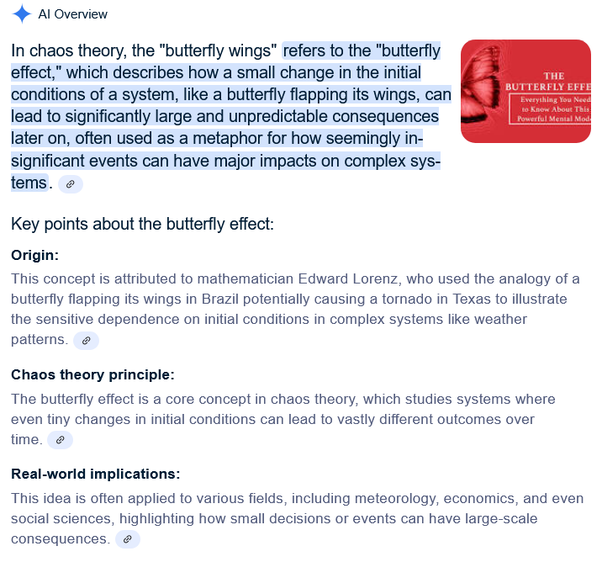
Cause and effect is physics, and so is Chaos theory, which is encapsulated within a concept called the “Butterfly Effect.”

In essence, it’s impossible to confidently predict the consequences of human behaviours because human societies are chaotic systems in which the most minor actions can lead to highly dramatic outcomes.

Whispering the correct sequence of words in the right tone into the correct ear can initiate a domino effect that can destroy an entire civilization (to translate the Butterfly Effect into a highly dramatic potentiality within the space of human dynamics).

That is valid science supported by observation and math.

Karma is “woo” — wishful thinking connecting a cause to an unconnected but desired outcome. It is supported only by the desire of the individual who hopes for a specific result. Reality doesn’t work that way, but coincidence can cause people to believe it does.

Having said that, if enough people desire an outcome, such as stopping a malignant force like Trump’s rabid destruction of the nation, then people will take action to affect an outcome through intent. This isn’t “Karma,” which suggests some invisible hand of the “human interaction space” (like the magical “invisible hand” of the free market) but cause and effect.

What will result from the escalation of conflict through the initiation of several protests as pushback to what the Trump administration is attempting through their implementation of Project 2025 is unknown. The only predictable aspect of where we are now is the guarantee that conflict will continue to escalate until it reaches a crescendo that can result in a complete breakdown of civilization through unmitigated chaos. How far all of this goes is anyone’s guess. We won’t know until the dust settles. We can only hope for a specific outcome based on the degree of public engagement and the escalation of protests against the takeover of the nation by a fascist entity.

That’s not karma because we can lose, while karma implies a guaranteed win. This is cause and effect in action, and the outcome is unpredictable.

People will call Tesla’s worldwide sales tanking karma because it feels good to say that. The reality, however, is that it’s the effect of a Nazi salute on the marketplace by a public that hasn’t forgotten the horrors of the Nazi scourge that extinguished millions of lives.

In short, I prefer to know the variables that can affect an outcome than hope some magical cosmic intelligence is balancing some invisible scale according to how I would wish the universe to operate.

Effects flowing from causes are reality, while karma is just wishful thinking.

How do atheists think this brief existence is all there is?

This post is a response to a question posed in its complete format: “How do atheists think this brief existence is all there is? Don’t you have a yearning in your heart that there must be something over the rainbow?”

That’s not exactly how that works.

This brief existence is all there is for this thing we call “ego.”

This thing we call “ego” is far from being “all there is” and is, in effect, as relevant to the universe as a speck of dust on our planet. The problem here isn’t the insignificance of ego but the ego’s addiction to being (or being perceived as) relevant beyond its existence.

There is much, much more to existence beyond the human ego, but as soon as each life ends, so too does that frail construct that demands immortality for itself on the sole basis of simply recognizing its own existence.

What we should be doing with human egos is learning how to train them to focus on the lives they get so that the benefits of existence are maximized for themselves and through others because that’s the only way for the ego to validate itself within the context of its limited existence.

Pissing away one’s life by catering to delusions of egotistical immortality is the most toxic form of grooming for one’s ego that invariably metastasizes it into a cancerous tumour for human society.

Whatever may exist “over the rainbow” is not for the human ego to experience.

This existence is all there is for the human ego.

The sooner the human ego can embrace that, the sooner it can grow to appreciate a gift that can vanish at any moment for any reason. Appreciation for the finiteness of one’s existence is precisely the point of a limited existence. There is no other way to transcend this limitation.

What are the 3 things that atheists would like from Christians?

This post is a response to a question posed in its complete format: “I won’t give up my faith, but what are the 3 things that atheists would like from Christians (or any religion really), in order to live in the best society possible?”

No one is asking you to give up your faith, and if someone does, then you have every right and justification to tell them where to stuff their opinion. You have every right to whatever belief you choose to hold. Sovereignty over one’s mind is an inalienable right (regardless of whether some might disagree — I’ll fight this one to the death — which is my belief, and if I choose a belief and hold onto it strongly enough to go to war to defend it, then I have to respect another’s right to do the same).

Having said all that,

I don’t impose my beliefs onto others (what I spoke of above was defending my belief — a big difference), and I do not want others to impose their beliefs onto me. I am severely offended by attitudes that do not respect my choice, yet I expect respect for theirs.

#1. STOP proselytizing. I don’t care if it’s a mandated directive. Do NOT impose your beliefs onto others if they do not want to endure your rendition of them. Please respect that you have the right to your beliefs ONLY because you acknowledge another’s right to their beliefs.

What this means in “real world terms” — NO MORE anti-abortion nonsense. NO MORE sexist, misogynistic imposition of your religious beliefs onto a society of individuals who do not share your beliefs. STOP PROSELYTIZING. PERIOD. Nothing of your belief system belongs in a shared society’s laws… nowhere in educational policy… nowhere in anything beyond its context.

By all means, use your existing houses of worship and your homes to worship, practice, or do whatever you like concerning your beliefs. DO NOT attempt to push your interpretation of your own beliefs onto a public sphere. Your beliefs are yours, not everyone else’s. Learn to respect that and put it into widespread practice. Speak out against toxic hypocrites like Jim Bakker, who pushes an ignorantly incendiary and self-serving agenda by riling up his “flock” into supporting violence to further his cause. That is entirely disgusting behaviour. Your beliefs do not belong anywhere outside the context they serve you.

#2. Get out of politics and learn to respect what is sacred about the separation between church and state. While you’re doing that, start paying taxes and take every dollar back from the rich evil monsters who are preying on the weak to con them into supporting their personally lavish lifestyles. (I don’t remember who it was now, and I’m not going to research it, but an example I remember from recent news was one hypocrite crying about needing a personal jet because public air transportation is full of sinners. — — I’m happy to report that person did not say that directly to my face because I’m not sure I would have contained my disgust with that particular attitude. Still, I can tell you, every one of those entitled monsters who prey upon the weak have nothing but enmity from me, and I’m pretty sure many others as well. Do SOMETHING about them because they certainly do NOT represent any spirituality or belief. They are the same cut of sociopathic monsters as those who lead terrorist groups from other belief systems.)

#3. Get out of science and learn to respect your boundaries and the role of religion in society. Your beliefs are not science or scientific in any nature or stretch of the imagination. Your beliefs do NOT trump scientific discovery within the realm of science. Evolution, for example, as your beliefs don’t bind a topic. Evolution occurs whether you want to believe it or not. Still, you need to understand how the moment you think your subjective belief somehow forms an equivalent counter-argument to hundreds of years of an evolving discipline, you betray your faith by stepping into territory which doesn’t belong to your faith and is not beholden to any subjective conclusions you may arrive at.

Facts are Facts. Period.

Arguing creationism as some form of valid response to evolution is a disgustingly stupid form of willful ignorance. It has polluted this world far too much already, and the disgusting attitudes of believers concerning this issue are just too much to deal with now. We have more significant problems as a species, and being bogged down by idiots who think their personal, insular, and subjectively defined perspectives on life should be given enough credibility to be treated seriously in a public dialogue only makes things worse for everyone.

Keep your faith, but know this; it is subjective and not remotely determinate about our physical universe. Learn to understand how faith does not trump facts because it should work the other way around. Physical reality should determine our beliefs because we are bound to this existence. Anything beyond it is speculation. If you want to call it a belief, go ahead, but it means nothing to the facts we all must live by together.

Do atheists believe in having faith, hope, and wisdom?

This post is a response to a question initially posed on Quora, and can also be accessed via “https://divineatheists.quora.com/Do-atheists-believe-in-having-faith-hope-and-wisdom-14

Neither of those concepts is exclusive to believers. That you ask this question means you’ve been subjected to disparagements about atheists by other believers who spread hatred instead of the peace and love your faith alleges to represent.

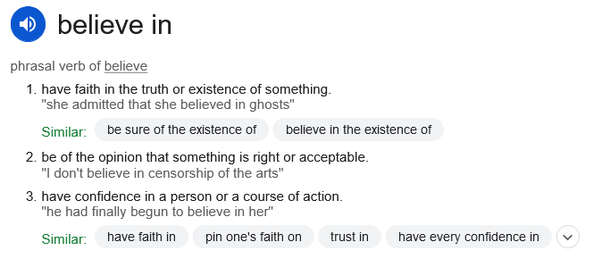
This particular atheist now cringes every time I see the words “believe in” because I know it’s coming from a believer who doesn’t understand belief. They overuse that expression as a shortcut for every bit of conceptual data their brains can accommodate.

It’s like watching someone put ketchup on everything they eat, from eggs to steak to cakes and doughnuts. It just gives me the heebie-jeebies.

I am learning to hate the expression “believe in” more and more every day because the people who are supposed to understand the implications of belief the most are the least capable of comprehending the implications of a belief.

Many believers confuse belief with entrenched insularity; nothing could be more toxic to the concept.

Many believers behave as if zealotry and belief are synonymous, but they’re not. They’re just excuses to refuse to learn, grow, and change. Invoking beliefs for believers is often the equivalent of a child whining about cleaning their room or taking their medicine. Letting go of toxic beliefs is just too much “woke” for far too many.

I have faith in myself and my ability to find a way to make it through this exceptionally challenging period in my life, but I have to accept that I may fail. I rely on hope to carry me through while smoothing out the rough edges and allowing me to maintain the necessary motivation to overcome adversity. I don’t see wisdom as a statically defined state of being but as an ideal, like a utopia, which serves more as a compass setting than a destination. There is no point in which a maxim of wisdom is attainable. Wisdom is often contextual and a subjective perception one has of another. To think of oneself as wise is just another means by which one admits membership into the Dunning-Kruger club.

I hope I have enough wisdom to survive my travails, but I have faith that I may succeed even if I don’t.

How can a believer provide evidence for God’s existence?

This post is a response to a question posed in its complete format: “How can a believer provide evidence for God’s existence to refute the claim of atheists?”

The real problem here isn’t that you don’t know how to provide evidence for God’s existence but that you see that no evidence exists but still insist your God does.

The lack of evidence should be the cornerstone of your disbelief in the existence of something.

It’s the same reasoning you would use to refuse to make a significant purchase like a vehicle without taking it for a test drive.

Your approach to your God belief is like reading an ad without pictures for a $100,000.00 sports car and sending money to an address in another country while expecting your sports car to appear at your doorstep the next day.

Do you usually make your major purchases without inspecting them first?

Would you recommend buying a house without doing a walkthrough?

Why, then, would you structure your entire life around something you can’t verify?

The best you have is someone else telling you it’s true.

You can invest in some incredibly valuable swampland from me if that’s how you make big decisions for yourself.

The harsh reality you’re struggling with is that atheists make no claims.

Atheists only refuse to buy swampland from an obvious charlatan whose only interest in you is how much money they can siphon from your pocketbook.

Can I say I’m an atheist when I’m agnostic?

This post is a response to a question posed in its complete format: “Can I say I’m an atheist, when I’m actually agnostic? If I say I’m agnostic I’m worried that people will either say that it’s not real, or try to convert me.”

You can say that your beliefs are your own. You have no obligation to share intimate details of your journey with anyone who isn’t a part of your life.

Anyone who presses you doesn’t respect your boundaries, and if that’s the case, tell them whatever they want to hear to get them off your case. They’re not interested in getting to know you as a person because they want to be closer to you but because they’re looking for some information about you that they can use for their benefit.

People in life will ask you questions about yourself only because they’re looking for weapons to use against you.

You cannot trust people who cannot respect your boundaries. Life does boil down to being as simple as that.

The next time you wonder if you’re “allowed to say something” or another about yourself, try to remember how an orange Nazi turd concocts bullshit about himself and others with every sentence spewing out of his lying piehole.

I am certainly not advocating for any “benefits” of becoming a pathological liar because that’s just disgusting. I am simply pointing out that you have no reason to tie yourself up in knots over how you describe yourself to someone else.

The harsh reality is that you could likely spend an entire month describing intimate details about your life and why you arrived at certain conclusions that prompted you to think one way over another. The chances are excellent that 99% of what you say will be lost on your audience. People remember only 20% of what they hear.

Most of what you say about yourself passes through another person’s perceptual filters, and you have no control over how they interpret what you say. The only thing you can do is make your best guess at understanding them well enough to use the right combination of words that will get them close enough to understand something resembling what you want them to know and then hope for the best.

Your thoughts and feelings are your own… and if you’re anything like what I’ve gone through, then one day, you’ll be agnostic within a specific context and then a militant atheist within another context the next day. The following day, you’ll be amenable to believers, and later on that afternoon, after encountering a zealous believer, you’re back to hating religion and thinking of yourself as an anti-theist while thinking atheism itself isn’t firm enough to get the stench of the zealous asshole off your body and cleared from your mind.

The entire point I’m getting at is that human beings are not robots. As much as too many people want to create labels and stuff people into neat little boxes, humans are not that defined in such discrete terms.

Humans are more like water or vapour, constantly shifting in the wind or changing direction and flow depending upon the shape of the land one moves over. Whatever defines you as you is summed up entirely as your collection of memories.

Meanwhile, your memories are not stored like magnetic particles on a hard drive. Your memories are stored in eleven-dimensional space as “signposts” — symbols that your mind unravels as you recall events from your life… and your recollection changes as your state of mind changes.

Humans are more fluid than literal fluids in nature.

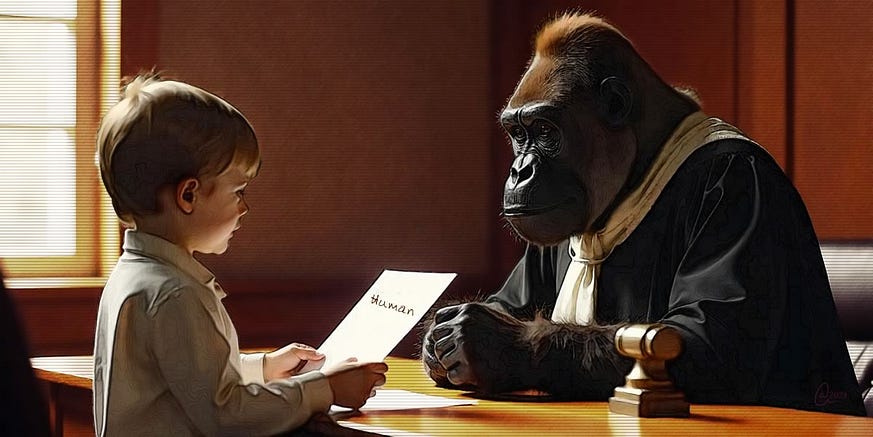
The next time someone asks you what you are, tell them you’re human.

The next time someone asks you what you believe, tell them you believe dinner is being served at 6:00.

Unless you find yourself in a long and deeply meaningful conversation with someone who truly wants to know your person, you have no obligation to barf up serial numbers for their mental registration of who they want you to be.

Be you and let the “Nosy Parkers” in your life be confused. That’s a “them problem,” not a “you problem.”

Being worried about how other people will respond to you because you’re trying to be honest with them about trying to figure yourself out is an unfair and intrusive expectation from another person.

You may not feel annoyed enough by such prying yet. If you manage to get on to your senior years, you’ll find yourself pissed off at such a rude and entitled attitude precisely because you have gone through a lifetime of being worried about telling people what you fear might be the wrong thing.

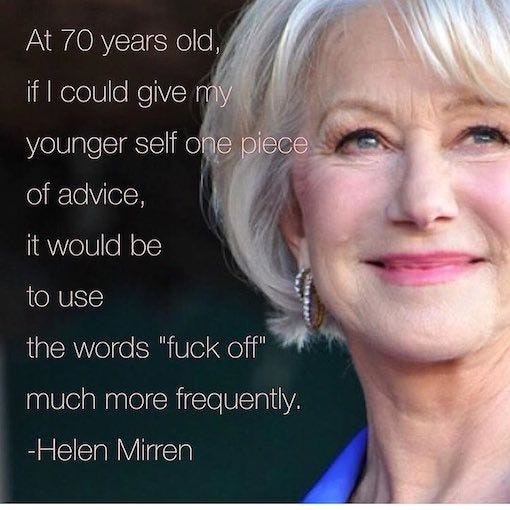
Don’t apologize for being who you are. You will only end up hating yourself for doing that. If someone decides they have a right to push their beliefs onto you, tell them to fuck off. Seriously. If Helen Mirren can endorse this response out of regret for being more polite than she should have been, you should not ever feel guilty about drawing your boundaries with a nosy someone in the harshest of terms.

Now that I’ve gone on this rant, I bet you might remember a half-dozen words… assuming you read any of it with any consideration instead of skimming over it all.

Good luck in navigating through this monkey house we call life. You’ll do fine if you can learn to duck and weave around all the flying feces.

Cheerioz