
Has Mark Carney presented a debt reduction plan?


This post is a response to a question posed in its complete format: “Has the Canadian Prime Minister Mark Carney presented a plan to bring down the massive debt?”

One of the harshest lessons I’ve had to learn when entering the professional world to hawk my services was understanding the difference between a cost-based mindset and a value-based mindset. I learned to despise the former and value the latter, most notably because it was far more rare an encounter. I learned to dislike the cost-based mindset because I found it generally characterized by a cynically misanthropic attitude that regarded intangible benefits as a scam rather than as a means of adding value.

This mindset can perform basic arithmetic but fractures into a mess of cynically driven frustration when performing simple algebraic functions.

What do you mean by greater product knowledge leading to increased confidence translates into increased sales? That’s just bogus. People want high quality for cheap. Don’t make things so complicated.” (An embittered rendition of the cost-based mindset.)

At any rate, to address the question, the answer is both yes and no… Unlike the typically myopic view of handling debt that CONservatives focus on, with a strategy that involves cutting one’s own throat by imposing austerity on the little people and redirecting more financial resources to the parasitic class, he has been busy focusing on a revenue generation strategy.

It’s difficult for MAGA Conservatives to wrap their minds around handling debt through multiple strategies. Because revenue generation is so much more complicated than simply axing a shaky infrastructure that punishes the working class, they never seem willing to examine this far better and more productive approach to fiscal management.

Carney has been busy discussing economic growth strategies with the local community and global leaders. Admittedly, these are longer-term strategies than cutting costs, as they are a far more effective and stable approach for managing debt.

Another downside is that conveying the benefits of such an approach to people who can’t or refuse to grasp multi-stage strategies is subject to the same criticisms that the Carbon Tax has faced, and that Maple MAGAts have been barking about how much they dislike it, perceiving it as a scam.

Short-term thinkers often struggle to grasp multistage concepts that require focused attention to understand how additional upfront costs can result in far more significant economic benefits in the long run through revenue growth, which more effectively manages debt than cutting costs. Cuts hamper economic growth so much that they can potentially send a nation into a financial death spiral.

Those who don’t understand the implications of short-term thinking should pay attention to how Mango Mussolini gives the world a stark lesson about how utterly misguided such a myopic focus on economics is.


The most straightforward rendition of this view of economics is given by Terry Pratchett in his 1993 Discworld novel Men at Arms, through a character named Captain Samuel Vimes in a “Boots Theory of Economics”
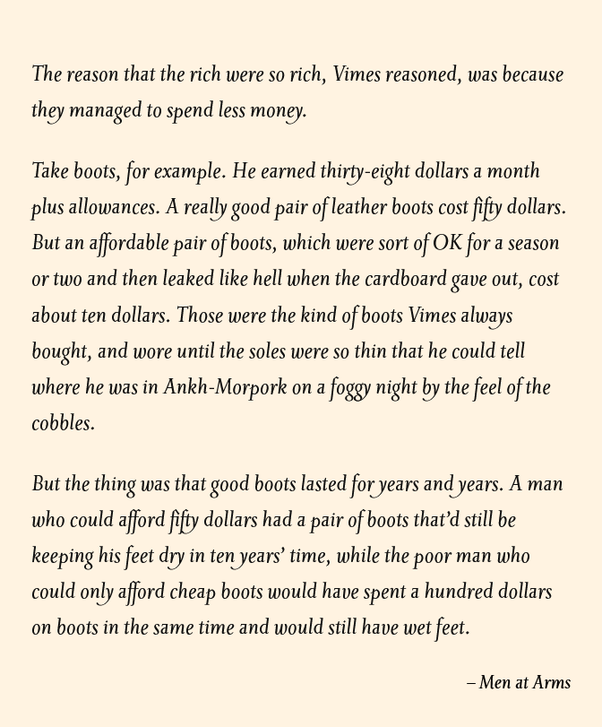
Carney’s strength as an economist lies in his understanding of value and his focus on creating long-term benefits by developing a value-based rather than cost-based strategy.

This approach forgoes making quick promises to please the impatient among the crowd and requires time to develop. Some people innately understand the importance of creating a coherent strategy, and it was this unspoken expectation that a grifter like Drumpf leveraged through a trust-based scheme when he claimed to have “ideas of a plan.”

The difference here is that the work being done by Carney is obvious, and CONservatives help to make it obvious when they whine about how much gas he’s consuming by flying abroad to make deals with more stable nations than the U.S.

Carney has developed a strategic plan through his actions and decisions. He hasn’t yet summarized it in an action plan that the short-term thinkers demand. They must wait until his strategy becomes an actionable framework for followers.

Why aren’t Americans taught that freedom from debt is an important freedom?

This post is a response to a question initially posed on Quora, and can also be accessed via “https://www.quora.com/Why-arent-Americans-taught-that-freedom-from-debt-is-an-important-freedom/answer/Antonio-Amaral-1

For someone who values a debt-free existence, it can undoubtedly be viewed as an absence of a burden that enables greater freedom of choice. However, the entire system of capitalism is based upon leveraging debt to create revenue.

Revenue and profits are seen as far more powerful versions of freedom within a system that can be leveraged in ways in which the debts themselves can be resolved by servicing them with the increased revenue they generate or by being forgiven.

Of course, this form of debt is not the same as implied by the question, which is based on the notion of debt accrued in purchasing lifestyle augments. For example, a purchase of an air purifier I made just today was made through a credit card, constituting an assumption of debt on my behalf. This purchase will generate no revenue, but I applied my justifications to the decision before making it.

One can argue that my decision decreased my freedom, but that’s only a tiny part of my decision. I can easily say in favour of the practical benefits of making this purchase, even with the context of it ultimately increasing my freedom (from headaches, specifically). However, that makes this degree of granularity in decision-making a cartoon.

Suppose the point of this question is to criticize people for spending thousands on a 100″ television through credit debt instead of a quick payment of a couple of hundred for a 24″ television that would leave them debt-free. In that case, these discussions are merely psychological masturbation sessions where people are attempting to objectify subjective considerations for themselves and applying essentially bigoted reasoning to determine values of rationality toward decisions made by others for things they value.

The reality, however, is that if one is going to argue how debt freedom is an important freedom, then so are many other forms of freedom. For example, freedom from a crushing health exploitation system through a universal healthcare system is also an important freedom that many don’t consider freedom because they’re obligated to support it through their taxes — even if it means a reduced fiscal burden and improved services. The fact that they have no choice but to contribute to it, whereas they do have a choice in a privatized system to pay much more and be rejected by their insurance carrier to die, is also considered an important enough form of freedom for many that universal healthcare remains unimplemented in a nation that likes to think of itself as a bastion of freedom even though it has the highest incarceration rates in the world.

The point is that no matter how vital debt freedom seems to some, sound fiscal management skills are more critical because debt is contextual. The largest corporations in the world carry the most significant amount of debt and begin by getting deeply into debt. Our financial systems are geared around rewarding debt.

Your credit score, for example, drops when you’re debt-free and increases when you have debt and show that you can manage it. The only way to improve one’s debt ceiling is to go into debt. You can live your entire life being a cash-only person and living debt-free, but when you reach a point where you need debt to resolve an issue or accomplish a goal, going debt-free becomes a liability in your application for debt.

In short, Americans are not taught that freedom from debt is an essential freedom because it isn’t. The ability to service one’s debt through revenue constitutes a far greater level of freedom. After all, there isn’t one investment manager who counsels investing one’s money into risky investments. They always counsel investing other people’s money.

Some may wish to argue for a return to debtor prisons based on this dynamic, but that would just penalize the wrong people.

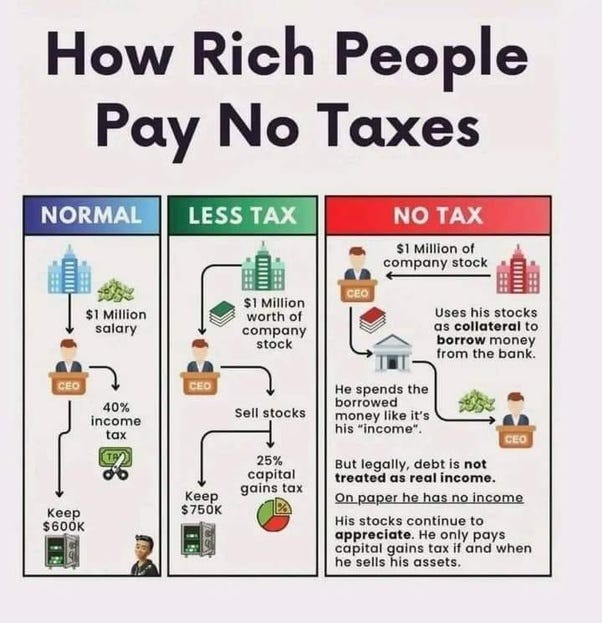
Here’s how wealthy people leverage debt to lower their cost of living, for example:

The wealthiest among us experience the most significant degree of fiscal freedom precisely by how they manage their debt.

The kind of debt and the thinking about debt described by this question is from an era when people could count on stable 40-year careers, prudent personal economic management, and modest living that would result in a comfortable retirement. Those days are long gone.