This post is a response to a question posed in its complete format: “How do you listen to people open up about their issues without trying to solve them? How do you just comfort people?”
One of the first things a first referral counsellor learns is that you cannot solve other people’s problems for them. Even more so, you don’t want to solve their problems because what you might see as a solution for yourself is likely not a solution for them.
What you end up doing is creating a dependency relationship with someone who now has a scapegoat to blame when your solutions backfire on them.
You end up giving them permission to take the easy route of blaming you for their problems instead of learning how to solve their problems for themselves.
You don’t want that kind of monkey on your back because it could haunt you for life.
Most people want to be heard without judgment. The act of actively listening to them while validating their emotions and the struggles they are experiencing is often the only thing they want or need.
Being able to openly express oneself without fear of being misjudged for their struggles or how they deal with them is all the healing most people need most of the time. That opportunity often gives them enough space to hear themselves through your perspective and devise solutions for themselves by being able to speak freely about their problems.
If you sincerely want to help people solve their problems, you must understand that the best way to accomplish both your goal and theirs is to listen and acknowledge their struggles while validating their feelings and who they are as people.
You almost cannot help someone more thoroughly than by letting them know they matter. Most people only want to know that someone hears them and sees them as a living, breathing, independent human being with a core of reality all their own, just like how you think of yourself. People often only need assurance that they can achieve their goals if they apply themselves.
At most, you can offer ideas for where assistance is available, identify resources they may not be aware of, or repeat their statements to them in your own words. Often, simply saying something they said in different words is enough for them to see their problem with different eyes and in ways they can more easily identify solutions.
It may feel especially tough if you can spot what appears like a simple solution to you, that you would rather hand it to them so that you can continue with other matters, but it’s more important to realize how this is a learning process for both of you. Both of you can learn more about yourselves by allowing the process to evolve naturally and without trying to push it to a conclusion you see as the most optimal outcome.
A solution may appear simple to you, but you can’t know all the underlying variables, and many of which they often don’t recognize themselves. No matter how simple the solution may appear, they must find it themselves before it can succeed.
The challenge this creates for you, which you use to your benefit, is that it takes the focus off your desire to fix their problem for them quickly and puts you in a position of thinking about a strategy for helping them to see their problem from different perspectives, including how you imagine is a solution. As long as they can feel that they have identified their solution on their own and without being given instructions to follow by rote, they will be more able to apply their creativity when implementing their solution without holding you accountable for their failures.
Although most of my professional life (over 30 years) has followed a self-employment path, predominantly through contracting/consulting relationships, I feel underqualified to answer questions about starting a business.
There are more reasons why people engage in business startups than there are people involved in starting a business. Some people choose business startup and development as a vehicle in itself. For them, it doesn’t matter what kind of business they start as long as it fulfills a strategic impetus to develop an organization that can become a valuable product to sell for a significant profit.
These are primarily “financially-aligned types” who choose endeavours based on perceived market opportunity, potential returns, risks, and barriers to entry. They seek out unfilled market niches or attempt to determine nascent trends to capitalize on or means by which they can exploit untapped resources. Their strategies for business startups are predicated predominantly on the potential for generating profit over any other concern. They may focus on knowledge domains in which they have interests or expertise. However, they tend to be “business agnostic” in that any business concept will do as a startup if it shows revenue or resale potential.
Some people start a business to capitalize on something of personal value to themselves that they can justify a deeper involvement beyond a hobby they can share with the world. Many successful food products, for example, began as family recipes that were unique and popular enough to grow a business into an enterprise.
Here’s a link to a video of “14 Entrepreneurs Who Built Food Empires” for reference (1:45 min):
An uncle of mine began his residential construction business because, in his own words, he “got tired of kissing ass.” He rejected employment as a labourer when I was still a preteen in the 1970s and decided to work in the construction industry because that represented to him, at the time, the lowest barrier to entry with the most significant potential to generate an income.
His formal education was minimal, and so he leveraged the skills and knowledge he possessed at the time to develop and begin his journey as a contractor. At first, he worked in low-level construction roles while developing skills in related areas, such as becoming a drywaller. This approach to gainful contract employment allowed him to accrue enough capital to leverage into a bank loan on undeveloped property he could use to build a house entirely under his initiative and effort.
His goal was to invest his time and labour into developing a product that resulted in a return that he could live on, reinvest into another property, and repeat that formula until he could grow a larger business entity.
He managed to create modest success over the decades. He was also a victim of his limitations as the Peter Principle manifested itself by making his attempts to expand beyond residential construction result in failure.
His path to riches is no longer available to low-income, low-skilled entrepreneurs for numerous reasons, including, but not limited to, the real estate market, which has largely been co-opted by corporate entities and incomes for construction labour that have radically shrunk.
Nevertheless, as a youth striking out independently, I was inspired by his initiative. I chose to emulate his path, partly out of desire and partly out of the opportunities available to me in my circumstances. I began my path by pursuing a compulsion for self-expression that led me to become the only person in my immediate family who completed an undergraduate education in the arts.
My career development path wasn’t as linear as my uncle’s, nor as prone to guaranteeing revenue growth and acquiring a strong capital position. I found myself constantly pivoting as the market rapidly changed through the introduction and evolution of a rapidly changing information technology landscape.
Now that we’ve gotten through that preamble and created a context for today’s post, I’ll proceed to my regular format of answering questions.
The path to success for people with no capital is a brutal row to hoe (and it’s become much harder over the last few decades as trillions in disposable income have been stolen from the middle class)*. You begin by selling your services. You then develop marketable skills and expose yourself to a stream of parasites (yes, I’ve become somewhat cynical — what can I say?) who will exploit your desperate need to survive for bottom dollar. Over time and much hardship, you can develop a body of work and a reputation that allows you to grow a better quality of client base.
Eventually, you develop enough of a portfolio that corporate clients will hire you for contracts. You’ll earn enough to reinvest into yourself and your business when you reach that level. That’s when you plan to transition from being a service provider to being a product developer.
Service provider is the most arduous slog that forces you to deal with the greatest number of exploitative sociopaths and gains you the least value of return for your time. It is possible to succeed at that level if you can excel at networking with people. If you’re an introvert, then it’s a rough go.
Product development requires a lot of up-front investment in time and capital, so it has a much higher barrier to entry. It’s also much riskier because your products may not succeed in the market for many reasons that often concern marketing issues, rather than product quality or market demand.
If you can get that animal tamed, you’ll be well on your way to creating a comfortable nest egg for your retirement… assuming that dramatically negative and unforeseeable surprises don’t upend all your work to leave you with nothing but resentment.
Good luck.
The self-employment ecosystem as a contractor/consultant was quite different in the 1970s than it is today. The middle class had plenty of disposable income and free time outside their work days to invest in various business schemes. I remember this dynamic as a standard media trope in family comedies. The household’s father perpetually chased wacky get-rich schemes each week while losing the family fortune with each failure.
Interestingly, it’s been revived as a trope in a new animated series entitled “Universal Basic Guys.” Here’s a link to information about it on IMDb: www.imdb.com/title/tt23469464/
It hasn’t received a very flattering rating of 4.8 out of 10. Although it may not be a creative piece of formulaic comedy, I found it amusing and entertaining enough to catch the entire first season. I wasn’t aware of its rating before mentioning it here, but it has received enough viewership to be greenlit for a third season in 2026. I am now looking forward to seeing what they do with it in the upcoming second season, which may be airing in September (based on its first season premiering in the same month of 2024).
As an aside, I have considered ideas for an animated series of my own over the years. However, this approach to a business startup requires more up-front development time than I’ve been able to afford while working to keep a roof over my head. It’s for these kinds of initiatives that I strongly endorse UBI. Nothing beyond investment capital is more valuable to a creative entrepreneur than time.
I had a brief opportunity to explore the creation of a graphic novel, but realized it would take about three years to manifest my idea into a finished product. I couldn’t afford to invest that time in something requiring an additional year or two to generate enough revenue to justify the effort. I suppose I could have started with a shorter product concept that could generate revenue in a shorter period of time and develop it over a greater number of years to become a lifetime body of work. My creative imagination, however, spans a wide range of concepts beyond a graphic novel. I wasn’t prepared to limit myself to a narrow focus, particularly when I had an online educational product in development that I intended to convert into a passive revenue stream.
There is no answer to this generic question. Every person and every circumstance is different. No one can honestly assert that one route is better than the other because this isn’t deciding which flavour of ice cream you want from among the choices in a freezer.
For most people, building their own tech company is beyond their reach due to a lack of resources. A majority of the population has no choice, upon completing a relevant education, but to find work immediately so that they can avoid homelessness and spend the next couple of decades paying for the education they have just completed.
This question is posed by someone so entirely out of touch with reality that they have no clue how privileged they are to believe those are equally valid options for anyone.
This question implies that the querent can avail themselves of resources that most cannot. The blatant ignorance of this fundamental reality for most indicates their mindset is insufficiently sophisticated to succeed in a self-determined course of action for their career. A decade or two of experience in some tech aspect may trigger an inspiration they can build on after being exposed to more of this harsh reality we all share.
A third option might be best for those who can consider these two options viable for themselves, but are unsure of which they would prefer: employment within a startup or small business environment that would expose them to the challenges they would face in building their own company from scratch while insulated from the risks of failing at high levels of decision-making for their business.
Good luck
My recent focus on developing a potential income stream through my written words has grown out of a therapeutic need for self-expression (mainly in response to a traumatic event changing my life course), which led me to Quora. I understand how radically diverse the field is and how few succeed in creating a lucrative career for themselves in this kind of endeavour without focusing specifically on writing for revenue generation.
I can’t do that because I’m just not built that way. I decided this is my path now because I realized I had written quite a bit on Quora when I reached twenty thousand answers. Publishing answers to questions has been a natural evolution from venting online on social media. I’m still doing that in many ways as I randomly select topics that inspire my verbal diarrhea to construct long-form written pieces.
I’ve been somewhat surprised to discover that my words have attracted a slowly growing audience, including followers and subscribers. I want to take a moment to express my appreciation for your support.
For the record, it’s made me more self-conscious about my expressions to the degree that I have learned to restrain my salty language and become a better person.
This post is a response to a question posed in its complete format: “What is the role of contract law in regulating business transactions?”
Donald Trump has a reputation for bragging about and laughing about stiffing contractors. He’s been getting away with it because he has had the financial clout to bully his victims out of their earnings.
It may seem such behaviour is anomalous in the business world to someone clueless about its prevalence.
Working as an independent professional puts one in a position of being the lowest-hanging fruit for predators. That often means accepting jobs from people you can’t trust and who are abusive in their treatment.
Anyone starting as an independent contractor learns to navigate this predatory minefield as best they can while developing a professional reputation that allows them to increase the quality of their clientele.
Over time, one is exposed to fewer predators, but the period in which one must survive at the outset is a make-or-break gauntlet of survival because most people will try to stiff you if they think they can get away with it.
The many people I worked with over the decades that I can trust can be counted on one hand.
Many will try to weasel bonuses out of you. Many will try to move the goalposts by having you retouch and redo your work because they’re not quite pleased with the idea they were excited about before. Many will extol the greatness of your work and how their clients love it but then tell you to sod off when you want to collect remaining payments.
I had one client for whom a project that could have been completed in three months extended well past eight months because they kept changing their mind about what they wanted while they tried to figure out what their superior wanted, when that supervisor of theirs had no clue what he wanted. (That business no longer exists. Most of my former clients no longer exist as the entities I did business with.)
Much of the cost of that overrun was borne by me as I worked an inhuman number of hours (two months of overtime within three months) trying to mitigate their incompetence. I was concerned about how long the project was taking to complete.
I lost a lot of money on that project, and as an independent contractor, that means a double-whammy of loss; the loss of compensation for the work done and the loss of work I could have done for another client that (theoretically) would have paid me for other work. I have easily lost more than several hundred thousand in direct losses due to being stiffed by clients (which doesn’t factor in much greater losses from indirect losses).
I have no idea how many people I have encountered who expected my work for free while extolling the benefits of a piece to add to my portfolio.
Contract law is like a rope holding back a tide.
It indicates where the boundaries of responsibility exist between parties, but it is as effective a barrier as one has the resources to defend their entitlements.
If you can afford court costs, winning a case often means simply outspending and outlasting the other party.
This is why, after decades of struggling through that kind of nightmare and encountering abusively parasitic sociopaths after abusively parasitic sociopaths from well more than fifty percent of people one does business with, that burnout becomes a common problem for independent contractors.
This is why I could never be in Donald Trump’s presence as he brags about stiffing people who have worked for him. This is also why the business relationships one develops must be based on trust, because, unless you’re a millionaire with deep pockets, most people can’t afford to bully people into paying them or bully people out of holding them to account in meeting their contractual obligations.
Contract law is a line in the sand that protects the vulnerable from signing their rights away because no contract can contravene established laws. The catch is defending one’s rights and holding the other party accountable for the agreement made within the contract between the parties.
Large organizations, such as software developers who employ onerous contracts that are so overwhelming to average users, who almost uniformly never read them, can entrap people into signing away rights to ownership of their creative content. For this reason, it’s important to post only lower-resolution copies of their work. They can never assume ownership of or resell without your permission while never posting work.
Here’s an example art installation piece by Dima Yarovinsky entitled “I Agree,” which shows how entirely exploitative a contractual agreement can potentially be for creatives who rely on social media to gain exposure to their work.
Question 1: How can remote workers maintain focus and productivity while working from home with distractions?
Depending upon one’s home environment and mindset, it’s much easier to maintain focus while working from home than in a work environment where random interruptions must be regarded as necessary enough to set aside what one is working on.
At home, especially if one is single and lives alone, there is no better environment for focusing on one’s work.
Being motivated enough to finish a task means being free from the metronomic effect of paying attention to a clock. There is no “gearing down” before the end of one’s workday. One can continue working on something until it’s finished.
The consequence of that kind of focus can result in working the equivalent of a double shift to finish a task. That then earns a time bonus of taking the next day off, which is a straightforward means of contributing towards one’s psychological well-being due to having the time to deal with personal issues that would otherwise become a stress-inducing time-management problem.
Remote work is the only work arrangement I will accept now, primarily because I don’t want to endure toxic people jockeying for position through politicking nonsense. If I’m hired to do a job, I want to be focused on the work and not be distracted by egotistical nonsense to make life unbearable.
Don’t get me wrong, I enjoy collaboration and work well with others, but there is always a difficult person in a crowd. Unless the relationship is one in which I am their superior (because I can mitigate their toxicity), I want to minimize my interactions with such types and “grey rock them” if the work requires interacting with them. I’m not interested in becoming embroiled in the social politics of a work environment, particularly not if it’s an environment rife with cliques and silos. In such environments, I prefer the role of mysterious social outcast. AFAIAC, I already share enough of my personhood and life online here on Quora as I care to share within any public context.
Question 2: Will remote jobs eventually require you to be on camera all day?
There isn’t any point in doing that if you understand the tasks being performed and the time expectations that can be estimated for them. Establishing a mutually respectful communication style with staff means one develops a trusting relationship with them. They will then provide updates and progress reports that you can verify based on the deliverables.
Your role as a leader is to ensure you are available to facilitate production, and if your employees trust you and your judgment, they will be open about their activities. They will often approach you with questions about direction, confirm decisions you can ratify or offer helpful insights into improving their work process. A good leader is a coach whom people want to learn from.
The only kind of leader who feels a need to micro-monitor their staff is an incompetent leader. That characteristic alone should be enough justification to replace that leader.
Whether onsite or remote, performance should be easy to assess. If not, the problem isn’t the employee but the management.
Marketing is a process of leveraging communications within an ecosystem.
Marketing must continually adapt to changes in an ecosystem to be effective.
Direct mail was an effective marketing strategy fifty years ago because there were few (relatively) inexpensive alternatives then. Radio, television, and national magazine advertising were pretty much the only other primary marketing channels that could get national reach for one’s brand, and those are (and were) expensive marketing strategies. Otherwise, one would have to place ads in local publications like newspapers, quickly becoming costly when scaling up nationwide by buying space in hundreds of publications.
Then the Internet arrived, and one could gain national and international reach for almost free.
Almost overnight, what worked steadily and unpredictably no longer did. The traditional market became prohibitive and ineffective as alternative media sprouted up everywhere.
Marketing has always relied on establishing trust with its consumers to create sales. So, relationship marketing became more focused on social media because a two-way, one-to-many dialogue was made possible.
Before then, marketing was mainly defined as a one-way, one-to-many communication.
The downside, however, has been such a low entry bar that everyone and their dog could compete on an almost level playing field.
A small operation could get international reach as effectively as a large corporation. That forced corporations to up their game. A saturated media market meant more comprehensive and audacious strategies for attracting attention.
Now, we have reached a point where advertising is starting to turn people off, and it’s become difficult to pinpoint effective marketing strategies because advertising has become a reason for people to avoid rather than be attracted to a brand.
Even the “give away something for free to attract people” has been losing its lustre. For example, being asked to register one’s email address and personal information to access an article is losing its harvesting effectiveness in a world where people create “junk-catching email addresses” to avoid spam.
There is no “better or worse marketing system” in a constantly evolving world. There is only staying ahead of the “pissing people off curve” and hope to make lasting connections that one can leverage for sales.
The only thing that does not change about marketing is the need to build relationships based on trust because that’s core to the human condition.
Getting attention is easy. Converting that attention into closed deals is an entirely different ballgame.
This post is a response to a question posed in its complete format: “Has the Canadian Prime Minister Mark Carney presented a plan to bring down the massive debt?”
One of the harshest lessons I’ve had to learn when entering the professional world to hawk my services was understanding the difference between a cost-based mindset and a value-based mindset. I learned to despise the former and value the latter, most notably because it was far more rare an encounter. I learned to dislike the cost-based mindset because I found it generally characterized by a cynically misanthropic attitude that regarded intangible benefits as a scam rather than as a means of adding value.
This mindset can perform basic arithmetic but fractures into a mess of cynically driven frustration when performing simple algebraic functions.
“What do you mean by greater product knowledge leading to increased confidence translates into increased sales? That’s just bogus. People want high quality for cheap. Don’t make things so complicated.” (An embittered rendition of the cost-based mindset.)
At any rate, to address the question, the answer is both yes and no… Unlike the typically myopic view of handling debt that CONservatives focus on, with a strategy that involves cutting one’s own throat by imposing austerity on the little people and redirecting more financial resources to the parasitic class, he has been busy focusing on a revenue generation strategy.
It’s difficult for MAGA Conservatives to wrap their minds around handling debt through multiple strategies. Because revenue generation is so much more complicated than simply axing a shaky infrastructure that punishes the working class, they never seem willing to examine this far better and more productive approach to fiscal management.
Carney has been busy discussing economic growth strategies with the local community and global leaders. Admittedly, these are longer-term strategies than cutting costs, as they are a far more effective and stable approach for managing debt.
Another downside is that conveying the benefits of such an approach to people who can’t or refuse to grasp multi-stage strategies is subject to the same criticisms that the Carbon Tax has faced, and that Maple MAGAts have been barking about how much they dislike it, perceiving it as a scam.
Short-term thinkers often struggle to grasp multistage concepts that require focused attention to understand how additional upfront costs can result in far more significant economic benefits in the long run through revenue growth, which more effectively manages debt than cutting costs. Cuts hamper economic growth so much that they can potentially send a nation into a financial death spiral.
Those who don’t understand the implications of short-term thinking should pay attention to how Mango Mussolini gives the world a stark lesson about how utterly misguided such a myopic focus on economics is.
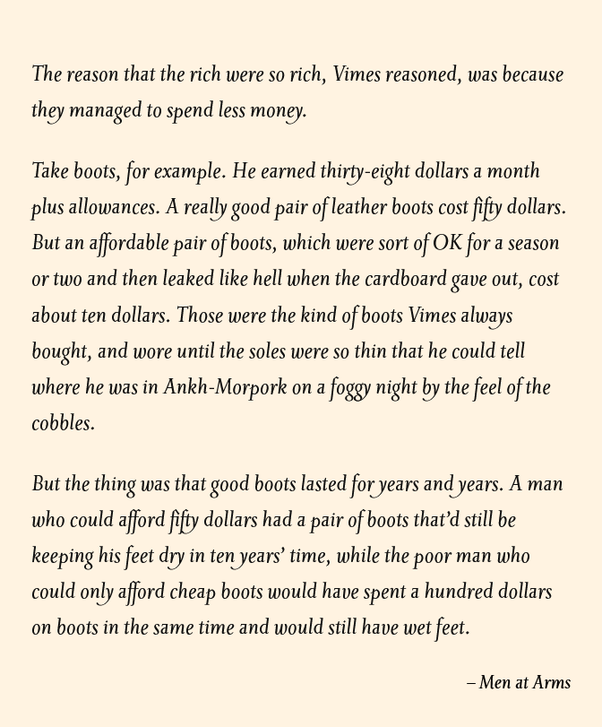
The most straightforward rendition of this view of economics is given by Terry Pratchett in his 1993 Discworld novel Men at Arms, through a character named Captain Samuel Vimes in a “Boots Theory of Economics”
Carney’s strength as an economist lies in his understanding of value and his focus on creating long-term benefits by developing a value-based rather than cost-based strategy.
This approach forgoes making quick promises to please the impatient among the crowd and requires time to develop. Some people innately understand the importance of creating a coherent strategy, and it was this unspoken expectation that a grifter like Drumpf leveraged through a trust-based scheme when he claimed to have “ideas of a plan.”
The difference here is that the work being done by Carney is obvious, and CONservatives help to make it obvious when they whine about how much gas he’s consuming by flying abroad to make deals with more stable nations than the U.S.
Carney has developed a strategic plan through his actions and decisions. He hasn’t yet summarized it in an action plan that the short-term thinkers demand. They must wait until his strategy becomes an actionable framework for followers.
This post is a response to a question posed in its complete format: “Why did people work for demanding leaders such as Steve Elon Musk? If they do not like them, why couldn’t they change their job?”
Jobs are not items in a grocery store that one can pick and choose at leisure.
Each job is a springboard to a better job or a deep dive into an abyss.
It cannot be stressed enough how critical it is to career success that one always has an exit strategy and a place to go if one’s job turns sour.
Jobs often go sour for reasons unrelated to performance and often due to abusive behaviours by management.
A personal case is one in which I was often extolled for my leadership skills while my supervisor would say to me, “You run a tight ship.” He would say these words to me while appreciating how much easier his life was due to my contributions. When I asked him for a reference letter, he wrote me a generic description of my length of employment as an act of spite to limit my options. He deliberately wanted to make it harder for me to make a vertical or even a lateral move away from an abusive environment in which he fraudulently presented himself as an ally who empathized with the abusive treatment I received from his supervisor.
Making matters more challenging is that jobs often go sour to such a degree that they are worse than not having a reference to support one’s candidacy for the next job. In my case, the Senior VP decided it would be fun to play a game of pretend I don’t know you each time we encountered each other. This went on for five years while I struggled with a salary 40 percent below market for my role on paper as I performed at levels higher than the manager and director above my role. They were happy to have me around, while I often saved their bacon and changed their tunes quickly when I chose not to go above my role and intervene to fix their mistakes.
A job relationship gone sour can become a barrier to continuing one’s career. More people than one would like to believe will easily choose spite to justify sabotaging a person’s career development efforts.
Someone as petty as Elon Musk could easily justify going to cartoonish lengths to destroy a person’s career on a whim. In his case, his reasoning is a consequence of the corruptive effects of too much power for anyone to possess.
Changing one’s job was much easier when we had a thriving middle class and various job options outside the structured and incestuous corporate world. Job options have become severely limited throughout the last several decades, in which one’s only choice for a stable career has mostly become a choice of serving as a cog in a multinational organization while hoping restructuring efforts don’t result in it vanishing overnight — like what happened with Twitter when Musk fired most of his staff on a whim.
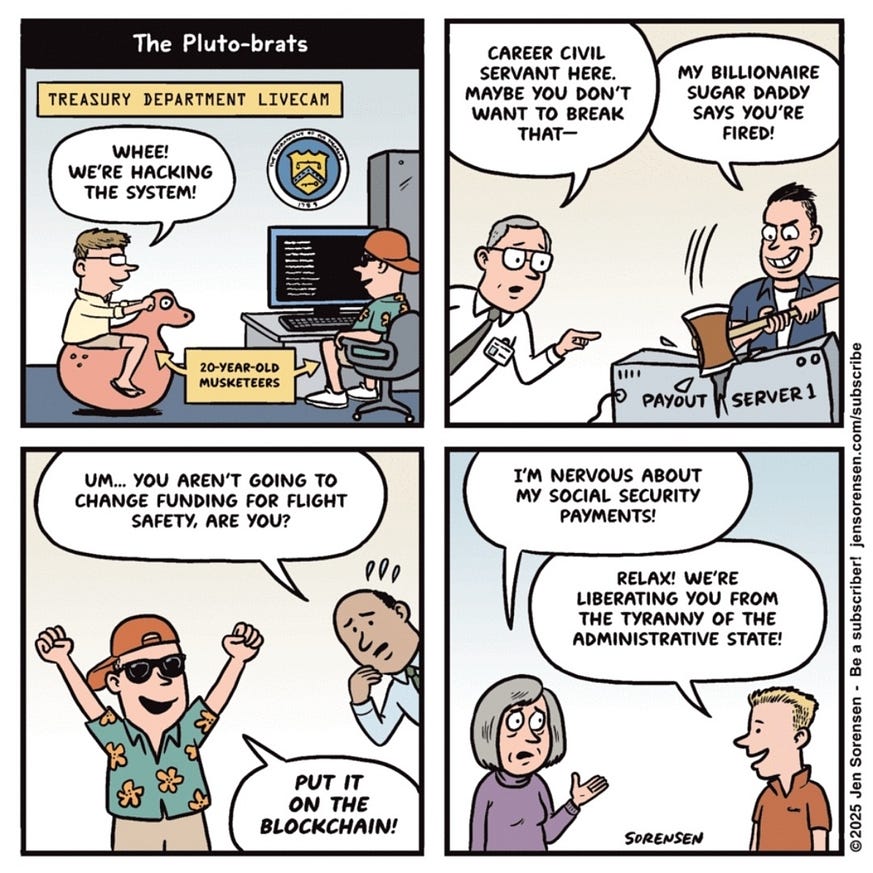
Musk’s latest attempts at accessing the personal data of three hundred and fifty million Americans are precisely for controlling their lives by leveraging their histories against them. Our choices in working for leaders we don’t like are becoming increasingly restricted to either that or homelessness and destitution. That’s not much of a choice.
If this nonsense continues, no one will be free to do anything without his oversight and the oversight of a fascist oligarchy.
No. The so-called “gig economy” is just a scam for large corporations to get away with paying people on a minimal scale for tasks without any commitment or standard employee protections, benefits, or pay equity.
It’s a way of paying as little as possible for disposable and interchangeable cogs who are desperate for any scraps they can get.
Even worse are the parasitic behaviours of gig exploiters like Uber, who leverage the vehicles supplied by drivers to create enough revenue to finance self-driving vehicles that will eventually eliminate all the gig workers. It’s like enriching someone who will throw you out onto the streets as a thank-you for the loyalty they expect from you.
It’s just a way of further exploiting people into poverty to leave them with nothing at the end of it all.
Forty years ago, an independent professional could earn a lucrative income from a thriving ecosystem populated by an entrepreneurial class of mom-and-pop shops that were everywhere. There was no need to deal with any large corporation to earn a comfortable living where one could easily afford a mortgage and meet all the expectations of the middle class.
Now, it’s impossible to sustain oneself without tapping into the corporate realm to earn an income. Meanwhile, their practices have grown increasingly insular while adapting to the rapidly changing technological landscape through utter ignorance and making inept judgments about candidates whose skill sets are so beyond their experience that they can’t hope to comprehend what they’re hiring for.
This is why we’ve had jokes about unicorn candidates with three years of experience with six-month-old technologies.
Surviving a gig economy is just a shortcut to long-term poverty.
This post is a response to a question posed in its complete format: “Why don’t big businesses reduce profits instead of increasing prices when forced to raise wages?|
Never in the history of generating income for oneself has anyone ever said, “Gee… I think I earned too much money. I should give some of it back.”
The answers you’ve gotten essentially echo the above sentence.
For example, many companies, like Walmart, deliberately underpay their people by enforcing tactics like union-busting and denying employees full-time status to permit them to qualify for additional benefits.
What they save on employee costs forces their people to qualify for government benefits. So even if you’re not their customer, you still subsidize their operation through your taxes. Their major shareholders laugh at you and your question.
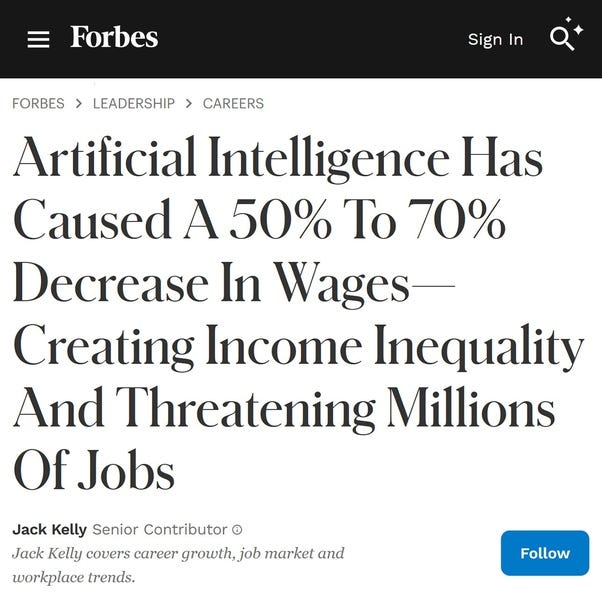
There is no way to solve this problem within the status quo. Even worse, this problem will continue to worsen as technologies in AI and robotics mature while automation replaces jobs to reduce employment costs even further.
The Walton family doesn’t care about how their employees might struggle. Jeff Bezos considers employees dying on his warehouse floor as collateral damage and the cost of doing business. A few thousand dollars toward a token effort to address optics is a low price to pay to force people into running according to the inhuman scheduling they’re forced to endure by filling orders according to a timed system.
Part of the problem with this question is that it presumes wages determine the costs of products that you pay for when that is the furthest thing from the truth. Wages are a minimal determinant in the price of products you buy.
Products are priced at the highest level that a market will bear. IOW, the price of a product is based on a formula applied to the speed at which shelves for that product are emptied. You have probably heard of the phenomenon of “supply and demand.”
The more demand for a product, the easier it is to justify its increased cost. The company knows it will still sell its product but get a higher margin, growing annual revenue and making it more attractive to investors. In turn, its stock value increases, and it appears much more successful as a company doing business in the marketplace. The entire system is geared around pricing products as high as possible while reducing costs as much as possible. The cost of labour is considered the most significant repeat cost of an operation, so it’s always targeted for reduction. Capital costs are written off in tax deductions, so a one-time purchase far exceeding the cost of labour for the year is still cheaper than labour because of that tax benefit.
When employers, capitalists, and their flying monkeys threaten higher costs for products due to higher wages, they’re just lying to the public to create the optics that their products require price increases that are functionally unnecessary but acceptable because people believe the justifications that are given. This happened due to the COVID lockdown when companies took advantage of public sentiment to indulge in price-gouging strategies.
Solutions to this and many related problems, such as the persistence and even increase in poverty, involve multiple strategies.
First, the downward pressure on wages can be addressed by eliminating the leverage of destitution that employers have with employees. Suppose an employment candidate doesn’t like the pay scale offered by an employer. In that case, they currently have a choice to begrudgingly accept being underpaid or face the risk of homelessness, starvation, and premature death. The solution to this problem is easily implemented through a Universal Basic Income. If candidates are free to turn down insufficient wages, then employers are put into a position of being more competitive to attract those they want on staff.
Corporate structures are an inherently antiquated holdover from medieval organizational structures. Corporations are strictly hierarchical entities that function like mini-autocracies. This dynamic existing within a democratic society cannot be but at odds with the society it operates within. It is in the “corporate DNA” to essentially function as a subversive entity within a democratic society that inevitably plots the demise of democracy and its overthrow to institute an oppressive two-class society of owners and serfs. The solution to this problem exists within worker co-ops.
Worker Co-ops (continued) Richard Woff is an economist and a professor emeritus of economics at the University of Massachusetts who provides compelling arguments in favour of worker co-ops. — Richard D. Wolff — Wikipedia — RDWolff –
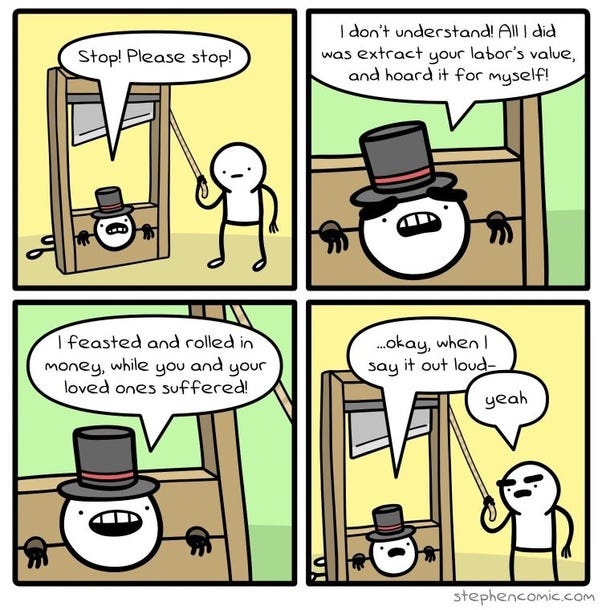
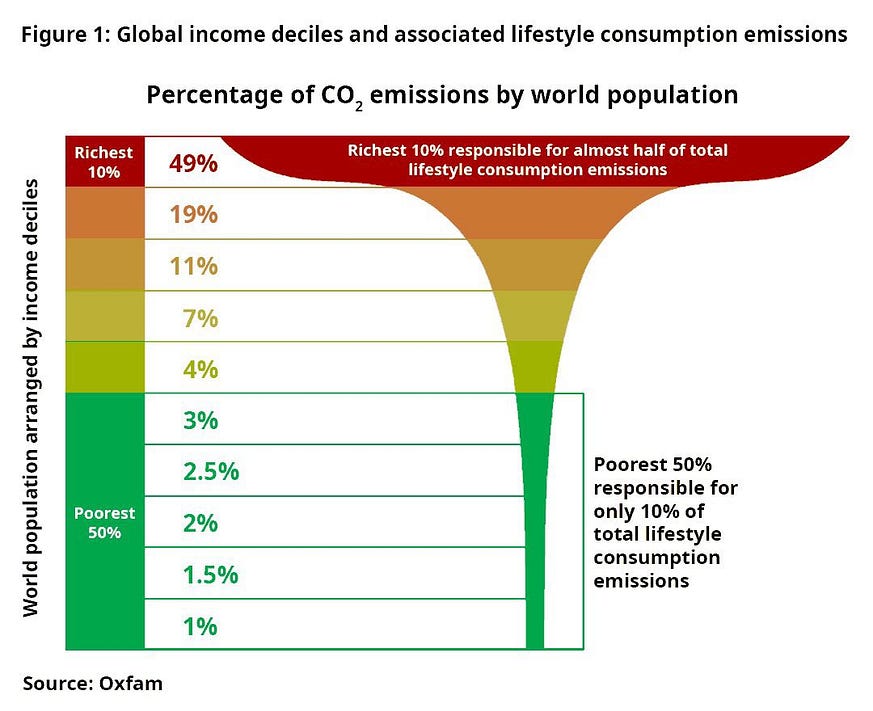
4. (Numbering Bullets in this kind of HTML formatting truly sucks the big one) Finally, the primary solution to the greed infesting human behaviour today that functions as a threat to human society is to place a global cap on personal net worth. This is the most difficult of all challenges to implement because it’s already hard enough to have an entire nation agree on something. For the world to develop solidarity in this matter appears to be an unreal fantasy, but it may be the case that Donald Trump and Elon Musk are opening the door for the world to get on board with it. There is no valid argument against it, particularly since the only argument that once held validity — financing large-scale endeavours — is now rendered moot through crowdfunding. The more money that exists in the working class’s hands, the more able the working class can participate in a democratic economy rather than be subjected to the whims of psychopathic power-mongers. We must first drop this delusion that wealth is accrued only by “special humans” who stand above the rest of us. It’s becoming ever more apparent to the public that not only does power corrupt, it is the corrupt and corruptible who are attracted to power.
We are rapidly approaching a point of no return in which we will either quickly resolve the problems threatening human civilization or lose the ability to respond to a global environmental threat.
This post is a response to a question posed in its complete format: “Is it ethical for employers to pay workers at the market rate even if it constitutes wage slavery and lets them barely survive?”
If you’re getting paid the market rate for a position you’re filling, that’s the highest level of ethics you should expect from an employer.
I worked for a government-related agency (part of the government Stewardship program of pseudo-outsourcing) for almost five years and was paid 40% below the market rate. I was stuck with that for reasons that will take this answer in an entirely different and unrelated direction. Suffice it to say that my options were radically reduced due to another arm of government choosing malfeasance to manipulate politically based optics in their favour at my expense.
At any rate, I found myself in this environment in a less-than-challenging role, which worked for me for a time as I had suffered a severe degree of trauma and needed mental space to learn how to cope with a new reality.
When I began working in this operation, management was so pleased with my performance and capability that they wrote an entirely new job description and offered me a full-time position within my first three weeks as a temp. Since my engagement before this one involved physically hauling 16 metric tons daily (at 52 years old) at an hourly rate less than one-quarter of what I had been used to as a professional, I jumped at an opportunity to function in a leadership capacity.
As much as I was surprised to enjoy the role and the people I worked alongside, I was shocked to discover that my rate was below the least-paid staff who reported to me. I was told I had to prove myself when I expressed my dissatisfaction. I responded that I already had, or they would not have created a new position for me. That changed nothing for the better for me, and I continued working there because I was more concerned with struggling through an ugly state of mind at the time and in no shape to be successful in professional interviews. I had already been bombing the ones I managed to get during that period.
During the first company Christmas event hosted by that employer, I had an opportunity to meet the Finance VP. I first witnessed him in his speech, declaring everyone was family. I was later introduced to him by an exceptionally proud supervisor and manager. The VP’s initially positive reaction indicated he had heard abundant good news about my performance.
He smiled and asked me a question. I managed six words before he turned around like I didn’t exist and walked away in another direction. I thought his behaviour was rude, which ended my thoughts on the matter as I continued to enjoy the event. As it turned out, that was my first indication of a sustained round of abuse I was to endure from him.
For the next five years, he played a game of “You look familiar, but I don’t know your name” with me. He enlisted his HR executive in his game as they behaved like they didn’t know me each time they visited the facility, averaging about twice yearly. His HR sidekick seemed to enjoy the game as she furrowed her brow each time she was introduced to the staff when she showed up on average once per year.
Throughout that period, I found myself constantly mitigating the incompetence of the leadership in the facility and saving thousands of dollars in lost productivity per week. I remember being given a production design assignment the manager couldn’t resolve, causing him great stress. The number of errors generated by his inability to deploy an effective production system seemed to stress him to the breaking point, and he thought I would make an appropriate scapegoat.
He offloaded responsibility for his job onto me under threat of losing my job if I couldn’t resolve his problem for him. It was pretty laughable in retrospect because I already had plenty of experience designing more complex production flows within a technical environment, so the system I devised resulted in a complete turnaround and a successful production flow that everyone appreciated, as stress levels among production staff also significantly dropped.
The short of this is that although I routinely exceeded expectations far beyond the role I was paid to fulfill, beyond management-level functions, and well into director-level functions, I could not find myself being paid the market rate for the job I had on paper. I was being paid 40% less than the market rate. I remember quoting that figure to a different HR personnel, and her response was an expression of surprise: “How did you know that?” I was more shocked by her question than I think she was about my knowledge of the market. It’s pretty easy to find out what the market pays for roles. However, the standing directive from company leadership was that discussing salaries was strongly frowned upon.
This environment had all the hallmarks of a highly incompetent and corrupt environment, and I’ve barely scratched the surface of examples I can provide. Do keep in mind, after all of this, that this environment represents government by proxy and the degree of corruption displayed was criminal. My constitutional rights were violated, and I had no recourse beyond the court system in which I could not afford to participate. I did, however, file a suit against them, so that’s on record if I can finally afford to take them to court.
After eventually receiving an agreement that I would have my income adjusted to near market rates, I experienced a gradual moving of the goalposts where my expectations degraded from an agreement they made to a realization they had negotiated in bad faith. My attitude degraded over time, and I stopped offering extra-curricular solutions to issues I had worked on during my off-work hours. I stopped stepping forward to volunteer for tasks above the role I was hired for, and the response was an attitude that I was being derelict in my job.
They eventually decided to terminate my position by claiming they were going in a different direction. This is an “at will” environment, and they were within their legal rights to terminate me at their discretion. I was entitled to six months of severance and received only four.
Workers have no protections in the modern workplace without the strength of union membership and the resources it provides.
Ethics is a matter of individual character; the shame is that ethics are not a universally held standard of conduct. The primary reason for people quitting their jobs is due to abusive environments. That means that most work environments are unethical, which aligns with my experience as an independent professional who has been stiffed by many people who hired my services to extoll their satisfaction with what they received and then denied me my compensation.
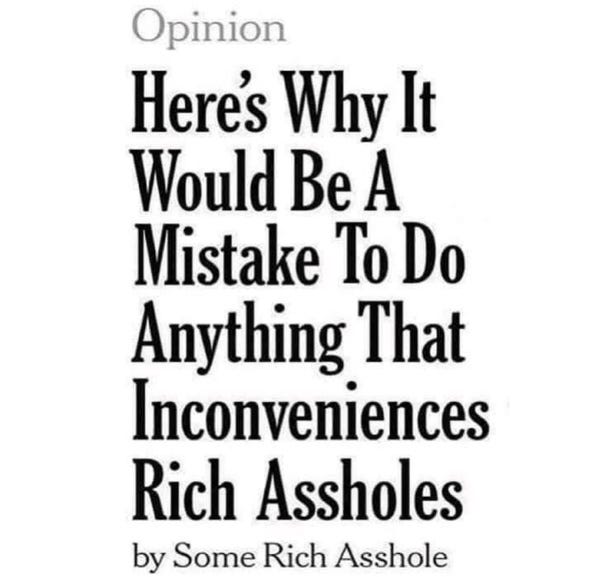
A LOT of employers and people who hire other people to work for them are entitled assholes who will screw over anyone they can get away with. It might be the case that I just had shitty luck, but it was far and above more than half of the people I encountered who lacked ethics.
This is only one reason that when people like Donald Trump or Elon Musk brag about stiffing their contractors, I see red. None of those people would want to brag about such horrid behaviour around me because, after a lifetime of enduring it, I doubt I could restrain myself. I would rather avoid a prison sentence for losing my shit over some psychopath’s gloating over how they screwed someone over.
If you’re looking for ethical behaviour from your employers, good luck because if you do find an ethical employer, hang onto them like they’re a prized treasure. They’re just as rare.
Getting paid at a market rate is at least better than getting paid less than the market rate and being expected to perform at higher levels of responsibility than those who get paid more to supervise your work. They don’t set the market rate, while most employers deliberately seek young and inexperienced people because they don’t want to pay the market rate.
A LOT of jobs I see posted indicate an upper limit of experience precisely because older workers know when they’re being ripped off or manipulated by an unethical employer.
















 thotbag