
Should US healthcare be a business?

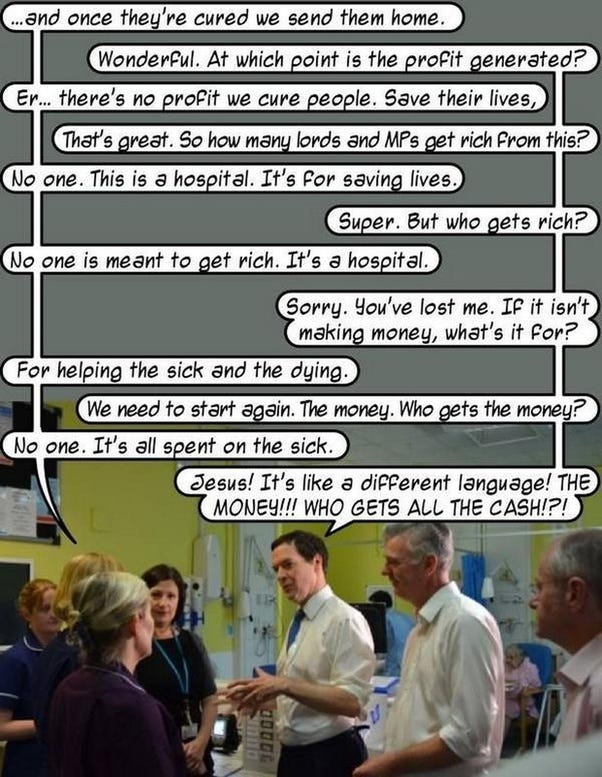
It should not be a business because it’s a public service, just like the military and the police… just like education should be.

When public services are operated with a profit-driven mindset, they deviate from their intended purpose, becoming corrupt and inefficient. This distortion invariably leads to their failure to serve the people.

Some things should never be run as businesses because their priorities are not profits but service, a value inherent to and critical for delivering effective public services.

It’s a fundamental truth that the primary goal of any business is profit. However, this profit-driven approach is incompatible with providing high-quality service. The two cannot coexist.

In business, one can choose only two out of three options between speed, price, and quality. It is a business mantra that recognizes you can only provide some of the three.

People who fail to understand business also fail to understand community development because you can’t provide a high-quality public service if profit is involved in any capacity. It is for this reason that all election campaigns should be publicly funded instead of privately financed for the profiteers who have corrupted the political landscape while transforming the nation into a fascist corporatocracy.

Restraining corruption within the political landscape demands a wall between business and state in the same fashion that a wall should exist between church and state. As institutions, they should not directly influence the other two’s nature, shape, or operation.

Corporations are medieval institutions based on authoritarian structures. Because of that, they cannot help but corrupt democracies, just like churches are also authoritarian structures capable only of corrupting the operations of a state.

The only efficient and effective way to operate a national healthcare system is to provide high quality at the lowest cost. The only way to achieve that goal is to pool all resources together and leverage a basic economic strategy called “economy of scale.”

As a citizen and a consumer, you apply that same strategy each time you buy something in bulk.

This isn’t rocket science, and the fact that the U.S. still can’t get its act together to do the right thing for its citizens is a testament to how badly corrupted by billionaires the nation has become.

The fact is that billionaires have invested a lot of money in programming people to believe the government is inefficient. The truth, however, is that all organizations become inefficient the larger they become.

The real solution to many problems the U.S. and the world are struggling with is acknowledging that “too big to fail” means “too big to exist.” No multinational corporation should exist today. No centibillionaires should exist today.

We’ve made a horrendous error in judgment by allowing power to be concentrated in the hands of the few. The consequence of that corruption is that a majority are now struggling needlessly when they were prospering only a few decades ago.

Community development is a service we provide for each other as part of the social contract.

There are plenty of opportunities outside of community service to make profits. There is no justification for turning every waking moment into a monetization opportunity — for anyone- and creating a culture in which that’s the expectation, which is a dysphoric consequence of a dysfunctional state of being that will sustain itself indefinitely.

As we have entered the late stages of capitalism, we can either adjust course toward a healthier and sustainable existence, or we will invite chaos into all our lives. We can stave that off by simply adjusting our biases. The first bias to change is acknowledging that healthcare is NOT a business.

Plenty of for-profit business opportunities exist within an endeavour as massive as healthcare. Like any non-profit enterprise working within a zero-based budget context, private industries are still free to operate on a for-profit basis. For a service as massive as a national healthcare system, that presents an incredible array of opportunities for innovation and competition by and between for-profit industries. The critical difference is that the decision-making body or board governing the healthcare operation isn’t distracted from providing essential services by a for-profit mandate.

There exists neither a need nor justification for basing the service provided to save lives on catering to a profit motive. It’s the worst way to serve a public with an inferior service at a cost that’s much more excessive than money because the price includes the lives of innocent people who are unfairly and unnecessarily made desperate to survive.

Why is Gen Z struggling with employment?

Genz Contemplating a Rapidly Changing Future

It’s not just GenZ.

The entire employment system is broken.

Many places advertising for employees aren’t actually looking to hire people inasmuch as conducting market surveys.

Many employers are so used to seeing hundreds of applications today that they narrow their vision for what they’re looking for on such strict parameters that they forget they are hiring people and not selecting machines.

Employers often over-rely on agencies who aren’t in the least interested in team building or cultural fits but in spotting skill sets to narrow their candidate lists by algorithms rather than people exercising their judgements.

Most applications are ruled out before any human sees them and are ruled out by humans if their applications aren’t formatted in the manner they expect.

Companies will often advertise for people “who think outside the box” but are so intimidated by outside-the-box thinkers when they interview them that they immediately reject that candidate.

Making matters worse for people in technical professions is having their skills evaluated by people without technical expertise, who judge the candidate based on the limits of their ignorance. They’re incapable of comprehending what skills are transferable and how they contribute toward success in a different area.

Even worse are companies that place upper limits on the experience they’re willing to accept, which rules out highly experienced candidates. Meanwhile, they also often advertise a requirement of years of experience in a technology that’s only been on the market for a few months.

Then they complain, after ruling out qualified candidates, that they can’t find anyone to hire because no one wants to work anymore.

Many unemployed people struggle to find work while being rejected outright because they don’t fit neatly into narrow boxes of expectations defined by ignorance and bias rather than insight.

GenZ may be experiencing struggles unique to their stage in the employment mill, but the overall employment system has massively degraded over the last several decades.

I’ve been struggling for ten years now to land a simple junior-level job in graphic production work to regain balance after having a thirty-year career as an independent professional destroyed by people who are supposed to protect and serve, not scapegoat for political gain.

Is leader authenticity a matter of integrity?

The original question this article responds to in its complete format is as follows: “Is leader authenticity a matter of integrity? Should leaders behave similarly across different contexts and situations? Provide a specific example to explain your position.”

Authenticity IS integrity.

I often cringe when I read “Should” so-and-so do, be, or say such-and-such because that implies an externally imposed expectation.

One “should” do, be, or say whatever is required to accomplish or achieve whatever one seeks to accomplish or achieve by meeting externally defined expectations. That’s about it. All other motivation is derived from establishing and maintaining an inner equilibrium in which one can exist in a state of balanced compromise between the demands of the world and the needs of the self.

Authenticity is determined by a matching of one’s words and deeds. If someone is going to live an authentic life and be an authentic person, they’re not fulfilling an external expectation. They’re living in consistent alignment with who they perceive themselves to be.

Their ability to consistently maintain their authenticity while acknowledging the impact of their behaviours on others is how they are deemed to have integrity by others who make that determination about them.

One doesn’t decide to have integrity as if it’s an accoutrement to their lives. One chooses words and deeds that maintain one’s inner balance with one’s external self to be an authentic person with integrity.

A leader is just an ordinary person who lights a path or blazes a trail others can follow.

Some leaders are incredibly toxic and take people who follow them down dark paths that are absent of integrity.

I would argue that the most influential leaders we have in the world today are primarily psychopathic monsters who bleed their followers dry while being responsible for setting our world on a trajectory toward oblivion.

Followers are just as important as leaders within a leader/follower dynamic. Without followers, a leader is a solitary traveller.

The challenge we have in this world today is that those who seek leadership should have something other than followers. At the same time, too many followers must learn to distinguish between leaders who can elevate and inspire them to achieve their best and those who lead them to their slaughter.

An authentic person with integrity behaves consistently with their values across all domains, contexts, and situations. That’s what authenticity means. Be, say, and do what is right and good for you without compromising the balance permitting you to remain whole as a human being with your own functioning identity.

Integrity means others can trust you to be consistently authentic and that you will sacrifice whatever is necessary to maintain your authenticity of self.

Leadership means others recognize and value one’s consistency enough to derive value from it in whatever capacity brings them to a state of internal equilibrium.

Should followers be too broken to value integrity, so will their leaders.

Temet Nosce