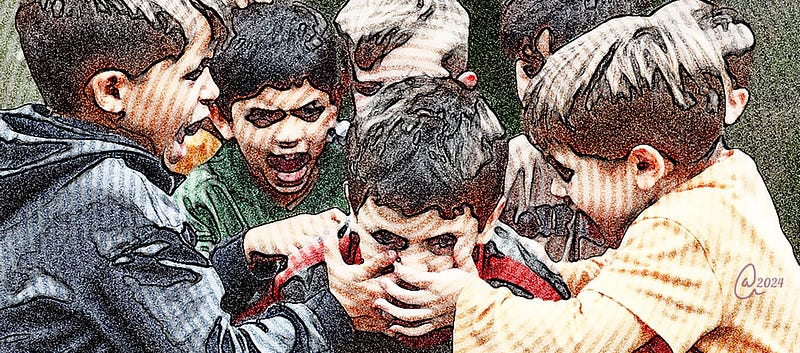
It’s a toxic coping mechanism for them, like an addiction. It is less a benefit than it is a salve.
Making others feel bad makes them feel less bad about themselves.
For a bully, bullying someone is like having their arm go numb, and they bang it against a wall to ‘wake it up” and restore circulation.
Without that outlet, their inner tensions build up and explode randomly. This exposes their weakness to whoever may have bullied them, resulting in them being bullied further by their bullies.
Bullying is learned behaviour, and it’s reinforced until it sticks and takes over one’s mindset.
When that happens, that person struggles with anger management issues as they learn to cope with their emotional fragility while alienating themselves from others until they learn self-control.
It’s easy to hate bullies, but it’s also easy to see how they became bullies just by looking at whoever bullied them.
(I have an example in mind of a homicidal police officer who contributed to the death of a person suffering from a mental health condition. I want to talk about it but can’t at the moment, but I intend to do so in a more appropriate manner. At any rate, I mention it here now because I saw a photo of him with his father, and his father had “bully written all over his face and demeanour” that most would not notice unless they have been victims of bullying themselves.
This is part of a more significant societal issue that has led to the “defund the police” movement.)
Bullying happens everywhere and at every level in society. Most bullying doesn’t involve any form of physical violence. Most bullying is just verbal intimidation, while a lot of it is a consequence of a power dynamic in a workplace.
Many low-level supervisors are toxic bullies promoted to their Peter Principle peak and stay there for life because they are viewed as effective at that level while incapable of handling higher levels of responsibility.
Bullies who manage to get higher in an organization tend to because the organization itself is entirely toxic from top to bottom, and people are selected for favouritism on their ability to capitulate to the pecking order.
These are environments rife with sycophants, high turnover rates, and senior executives who refer to their staff as family while they rip them off of value for their labour.
Cyberbullying is just more accessible for a bully because they don’t have to risk direct consequences from a reactionary response. They can take their time planning their attacks while knowing their victim can do nothing to harm them.
Cyberbullying is probably the most cowardly form of bullying because of it. In some ways, it may also be the easiest to deal with because many sites and systems have blocking mechanisms that prohibit bullying, and that’s why we often see people on Quora complaining about “cowards” turning off their comments.
The more serious versions of cyberbullying are more complicated to deal with because they often involve kids from a common and relatively small social circle where they share personal details with classmates, for example, that they cannot get away from or block in ways that prevent another avenue of bullying by their bully.
Until we can acknowledge the full scope of the problem of bullying in society, victims are essentially left to their own devices to develop coping strategies for themselves, and that’s the greatest shame in our failure to address bullying in society.
 thotbag