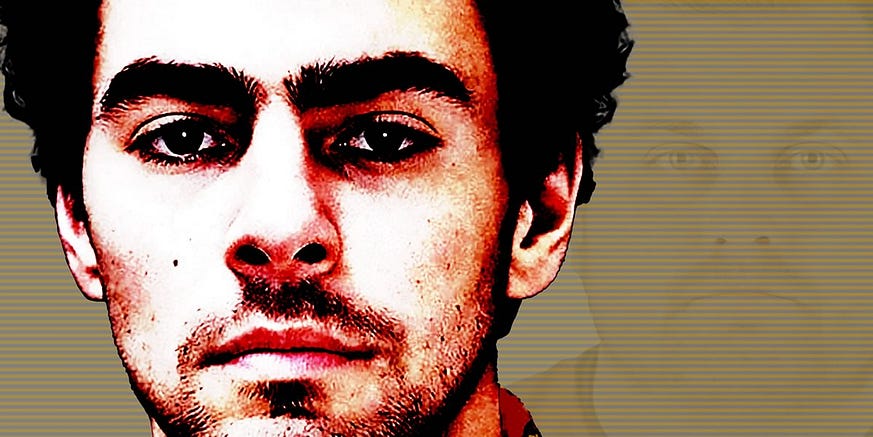
This question cannot separate the person from the act that introduced the person to the world. The person and the act are now inseparable. No one can answer this question independently from knowing why he is known.
What people think of Luigi Mangione will forever be the act superimposed upon a subjectively constructed image of him.
The only means by which one can now render an objective description of him is by offering up statistical data and facts about his life. Who he is as a person is now beyond anyone’s comprehension. No one can know what motivates his existence or what comprises the subjective state of Luigi Mangione beyond surmising a person who has experienced a breaking point in their life in which it was better, in his mind, to do the unthinkable for most of the rest of us than to continue an invisible march into a nightmare he could no longer endure.
No one can know what that feels like unless they’ve been forced to walk in similar shoes.
One conclusion that can be drawn about his personhood is that he demonstrated an ability to sacrifice himself to act on behalf of thousands of faceless victims forgotten in the march of greed.
Along with losing the ability to think of Luigi Mangione as a being separate from his act, neither can we separate the notion of the tens of thousands of victims lost to us every year in service to the God of profit. We can no longer forget how easy it is for many among us to justify murder if it means pocketing riches and obtaining a life of material wealth for oneself.
None of us can separate Brian Thompson’s callous extinguishing of lives from an algorithm to be rewarded for it in service to the monsters who refuse to honour the social contract and a local thug who robs a convenience store for a drug fix without admitting to being a sociopathic monster.
The reality between the two scenarios is that the local thug is less of a monster than the billionaires who think nothing of the lives they extinguish while offering up the lie that there is nothing they can do about it.
None possess the courage or the integrity to distinguish between ability and desire.
Every insurance billionaire can choose otherwise, but they don’t and hide behind the lie that the protocol they devised to protect their material luxuries is immutable and outside their control.
What I think about Luigi Mangioni for sacrificing his life to show us all our ugliness in a black mirror of a broken society is that he should not have been forced to put all the rest of us to such severe shame, and even more so is the pity that we still can’t grasp how evil our world has become.
This post is a response to a question posed in its complete format: “Why won’t rich people just donate a tiny bit of all their wealth to poor people?”
Some of them do. MacKenzie Scott, the ex-wife of Amazon founder Jeff Bezos, has donated over $17 billion to charitable causes since 2019. Our problems, however, can’t be fixed by relying on a few donations by the small percentage who care about other human beings beyond themselves.
People need to stop thinking about ways to guilt the few rich capable of feeling guilt into ponying up on behalf of those who don’t care in the least about the poor as long they shut up and die quietly and out of sight.
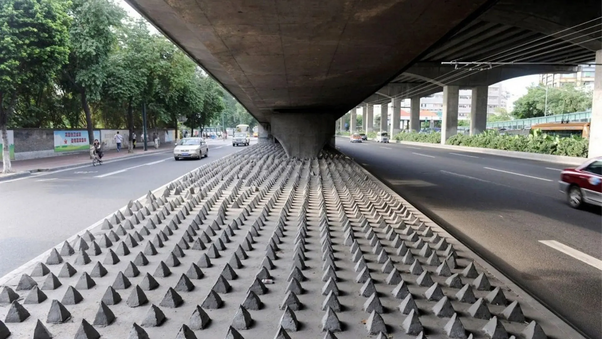
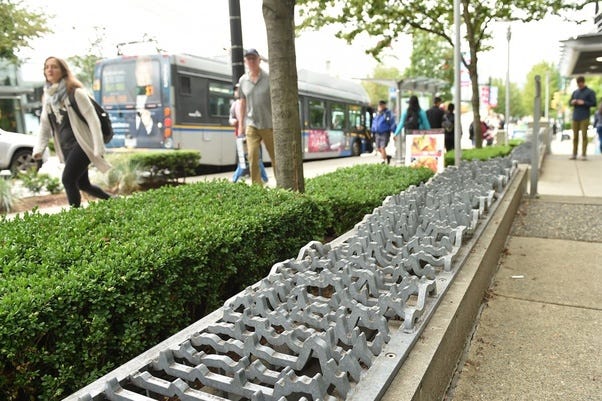
Why do you think “hostile architecture” exists?
A lot of people don’t want to help the poor. They want them gone out of sight and out of mind. They want to blame the poor for creating their conditions of poverty.
They want to think of them as lazy addicts who irresponsibly ruined their own lives.
It’s no different than shaming a woman for her clothes or behaviour for inviting a rapist.
It’s like shaming a mugging victim for paying cash for their drink in broad daylight.
People don’t want to think about why things go wrong for other people because it means dealing with the possibility that things can go wrong for them. If people believed they could also become one of “those people.” many would just give up, while others wouldn’t be able to function past their anxieties.
Although the existence of centibillionaires is a huge symptom of a system so broken that so many poor exist, no one wants to change anything because it means having to do things differently than they’ve become used to.
Look at how impossible it’s been for Americans to adopt a universal metric system — even though it would save them money.
Look at how impossible it’s been for Americans to adopt universal healthcare — even though it would save them money and lives.
People may demand change, but they hate change. Many people prefer complaining about how bad things are to doing something different because they fear change will be worse than what they’ve gotten used to.
My province of BC has had three referendums on electoral reform that would have made our elections more representative of the people. We would have become a more democratic province that more effectively addressed the needs of the people if the people could vote for what they want rather than vote against a change they don’t understand. Even worse, the change is easy to know if one makes a small effort to educate themselves, but they don’t and won’t understand something until they’ve lived it. When people are unsure, they consistently vote to maintain a corrupt status quo instead of voting to change it.
Americans are going to continue voting for corrupt leaders until they realize their lives are at so much risk that the choice is no longer “change or continue suffering” but “change or die.”
That’s where we are right now… or at least, those who refuse to read the writing on the wall will eventually figure out that’s the case when they start seeing the suffering around them can no longer be denied. They will change only when they become more afraid of maintaining a destructive status quo than the change they can’t understand until they’ve made their change.
Rich people won’t give up their wealth, even in part to sustain a failing system until it fails so badly that they start running and hiding for their lives from the mobs who are angry enough to repeat history. They won’t change what they’ve gotten comfortable with, even if it means they’ll end up more prosperous.
This is why “woke” is such an important concept these days — because we are at the stage where a lot of people are sick and tired of screaming “Wake up!” to people who insist on ignoring the threat they’ve become to our future.
The bullying Nazis among us still think they can play their bullying games endlessly while laughing at the “librul” tears they imagine are being shed out of frustration without realizing those tears are being shed because of what comes after those tears… the mourning of having to do what could have been avoided.
The few wealthy people cannot, through donating portions of their money, fix what’s broken.
The system needs to change on fundamental levels enough to force the greedy sociopaths to acknowledge the critical importance of maintaining a universally sustainable social contract. They need to understand the benefit of giving up some of their money to pay back into a system that allowed them to become rich in the first place.
Allowing a small number of elite few to grow hoards is not how to develop a sustainable economy or lift people out of poverty.
People like Musk know this. They don’t care because they see themselves as entitled to rule over the rest of us like we were herd animals.
Eventually, someone like Musk will push society far enough for the guillotines to come out and put his head on a pike. He doesn’t believe that’s what he’s inviting into his life. He thinks he is untouchable… just like Trump thinks he’s untouchable — that no one would dare do the unthinkable.
Suppose Trump decides to start a war with Canada, and NATO steps in. In that case, the chances of an American military officer putting a bullet in his head on the brink of launching a nuclear attack against a long-time partner becomes a very real possibility. Just because he’s the “commander in chief” doesn’t mean he has carte blanche to do whatever he wants. Everyone has limits. That’s just life. We must acknowledge that and protect them for everyone, for all our sakes.
We don’t know right now what those limits are and what it will take to cross that one bridge too far… but if or when it does happen, there will be chaos in the streets. We’ll be spending the next hundred years dealing with profound regret while armed with microscopes to examine in micro-detail how it could be that we allowed this nightmare to go on as long as it did.
We will be kicking ourselves with the kind of regret that will change us forever in ways that will horrify us deeply if this happens again. We should be paying attention to how the German people have had to cope with their recovery from the madness that overtook them. We should be learning from history, but 76 million people voted for a repetition, while another 80 million said they didn’t care enough to do anything different but pretend it wasn’t their problem to solve… so they made it their problem and everyone’s problem.
Meanwhile, it’s unfair to the few wealthy who are generous and care about humanity to put the onus on them alone to solve the problems we all have a responsibility to solve.
If that means we have to start punching Nazis to get them to develop enough humility to behave like human beings, then we need to start swinging as if our lives depend on it because they do.
Nothing will change until we take this dystopia seriously enough to deal with the threats we face in the form of hatemongers who feel themselves entitled by God to rule this world.
If there’s one thing we can learn from Luigi Mangione, it’s how overwhelming this problem is and how overpowering the enemy is. They’re not taking any breaks now that they’ve been given the keys to transform the landscape radically. They’re putting the pedal to the metal, and if it means running over millions of homeless people with a bulldozer, then so be it.
They don’t care about the poor. They are happy to destroy the easily victimized among us.
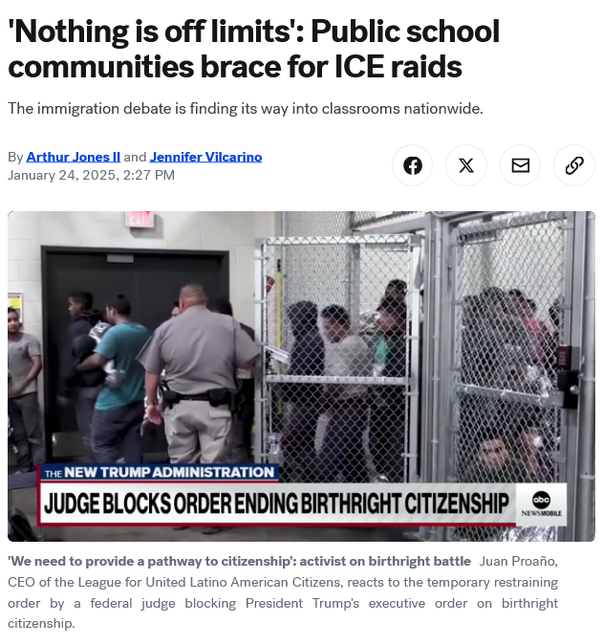
Why do you think they’re starting with schoolchildren?
Their options are always limited to housing, which most often includes conditions that would be unbearable for those who take their ability to afford decent housing for granted. Consequently, any time spent with anyone living a marginal life will reveal horror stories most people could not believe were real.
As an example, someone I know had no choice due to prior “accommodation difficulties” (of which this person was a victim of the behaviours of others in this prior matter), chose an opportunity of availability and expedience because neither time nor resources allowed the luxury of shopping and waiting. As a result, a choice was made for a temporary resolution to bide time and save money for something better. The living conditions were rather horrendous as it was a suite within a house (which tends to be what’s most available at the lowest costs) owned by a hoarder who often snooped and eavesdropped while generally inebriated every waking moment — fortunately, not the violent type.
At any rate, this temporary accommodation was six months filled with fun and adventure, ending in an almost surreal form of coincidence. Upon having found another, more appropriate suite in a moderately priced complex and beginning preparations for moving, the owner was found unconscious. He was rushed to the hospital and treated for a heart condition, but since his mental faculties had failed so severely, he was moved into a care facility. Of course, this turn of events meant relocating sooner rather than later.
This person’s new and seemingly stable accommodation required some austerity to maintain a stable and relatively comfortable lifestyle. After the one-year lease expired, the rent increased by its legal maximum. Shortly thereafter, they were informed that the building complex had been sold and that the new owners were considering redevelopment, which may require them to move again.
This is one of the overlooked details of poverty. The lack of stability itself is an incredible drain on resources, which means this approach to living by addressing crisis after crisis over time is psychologically, physically, and financially draining. The consequence is this is just another forgotten example of how poverty is an existence of perpetual punishment for simply being poor while having little to no access to escape.
A harrowing statistic I’ve just recently posted in another answer to another question since answering this question 6 years ago is the number of people who work full time and are homeless.
I was also prompted by what’s been happening in California with predatory real estate corporations owned explicitly by Blackstone and headed up by Stephen A. Schwarzman from an email I received from Brave New Films. It prompted me to create a provocative meme to post on Xitter that may be a bit too provocative for some but can’t be ignored as a practice that can only be endorsed by psychopaths who are responsible for the current state of dire straits experienced by victims of theirs.
This is an argument against corporate ownership of residential real estate.
This post is a response to a question posed in its complete format: “Imagine that millions lose their jobs due to AI. Is there a way for those who have lost their jobs to effectively declare war on AI?”
Well, that’s pointless.
People will not lose their jobs because of AI but because corporations save money on labour costs.
AI is a tool, and the argument that ammosexuals love to barf up applies here: “Guns don’t kill people. People kill people.”
AI doesn’t kill jobs. Capitalists kill jobs because they can and are incentivized by it within a system that worships personal wealth above all.
We, as citizens, kill jobs through our apathy and through our empowerment of those who prioritize their material benefits at the expense of the many they can exploit.
We bring this upon ourselves by not having a coherent social development roadmap. We allow our societies to grow by chaos rather than responsible systems management strategies.
We empower our leaders through a reactionary process of social development rather than a strategically reasoned and proactive process.
Sadly, authoritarian regimes are far more successful along this vector than democracies because their decision-making is limited to small, centralized powers.
This is part of the reason that the public has been increasingly questioning the value of democracy while looking toward authoritarian models to solve our problems for us.
Sadly, the solution for democracies to be far more effective in mobilizing social development in a coherent and unified direction is entirely contingent upon the quality of the education the public receives.
For instance, the transition to a fully automated society is an inevitability. There is no point in resisting it. We would all be much better off by leaning into it and demanding we adapt our systems to manage the transition better so that we can mitigate collateral damage.
Instead, we are experiencing a chaotic transition led by random powers following personal visions motivated by personal benefit rather than social good.
If our education systems provided a more comprehensive insight into social development, much of the public would be engaged in the political process in strategic rather than reactionary ways.
We would be more unified as a people in identifying trends and developing coherent strategies for successfully managing the challenges we face.
Instead, we are burdened by a dearth of education that reduces a population into cheerleading camps driven by emotionality that can be characterized as juvenile reactions against authorities. Considering how democracy means each person is a governing authority member, this is beyond an asinine apprehension of how one’s government works or how it can be made effective.
Democracy demands engagement, yet our apprehension of engagement is limited to how many likes one gets on one’s post. That’s not even remotely resembling engagement.
That’s like claiming every celebrity walking a red carpet and waving at the throngs is socializing with friends.
Sadly, part of the problem has been deliberately cultivated by the capitalists who want us distracted enough from the sausage-making process to allow them to remake human society into their image.
They have been succeeding remarkably within the U.S. as it has become a dystopian corporatocracy that prioritizes gun sales over the lives of children and billionaire profits over the healthcare needs of citizens.
The public has been so conditioned to prioritize profit at all costs that they will fight to preserve a billionaire’s right to kill people for profit.
We can’t govern ourselves in a democracy if all of our time is focused on survival and profit-churning. Most of us don’t care to be involved in the decision-making process, which would be okay if we could trust our information systems to prioritize informing people over chasing profits.
Instead, we have media that has become a singular, massive entity of public influence predicated upon churning conflict to maintain attention justified by revenue increases.
Instead of informing the public on issues of criticality to the future of the people, we have this kind of incendiary rhetoric from an attention whore indulging in shock stupidity to justify their salary increases by ginning up the rubes to create conflict.
Less than one hundred years ago, this kind of crap would be shut down immediately because it would be considered a precursor to war.
Instead, the attention-seeking mentality justified by the profit (and power-seeking) motive does not care about the casualties created by irresponsible language.
The value of human life has been downgraded, if it ever mattered to society, to a level that’s no greater than the Roman arenas when people were killed for entertainment.
If we don’t start asserting some standards on coherent behaviour that cultivates the best of us as a species, we will continue careening headlong into chaos.
Humans can take only so much abuse before they break. Everyone can break, and people like Watters are playing with fire. There’s no way he will be safe again crossing the border into Canada because of his disgusting language. Some might argue that any aggressive response against him is unjustifiable, and that may be valid, but it doesn’t change how humans behave when aggrieved. I’m confident few Canadians will give him a warm reception for his remarks if he ever crosses the border. At best, at least from my perspective, he’s earned a bloody nose for his garbage.
This kind of bullying rhetoric is toxic to society and is a betrayal of the social contract.
The acceptability of this nonsense and its prevalence is why we have no coherent strategy for managing our transition into a fully automated society. The acceptability of this kind of incendiary distraction from critical information the public needs to make proper decisions to minimize casualties in our transition will create unnecessary casualties. This kind of thinking is what permits bigotry to determine outcomes that dramatically affect lives.
This kind of nonsense is why this question exists in so many forms everywhere and why I’ve already answered this question in several forms by now.
The issues are not complex, but they are made so because we’re not talking about them where we need to be talking about them. We’re allowing jackasses to troll for reactions in “respectable mainstream media” that we would mute and block online if they were individuals and not expensively dressed and cosmetically pampered media personalities.
We are being betrayed by the Fourth Estate each and every day — and to the degree that a majority of the world now believes the U.S. is a tragic case of end times for a nation that has become so corrupt, it can never be trusted for leadership in the world again. However, anyone may parse the 2024 election, and one cannot ignore the role of the media in installing a monster in the top job for the nation.
If you genuinely want to declare war against the loss of jobs, then you need to take it to those who benefit from displacing jobs. You need to start pressuring the billionaires and the corporations they benefit from while ripping off the public through tax avoidance schemes.
Instead of war, you should demand responsible management for an unavoidably dramatic and traumatic societal transition by insisting on the only sane solution to this period in human history, UBI, as a starting point toward sanity in our social development.
The worst thing about where the world is at in this transition is that the next four years are being defined by a parasitic presence seeking to empower further those who are disempowering the working class while replacing workers with automated solutions to toss millions out onto the streets to fend for themselves.
We must stop blaming AI for job losses because it’s just a gun in the hands of mercenaries.
An 11-year-old trying to generate $100 daily is a travesty of epically dysfunctional proportions for society.
That’s a friggin horror show straight out of a Dickens novel.
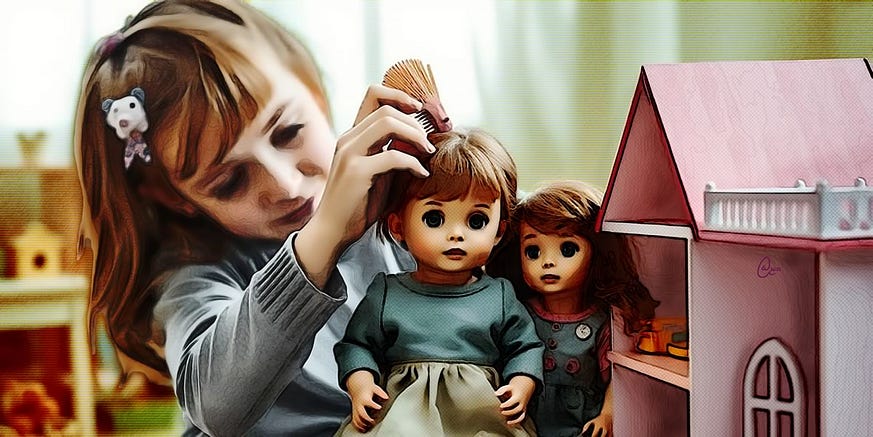
An 11-year-old should be playing dress-up and letting their imaginations soar, not concocting survival schemes.
As much as I can feel compassion towards whatever circumstances motivate you in this direction, I’m also highly disgusted by them.
This question makes me want to pull out guillotines and give billionaires free haircuts below the neck.
The problem you face is that you have no leverage to make that amount of money daily.
That means you will have to spend every waking moment focused on generating that amount of money by performing services for people who will treat you like dirt. Many won’t even pay you for a day’s work because you cannot force them to pay you.
You will become an embittered sociopath by the time you hit twenty. That will make you able to justify ripping off everyone you encounter as you learn to treat people like marks and evolve as a predator in society.
I don’t know what solutions might be available, but selling lemonade won’t work. Door-to-door sales of products might work, but that exposes you to predators.
I’m not even sure it’s legal for you to earn money in an employment capacity. Laws in your area may be different, and if you’re American, child labour is just around the corner with a Trump presidency.
Even worse is that making yourself available to generate revenue exposes you to the ugliest of predators who would choose to use you as a playtoy for inhumanly sick and twisted people.
Damn, but this question severely bothers me.
You’re a frigging child.
You should have a childhood with friends, playing ball outside in the sun at the park with other kids, not trying to make money.
Please try talking to a counsellor at your school because the way you’re thinking right now means you’re giving up your childhood and almost literally guaranteeing you’ll be chewed up and spit out by your early twenties. You’re nearly guaranteeing you won’t make it to your thirties.
Please talk to someone who cares and can help you because there’s nothing anyone online can do for you — and if anyone offers, you can’t be sure they’re not a wolf sizing you up as a tasty meal.







 thotbag