
This post is a response to a question posed in its complete format: “Why did people work for demanding leaders such as Steve Elon Musk? If they do not like them, why couldn’t they change their job?”
Jobs are not items in a grocery store that one can pick and choose at leisure.
Each job is a springboard to a better job or a deep dive into an abyss.
It cannot be stressed enough how critical it is to career success that one always has an exit strategy and a place to go if one’s job turns sour.
Jobs often go sour for reasons unrelated to performance and often due to abusive behaviours by management.
A personal case is one in which I was often extolled for my leadership skills while my supervisor would say to me, “You run a tight ship.” He would say these words to me while appreciating how much easier his life was due to my contributions. When I asked him for a reference letter, he wrote me a generic description of my length of employment as an act of spite to limit my options. He deliberately wanted to make it harder for me to make a vertical or even a lateral move away from an abusive environment in which he fraudulently presented himself as an ally who empathized with the abusive treatment I received from his supervisor.
Making matters more challenging is that jobs often go sour to such a degree that they are worse than not having a reference to support one’s candidacy for the next job. In my case, the Senior VP decided it would be fun to play a game of pretend I don’t know you each time we encountered each other. This went on for five years while I struggled with a salary 40 percent below market for my role on paper as I performed at levels higher than the manager and director above my role. They were happy to have me around, while I often saved their bacon and changed their tunes quickly when I chose not to go above my role and intervene to fix their mistakes.
A job relationship gone sour can become a barrier to continuing one’s career. More people than one would like to believe will easily choose spite to justify sabotaging a person’s career development efforts.
Someone as petty as Elon Musk could easily justify going to cartoonish lengths to destroy a person’s career on a whim. In his case, his reasoning is a consequence of the corruptive effects of too much power for anyone to possess.
Changing one’s job was much easier when we had a thriving middle class and various job options outside the structured and incestuous corporate world. Job options have become severely limited throughout the last several decades, in which one’s only choice for a stable career has mostly become a choice of serving as a cog in a multinational organization while hoping restructuring efforts don’t result in it vanishing overnight — like what happened with Twitter when Musk fired most of his staff on a whim.
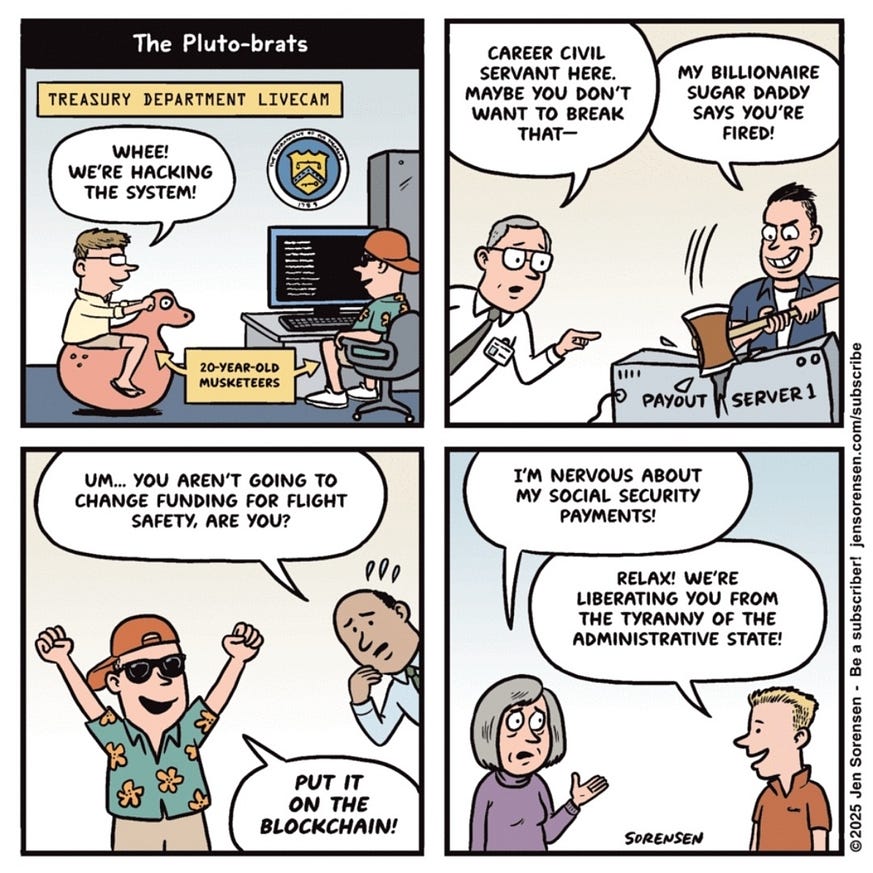
Musk’s latest attempts at accessing the personal data of three hundred and fifty million Americans are precisely for controlling their lives by leveraging their histories against them. Our choices in working for leaders we don’t like are becoming increasingly restricted to either that or homelessness and destitution. That’s not much of a choice.
If this nonsense continues, no one will be free to do anything without his oversight and the oversight of a fascist oligarchy.

 thotbag