Sadly, the real question is the one you’re avoiding.
The real question is the question you have flipped around because you’re too afraid to face it.
The real question is a reversal of the deflection you have concocted to protect the lie you live by.
The real question is: What makes the bible believable for you?
The talking snake or the talking donkey? How is love expressed through mass murder? How can one’s female children be chattel to be sold? Talking bushes? Magic?
What in any of that is believable or moral to you?
Do you sincerely believe that animals from around the world travelled thousands of kilometres to sit peacefully, predators and prey alike, in a small boat for months while the entire globe was flooded and most of life was wiped out?
Do you believe an entire species born of two people who bear male children can magically fill the Earth with enough children to fill the globe?
Can an entire sea be temporarily parted to make way for peasants to cross on foot? Perhaps you’re one of those who think the moon can be chopped in half and reconstituted? (No? Different book, eh?)
Can a person be swallowed by a massive fish and live inside its belly with all the abdominal acids for three days without any ill effects?
Can people indeed be brought back from the dead? Can water truly be converted into wine? Can rocks be transformed into bread? Did people live for almost one thousand years? Was an entire river converted into blood? Do cherubs and demons genuinely exist? Can people be transformed into pillars of salt?
What exactly do you find believable within the bible?
This post is a response to a question posed in its complete format: “As there is no evidence that consciousness emerged from unconscious matter, then who created consciousness, according to atheists?”
The people you should be asking this question are not atheists but specialists who have expertise in this subject.
Atheists understand that one of the most glaring fundamental flaws in the believer mentality is that you expect knowledge to be a one-stop shopping process where you don’t consult authorities who specialize in a knowledge domain.
Believers like yourself behave as if your knowledge authorities are shopping centres of expertise.
This is why you look to your priest, minister, or religious leader to answer all the big questions in life, even though they have no clue what the correct answers are. Most of them pull nonsense out of thin air, and you lap it up like it were gospel. This is why so many of you struggle with a simple definition of disbelief for atheism.
That’s why you struggle with mastering simple tasks like knowing how to get real answers to your questions.
It is this kind of intellectual laziness that destroys your critical thinking skills.
For example, you pose questions like these as if they’re effective “gotcha questions” that can score you a win against your theological enemies.
You don’t care to understand the answer because you’re more interested in embarrassing atheists so that you walk around like a cock on a block and brag to your insular friends.
It’s pretty sad because the simplest way to address your nonsense question is to ask how you think any “who” is involved in the answer or even matters in considering an answer.
You presume a “who” is involved without any justification beyond the conditioning you have been subjected to daily since first learning how to say “momma.”
No one but you claims consciousness emerged from unconscious matter because you don’t bother to educate yourself on what humanity has learned about consciousness, what it is or how little we know about it. You don’t have the slightest clue how little you know about consciousness, but you behave as if your pat answer of a “who” is your secret weapon to put atheists in their subordinate place.
That’s just sad.
I doubt you even understand that what you have concocted is a straw argument. You create a fiction in your mind of what you think atheists believe about consciousness. You behave as if being an atheist magically imbues a person with knowledge in the scientific domains of biology, neurology, physics, and psychology — to name only a few that have explored the subject of consciousness.
You make this grotesque mistake in judgment because you have been taught to believe the magic words “God did it” answers every important question in life.
That’s just sad, annoying, and frustrating when believer after believer repeats the same nonsense daily by the dozen on every social media site.
Because of that, we know you don’t care about learning, much less understanding the numerous answers to your oversimplified question. You don’t realize that your simple question hides many questions you have no real answers to beyond “God did it.”
For example, you can’t identify or define what you mean by “unconscious matter,” but it’s clear from your wording that you’re thinking about something as simple as a rock. In your mind, the difference between a rock and a thinking being is magic. Forget about prions or viruses that behave like living creatures but aren’t.
You expect atheists to answer your question with humming and hawing that you can interpret as a win in the same way that MAGAts get off on “stickin’ it to the libs.”
If you cared about the concept you invoked, your question would be more specific and up-to-date with what science has discovered.
You would be asking not atheists but a mycologist about consciousness in mushrooms and fungus. You would be fascinated with how trees can talk to each other, and you would be respectful enough of the people you ask your questions, not assuming every atheist you encounter has knowledge and expertise in these fields.
The simple answer to your simplistic question is that there is no “who” beyond the wishful thinking of a childlike mind.
The existence of consciousness is accepted as a fact, but we don’t know what it is, how it exists, nor even the limits or range of forms in which it exists.
This post is a response to a question posed in its complete format: “Why do scientists believe that the universe and the Big Bang can come from absolutely nothing but find it so hard to believe in the Holy Spirit?”
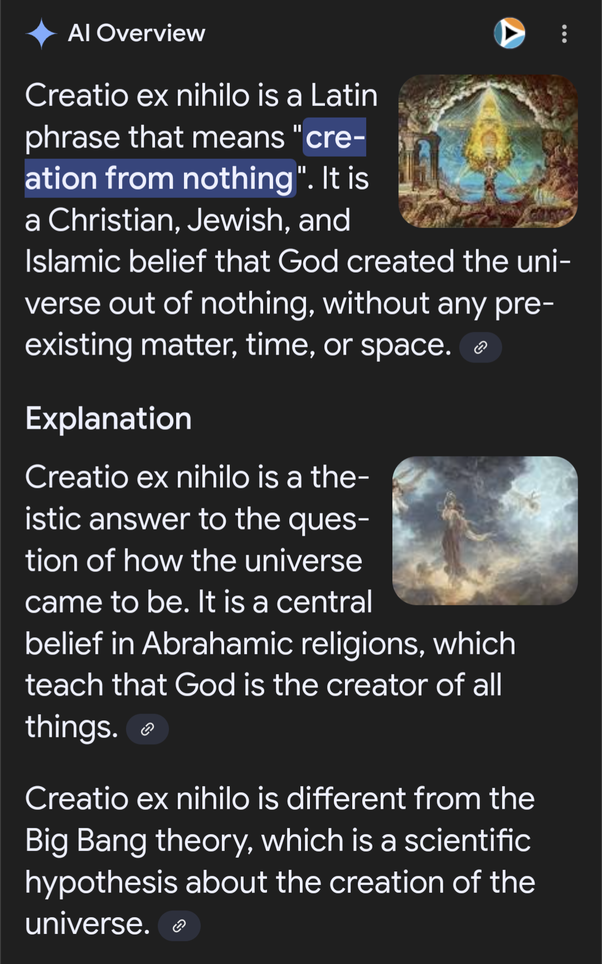
Creatio ex nihilo
This is a Latin phrase which means “creation from nothing.”
It is a phrase used in all three Abrahamic religions. The idea of something from nothing comes from the Jewish, Christian, and Islamic religions, not from science.
Scientists don’t claim something came from nothing. Your religion makes that claim.
Instead of learning about your religion, you invent nonsense derived from your religion and concoct fiction about a discipline you choose to remain ignorant of while using your fiction as justification for smearing what you have made no effort to learn anything about.
Don’t you think that’s a bit convoluted?
It’s referred to as a straw argument.
Your straw is a religious phrase you attribute to science, and then you use that false attribution as justification for fraudulent criticism. You imply hypocrisy in science while embodying hypocrisy in your question.
If this were a behaviour that rarely occurred, it would be easy to overlook. Instead, the hypocrisy you have demonstrated occurs so often that it’s almost a surprise when a question by a believer to atheists isn’t hypocritical.
Where does one find a “Holy Spirit” buried under so much hypocrisy from religious folks?
My memories of church doctrine don’t seem to include hypocrisy as an attribute of the Holy Ghost. Perhaps I missed that while my eyes rolled back up into their sockets as my head began thumping from all the mind-numbing nonsense I was being exposed to.
It could be my knees getting sore from the padded board while I wondered when I could sit back in my seat.
At any rate, I always found myself more interested in learning about scientific concepts because they made sense. I felt like my imagination was lit up when learning something tangible, while my mind felt dulled into a stupor every time I felt forced to endure the mind-numbing religious patter.
I never understood why people would prefer being lulled into a stupor to stimulating their imagination. I used to chalk that up as a subjective preference indicating benign differences between people.
I have come to realize, however, that the incuriosity of people who prefer to wallow in fiction rather than choose to stimulate their imaginations with knowledge indicates a tremendous gulf which creates problems in society.
Dialogues online with religious people rather than in person seem to provide greater freedom in exploring those differences in thinking, so perhaps you can address in more personal terms why it is that you don’t know your doctrine and believe the doctrine you don’t know but have heard it somewhere is a product of science.
Aren’t you in the least embarrassed to realize you have admitted to being ignorant of both science and the religion you seem to want to be associated with?
How does one go through life pretending they are devoted to this thing called religion but remain so ignorant of it at the same time?
I’m sure your first instinct is to dismiss these words as “fake news,” so I’ve included an AI summary to help you cope with how you have just humiliated yourself in a way not unlike peeing in your pants in public.
This post is a response to a question posed in its complete format: “Dear Atheists, do you think its better to have faith, or no faith?”
Believers should learn to understand how various forms of faith exist that don’t require you to check your brain out of service to maintain them.
For example, one can have faith in all the other drivers on the road to mostly observe the rules of the road.
One can also have faith in the referee for your game who is sincerely interested in being objective.
One can also have faith that the person they hire for a job sincerely wants to succeed and contribute to your success.
None of these forms of faith are guarantees against misjudgment but are optimistic expectations that will generally pan out positively. The odds of a negative outcome are far fewer than a positive outcome.
These are forms of faith based on an awareness of the world and an objective understanding of how people generally behave.
We know there are outliers and sometimes disappointments, but for the most part, one’s faith in these conditions is met with positive results.
This is a justifiable form of faith.
What is not a justifiable form of faith that essentially amounts to wallowing in self-serving delusion is believing in the existence of a human-like entity endowed with magical powers seen nowhere else in the universe… particularly when assuming such an omnipotent being of galactic proportions will intervene in the life of something less than a speck of bacteria to it… and most especially in matters of convenience like one’s favourite team winning a ballgame or a parking spot opening up in a timely manner.
Otherwise, it is much better to have enough faith in oneself to ignore the naysayers in one’s life than not because one will never have any hope of realizing one’s goals or dreams without it.
This post is a response to a question posed in its complete format: “What question/s and their answer/s best discern a true patriot from a fake one?”
This question is problematic on several levels because a “true patriot” is essentially a subjective assessment until one’s actions are identified as universally consistent within a broad recognition of patriotism.
For example, Mike Pence could have been easily viewed as a traitor while serving alongside Donald Trump, but he proved otherwise with his final official act in office as a VP.
Luigi Mangione can be viewed as someone who has betrayed the social contract by extinguishing another’s life. Still, he can also be considered as paying the ultimate price to protect the lives of countless thousands within a dysfunctional system that preys upon people while victimizing them for profit. Few actions are more patriotic than sacrificing one’s life to end corruption. Whether that’s considered patriotic is a matter for history to pass judgment.
The same applies to Edward Snowden, Julian Assange, Joe Darby, Karen Silkwood, Daniel Ellsberg, Frank Serpico, Chelsea Manning, and a panoply of whistleblowers throughout history.
Patriotism is far too nuanced to identify within a survey methodology. People are not static objects. People’s actions do not align directly within predictable margins, fitting generic descriptions of subjectively defined concepts that evolve as society changes.
A question as simple as “Do you love your country?” is quickly answered through deception, malicious intent or naively justified expedience. A person can believe they do love their country while acting in a treasonous way. Conversely, a person can be perceived as hating their country and acting supremely patriotic by sacrificing their life to protect it.
Adding further complications to this question is that communication is a nuanced process. At the same time, the more subjective the concepts that any survey attempts to address, the less effective the multiple-choice answers are.
Adding another level of complexity to the mix is the notion of “true” as a qualifier for suggesting patriotism is a binary state. Where is the distinction between “true” and “not true?” Is “not true” the equivalent of “false,” or can there be states of patriotism between “true” and “false?” I think I’ve already identified some of those intermediary states above.
I don’t believe any specific question or answer can identify some nebulous standard for a largely subjective state of mind that can change according to circumstances.
Ultimately, the only way to know is if the person in question can appreciate and value the social contract such that it’s the highest priority in their mind when considering political positions because it indicates a community perspective over a narcissistic one. That’s not information one can determine through a survey approach.
This post is a response to a question posed in its complete format: “How can we determine the truth about the existence of God? Should we rely on the beliefs of atheists or believers?”
This question is heartbreaking.
There is not a single thing in your life that you struggle with determining whether that thing exists other than your desire to believe what other humans have told you is true.
No other human has ever had to tell you the sun exists. You can quickly determine that for yourself. No other human has ever had to tell you mountains exist. You can quickly determine that for yourself. No other human has ever had to tell you oceans exist. You can quickly determine that for yourself. No other human has ever had to tell you cold viruses exist. You can quickly determine that for yourself. No other human has ever had to tell you snow exists. You can quickly determine that for yourself.
Nothing other than supernatural nonsense puts you into a quandary of wondering whether it exists or not.
You might wish to believe ghosts exist but will never see or experience tangible evidence to support any belief because no evidence exists. The same applies to goblins, leprechauns, fairies, angels, demons, the Easter Bunny, and Santa Claus. All of these imaginary beings are products of fiction, in which you will never experience a real-life manifestation of any of them.
It’s not that no one has been looking — quite the contrary. Millions worldwide have been searching for evidence of these phenomena for centuries. There have been television programs for decades with teams of people equipped with the most modern technologies to help them find evidence.
Let’s contrast that against something that was theorized to exist in 1964. A particle officially referred to as the “Higgs Boson” was determined to exist by extrapolating from the evidence that showed a massive gap in our understanding that could only be explained by something the public became aware of as “The God Particle.”
It was named so, not because it bore any relationship to your magical sky daddy, but because it was difficult to find. A physicist by the name of Leon Lederman wrote a book in 1993 called “The Goddamn Particle,” which was an expression of frustration over how difficult it was to find.
Everything about physics on this scale showed that it had to exist, but it couldn’t be found.
It was finally discovered forty-eight years after theorizing that this particle must exist to explain how mass is transferred to other particles like electrons and quarks. The Large Hadron Collider in Switzerland gave us the first proof of its existence. We had no tangible evidence of its existence up until then. We did, however, have tangible evidence of its necessity to exist to explain other phenomena that could not otherwise be explained without it.
IOW, without the existence of the Higgs Boson, much of physics would have just broken down into a jumble that could not make sense, be adequately explained, or avoid being relegated to the same realms of the imagination that the supernatural exists.
Without tangible evidence of its existence, all scientific discovery was at risk of being viewed in the same terms as magic — inexplicable woo.
Physicists set out to find it according to the clues pointing to where it must exist, and that’s where it was found.
No such corollary exists with the god concept.
Nothing in the universe requires god as an answer to an unanswered question.
The only reason you and everyone else who struggles with the concept are hung up on it is that it appeals to your emotional need for the universe to make sense in a paternalistic way… in the very same way, life made sense to you as an infant in the cradle whose parents or guardians ensured you had food in your belly. Life made sense to you as an infant when your diapers were changed to keep you comfortable and warm each day.
Your yearning for God is the desire of an infant wistfully hoping the chaos of life makes sense on some level beyond your comprehension… and that may very well be the case, but it isn’t due to some magical parent who will care for you like an infant in a cradle.
Atheists have no beliefs about god, so turning to atheists to answer questions that are your responsibility to answer for yourself is a disservice to you.
Other believers will tell you what they are desperate to believe is true, while atheists will tell you they don’t believe that nonsense.
This atheist will tell you that if something like a god creature exists, it doesn’t exist in any form that any human has been capable of imagining. Our universe is too vast, alien, and too far beyond human comprehension for us to have the slightest hope of untangling its mysteries enough to know anything with any certainty.
This atheist will also say that every manifestation of god by humans is an extension of their egos and represents the epitome of delusional human arrogance.
This atheist will strongly recommend that you stop wasting your valuable intellect on pining for a cosmic super daddy of the imagination and focus it on trying to detangle the complexity of life on Earth. There is already plenty here for us to figure out on our own, wasting valuable time and effort in pining on something irrelevant to the physical reality we share.
Pinning your hopes and dreams on the existence of a Father Cosmos is an abdication of your agency. It is a way of giving up on your gift of free will that you would expect someone to dictate your life to you instead of rising to the challenge of living your own life. It is a way of running away and hiding from the freedom you have been given, which has been hard-fought and won through bloody sacrifice after sacrifice throughout history for you to benefit from.
Pinning your hopes and dreams on the existence of a magical authority is giving up on yourself and retreating into a darkness of slavery and hopelessness in an existence of oppression made worse by the fact that you would only be serving the most depraved humans on the planet who don’t care in the least about a god beyond how they weaponize that concept against you and steal your life from you to benefit themselves.
This atheist strongly encourages you to live your life for yourself and not for some fantasy peddled to you by a parasite who wants you to believe nonsense because it benefits them at your expense.
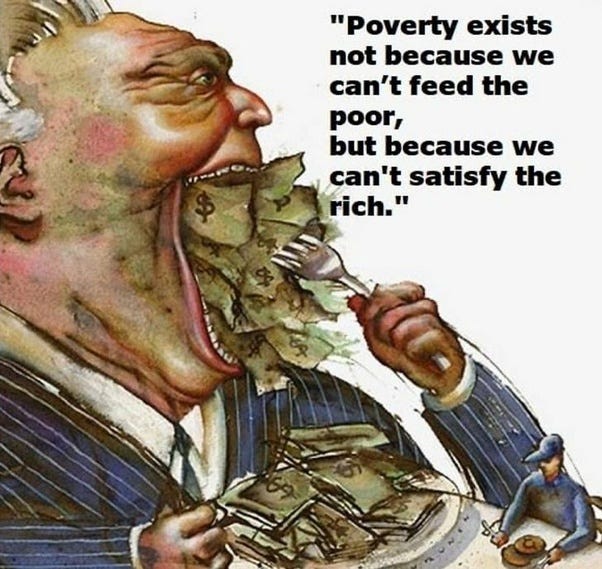
Setting aside the failings of individuals who make bad decisions and cause problems for themselves, because there is always a tiny percentage of people who need more guidance to make better decisions, the vast majority of people suffering in poverty have done everything right with their lives and are still struggling.
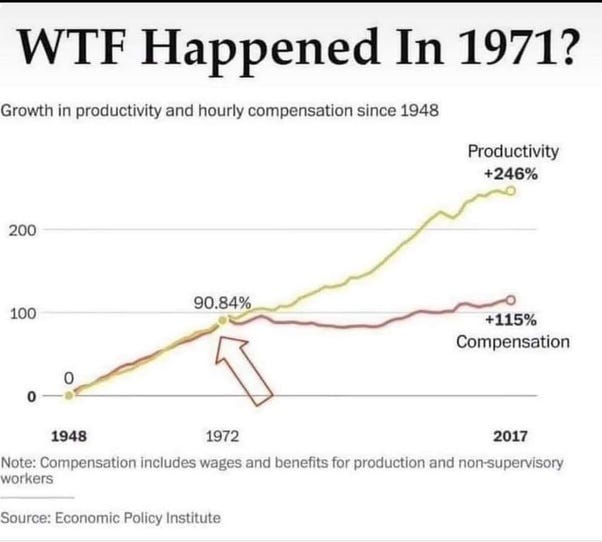
A big part of the reason why that happens is that too many people waste their time wallowing in a misanthropic belief that poverty is due to the victims of it being responsible for creating their poverty and that if they just did something different with their lives, they, too, would be among the wealthy in society.
This myth that poverty is a self-imposed sentence is precisely what the thieves in our lives want the people to believe.
This myth that poverty is a self-imposed sentence helps people to believe they won’t become victims of poverty themselves.
This myth that poverty is a self-imposed sentence overlooks how our culture is geared entirely around impoverishing the majority in favour of the sociopaths who are willing to destroy lives to achieve personal material benefit.
This myth that poverty is a self-imposed sentence is why people become poor and broke because believing this nonsense allows poverty to exist in a post-scarcity world that could easily eradicate poverty overnight — if we could only address the rampant greed corroding the social contract to be the actual cause of poverty instead of shaming the victims suffering unnecessarily in a state of poverty that would not exist if economic justice existed.
There hasn’t been a time in my life where I have not been blamed for the clients who have stiffed me after praising me for doing work they benefited from.
Try to make sense of that.
It’s precisely what Donald Trump does when he calls the contractors that worked for him losers. He put thousands of people out of business throughout his life by not paying them for doing work on his behalf, and as far as he is concerned, it’s their fault.
This question embodies a corrupt attitude that pervades society, and it is this attitude that permits poverty to exist.
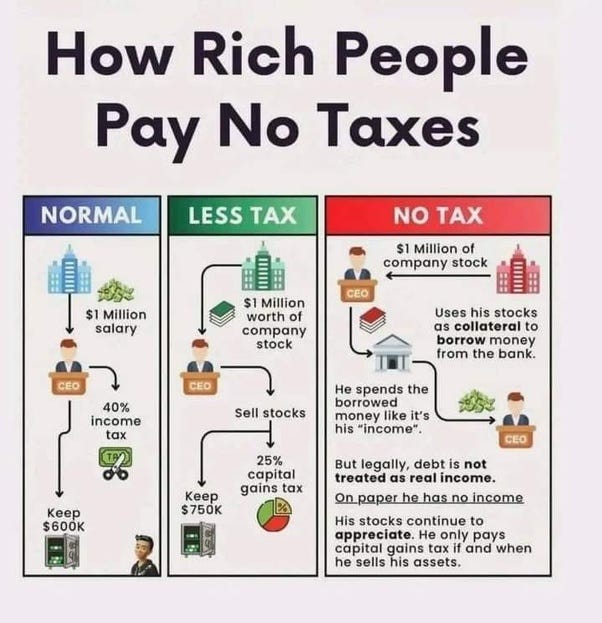
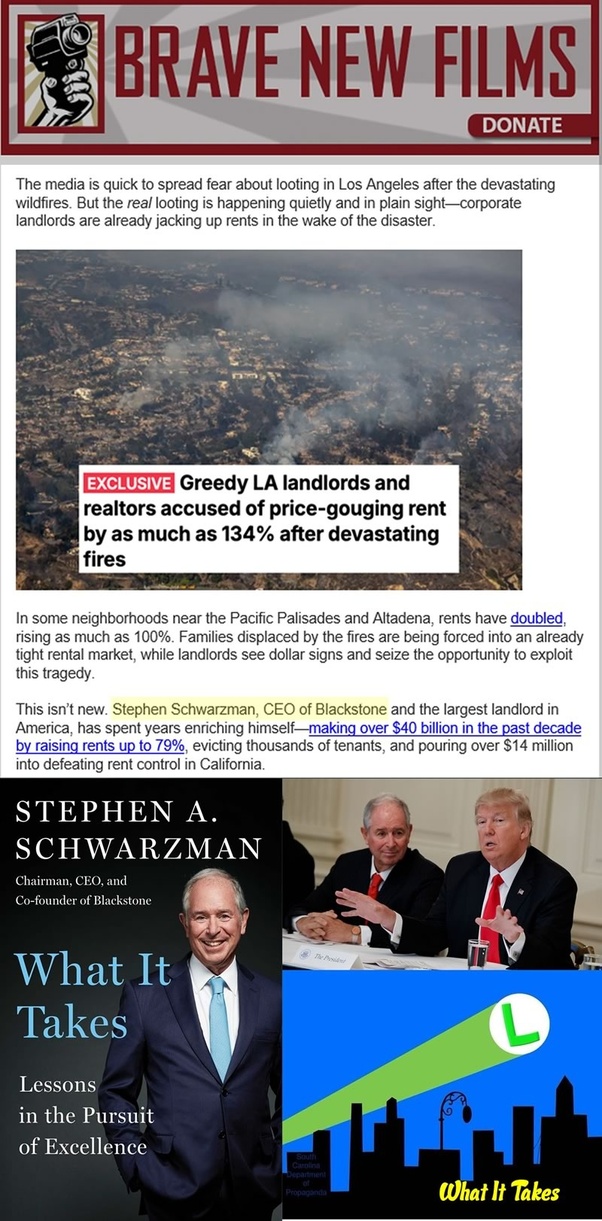
It’s the same attitude that admires how people can avoid paying taxes and envies that ability enough to want it for themselves.
This question enables the attitude of greed to characterize the rot infecting humanity and destroying human civilization because it teaches us to forget that we are all in this together.
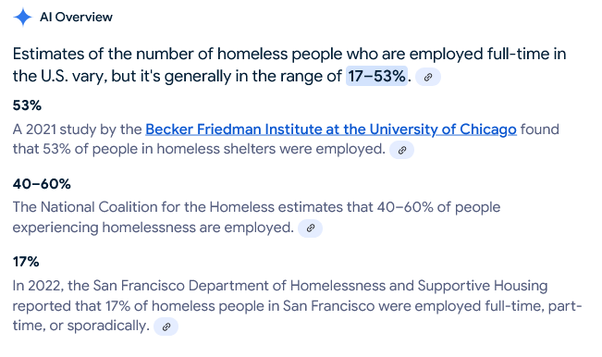
Up to about half the people who are homeless in the U.S. are working full-time jobs.
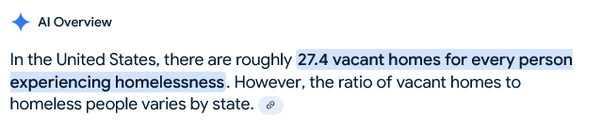
There are over 25 times more vacant homes in the U.S. than there are homeless people.
Try to make sense of that… and then get pissed off about this:
“Atheists are a group which share characteristics or interests or views in common beyond disbelief in a God creature.”
“Atheists have no morals.”
“Atheists reject or hate God or worship Satan or any fictitious creature imagined by theists.”
“Atheists believe in science.” (No one, atheist or otherwise, who understands or has a basic understanding of science “believes in” science. Science is not a matter of faith, so please stop superimposing your insular paradigm onto others.)
“Creationism is an alternative to evolution.” (Also, don’t ever call people, atheists or otherwise, “evolutionists” because that’s just plain ignorance at an incredibly ignorant level of insular stupidity.)
Other statements like “God bless you” are contingent upon an individual atheist’s perspective on the matter. (I’m okay with people expressing positive sentiments in terms they are comfortable with and interpreting them as such.)
Atheists do not, as a whole, hate theists; they want them to stay in their lane and stop pretending like their beliefs trump facts because they don’t. Freedom of religion is the freedom to believe as you wish, not the right to impose your beliefs onto others. I don’t care if you think your interpretation of your scriptures causes you to believe homosexuality is wrong; you’re not God, and you have no right to pass judgment on people for how they were born… oh, and stay out of politics or start paying taxes like everyone else does.
By the way, Jesus wasn’t white, and his views were liberal. He did not support wealth but service to his fellow humans. He was not a narcissist who cared more for himself than the poor. His life was dedicated to peace, not war, nor to becoming wealthy or superior to others. He washed the feet of lepers to show you what that means, so betraying your saviour with your idiotic divisiveness and hatred will only send you to the hell you fear (if your beliefs pan out to be confirmed).
Even worse than simply betraying your beliefs, you make life hell for others — yes, I know, not all religious types are hypocrites. Still, all religious types must call out hate-mongering hypocrites like Steven Anderson, Kenneth Copeland, Jim Bakker, and the Westboro Baptist Church, who all prey upon your fellow believers by feeding on their insecurities. Make an effort to show the world you do believe what you claim to believe by raising a humungous stink over the very many atrocities committed by supposed religious leaders. There is no bloody way any religion can have any claim on morality when the predation of minors is institutionally protected. You must clean out the corruption in your own house first before you can hypocritically claim to care about so-called “unborn babies.” All this hypocritical crap makes people justifiably hate you and everything you claim to believe in — even the innocent ones among you; and worse for you, it makes people run away from your toxicity while eviscerating your credibility in everything you claim to believe.
That should cover most of the broad strokes I can identify from the top of my head (yes, it’s true, my references were Christian because that’s what I am most familiar with, but that doesn’t mean every other form of theist fantasy gets a pass because these sentiments apply to you, too.) We are living in a world characterized by disinformation and hatemongers to disenfranchise innocent people who cannot defend themselves. At the same time, hate crimes escalate as a monstrous hypocrite profits from selling autographed bibles.
(I wrote this five years ago and have been discussing these issues throughout my entire life, and instead of seeing any improvements with your lack of integrity issues, we’re seeing an increase in the kind of hypocrisy that would send chills down the spines of your venerated saviours. It’s horrifying just how little effort religious followers put into holding their leaders accountable for the hate they spread, and you dare to pretend you have a moral high ground. It is this kind of hypocrisy that’s driving people away from you.
If you want to be legitimately viewed as a moral people, then concentrate on feeding children in your schools instead of putting up fraudulent props like your Ten Dogmatic and repetitive Commandments. Kids need nutrition to focus on school and succeed at getting an education, not orders barked at them with threats of eternal punishment. This isn’t supposed to be the dark ages any longer. Those were over 500 years ago.)
All I can say as a summary is, Thank God I live in Canada because Americans are in for one helluva wake-up call over these next four years. What truly sucks, though, is how much of a negative impact you’re going to have on the entire rest of the world as you grapple with your lack of basic human decency.
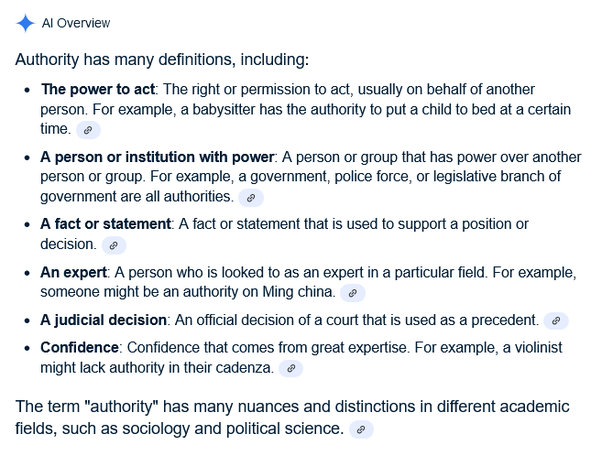
There appear to be two distinct perceptions that dominate public responses to authority.
On the one hand, an authority is an entity with the power to issue demands, impose edicts, and enforce compliance. On the other hand, an authority is a trusted entity that serves as a resource for empowering people and enabling their ambitions.
Our good friend and authoritative source of plagiarized information, AI Bot (Ayebot? iBot? EyeBot? — It needs a name so that it can be further anthropomorphized. “Gemini” seems a bit too much like impersonal woo.), provides a bit more detail:
Wikipedia has this definition, which appears to favour an interpretation based on an exercise of power:
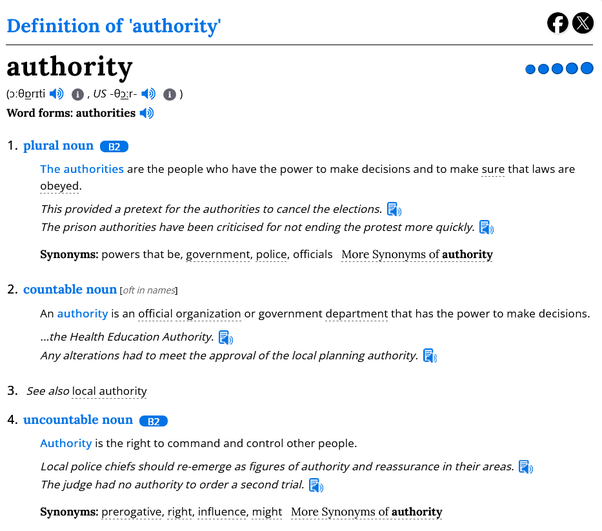
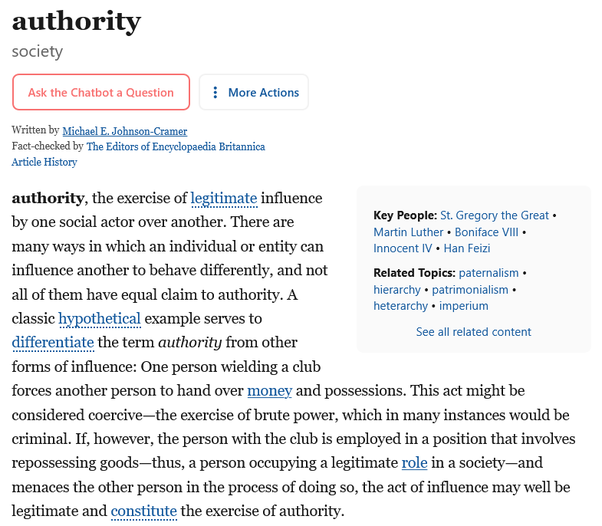
Let’s comb the world of language authorities to see how they interpret authority:
Collins has this to say about authority:
Britannica attempts a more concise definition favouring “influence” over “imposition” like Collins.
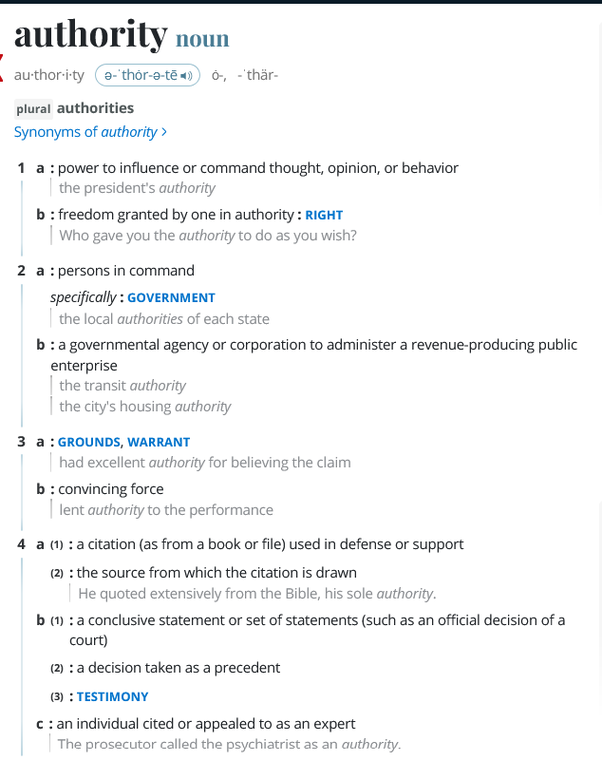
Merriam-Webster provides a more comprehensive overview of how “authority” is apprehended and implemented in society — although imposition precedes influence in its hierarchy of interpretations.
Interestingly, two of the world’s premiere language authorities place a profit premium on sharing basic definitions for words… which begs the question of the value of definitions versus profit and whether these institutions actually are authorities in realms beyond basic definitions.
Oxford at least asks for personal information to be granted access to elementary information, while Cambridge’s efforts are laughable.
These last two efforts suggest to me that their authority is entirely contingent upon reputation — part of the “old boy’s club” of authoritative prestige in the world, which essentially shuts out the plebians among us who must wrestle with “inferior language authorities.”
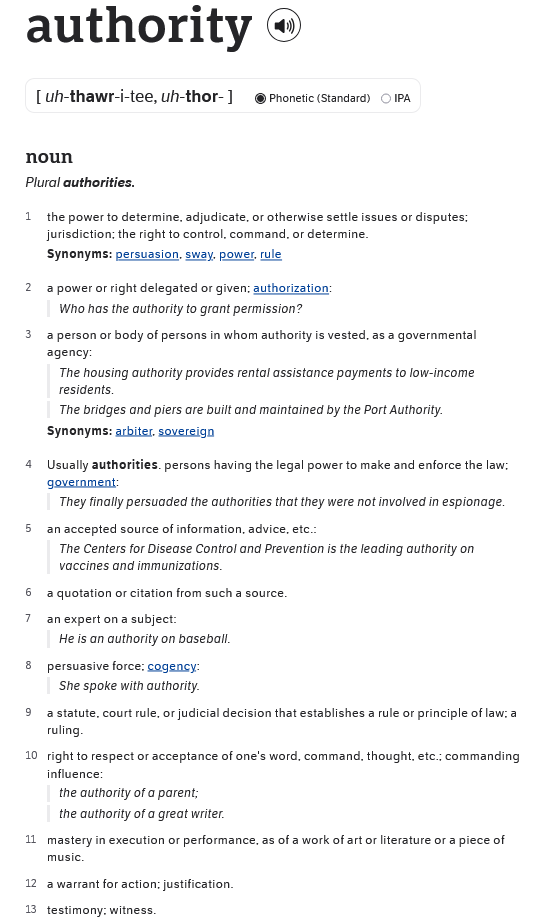
Meanwhile, freebie entity Dictionary dot com presents itself as a superior authority in marketing and business development to the two staid elements of anachronistic society above and provides an even more comprehensive set of definitions than Merriam-Webster.
This tells us that authority is actively cultivated by those who desire it and then, once achieved, is actively protected and zealously guarded beyond levels resembling reason. At the same time, newcomers overturn established authorities who fade into oblivion as the barbarians at the gates no longer storm them out of existence but supplant them through more effective forms of adapting to an ever-changing world.
In short, “authority” can be explained entirely by the dynamics of ego, power, and how much one is addicted to asserting their prominence in a chaotic world.
Interestingly, the most respected authorities throughout history have rejected the impositional form of authority flowing from within in favour of empowering the people at large by serving as a resource for enabling their assertions of personal authority within their relative spheres of influence.
For example, people still recognize the names of rare individuals who embodied humility, such as Gautama Buddha — or even a more modern instance like Nelson Mandela. Still, few outside dedicated historians can remember the many “authorities” throughout history who imposed their will upon the public. Those remembered are often anomalies serving as massive engines of destruction whose names are whispered rather than revered. Few among those whose authority was impositional in nature are remembered for their introspective wisdom, like Marcus Aurelius and Sun Tzu, but are revered for their insights in contrast to those of the conquerors like Alexander the Great or Genghis Khan, who are studied for their strategies (and often critiqued for their human failings).
For example, I predict that if humanity survives in some form resembling the humanity we know today, Jimmy Carter will be remembered with deep reverence and respect one thousand years from now. In contrast, Donald Trump will be remembered as the cautionary tale of a bull in a china shop whose lesson for humanity is the necessity of restraint and accountability.
Self-sacrifice isn’t a “gift,” it’s a responsibility and a call to action.
Self-sacrifice can occur as a parent sets aside their desires to make way for their children to achieve successes outside their reach. For example, a parent who works multiple jobs to help their child get an education that will give them a better life than they could attain has generally been regarded as a “typical” or “common form of self-sacrifice” and often considered noble.
Other forms of self-sacrifice, such as jumping on a live grenade (for an extreme and improbable example to make a point) to protect a crowd, are a requirement created by circumstances that would be unnecessary if extreme conditions were not present. This form of self-sacrifice is an artificially created necessity that could have been avoided if the motivations behind the person throwing the grenade were mitigated proactively.
This form of self-sacrifice is an instinctive form of preservation that extends beyond the limits of one’s life. It is an expression of commitment to the social contract historically responsible for elevating humanity beyond the baser instincts that drag us backwards into primitive states of existence. Over and above the preservation of one’s self, selfless preservation is performed from the exact sentiment of a parent sacrificing themselves for their child. It is an act of love in the extreme. It is an embodiment of the best of what humanity can be.
Like the child whose life is enriched by their parent’s self-sacrifice, the beneficiaries of such an act of selflessness have not received a gift to luxuriate in but an obligation to follow suit and make life better for those who come after.
This is how social evolution must progress in the face of apathy and against those who place themselves and their desires above the needs of others.
Without the capacity for self-sacrifice, the future of humanity is decay and self-destruction.
Self-sacrifice within this context is a warning that without the courage demonstrated by the few willing to alert an apathetic world of the need to take action, the conditions causing the suffering that demanded the sacrifice of one’s self will worsen and create more victims.
Self-sacrifice within this context is the canary in the coal mine warning the rest of humanity that death is on its way and alerting the people that they are facing a choice to serve a higher purpose than their fleeting whims or be sacrificed by parasitic forces as fodder for the conditions demanding their blood.
Self-sacrifice is a warning to the apathetic that if they do not rise against the threats facing them, their turn will come, and it will be far worse for them than the person sending their message of warning through their self-sacrifice.
Self-sacrifice can be defined with a simple quote: “Silence in the face of evil is itself evil.”
Here is an example of a story about a Pastor who sacrificed himself to try and stop Hitler while saving numerous lives. I’m posting it here because the space I otherwise posted seems unwilling to approve it in another answer because it’s appropriate to this question and because we are at a point where we are repeating history.
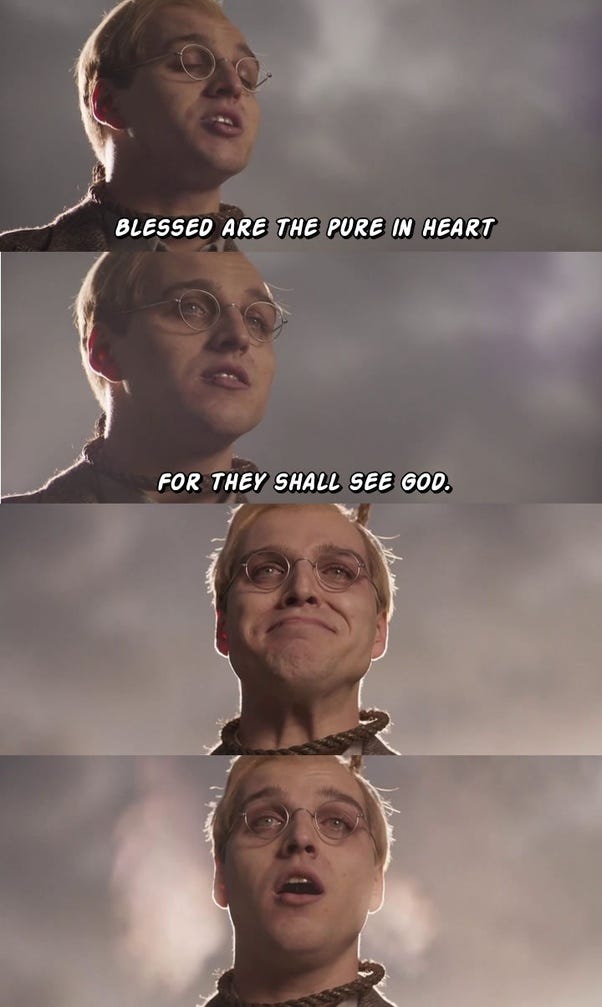
Dietrich Bonhoeffer February 1906–9 April 1945), was a German Lutheran pastor, neo-orthodox theologian and anti-Nazi dissident who was a key founding member of the Confessing Church. His writings on Christianity’s role in the secular world have become widely influential; his 1937 book The Cost of Discipleship is described as a modern classic.[1] Apart from his theological writings, Bonhoeffer was known for his staunch resistance to the Nazi dictatorship, including vocal opposition to Adolf Hitler’s euthanasia program and genocidal persecution of Jews.[2] He was arrested in April 1943 by the Gestapo and imprisoned at Tegel Prison for 1½ years. Later, he was transferred to Flossenbürg concentration camp.
Bonhoeffer was accused of being associated with the 20 July plot to assassinate Hitler and was tried along with other accused plotters, including former members of the Abwehr (the German Military Intelligence Office). He was hanged on 9 April 1945 during the collapse of the Nazi regime.


















 thotbag