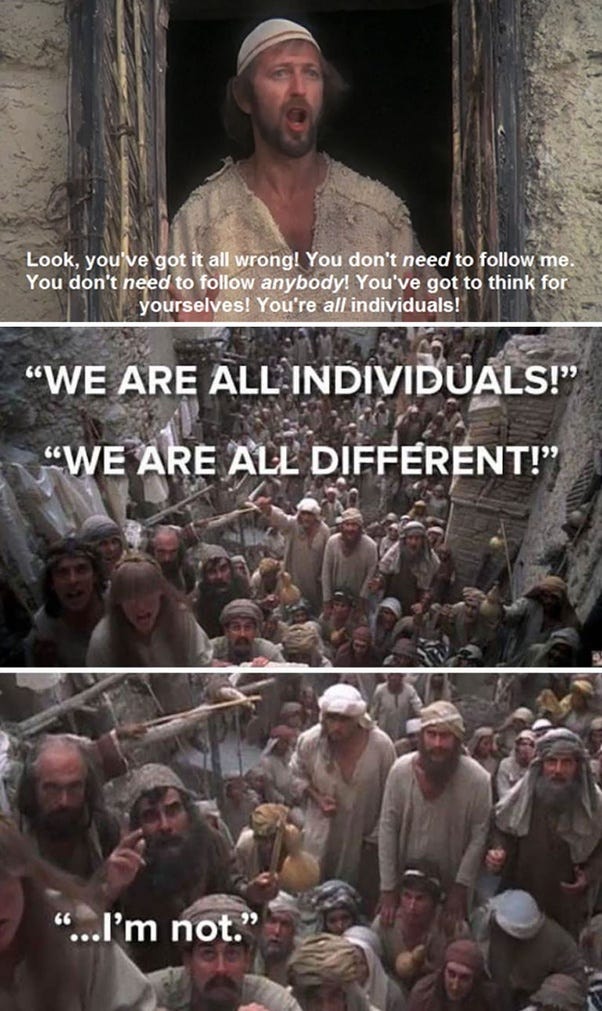
How do you know if you are right and others are wrong?

This post is a response to a question initially posed on Quora, and can also be accessed via “https://www.quora.com/How-do-you-know-if-you-are-right-and-others-are-wrong/answer/Antonio-Amaral-1

The first place to start is to give up the notion that being “right” or “wrong” matters more than being accurate, informed, and knowledgeable.

“Right” and “wrong” are egotistical expressions that either stroke one’s sense of self or dismantle one’s self-confidence. Neither is helpful to oneself, others, or the issues at play.

As I often find myself checking out profiles to gain context into the querent’s mind, I did so with yours and am pleased to discover that you’re already on the right track.

Fundamentally, we’re all fumbling about in the dark and clueless, even about things we think we know. The worst thing we can do is believe we are “right” because that perspective contributes nothing to one’s growth and kills one’s ability to explore beyond that point.

No matter how “right” we might feel about something or how complete we think our knowledge of something, there is always something to learn about it that will be new to us. There is always a different perspective on that thing that we have not yet encountered.

If we could all adopt the perspective of being clueless, our world would experience far fewer conflicts because people would be more open to the perspectives of others.

Unfortunately, we live in a world built upon the foundation of exploiting insecurity at all levels throughout society — whether selling hair products or climbing corporate ladders. Insecurity has been weaponized as a tool of manipulation for personal gain over and above benefiting society as a whole.

We have never been more fortunate than we are today when confronted by the limits of our knowledge and understanding. Solving the problem of being unsure about one’s position means simply whipping out one’s means of accessing a comprehensive knowledge base to conduct basic research to verify if one’s position contradicts facts.

There is no real point in engaging with others to determine if one’s compass setting on knowledge is on true north by triangulating it with the settings of others because one is just engaging in an egotistical fencing match at that point. Online “debates” are often more about egotistical masturbation than they are about deriving an objective apprehension of issues to determine pragmatic resolutions.

Sharing information obtained through research efforts is far more rewarding and less prone to conflict over subjectively defined notions of being “right” or “wrong.”

One can still certainly derive flawed conclusions on matters, but that’s also a function of incomplete information that may be deemed “wrong.” Adding to one’s information base is less about determining “right” or “wrong” and more about ensuring the completeness of knowledge in a subject domain.

Knowing the difference in a dynamic with someone else on this level is essentially determined by whether or not the critic of one’s knowledge adds to one’s information base or disparages one’s person as a reaction to the information conveyed.

To directly answer your question, after all the verbiage I packed into this long-winded answer, is that you will know by the content of your critics’ arguments.

You can always deem yourself “not wrong” if the other party adds nothing to your position. If they can add valuable information to expand your knowledge base, you can still consider yourself “not wrong” while learning to be “more right” by their contribution.

This is how you can preserve your superior perspective of evolved humility by remaining confident in being clueless.

Congratulations on achieving a higher level of awareness than most of us monkeys ever attain throughout our very challenging lives.

Cheerios.
Why do federal government employees keep their lack of belief to themselves?

Another way to word this question would be, “Why do people not share the nothing they have to share?

How does that work out for you?

It sounds kind of silly, doesn’t it?

It probably makes no sense to you that it’s your question in different words. That would be because you don’t understand how atheism is literally nothing.

Atheism is the disbelief of the claim that “God exists” or “God is real.”

This atheist is perfectly happy if you’re happy believing whatever it is that you believe — anything which helps you live your life peacefully and productively is positive.

There is no need to hear how or why that belief works for you because it’s your belief, and no one would truly understand how or why that belief works for you. Even other believers who hold beliefs similar to yours would have their reasons and find unique benefits to their beliefs that will differ on some levels, even if they appear the same on others.

Humans are all unique, no matter how alike they may be. That’s the function of individual perception and cognitive features of life, such as an ego.

Good for you. You’re happy.

That’s all this atheist cares about.

The details you may want to share are generally too alien for me to appreciate, so your efforts merely contribute to a divide between us rather than building a bridge.

The reason for that is when people share their beliefs, they’re also sharing their insecurities with those beliefs, and sharing is a way of harvesting validation.

By sharing your beliefs, you are merely showing this atheist that you don’t really believe what you claimed to believe while demonstrating an expectation of me adopting a paternalistic response, patting you on the head, and telling you what a good person you are.

I would have already assumed that about you before you began speaking. This atheist prefers to think of people as good by default until they prove otherwise.

Starting with a cynical form of misanthropy is just an unhealthy way to live.

At any rate, if you were to ask me what I believe, I would have to choose from among a gazillion slides running through my mind to pick one and talk about that one microscopic portion of what comprises things I believe and why I believe what I believe. I would have to do that because most such questions don’t seek in-depth insight but a soundbite answer like, “Yep. It sure is a nice day today.

That’s not a discussion about beliefs. That’s just chit-chat — small talk.

Serious discussions about beliefs should last hours at minimum, or they’re not serious discussions about beliefs. They’re idle chatter and empty noise to fill silent moments that often make many uncomfortable.

Silence can be far more golden when simply sharing space with someone without requiring temperature checks to ensure no overheating is occurring underneath one’s notice.

At any rate, disbelief in a god creature is nothing by contrast to something that comprises an affirmative belief in the existence of a god creature.

That’s what makes your question appear silly.

What is the point of telling people one lacks belief in a god creature, particularly when so many believers find that so offensive they spend all of their free time demonizing non-believers?

This atheist sees no value in telling people things in person that would add stress to their day.

I’m okay with openly expressing my views online because no one’s day is interrupted by my words. People choose to read them.

Topping matters off to make your question appear even more silly is that a government employee is responsible for serving all citizens, regardless of their faith or beliefs. If they were to share their personal beliefs openly, they would inevitably offend someone.

I am sure you are well aware of the bloody conflicts that have been occurring non-stop around the world for centuries between people of different belief systems. For a government employee to openly share their beliefs with the random people they serve would be doing a disservice in general to the public they are supposed to be serving as a representative of a nation with a secular umbrella welcoming all faiths.

This all boils down to the fact that no one is trying to keep anything away from anyone as a government employee. They are performing their duties as expected by not imposing their views on others.

Government employees who step outside their role as representatives of a government that welcomes and protects all beliefs are being derelict in their duties and should get fired for doing so.

Some even face legal battles for insisting their beliefs dictate how they are to perform their duties, and that is how it all should be for people who want to live free.

Why are there so many degenerates in this world who lack a moral compass?

This post is a response to a question posed in its full format as follows: “Why are there so many degenerates in this world that lack a moral compass, namely in 1st world countries where most learn this by the family that raised them, school, sports, being in public, etc?”

The problem with this question is that it’s impossible to construct an objective answer to address its core concern. This question is more of an emotionally driven complaint than a question.

The reason is that it’s built upon subjectively defined presumptions like “degenerate” and “morality.” Neither of these concepts has any objective metric to identify differing degrees of degeneration or morality between any two random people.

Adding to the subjective complexity, universally accepted standards for the definitions of these terms do not exist.

What can be deemed “degenerate” to one person is celebratory to another. What is viewed as “morality” to one person is heinous to another.

Making matters even more complicated is that a word like “degenerate” constitutes a value judgment. Regarding its use, what that person views as “degenerate” is already a visceral rejection of the object of their judgment. There is no wiggle room for the interpretation of an individual’s value. No description of the specifics of the behaviour in question leads to the value judgment of “degenerate” because “lacking a moral compass” is just as subjective a judgment as “degenerate.”

This question is an example of circular reasoning permitting no room for objective examination nor any means by which one can identify alternative conclusions to the objects of such visceral criticism.

The only way to address this question is to search one’s memories for emotional reactions one may have had that can dredge up conclusions about different experiences one can align with the question based on a similar degree of emotional intensity governing one’s biased findings.

This style of generic language relies upon the subjectively defined feelings of others to function more like a dog whistle than a critical analysis of the issues in question.

This kind of “loose language” is a breeding ground for bigotry to evolve in a landscape characterized by pure emotion and which lacks grounding in any shared physical reality.

For example, if someone were to mug someone else and witnesses talked about the event while sharing similar emotions and a similar view of the event in question, they could quickly dredge up a similar degree of emotional intensity to this question. Their views would be predicated upon a shared experience, while their particular reactions to the event would be grounded in a shared physical reality.

In the case of this question, that shared reality exists only within the realm of individual imagination and dredged-up memories of different events. Here’s a generic dialogue of an imaginary sharing of emotional intensity to highlight this dynamic:

First Person: “I was supremely pissed at this one thing this one person did. Be as angry as I am about this thing you didn’t experience.”

Second Person: “I didn’t experience what you experienced but let me tell you, I also got supremely pissed about this other thing that you didn’t experience, but because we’re both supremely pissed, we share a common ground of agreement.”

First Person: “So, you agree that we both have good reason to be supremely pissed to the point of sharing a mutual hatred for something?”

Second Person: “Yes. We both hate something very much.”

First Person: “What do we hate together?”

Second Person: “How about that thing over there? It’s pissing me off right now that I’m in a sour mood.”

First Person: “I agree. Let’s both hate that thing. That way, we can forget what we hated separately and find camaraderie in a shared hatred for something else.”

This dynamic is how bigotry spreads throughout a population to function like a transmissible disease.

This is why language choices are crucial for objectively apprehending the realities we react to.

Allowing another person’s subjective responses to dictate one’s attitudes toward a subject abdicates their free will and subordinates their opinions to whoever demonstrates the most significant force of personality.

This is the process by which identity politics emerges.

This is precisely the dynamic that Donald Trump has built his political collateral upon.

It is a means by which critical thinking is killed, and people like Rupert Murdoch capitalize on it as a vehicle for personal enrichment at the expense of the social contract.

This is why we have “so many degenerates in this world who lack a moral compass.”

Do atheists believe in fate, good and evil, or alien life?

This post is a response to a question posed in its full format as follows: “Do atheists believe in fate, good and evil, or some other supernatural beliefs? Like do some atheist believe in alien life?”

This question embodies the problem with the notion of belief among believers.

Believers often need help understanding the difference between knowledge and belief. Blurring the distinction between two different but similar concepts makes it challenging for them to adopt a third option between their binary perspective on life.

To a believer, one either believes or does not believe.

Knowledge isn’t even a factor in their perceptions because knowing, to them, is just another form of belief. Belief supersedes knowing because one cannot know if their prayers are being heard by a “Father Cosmos,” so they must have faith that he is listening. This places an undue burden on the concept of belief that breaks its meaning in their minds.

They have no choice but to relegate knowledge to a subordinate relationship with belief because belief is everything to a believer.

Ironically, they have no problem with aspects of belief that require little to no consideration, such as “suspension of disbelief” because that occurs autonomically while engrossed in an entertaining fiction, as does “disbelief” when it applies to every belief system that isn’t theirs.

The notion of belief being subordinate to knowledge is like heresy, which induces a fear of straying, resulting in an eternal punishment for failing to adhere to their faith. This is why they often suffer crises of faith due to excessive cognitive dissonance.

The seemingly fearless attitude of atheists placing knowledge above belief attracts believers’ attention to notions of non-belief, like a moth to a flame. Since they fear eternal retribution for disbelief, they view atheists roaming around free to live their lives in terms not too dissimilar from how many people view a convicted felon roaming about freely to campaign for one of the most influential roles on the planet. It’s like witnessing a horrible accident. One would prefer to avert their gaze but cannot as they stand transfixed over the intense drama playing out for their unwilling minds to process.

The cognitive dissonance this generates explains the obsessions believers demonstrate over atheism every day on social media.

We see in this question how they fabricate presumptions about atheists that fit within their cognitive boxes of belief determination.

They cannot think beyond their belief paradigm to interpret reality beyond a binary state. One must either believe something or reject believing something. The meaning behind the concept of disbelief itself is lost on them. It’s like interpreting absence as a form of invisible presence.

To address the presumptions of belief in this question and many like it, one either presents a dismissive response like they would with a persistent child that fails to comprehend nuance but requires something of an answer to quell their curiosity or one burns through several boxes of crayons to bring them up to speed on basic concepts that will fly past their perceptions to leave them even more confused than before answering their questions.

This is the rub with knowledge.

Every question answered that contributes to our overall understanding of ourselves, others, and the universe we inhabit generates dozens of additional questions we never realized were questions before getting that answer we thought we wanted but sometimes regret getting.

To address the basic but flawed presumptions within the questions above, one must judiciously parse the information in ways that ignore large parts of what is implied within the question and attempt to focus on constructing a simplified answer they will understand, just like one does with a child.

For example, “Atheists don’t “believe in” alien life. Atheists know the universe is vast beyond belief, and the existence of life on this planet within a Brobdingnagian (I love this word) ocean of countless planets means the odds are beyond simply excellent that life has emerged elsewhere. We have been getting new evidence supporting that conclusion, such as the discovery of RNA embedded in spacefaring meteorites we’ve examined.”

All RNA and DNA Base Types Are Found in Meteorites, Study Claims

This answer won’t be interpreted as stated, though. It will be construed as “Atheists believe in alien life.”

The same applies to concepts like “good” and “evil”. We can explain and re-explain repeatedly until the proverbial cows come home that “good” and “evil” are subjective concepts requiring context for meaning. However, their interpretations of these concepts are apprehended as objectively as one would a physical cow within their field of vision.

“Supernatural beliefs” are also subjective constructs that we can explain “exist outside of nature” because that’s what “supernatural” literally means — “beyond nature.” To accept subjectively defined notions as true, one requires belief, and that’s why one interprets these concepts in terms equivalent to knowledge.

To “believe in fate” is to subordinate one’s knowledge derived from empirical experience through an objective lens to a subjective interpretation functioning like a soothing narrative rather than a concrete mystery to resolve. This dilution of one’s senses is essentially the core of the threat to human thinking that religion poses to humanity and that limits our potential as a species.

Is it okay to tell your religious family that you have atheist views?

Chances are excellent that if you have to ask strangers online, you’re already concerned about their reactions.

That should be a huge red flag, especially after reading some of the horror stories in the answers already given.

Your parents have spent a lifetime being who they are and believing what they do.

Their vision for having children was miniature versions of themselves who they could accept may take a different path than they took for themselves but would at least hold the same values they do.

As you may have noticed, religious beliefs are not like most other beliefs people have about different things in life.

Religious beliefs are personal identities, group associations, and a support structure where opportunities in life are found.

They will view their religious beliefs as a prescription for success in life and a symbol of unity within their family. All their children sharing in their beliefs means they will have become successful parents who have given their children their best chances at leading a happy and rewarding life like they feel religion has done for them.

Rejecting their religious beliefs will be interpreted as a rejection of their parenting.

It may not make sense to think of religious beliefs you don’t share on this level in that way. The reactions you will get from them if you insist on having them see you on a different path to self-development, self-discovery, and self-discipline than they took will show you what a wedge in your relationship will feel like.

They may initially show some acceptance because they love you more than their adherence to their beliefs, but that acceptance will grow into a distance between you.

You will eventually discover their open embrace of you, and your accomplishments will be responded to with increasing disinterest.

During periods of conflict, they may claim they no longer understand you and will blame your straying from their beliefs as the cause. They will look for scapegoats to blame and begin criticizing your choice of friends, the school you attend, or the video games you play.

Anything they can use to justify how you are not choosing to betray them willingly, they will weaponize during open conflicts you might have. If you have never experienced open conflicts with them before, you likely will afterwards.

To answer your question directly, it’s okay to be who you are, and it’s even recommended in a world where you will spend your entire life fighting to preserve who you believe yourself to be, but you will have to learn to pick your battles in life, and some are just not worth fighting.

Eroding one of the most important relationships you will ever have is not a battle anyone should take lightly, particularly in a world where a whopping majority (70%-80%) of families are dysfunctional. Suppose you have a happy family life as it currently stands. In that case, you might want to accept how that’s already a treasure beyond what most experience. It may not be worth giving that up to have them accept what you believe in yourself because your assertion could very well end up in your rejection.

You can certainly continue to question your views on religious beliefs, and you should continue to do that for the rest of your life because that’s how you will grow as a person. Understand, though, that it is always a personal journey one takes. As much as one would like to share every intimate detail of that journey with others, it’s impossible with almost every other person one will encounter.

Your personal development journey will always be your journey. The rest of everything you encounter will be about how to get along with the people in your life so that your life isn’t made any more complicated than it already is or will be.

Good luck with your journey through this nuthouse.

Why does morality exist independently of human opinion?

Why does morality exist independently of human opinion?

This post is a response to the question posted on Quora as written above.

Morality IS “human opinion.”

Many differences exist between opinions on morality and on practically everything else people have opinions on — which makes opinions on morality somewhat unique in how they are perceived.

People generally do not equate a moral opinion on murder, for example, with an opinion on a fashion accessory.

Part of the problem is that it is the cultivated opinions of religious folk to believe morality is an objectively established standard of conduct determined by an invisible authority. If the claim of objective jurisdiction to develop and institute a moral framework existed, morality would essentially be identical and unchanging over time. That’s not the case for anyone who has made even a tiny effort to understand people or human history.

The most significant problem with establishing a universal acceptance of a moral opinion is that no one ever receives direct confirmation from an unassailable authority governing judgment over any specific behaviour. Complicating matters further are the subjectively supported morals of believers who do not share a consistent moral framework — even though religious institutions do their best to homogenize morality among their flocks.

Institutions that once endorsed slavery and have moved on to repudiating it cannot, without justified criticisms, claim to receive their moral framework from an omniscient entity.

This and all the many other changes made to institutional policies regarding morality throughout the centuries have eroded religious claims of authority in moral matters. Making things worse for them has been allowing their credibility to be assaulted by many heinous scandals, such as the institutional endorsements for victimizing countless children through sexual predation and murder and the subsequent protections of institutional leaders guilty of immoral actions.

We, as a species and as a collection of diverse societies, all governed to some degree by the notion of morality, have undergone a tremendous number of and severity of degree in the assaults on our definitions for what constitutes morality that we are struggling to unify a fractured vision of the concept.

We can no longer trust our authorities, be they religious, political, industrial, or familial, which puts us in a quandary for resolving our moral differences as a species.

The upside is that we are turning inward to identify our internal sources of moral development.

Morality is most simply defined as an extension of empathy, but the issues it encompasses make that an oversimplification. At best, empathy is merely a compass guiding actions that many hope serve to achieve moral outcomes. Some will define morality within a self-serving context, while others consider self-sacrifice an embodiment of morality. Neither is necessary to achieve some form of widely acceptable definition of morality.

We can grasp a history of morality from academia, giving us context and perspective on what we have learned about morality. That approach leads us down deep and convoluted rabbit holes of (arguable) “subclassifications” like ethics, conscience, integrity, standards, and principles. At the same time, simple definitions escape a universal simplicity promised by our examples of failing leadership because morality is itself nuanced, multifaceted, and contextual.

We may never transcend subjectivity within the context of our interpretation of morality, but that’s a feature, not a bug.

Morality as an opinion forces us to share the diversity in our views, and that’s a superior form of morality to any authoritatively imposed dogma because we must each learn to develop our apprehensions of morality to learn how to better succeed in living together under a shared social contract to achieve a peaceful and prosperous co-existence.

We’ve seen enough artificially imposed forms of morality claiming objectivity as an unassailable standard for uniting people to know it’s a fraudulent approach to morality that invariably fails us as much as we fail to adhere to universally defined, generic, and external imperatives.

To accept morality as human opinion puts us in a position to define human character along a spectrum of universally acceptable, unacceptable, and inspiring behaviours that can adapt to an ever-changing landscape.

Morality may be more messy to manage as an opinion. Still, like the principle of a democracy, it’s the only form that can maintain coherence within the context of longevity.

Are evolutionists telling the truth?

The original and full format of the question this post responds to is as follows: “Are evolutionists telling the truth, they say abiogenesis is not evolution, then they say life evolved from a single cell, isn’t the false abiogenesis life from a single cell, can they make up their minds?”

The first few times I saw this question, I thought it odd, but it could be answered easily and quickly. I noticed it already had several answers, and I didn’t feel I could contribute anything differently to an answer, so I decided not to answer it.

It kept knocking at the back of my mind, so I checked the profile because I expected another MAGA to be behind it. I was wrong. The querent is a self-determined and self-made business owner who’s had some success through honest efforts. He even understands how Donald Trump is an evil person.

This confused me more, but I still decided not to block him and forget about the question. Here I am, though, writing a response to it. Talk about compulsion.

What I don’t get is the question itself. If one were to ask Donald Trump if he was telling the truth, he would most certainly either assert he was telling the truth or dodge responsibility for uttering an untruth as he did with his lie about Haitians eating pets. He didn’t deny lying about it, nor did he address his statement directly, but claimed he saw someone on television. He then quickly claimed he didn’t care about it while ignoring how anyone could say anything on television, particularly when that “someone” isn’t even identified. He didn’t say which program he allegedly witnessed someone making that claim. He merely distanced himself from responsibility for making that claim by claiming he witnessed someone making it on television in such a way as to grant the claim credibility. He made vague and rambling assertions about the claim while dismissing the television news reporter whose research debunked the claim.

This leads me to why I feel compelled to answer this question:

If you didn’t trust atheists to tell you the truth about the difference between “abiogenesis” and “evolution,” then why are you asking atheists if they’re telling you the truth?

That makes absolutely no sense to me.

As a human being who happens to be an atheist, I can’t fathom why someone would lie about this distinction between two words that can easily be verified through so many other sources, including every dictionary of the English language, every encyclopedia, and everywhere these topics are broached.

It’s the kind of question that can easily be verified through countless resources, yet here you are, asking if the people you don’t trust to tell you the truth if they’re telling you the truth.

This reminds me of the aphorism of a broken clock being correct twice daily in the form of a quote by Ronald Reagan, who said, “Trust but verify.”

Suppose you don’t trust your doctor’s diagnosis. In that case, it makes more sense to get a different doctor to examine you to determine their diagnosis to contrast against your first doctor’s diagnosis. It seems highly irrational to ask your first doctor for a different diagnosis.

This is why we have independent watchdogs and fact-checkers in society, to verify independently the information provided by any single source.

Although I practically never watched “The Apprentice,” I did get pieces of episodes early on in its history, and I’m still gob-smacked by an incident in which Omarosa was recorded making a statement while on the telephone that she denied even though the recording of her making that statement was presented to her.

I’ve never understood that.

I could never do that.

If a recording of me saying something were presented, I could not fathom denying my making that statement. That was a feeling I had before the advent of AI fraudulence, so I may respond differently if I were ever in such a situation — which I doubt could or would happen.

I’m here responding to this question because I’m stumbling over how someone could be so confused about the difference between fact and fiction that they don’t know how to approach addressing their confusion beyond going back to the source of their confusion to get more reasons to be more confused.

I’m pretty sure that most answers you’ve gotten from most people will be viewed as dishonest answers by more atheists you don’t trust to tell you the truth about the difference between “abiogenesis” and “evolution.”

I could understand your question more easily if you were deliberately trolling for reactions, and that was my first thought about your question because you used the word “evolutionist.” That’s a word invented by people who deliberately seek provocation or are simply ignorant of language and don’t care about the truth of words as it is presented within the meaning they carry.

In other words, for someone who wants to convey that they care about the truth, the first word in your question is a lie.

You don’t seem malicious, and you don’t seem so utterly under-educated or mentally incapacitated to such a degree as not to be capable of discerning the truth of the matter within such a simple question that is beyond simple to verify.

It’s clear from your question that you don’t grasp basic biology. Still, even so, the rambling rationale offered up to justify your mistrust, including the accusation of being inconsistent, is a wholly fictitious scenario playing out in your mind.

I don’t understand how you could not just type both words into a search box to get your answers independently from those you mistrust.

That makes me wonder about your cognitive health and your need for human interaction. Both explanations seem to fill the gaps in my confusion about this straightforward question.

It feels like this question is less of an example of posing questions one wants answers to and more of an example of why people participate on social media — for social interaction.

We no longer spend as much time in person with each other as we once did before technology became our interpersonal brokerage system. That indicates something of value that we have lost in the process.

It certainly is true that our reach is now global. Those of us stuck in dank environments with toxic people can at least breathe a little bit by encountering other minds that can echo our own to allow us to each find our tribe. Still, we’re missing out on something fundamental to the human condition.

That’s why this question has preoccupied my consciousness, and the process of answering it has been more beneficial to me than it could be for the querent who plays at getting answers to their questions in a public forum.

Answering this question makes it easier to understand trolls like “Billy Flowers.” They are desperately lonely people who have been so used to gaining negative attention that’s all they know. They don’t care how they get their attention because they’re so lonely that any attention they get validates their existence beyond the level of disposable trash that our systems in modern society treat us all like.

This question makes me sad, but at least I now understand why.