
This post is a response to a question posed in its complete format: “If you lived in an advanced-utopian civilization, what would likely be some of the hallmarks of said thriving and freedom loving society?”
On my way to where I am now to undergo a first-time experience that I’m not looking forward to, I had the opportunity to observe a passenger on the bus who prompted me to think about the environment I grew up in.
This person, who appeared somewhat masculine in his maleness, was adorned with a few piercings that were never seen in the backwoods troglodyte village of toxic masculinity I grew up in, but that was not what caught my eye. I’ve seen enough piercings, tattoos and a variety of body decorations now that most of it goes unnoticed.
In this case, his nails first caught my attention, and the colour he had painted on them appeared an aesthetically pleasing burgundy. That’s what prompted me to notice the rest of his presentation.
My cultivated biases assumed unimportant superficial characteristics about this person. Still, upon further glances, I felt them melt away because, beyond the decorations, he appeared like a typical CIS male to me.
I wondered how much of that approach to aesthetics I would have adopted had I been raised in a “more modern” setting.
I never experienced more than passing thoughts about getting an ear pierced or getting some tattoos that I never found the courage to do. Still, I would have if it were not for the rather conservative upbringing I experienced in a low education and highly biased environment that has left me with a lingering self-consciousness of doing so.
Then I arrived at my destination, and while patiently waiting for an appointment (that would consume most of my day but won’t begin for another hour, even though I was expected to arrive two hours before admission), I encountered this question on my notifications feed.
My first thought went to the person I observed and how social expectations would be far less regimented and myopic in a Utopian environment.
Another characteristic I would expect is that my waiting experience to perform a standard procedure would be done at home with far less discomforting advanced prep and greater expediency.
I also read, on my bus trip here, that the UK has been making “anti-cancer injections” available to the public for addressing about fifteen common varieties of cancer. It’s a treatment that appears to function like a vaccine by boosting a body’s immune system and training it to recognize cancer cells, to remove them naturally in their early stages. The article was, however, rather skimpy on detail, so I will research it further in depth when I get home.
(Here we go — my appointment was far shorter than I feared.):
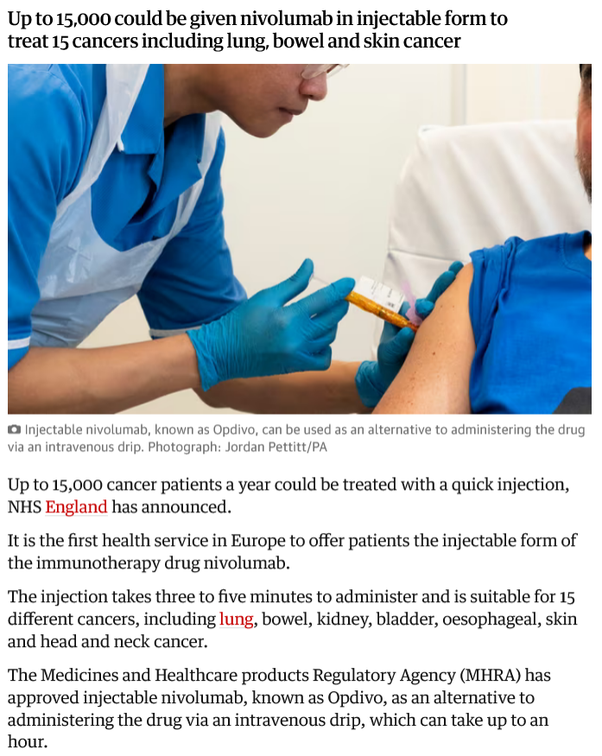
Cancer patients in England to be first in Europe to be offered immunotherapy jab

NHS England » NHS Cancer Vaccine Launch Pad
I think simple remedies for complex medical challenges that we struggle with today would also be another feature of a utopian environment.
Other features of an advanced society to me would include, along with many technological advances for assisting with biological issues, transportation, and the provisioning of various resources like education and access to community administration processes for public engagement, would include access to resources permitting one’s development of a meaningful vocation without being distracted by meeting basic survival challenges.
Whatever interests a person might have would be easy for them to explore without encountering numerous barriers preventing them from developing their interests in ways that engage and benefit the public.
For example, I read about an eleven-year-old girl developing a means of testing for lead contamination in water.

While we can celebrate the innovation and ingenuity demonstrated by a remarkable youngster, we often overlook how such a child would have required access to supports not common to most to have been privileged enough to pursue an interest to such a degree that their idea can save lives.
One of the most destructive limitations we place on human potential is the misanthropic attitude many people display, cultivated by an economic system distorted by toxic competitiveness.
A utopic society would have cleansed our collective psychologies of the many mental health maladies that we’ve inherited from centuries of generational CPTSD. The most potent form of utopic boost to our potential as a species is our ability to support one another while possessing the courage to address the psychological dysfunctionalities that hamper our development.
A utopia would be a humanity free from the burden of many of the toxic aspects of human psychology that are the cause of so much pain and suffering on levels that would be considered outlandish in fiction and a bloody horror show of sociopathic stupidity in real life.
This kind of shit, for example, would not exist in a Utopia because we would have matured enough to acknowledge, first and foremost that this is a treatable medical condition that should disqualify these people from operating in any position of authority. This kind of broken mentality should be considered a socially destructive mental health issue in which the effects are severe enough to warrant mandates for compulsory treatment before being allowed to participate in activities that could be harmful to others.

A Utopia would not be suffering from a mental health pandemic affecting one in five people and resulting in a whopping majority (70%-80%) of families being dysfunctional.
Until we can deal with our mental health issues, however, any form of utopia will remain a pipe dream as we allow our species to be consumed by the chaos created by our psychological dysfunctionalities.
When I witness casual examples of people breaking stereotypes, however, such as a male with burgundy nails, I think that although we may be dragging our asses into maturity as a species, at least we can see some subtle signs of progress.




 thotbag