How Much of Political Messaging Relies on Public Bias?

This post is a response to a question posed in its complete format: “Are politics and marketing highly dependent upon, and structured around, the inability of the masses to think logically, act responsibly, and go beyond surface thought; especially go beyond surface thought?”
“All Publicity Works Upon Anxiety.”

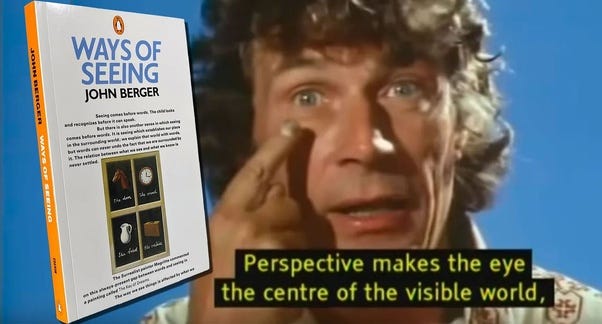
John Berger’s “Ways of Seeing” was an excellent introduction to my young mind as an art student in the early 1980s, helping me become more consciously aware of the then-daily bombardment of thousands of messages. It’s been decades, so I vaguely remember it, but I recall being repeatedly reminded of it over all this time. That suggests some “staying power” in my mind, with value over time. The book and/or the four-part documentary series created from it are both worthwhile experiences.

All four episodes have been combined into a single 2-hour YouTube presentation.

“We never look at just one thing; we are always looking at the relation between things and ourselves.”

The numerous concepts this short volume addresses introduced me to the layers of meaning in the images we encounter. The venue, the presenter’s intent, and the state of mind we bring to the viewing experience all coalesce into a unique perception we create for ourselves.

We are bombarded daily by thousands of images, according to the observations made in the early 1970s. I imagine the then-massive number I don’t quite recall at the moment (and am too lazy to scrub through the video to find it) has mushroomed by orders of magnitude since.

Marshal McLuhan challenged presumptions about media and its consumption.
We learned to think strategically about the messages we consumed.
His maxim, “The Medium is the Message,” gained him some notoriety among the media-savvy.

Then came “SEX” on a Ritz Cracker;

I’ve referred to a “we” requiring a definition. I think it was implied in “media-savvy” because it relates to awareness of what we are expected to believe and why it is essential to accept what is desired of us.

To be “media savvy” means being aware of the content of the ideas we consume and of how we choose which ideas to consume.

All Communication is Purposeful

We communicate not out of a compulsion to occupy idle time,
not even necessarily for social entertainment,
at least not when we go beyond the most superficial levels.
We communicate with one another because we must to survive.

Without communication, we would not be here today to examine our communication.

Who benefits most from what we believe?
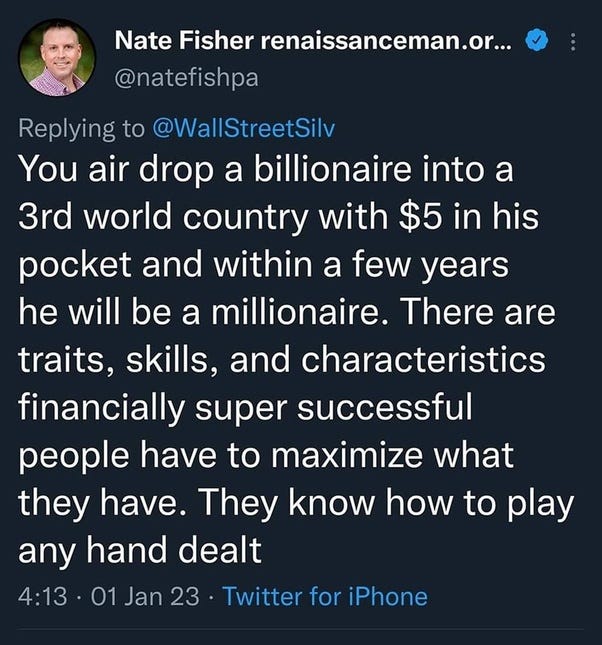
It seems less about the people and more about benefiting those who have benefited most from a predatory system.

The above examples are from popular social discourse, about forty years ago and below is an example of current popular discourse:

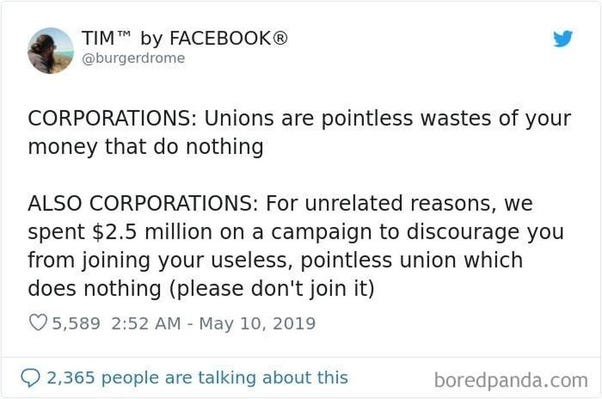
(I refer to this example above as “popular” because it represents strategic messaging to serve a communication function of industry within the broader context of a culture structured around industry, economics, and consumption.)

The strategic manipulation of messaging is prevalent throughout society, in every domain, from interpersonal dynamics to international relations.

Whatever humans evolve into, some form of socially cohesive network of “shared perspectives” will perpetually question our experiences and compose new narratives to correct our collective perspectives.

Many of us do so with earnest and deep commitment to learning. Most will spare what time they can through highly structured days, allowing minimal opportunity for reflection.

We won’t stop thinking and talking about our experiences because we can’t. Willful ignorance may take centre stage from time to time, but it eventually gets the hook to exit left as it’s booed off the stage.

If the story doesn’t touch grass and meet reality, the people eventually figure out we’ve all been played for suckers by ever bigger games of power, and we find ourselves repeating history as ever-expanding dominions of power promise unity and deliver submission.

The barrage of imagery, sounds, videos, and merch-oriented stories has become increasingly overtly political. Factions grow around concepts and issues, not geography or physical commerce, but in the world of ideas, of how we think, how we see the world, and how the world looks back at each of us.

What do we want?
Certainly not chaos?

Chaos invariably leads people to one incontrovertible conclusion: for communication to succeed, there must be a relationship of trust. Without trust, there can only be chaos.

Choosing trust is a binary decision about life and what that means to each of us, from micro to macro scales, now encircling the globe.

Trust Means Accountability:

One hundred years ago, our circles of trust were local and lifelong.
Today’s global reach with casual effort was unimaginable then.

Where we end up one hundred years from now is provocative to contemplate. Some form of examination of the information we consume will continue for as long as some similar form of abstract thinking persists.

How Aware Are We Today?
Or, how much awareness can our general public sustain without inviting chaos?

What do we reeeeeally know about what’s going on around us?
Well, that’s easy, chaos.

Changes are occurring everywhere while everyone competes for resources and integration into the general machinery of social production.

We know how power structures coalesce to construct universal narratives about the acceptable social order we are encouraged to support, while our own needs are increasingly neglected.

We know that some messages aim at social disruption, whereas others aim at social cohesion.
What we do as a society to facilitate cohesion after a half-century steady diet of failed promises.

I’m reasonably sure most of the public knows, or is becoming aware of, the apparent disarray in our politics. How dependent is this massive economic superstructure on our willing participation?

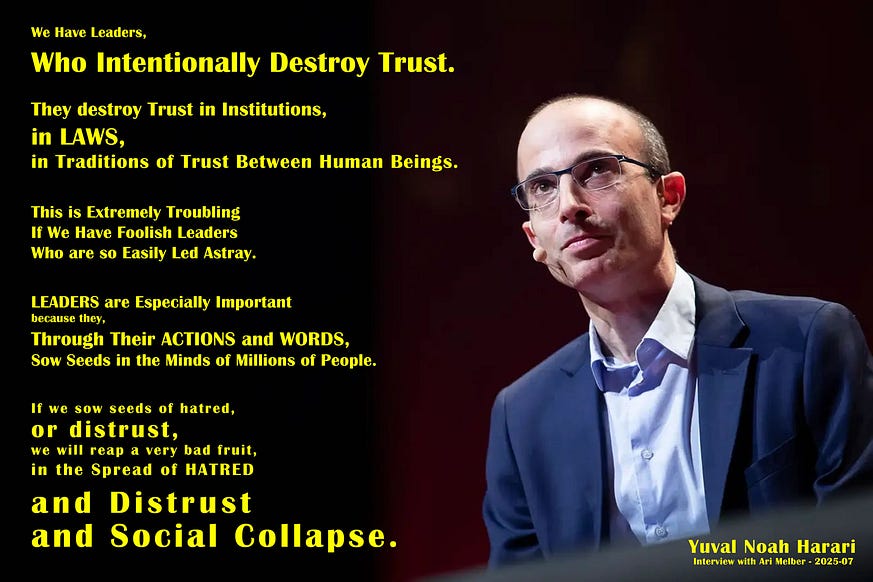
We must have leaders we can trust who will represent the needs of the many over the few who benefit most from a corrupted system gone askew.

Is social media marketing better than traditional marketing?

This post is a response to a question initially posed on Quora, and can also be accessed via “https://www.quora.com/Is-social-media-marketing-better-than-traditional-marketing/answer/Antonio-Amaral-1

Marketing is a process of leveraging communications within an ecosystem.

Marketing must continually adapt to changes in an ecosystem to be effective.

Direct mail was an effective marketing strategy fifty years ago because there were few (relatively) inexpensive alternatives then. Radio, television, and national magazine advertising were pretty much the only other primary marketing channels that could get national reach for one’s brand, and those are (and were) expensive marketing strategies. Otherwise, one would have to place ads in local publications like newspapers, quickly becoming costly when scaling up nationwide by buying space in hundreds of publications.

Then the Internet arrived, and one could gain national and international reach for almost free.

Almost overnight, what worked steadily and unpredictably no longer did. The traditional market became prohibitive and ineffective as alternative media sprouted up everywhere.

Marketing has always relied on establishing trust with its consumers to create sales. So, relationship marketing became more focused on social media because a two-way, one-to-many dialogue was made possible.

Before then, marketing was mainly defined as a one-way, one-to-many communication.

The downside, however, has been such a low entry bar that everyone and their dog could compete on an almost level playing field.

A small operation could get international reach as effectively as a large corporation. That forced corporations to up their game. A saturated media market meant more comprehensive and audacious strategies for attracting attention.

Now, we have reached a point where advertising is starting to turn people off, and it’s become difficult to pinpoint effective marketing strategies because advertising has become a reason for people to avoid rather than be attracted to a brand.

Even the “give away something for free to attract people” has been losing its lustre. For example, being asked to register one’s email address and personal information to access an article is losing its harvesting effectiveness in a world where people create “junk-catching email addresses” to avoid spam.

There is no “better or worse marketing system” in a constantly evolving world. There is only staying ahead of the “pissing people off curve” and hope to make lasting connections that one can leverage for sales.

The only thing that does not change about marketing is the need to build relationships based on trust because that’s core to the human condition.

Getting attention is easy. Converting that attention into closed deals is an entirely different ballgame.

Are people presenting Chat GPT answers as their own?

This post is a response to a question posed in its complete format: “Are people taking Chat GPT answers and posting them on Quora? It seems there are many answers all with the same format every time, and sometimes people post the same answer twice. It is very annoying. How can this be stopped?”

There appears to be less of that behaviour today than about a year ago when ChatGPT became a public sensation.

AI-generated content has generally been easy to spot, and I’ve blocked several accounts where people have tried passing off AI content as their own. It may be for that reason I see less of it.

People may also have become more discerning with their inclusions of AI-generated text — by removing obvious clues and editing the content before posting it. ChatGPT has also evolved and become more sophisticated and less easy to spot.

I use Grammarly to speed up my writing and clean up errors, but I still struggle with its structure as it “suggests” changes that are not natural expressions to me.

My experience with it has affected my writing by improving it and relenting on choices I would not have made. I’m unsure how I feel about that beyond feeling a bit dirty in accepting a suggestion out of expedience rather than rewriting an entire paragraph to make it acceptable.

I will fight more vigorously against Grammarly on my desktop than on my phone because typing — especially editing- can be a pain.

Grammarly can generate content from existing text by rewriting it in a more grammatically acceptable (not always correct) format. This makes it somewhat different than the content generated by ChatGPT and other AI LLMs used for content generation.

There also exists AI systems that are designed to spot AI-generated content, of which I am sure many are included within academic budgets. I noticed recently, however, that new AI systems are emerging that claim to be capable of passing muster on being scrutinized by AI detection systems.

Whether those are effective or not, I don’t know. Still, I suspect this will continue to be an evolving issue where it will become impossible to differentiate between human-generated and AI-generated content.

For my part, it seems like I’m being encouraged to cuss more frequently to ensure people understand that they are reading words produced by a human mind over that of a “robot,” but that may be an excuse with a limited shelf life.

Why AI Writing Can Never Truly Replace Human Writing


This post is different from my typical fare. It is an answer to a question posed on Quora, but it’s also a response to a post I’ve read about AI replacing human writers. My arguments have consistently been that as long as an AI is incapable of feeling emotions like love, sorrow, hatred, anger, and the entire range of emotions bred into us throughout centuries, it will never be capable of stimulating emotion within people. AI will never, on its own, connect with humans emotionally. Humans may imbue their AI experiences with emotions, but those are projections. Those emotions are mirror reflections of oneself and one’s biases. They can certainly help develop mindfulness techniques, but that becomes a self-referential silo.

Socialization is how we grow past our self-imposed boundaries, and we need input from other humans to understand ourselves truly. The purpose of this post is to prove this contention. How I will be doing that may seem somewhat circuitous, but please be patient enough to get to the punchline because I think it’s amusing, and I hope you will be too. Thanks for reading my gurgitations.

Here is the question posed on Quora that I answered:
As far outside of religious context as possible, can any atheist explain their personal decision to not believe?
https://www.quora.com/As-far-outside-of-religious-context-as-possible-can-any-atheist-explain-their-personal-decision-to-not-believe/answer/Antonio-Amaral-1
As far outside of religious context as possible, can any atheist explain their personal decision to not believe?

You ask this question as a believer because you must choose to maintain your belief consciously.

Every day is a day of ritual affirmation of your belief. At least once per week, you socialize with people to reinforce your choice to believe.

Your crises of faith are caused by the fact that you sometimes struggle to maintain your beliefs. You have doubts about your beliefs, but you do what you can to put them aside, and that may include a prayer or a castigation against Satan invading your thoughts with temptations to stray.

You may even turn to your book to find inspiration to hang onto your belief. You see words that confirm how hanging onto your belief is sometimes a struggle and that you must stand firm and never lose that belief.

You fear losing your belief because you feel like you’re letting down a paternalistic entity that will be disappointed and angry with you for not maintaining.

You struggle with the fear of an eternal punishment for betraying your commitment to your belief, and yet, after all of that, you still wonder why you endured all that turmoil.

You may tell yourself that it’s a test of your character and that if you pass it, you will be graced with an eternal reward instead of an eternal punishment.

You still wonder how people can live without that struggle, so your curiosity prompts you to ask how people would choose against what does not feel like a choice.

In your mind, you may think you have a choice, but you have a choice because a choice between Heaven and Hell isn’t much of a choice. It’s a no-brainer. After all, who would be stupid enough to choose eternal torture?

This prompts your curiosity because many people seem unconcerned about what you believe will happen to them.

Your mind struggles with the notion that people would choose eternal torture on a lake of fire as if it’s never going to happen to them.

It makes no sense whatsoever to you that people would choose to reject Paradise in favour of Hell.

The problem, however, isn’t that people choose not to believe because you can’t actually “choose” to believe. You know this yourself because you don’t “choose to believe.” You choose to maintain your beliefs.

What you do not understand about atheists and atheism is that people do not choose to become atheists.

People awaken to a new reality about themselves that they no longer believe the illusion and realize after the fact that they have become atheists.


Here’s the punchline:

An AI may be trained well enough to identify what I identified in the question posed. I don’t believe an AI could trigger the querent on such a visceral level by being so on point that they become defensive and dismissive of the information they encounter. This is a technique I refer to as “forced introspection.” This person will continue to deny, as we already know from our experiences with the MAGA mentality. However, they won’t forget how they were triggered to discover that their dismissal of what they read will vanish from their consciousness without an impact.

This dynamic can only occur between humans, so I feel comfortable putting all my economic eggs in the creative content basket. I’ve wasted a lifetime attempting to fit into a broken system and have become worse for wear. I may not ever see the same income potential I was well underway in achieving before a nuclear bomb on my life ended that aspiration. At least I can spend whatever time I have left expressing myself and permitting myself to be the “real me” through doing what I love doing.

Temet Nosce

Should we care about others’ feelings when being honest?

To be completely honest within this context, one must also be honest with one’s motivations for “being honest” in the first place.

“Being honest” does not necessitate conveying any messages to anyone else. There is always a motivation for the information one shares. To “be honest,” one must be aware of why they are compelled to share that information and what they seek to accomplish by sharing that information.

For example, to “be honest” about telling someone they’re fat and ugly isn’t actually “being honest” beyond informing the other person of what one’s personal biases are. Delivering information in a callously insensitive manner implies that the honesty of their intent is emotional manipulation.

To be completely and transparently honest within such a context, one should qualify their opinion by being honest about their biases. “I’m very biased toward a person’s aesthetics and react viscerally to the condition someone of being overweight due to unresolved personal issues, and because I’ve been conditioned to define beauty within a shallow, commercialized, sanitized, and two-dimensional context, therefore I interpret your physicality as fat and ugly.

No one ever goes to such lengths to explain their biases. Most people who indulge in the “honest” expressions of their biases just cut to the conclusion, and that’s much more hurtful to the feelings of others. The consequence of “failing to care” about the emotions of others in such a context demonstrates one does care about the other person’s feelings, not in a productive or supportive way but rather in a destructive way. They intend to create harm deliberately, which implies “caring” about other’s feelings.

They are not sharing their honest opinion in such a context but conveying information to hurt the feelings of others. Within such a context, “being honest” necessitates being forthcoming about the nature of their opinion and why they share it. In either case, one does not escape “caring” about other’s feelings while implying they care more about escaping the consequences of their impact on that person’s feelings.

I don’t think I’ve ever heard anyone declare, “I’ve got personal issues to resolve; therefore, I’m going to use you as my vessel for working them out to make myself feel better by making you feel worse about yourself.

That would be an example of a bully “being honest” (for a change).

Cases outside the context of an abuser/victim dynamic can have a significant impact on the feelings of others, such as informing someone of the passing of a loved one. No matter how one delivers that information, the other person’s feelings will be impacted.

One’s intentions are just as crucial to sharing information within this context as in the previous example.

To be honest with one’s intentions, in this case, means understanding how one’s information is delivered impacts the receiver’s ability to parse that information fully and accurately. Ensuring the other party successfully understands the message conveyed within its complete context, some level of awareness and sensitivity to their emotions is crucial to the success of their information delivery efforts.

Failing to consider the emotional impact of the information conveyed implies that one’s intentions are less focused on knowledge transfer than on impacting the recipient’s emotional state.

In both cases, these are examples in which one does not escape the consequences of their regard toward the feelings of others in the information-sharing process.

Emotion is a component within an information-sharing context, even in benign situations such as small talk. “It’s a beautiful day today.” This may superficially seem like an unemotional example of innocuous small talk, but the reactions it can engender carry an emotional component within it. The emotions are not as pronounced as in the previous examples, but they exist. One feels better by being reminded of a pleasant experience, just as they would feel something if the day were not beautiful (which, in and of itself, is an emotionally charged word due to its subjective nature).

Further stripping emotion from the dynamic of information-sharing by limiting interaction to a functional level, such as a transaction, still contains an emotional element because humans are emotional beings. For example, “Your McSappy Meal is $5.99” can engender an emotion in the recipient who feels overcharged.

One plus one equals two.” — “Can you prove that?” or “Do you think I’m too stupid to know that?” or “I’m not a friggin’ child in elementary school. Can’t you provide a better analogy?

Being honest means being honest about the nature of the care demonstrated toward the feelings of the person with whom they share their information. To care about the feelings of others often implies enough sensitivity toward their emotional state to minimize a potential disturbance, but that’s not the complete spectrum of caring about the feelings of others. Far too many people “care” so much about how others feel that they devote significant energy toward ensuring others feel worse than they do.

Some people “care” so much about other’s feelings that they make a point of being utterly dishonest with themselves while sharing information intended to create harm or incite conflict while escaping the consequences of doing so through a mask of innocence they can declare as “being honest.”

All information shared between people implies an emotional dynamic within its conveyance, either strictly by the content or when augmented by the messenger’s intentions. There is no escape from feelings in communication, while “being honest” includes acknowledging the emotional component of their messages and the impact on the receiver.

How to Restore, Strengthen and Preserve a Democracy

Democracies are strengthened by the degree of engagement by the people. The more people become informed, engaged with, and involved with their government and its activities, the more secure the democracy.

A disengaged and apathetic citizenry makes a government susceptible to corruption.

Restoring and reinforcing the stability of democracy begins in the classroom with a comprehensive civics-oriented strategy for equipping students with the skills and insights to achieve success in effective governance and their personal lives.

As it turns out, the overlap in skills for effective governance and success in one’s personal life are represented as an almost clean circle in a Venn diagram.

The range of interpersonal skills one can and should develop are core competencies for life. Communication skills, negotiation skills, and conflict resolution skills are all universally valuable skills. Developing competencies in areas like Robert’s Rules of Order and understanding the nature and process of effective legislation (rules to live by) may be more niche but are transferable skills that can be applied in other areas of life, particularly when they’re not considered obscure skills by a majority like they are now.

The more people who know how to declare a point of order, the fewer conflicts could escalate into violence.

Of course, the development of logic and critical thinking skills should be included in the curriculum, if not as courses but as strategies for delivering an existing course load.

Applying critical thinking skills development within a history class, for example, would increase student engagement simply by structuring the information delivery process through a means that challenges one’s thinking skills.

On an entirely different and equally crucial level is the reinforcement of a commitment to the role of the Fourth Estate in society. The profit motive must be removed to protect objectivity in the information delivery process, ensuring the public is adequately informed of relevant news in the most agnostic way possible.

Breaking corporate media into community-based employee co-ops will create a culture of checks and balances that approach the self-regulating effectiveness of the peer review process within the scientific community.

The election process is another area that must be made as agnostic as possible. Removing the undue influence of money in elections and reducing the tribalism of the currently corrosive culture in politics is critical to mitigating ideological bias. First-past-the-post elections should be replaced with proportional representation and ranked-choice voting.

With these measures, an exceptionally stable democracy can emerge on level ground with inbuilt resistance to corruption.

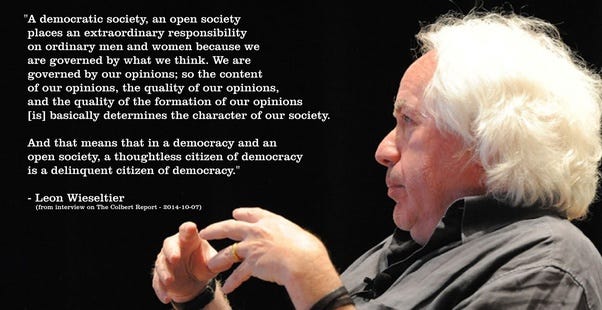
Leon Wieseltier — Quote on Democracy

Is it worth responding to the laughing emoji reactions to a tragic post on Facebook?

This post is a response to a question that was asked in its complete format: “What do people think of others who react with a laughing emoji to a serious or tragic post on Facebook? Is it worth going through the list and giving them all a nasty pm, or would this be a rather pointless and sad exercise?”

That list you imagine going through to castigate people individually is often over one hundred people and can sometimes be several hundred to over one thousand.

Going through one list of even just one hundred people would easily chew up your entire day.

You would also have to deal with pushback and people reporting you for intrusive messages on their DM.

You would likely find yourself consigned to Facebook jail for your efforts.

Even the process of blocking on Facebook is onerous enough where if that’s all you did was block one hundred people, that would easily chew up a few hours of your day…

On just one post.

Odds are excellent, and you could find at least half a dozen such posts that motivate you to block hundreds to thousands daily.

It could be a full-time job just blocking people, and you would still find a never-ending supply of names to block within a user base of two billion.

Blocking one thousand people daily would take three years to block one million people.

If you were to go by statistics that bear out at one in five people having severe mental health issues, you would need to block 400 million people.

That would be a lifelong job working every day from morning until you fell asleep without any break from that task.

If that’s how you wish to spend your life, it’s your choice, but you may find other approaches to making your point more beneficial to your sanity.

You can post a public comment on a post where you can chastize all inappropriate laugh reactions at once. I’ve done that, and it can feel rewarding when you get a lot of feedback from people who appreciate someone publicly criticizing lousy behaviour. You will also find that you’ll get laugh reactions on your complaint that you can address.

If you think you will have a discernible impact on behaviours, then you’re not being realistic because succeeding on that level will require years of effort.

You may want to consider lobbying Facebook for improvements to their blocking process because it sucks. It’s onerous and constantly redirects you to pages you probably don’t want to see repeatedly.

Change.org has a petition that has already gathered 296 signatures, and as of this writing, it requests that the Laughing Emoji be removed from Facebook altogether.

Sign the Petition
I recently wrote feedback to Facebook about something that’s been bothering me about their emoji feature. Here is what…www.change.org

If it gains enough traction, we might see at least some changes to their emojis if the laughing emoji isn’t removed altogether.

Here is another article calling for its removal:

No laughing matter: Why it’s time to cancel Facebook’s haha reaction
That squinting, grinning idiot is poisoning Facebook.thespinoff.co.nz

Whatever you decide to do at this point, it’s probably wisest to consider it more personal venting than instigating social change. Otherwise, you will tire yourself into a frustrated frenzy while spinning your wheels and going nowhere.

A helpful quote you should keep in mind for whatever you choose to do is from Winston Churchill.

Good luck with whatever you choose to do.

Does gossip cause negative group processes, or do negative group processes cause gossip?


Gossip corrodes group cohesion, while negative group processes can feed gossip as people require an outlet for their frustrations.

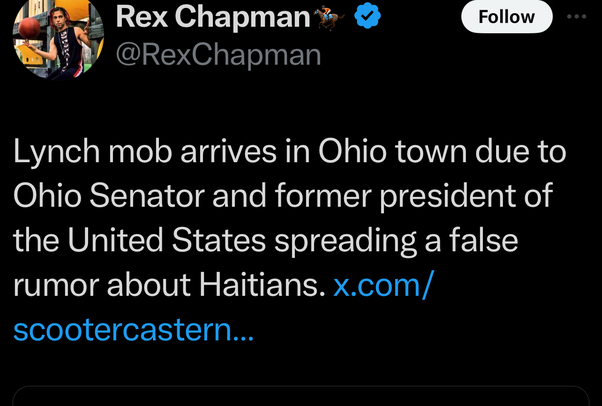
On a national level, we’re observing a distressing trend. People, disillusioned by ineffective processes, are seeking outlets for their frustrations. This often leads to the scapegoating of marginalized subgroups by influential voices within the group. However, this blame game does nothing to address the root causes of their frustrations, only serving to perpetuate the cycle of negativity.


The consequence of blame-shifting leads to spiralling instability within the group and nation, as is the case with what’s happening worldwide as we experience increasing protests due to historic levels of income injustice.

The solution to this problem is two-fold: address the underlying causes (the elements negatively affecting group processes) and hold leadership accountable for de-escalating rather than escalating group negativity. It’s crucial that we, as a society, hold our leaders responsible for their actions to empower positive change.

On a national scale, we are struggling precisely because of the messaging we are all receiving from all fronts, including political leaders, leaders in our information brokering system (media), and our captains of industry. All forms of leadership in society today are primarily responsible for the increasing destabilization we are experiencing today of what we refer to as a “civilized society.”


We live in a world where those most responsible for ensuring group cohesion act in service to their best interests at the expense of becoming the underlying causes of group destabilization.


We are deliberately inundated with negative messaging because it serves the shallow interests of the few among us with too much power who view the rest of us as pawns in service to their whims. This is a practice of mollifying a public that has existed since the dawn of human civilization and has been taken to new extremes in today’s interconnected world in our information age.


Messaging has become the modern equivalent of tanks on a battlefield where the prize to be won and the territories to be controlled are the minds of the little people who serve as pawns in their games of power.

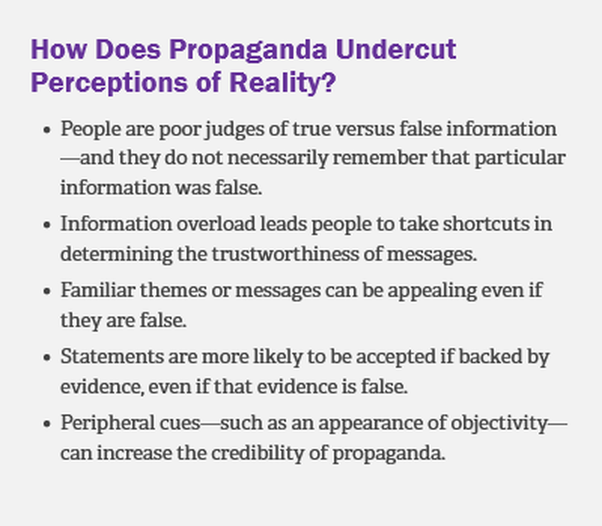
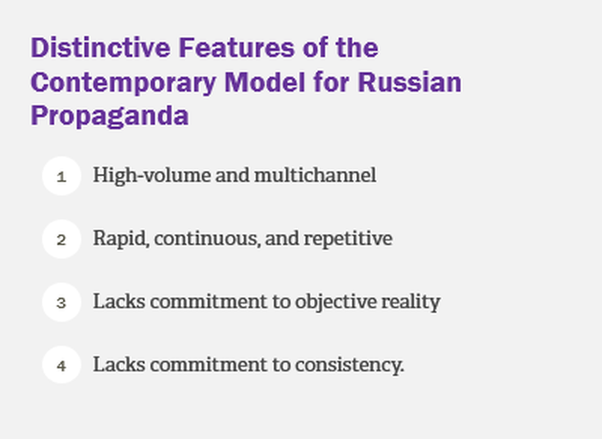
“All other things being equal, messages received in greater volume and from more sources will be more persuasive.”

Russia’s “Firehose of Falsehood” Propaganda Model

Since its 2008 incursion into Georgia, there has been a remarkable evolution in Russia’s approach to propaganda. Effective solutions can be found in the same psychology literature that explains the Russian propaganda model’s surprising success.

https://www.rand.org/pubs/perspectives/PE198.html


Fortunately, we can refuse the negativity directed toward our fellow victims because we outnumber the few who seek control over the many and because we can lose our ability to make our own determinations about the future we want by willingly handing over control of our minds to those who would seek to sublimate all of human society to servants in thrall to their whims.

We can reject gossip and demand adherence to the primacy of facts from all our leaders, politicians, media empires (the Fourth Estate), and plutocrats.

If they don’t obey the wishes of the masses, then we can organize and make them follow the social contract they are beholden to and obey the needs of the societies they benefit from.

What has caused people to lose their common sense (2019-present)?

This post answers a question posed on Quora’s Question and Answer site.

The major problem with the concept of “common sense” is that it’s subjectively defined gibberish.

What may construe “common sense” to one person means something else entirely to another.

For example, here is another question you posted on your profile:

“Why do liberals have a light approach on [sic] immigration policies? (serious answers only!)”

This has meaning to you, but a “light approach” is an entirely personal definition characterized by personal bias without any reference to any authoritative body that can provide a working definition of how that applies in real life.

What that term evokes to understand what you mean requires considering an oppositional view of that expression. The “opposite” of “liberal” is “conservative,” and the opposite of “light approach” is “heavy-handed.” From drawing those oppositional points of reference, one can determine what you imply within your question.

This is a general approach for deriving meaning that most people often (and subconsciously) undergo when responding to subjectively defined terms.

The expression “common sense” is interpreted similarly; “common” to “uncommon” and “sense” (in the context of awareness or knowledge) to “ignorance,” except that in this case, the result is vaguely referential gibberish — “uncommon ignorance.” The consequence of a subjectively defined expression that cannot derive meaning beyond the words themselves leaves people with the only option of accepting those words at face value — “common sense” means “common sense” (“common awareness” or “common knowledge”).

If anyone asks, “What does “common sense” mean?” It means “common sense” — a sense regarded as common — standard, familiar, expected — not specific to anyone or anything we can identify, nor does it reference any specific sense like hearing or seeing, but it does imply cognitive ability.

If you don’t get that, you lack ‘common sense.’”

It’s an expression insulated from criticism because it refers to nothing but one’s subjective interpretation of what that applies to.

If it makes sense to me, then it must be ‘common’ sense.

This is where we run into trouble with that expression. Not everyone has what everyone else would consider “common sense,” and no one can devise a universal definition of what constitutes “common sense.”

That leaves us with a sticky situation in which people will read or hear something like this from a “leader” in society and think this reflects “common sense.”:

Listening to these words is easier than reading them. Listening to their sounds while one’s attention captures key concepts like “tough hurricane” makes it easier to accept the meaning conveyed within the sentence.

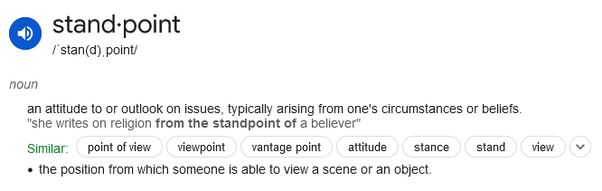
Reading these words, however, makes it tough to ignore all the rest of the words that, together, amount to a string of gibberish. Since when does water have a “standpoint”?

Water has no “outlook on issues,” but the gibberish of this sentence is still interpreted as “common sense” by people whose discernment of meaning is fuzzier than others.

This leads us back to understanding how the perception of having “lost” something for which no universal definition applies is due to personal bias.

Since no objective metric exists for defining “common sense” in the real world, the only explanation is that one’s awareness of something they took for granted as true of most people suddenly seems not to be the case.

It follows that the answer to your question isn’t that “common sense” has been lost but that you have awakened to realities you never before realized existed.

I don’t know why you selected 2019 as the year for which you have noticed a decline in “common sense” and have searched online for significant events that may have contributed to your conclusion. I’m pretty sure you’re not referring to July 10, 2019, when the final Volkswagen Beetle rolled off the line In Puebla, Mexico or that it was the last of 5,961 “Special Edition” cars exhibited in a museum, but I could be wrong.

I suspect that year is also a distinction of an event of personal significance beyond whatever else may have happened worldwide. It would be an explanation that makes more sense than anything listed within this record:

https://www.history.com/topics/21st-century/2019-events