
This post is a response to a question initially posed on Quora.
Human rights are essentially an agreement between humans to protect a characteristic or behaviour of all humans within their community.
Human rights exist only by virtue of the agreement itself and the degree of commitment by other humans to protect those rights.
This is a global issue, with human rights being violated all the time and everywhere on the planet. It’s a problem that demands our immediate attention and action. This is why human rights are violated all the time and everywhere on the earth.
We have far too many humans who view rights as scalable according to their essentially misanthropic perceptions of humanity — because we are suffering from a mental health pandemic affecting at least one in five among us. We are only now beginning to realize that we are a species that has been suffering for centuries from generational trauma from our barbaric origins.
The fight for universal human rights is a fundamental building block in a healing process that will require centuries to emerge from.
We are far better off today than we were one century ago simply because of our increased awareness of the issues we are dealing with and an emerging appropriate context from which we interpret our experiences.
Human rights are crucial to preserving the social contract and ensuring systemic stability.
Without human rights as a concept enshrined into law, we descend into barbarism.
After writing this answer and posting it, I realize I’m doing a disservice to the concept by providing such little context.
Human rights have a long and bloody history of development in which their inklings as concepts we should value as a species were responses to centuries of brutal violence characterizing human life.
The earliest examples of human rights enshrined in local laws date back to circa 2350 BC in Asia as the reforms of “Urukagina of Lagash,” which evolved into more well-known examples of legal documentation such as “The Code of Hammurabi” from circa 1780 BC.
Ancient Egypt also supported fundamental human rights through documents such as “The Edicts of Ashoka” (c. 268–232 BC). Other principles of human behaviour emerged during this period, while one such principle has been incorporated throughout most living religions today and is popularly known as “The Golden Rule.”
Fast forward to 622, and “The Constitution of Medina” functioned as a formal agreement between Muhammad and the tribes and families of Yathribe, which included Muslims, Jews, and pagans. This agreement was an early means of uniting all peoples of the land under a common identity referred to as “Ummah” and incorporated several changes to how slavery was defined and limited.
Early Islamic laws from this period incorporated principles of military conduct and the treatment of prisoners of war that became precursors to international humanitarian law.
Moving forward into the Middle Ages, the most influential document establishing the modern basis for human rights was the creation of the “Magna Carta,” itself heavily influenced by early Christian thinkers such as St Hilary of Poitiers, St Ambrose, and St Augustine.
The Magna Carta of 1215 influenced the development of “common law” and several constitutional documents following, all related to human rights, including the (1689) “English Bill of Rights” and the (1789) United States Constitution.
Some may remember from the Iraq War and the establishment of Guantanamo that the Bush administration suspended the writ of “Habeas Corpus” — the right to know what one has been accused of — was a right established in the Magna Carta. This was a fundamental violation of a basic right that set the nation back in time to an era of barbarism — and they hypocritically leveraged that violation to commit war crimes for waterboarding that the U.S. itself forced Japan to face an international tribunal for war crimes over the same behaviour decades earlier.
This is a stain on the American people that will not wash off their conscience while they do nothing to own responsibility for their grotesque violation. This dark moral failing of the nation has become a slippery slope of moral failures permitting the monstrosity of immoral behaviour. We — as in the world- are now on the verge of potentially falling entirely into a pit of immorality because of their “leadership” in this area.
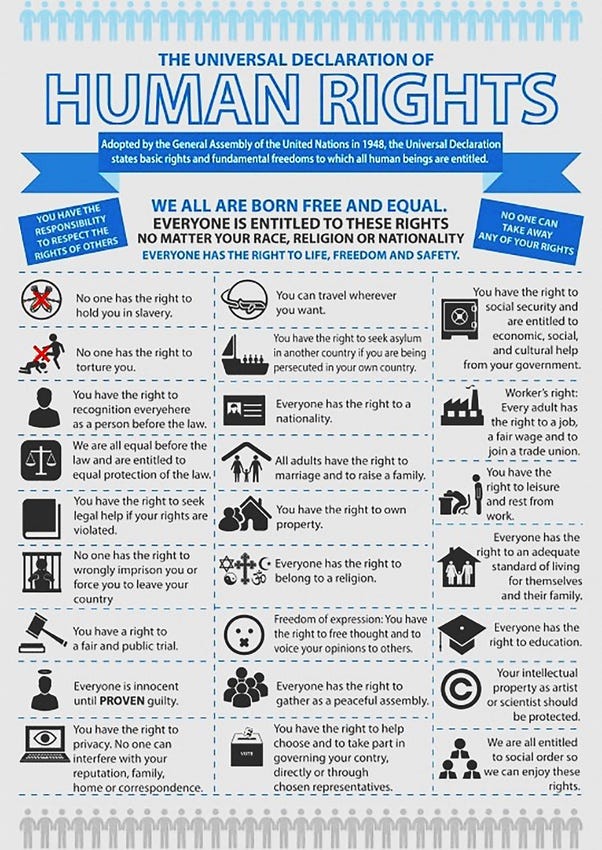
At any rate, I’ll avoid proselytizing further and get to the goods of reading material and a “pretty picture” at the end with a chart of the Universal Declaration of Human Rights:
History of human rights — Wikipedia
A Short History of Human Rights
A brief history of human rights — Amnesty International
Universal Declaration of Human Rights | United Nations

































 thotbag