This post is a response to a question posed in its complete format: “Are people taking Chat GPT answers and posting them on Quora? It seems there are many answers all with the same format every time, and sometimes people post the same answer twice. It is very annoying. How can this be stopped?”
There appears to be less of that behaviour today than about a year ago when ChatGPT became a public sensation.
AI-generated content has generally been easy to spot, and I’ve blocked several accounts where people have tried passing off AI content as their own. It may be for that reason I see less of it.
People may also have become more discerning with their inclusions of AI-generated text — by removing obvious clues and editing the content before posting it. ChatGPT has also evolved and become more sophisticated and less easy to spot.
I use Grammarly to speed up my writing and clean up errors, but I still struggle with its structure as it “suggests” changes that are not natural expressions to me.
My experience with it has affected my writing by improving it and relenting on choices I would not have made. I’m unsure how I feel about that beyond feeling a bit dirty in accepting a suggestion out of expedience rather than rewriting an entire paragraph to make it acceptable.
I will fight more vigorously against Grammarly on my desktop than on my phone because typing — especially editing- can be a pain.
Grammarly can generate content from existing text by rewriting it in a more grammatically acceptable (not always correct) format. This makes it somewhat different than the content generated by ChatGPT and other AI LLMs used for content generation.
There also exists AI systems that are designed to spot AI-generated content, of which I am sure many are included within academic budgets. I noticed recently, however, that new AI systems are emerging that claim to be capable of passing muster on being scrutinized by AI detection systems.
Whether those are effective or not, I don’t know. Still, I suspect this will continue to be an evolving issue where it will become impossible to differentiate between human-generated and AI-generated content.
For my part, it seems like I’m being encouraged to cuss more frequently to ensure people understand that they are reading words produced by a human mind over that of a “robot,” but that may be an excuse with a limited shelf life.
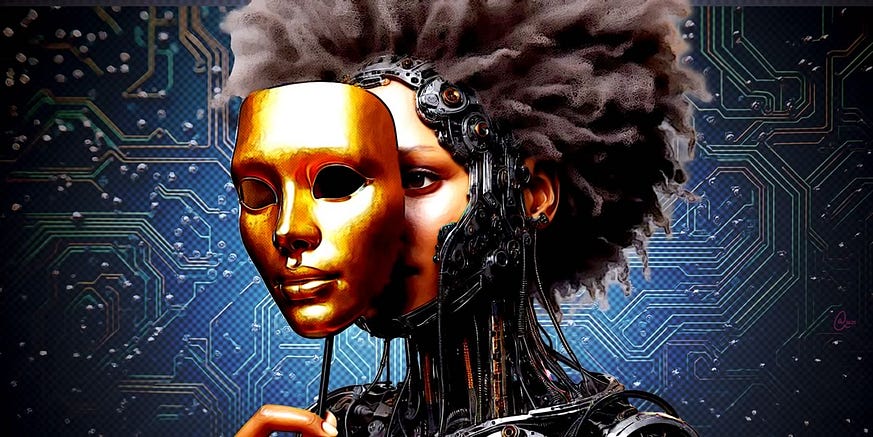
This post is different from my typical fare. It is an answer to a question posed on Quora, but it’s also a response to a post I’ve read about AI replacing human writers. My arguments have consistently been that as long as an AI is incapable of feeling emotions like love, sorrow, hatred, anger, and the entire range of emotions bred into us throughout centuries, it will never be capable of stimulating emotion within people. AI will never, on its own, connect with humans emotionally. Humans may imbue their AI experiences with emotions, but those are projections. Those emotions are mirror reflections of oneself and one’s biases. They can certainly help develop mindfulness techniques, but that becomes a self-referential silo.
Socialization is how we grow past our self-imposed boundaries, and we need input from other humans to understand ourselves truly. The purpose of this post is to prove this contention. How I will be doing that may seem somewhat circuitous, but please be patient enough to get to the punchline because I think it’s amusing, and I hope you will be too. Thanks for reading my gurgitations.
You ask this question as a believer because you must choose to maintain your belief consciously.
Every day is a day of ritual affirmation of your belief. At least once per week, you socialize with people to reinforce your choice to believe.
Your crises of faith are caused by the fact that you sometimes struggle to maintain your beliefs. You have doubts about your beliefs, but you do what you can to put them aside, and that may include a prayer or a castigation against Satan invading your thoughts with temptations to stray.
You may even turn to your book to find inspiration to hang onto your belief. You see words that confirm how hanging onto your belief is sometimes a struggle and that you must stand firm and never lose that belief.
You fear losing your belief because you feel like you’re letting down a paternalistic entity that will be disappointed and angry with you for not maintaining.
You struggle with the fear of an eternal punishment for betraying your commitment to your belief, and yet, after all of that, you still wonder why you endured all that turmoil.
You may tell yourself that it’s a test of your character and that if you pass it, you will be graced with an eternal reward instead of an eternal punishment.
You still wonder how people can live without that struggle, so your curiosity prompts you to ask how people would choose against what does not feel like a choice.
In your mind, you may think you have a choice, but you have a choice because a choice between Heaven and Hell isn’t much of a choice. It’s a no-brainer. After all, who would be stupid enough to choose eternal torture?
This prompts your curiosity because many people seem unconcerned about what you believe will happen to them.
Your mind struggles with the notion that people would choose eternal torture on a lake of fire as if it’s never going to happen to them.
It makes no sense whatsoever to you that people would choose to reject Paradise in favour of Hell.
The problem, however, isn’t that people choose not to believe because you can’t actually “choose” to believe. You know this yourself because you don’t “choose to believe.” You choose to maintain your beliefs.
What you do not understand about atheists and atheism is that people do not choose to become atheists.
People awaken to a new reality about themselves that they no longer believe the illusion and realize after the fact that they have become atheists.
Here’s the punchline:
An AI may be trained well enough to identify what I identified in the question posed. I don’t believe an AI could trigger the querent on such a visceral level by being so on point that they become defensive and dismissive of the information they encounter. This is a technique I refer to as “forced introspection.” This person will continue to deny, as we already know from our experiences with the MAGA mentality. However, they won’t forget how they were triggered to discover that their dismissal of what they read will vanish from their consciousness without an impact.
This dynamic can only occur between humans, so I feel comfortable putting all my economic eggs in the creative content basket. I’ve wasted a lifetime attempting to fit into a broken system and have become worse for wear. I may not ever see the same income potential I was well underway in achieving before a nuclear bomb on my life ended that aspiration. At least I can spend whatever time I have left expressing myself and permitting myself to be the “real me” through doing what I love doing.


 thotbag