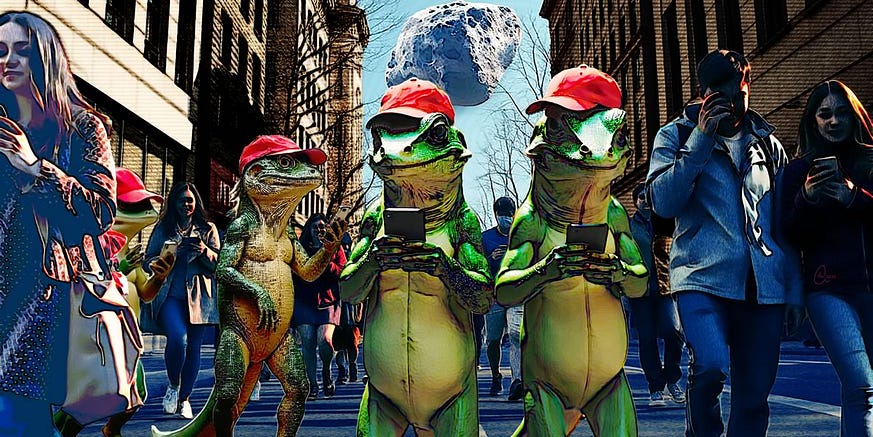
Do you think that society was better before social media?

This post is a response to a question initially posed on Quora, and can also be accessed via “https://www.quora.com/Do-you-think-that-society-was-better-before-social-media/answer/Antonio-Amaral-1

No.

All of the ugliness we see on social media didn’t just magically appear because of social media. Social media is simply a means by which people can express their natural selves. People have always been the way they are on social media. The only difference is that their voices and behaviours were not broadcast to the world.

Before social media, people lived in social silos which enabled toxic people to rule their environments. Their victims had no outside support or validation for their suffering and were groomed to believe they had to accept the toxicity as normal. People have been groomed for generations to believe social reality is immutable, that change is impossible.

We can now see that the opposite is true, and social media helps bring about change.

Social media brings about social change much faster than was ever possible, and that makes social media a solution to society’s woes, not a problem.

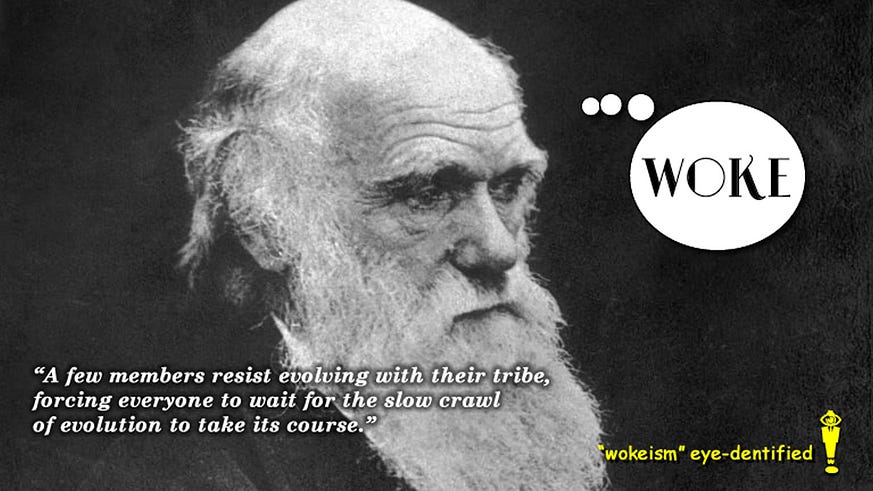
Consider, for example, how concepts like “Woke” are used as weaponized disparagements to enable the corrupt among us to leverage hatred into legislation sending society back into the dark ages.

Fifty years ago, and before social media, similar terms like “tree hugger,” “do-gooder,” and even “liberal” were terms of disparagement in which whatever little media attention was given to them existed without pushback from a public rejecting the toxicity. “Politically incorrect” was such a term that took hold as a disparagement before social media, and it is now widely accepted as a negative characteristic in society.

The pushback it received wasn’t magnified like “woke” has been through social media. Consequently, the attempts made to weaponize “woke” like all disparagements which began with positive connotations haven’t succeeded at converting “woke” into a negative. “Woke” is now a term that backfires onto those who try to use it as a disparagement. Through pushback on social media, “woke” will reassert itself as a wholly positive connotation. In contrast, those who invoke stupidities like “woke mind virus,” and “go woke go broke” will increasingly become viewed as enablers of toxicity much like the red alert beanies in society have become.

This represents tremendous progress in the fight for human decency on how we perceive concepts and how they frame our interactions with the world.

It’s almost quaint, now, to think of “do-gooder” as a bad thing to be called; and to such a degree that if someone is to refer to someone else as a “do-gooder” today, they sound like sociopathic idiots. That conceptual lifecycle is what has happened now with the term “woke.” It’s taken a fraction of the time for the implications of the word to settle into our public consciousness within the context it originally conveyed.

Being called a “do-gooder” fifty years ago meant one would retreat in embarrassment, but now, the accusation garners confusion. The person who hurls that accusation appears like an idiot.

In contrast, “woke” became popular less than two decades ago. It appeared as a positive connotation that the toxic among us attempted to weaponize like they have with every positive connotation in society. Within a comparatively short time, people who weaponize “woke” are already being regarded as toxic idiots.

Without social media, the weaponization of “woke,” and the legitimacy of concepts like “woke mind virus” would have been accepted as valid disparagements in which those are “woke” would retreat from social discourse because they had no outside support.

Arguments and counter-arguments flitted about in geographically isolated silos and never managed to spread from community to community. The consequence was to cultivate localized and insular community values. Social media cultivates community values across the globe. Social media breaks down the silos, and the barriers of distance between human beings and empowers those who must face the bullies attempting to corrupt positive values in society.

The best weapon against bullying is social media because of this. It’s also a megaphone for bullies, but they’re outnumbered by those they victimize and they are generally stupid people.

For example, the best thing that Trump could have done was to have that media circus of bullying Zelensky. He claimed, during his ego masturbating rant, that he “let it go so long” for a purpose suiting his goals, but it backfired spectacularly.

He and Vance were viewed as the bullying thugs they are and I’m sure this will be a watershed moment for many who have blindly supported Trump. Many people, if not most of us, have been exposed to bullying and the thing about bullying, is that the victims of bullies never forget.

Social media is community development on steroids. The problem with social media, however, is that it is predominantly operated on a for-profit basis, which makes it impossible for social media to cultivate positive social values deliberately and strategically.

Community development on social media occurs organically and within a chaotic environment. The fact that we can progress on issues through this chaos is a testament to the human spirit. No matter how the toxic people among us make life difficult for the rest of us, we are pushing back and succeeding in gaining ground on establishing a baseline for decency. It may occur glacially in contrast to what would be possible if a publicly owned and operated, not-for-profit social media environment existed within and to compete against the for-profit model.

We are, however, succeeding in making “woke woke again”.
I’m sure many people would quickly gravitate to a much safer environment where they could trust that their personal information wasn’t being mined for profit.

How do Canadians and Americans feel about each other?

This post is a response to a question initially posed on Quora, and can also be accessed via “How do Canadians and Americans really feel about each other?”

This Canadian thinks of Americans in ways not too dissimilar from how I think of fellow Canadians. Most are decent human beings at heart. Many are misguided and gravely misunderstand the nature of today’s dysfunctionality in society. A few — or more than just a few, but a minority nonetheless, are toxically stupid to the point of being beyond redemption.

All but the third group are reasonable and amenable to working together to identify the best solutions which meet the broadest range of needs of the citizenry. Our cultures are similar but unique, while, as a whole, Canadians appear to have more insight and respect for the values declared by Americans as being core to their identity.

Much of the discord in America, for example, in the value of freedom, lies in the difference between Canadians being more community-oriented. Americans tend to breed an isolationist degree of individualism. The resulting perception of freedom between the two nations is that Canadians regard freedom as derived from our community, and Americans appear to interpret freedom as the ability for an individual to do whatever they please whenever they please.

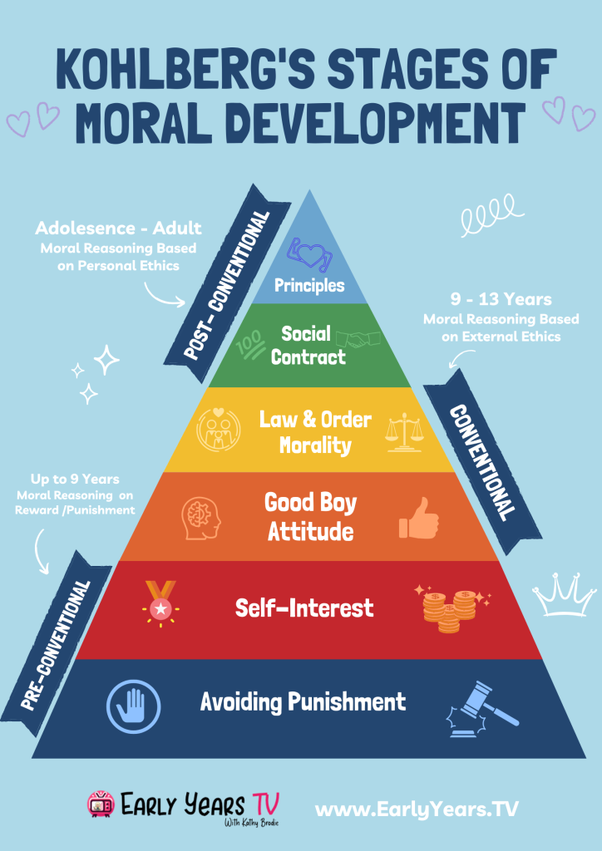
If we were to track this difference through Kohlberg’s Theory of Moral Development, we can see a distinction in the degree of moral evolution this represents.

Caveat: Like all models, this is not a universal prescription defining all people in any culture, and so this may generally describe some fundamental cultural differences, the overlap between cultures exists in the developmental differences between individuals.

Canada has no shortage of people who fail to grow beyond the pre-conventional stage. We do have our flavour of Maple MAGAts — the toxic form of extremist conservativism plaguing the planet. It is certainly more prevalent in the U.S., but that’s entirely due to economics.

The U.S. has always had a much larger budget that has always been more attractive to society’s predators. IOW. The economic success of the U.S. has been its most fundamental weakness.

It is in the best interests of those seeking power to ensure the populace is developmentally stunted. Keeping people on the level of pre-conventional development makes them more malleable and amenable to influence from authorities. Teaching them to fear punishment keeps them in line and converts them into sycophants addicted to chasing their self-interests.

This works for most of the population, which functions as workhorses to keep the machinery of society operational. Still, the next level of conventional morality is also necessary to function as an administrative body to keep the rabble in line.

All nations leverage this developmental dynamic through intrinsic and extrinsic punishment and reward systems. Canada and the U.S. are no different in this regard because this is a dynamic cultivated by power structures.

The causes of the distinctions between nations begin at the third and uppermost level of development, in the post-conventional stage. This is where philosophies and ideologies live that define the visions guiding all citizens in their perceptions of themselves and as members of a community.

This is where the distinction between “melting pot” and “multicultural mosaic” lives and flows throughout society to form a cultural identity.

It appears ironic that a nation that values individuality is adamant about conformity, but that’s explained in the differences between these two perceptions of national identity. One cannot truly value individuality when their culture homogenizes its citizens through a melting pot. (Many) Americans consider Canada a “socialist” country, but we value individuality, and freedom, by extension, more than Americans because we embrace and celebrate diversity as core to our cultural heritage.

I am proud to have Quebec as a part of Canada precisely because their contrast has kept Canada from falling into the same self-serving traps of insular arrogance that Americans have. They’ve been regarded as pains for many westerners, but so have westerners been regarded in similarly disparaging ways by our French-speaking members of our family. However, the dynamic between divergent cultures characterizing Canada makes us strong and coherent as a nation, which values its people above those who would rule us.

Americans would do well to learn from our dynamic and begin to treat their Spanish-speaking population with the same respect. It would help you grow as a nation with something more nuanced as a culture beyond the bombast of commercial ostentatiousness and avoid being viewed as the meth lab we live above.

What is Art for, and Why is it Important?


This post is a combined response to a couple of questions initially posed on Quora and written in their full format as, “As an artist, how would you answer this question? What is art for?” and “What is the importance of art in our society?”

Canadian poet Irving Layton described artists as canaries in coal mines because they are the barometers for society, which compels us to expand our perceptions by confronting often harsh truths.

Art changes how we understand the world by reflecting reality back to us within directed contexts to focus our attention on aspects of life presented in often unfamiliar and/or uncomfortable ways.

Art enriches our lives and reminds us of our humanity while connecting us through the artist’s work.


“What is the importance of art in our society?”

To adequately address this rather direct but general question, some context is needed to frame an answer which fully encompasses its implications.

There are three general perspectives upon which to address this question.

From an individual’s perspective

The importance of art in an individual’s life is a broadening of perspective and a deepening of insight into… well, literally everything about the human condition. From an observer’s perspective, art connects us on a visceral level. Whether it be music that moves us, a few well-chosen words, or an awe-inspiring spectacle, the experience is a validation of belonging to something greater.

From an artist’s perspective, it’s the cheapest therapy form.

Cumulatively, society benefits from the positive contributions resulting from affirmative expressions of community life within larger societies.

From a community’s perspective

Art brings attention to issues often overlooked, misunderstood, misrepresented, or misapprehended in ways which provide unmatched clarity in creating understanding. Art can mobilize a community and motivate social change, contributing to stability within larger societies.

From a society’s perspective

Art reflects the most profound truths about life, the human condition, and society in general.

Art provokes social introspection and defines boundaries while providing clarity on issues.

Art provides the public with psychologically supportive outlets of expression that contribute to overall social stability.

Artistic activity provides a healthy return on investment to every level of an economy.

Artistic history provides us with deep insights into our evolution as a species, and it is an activity that also provides insights into our future, like every other discipline of discovery.

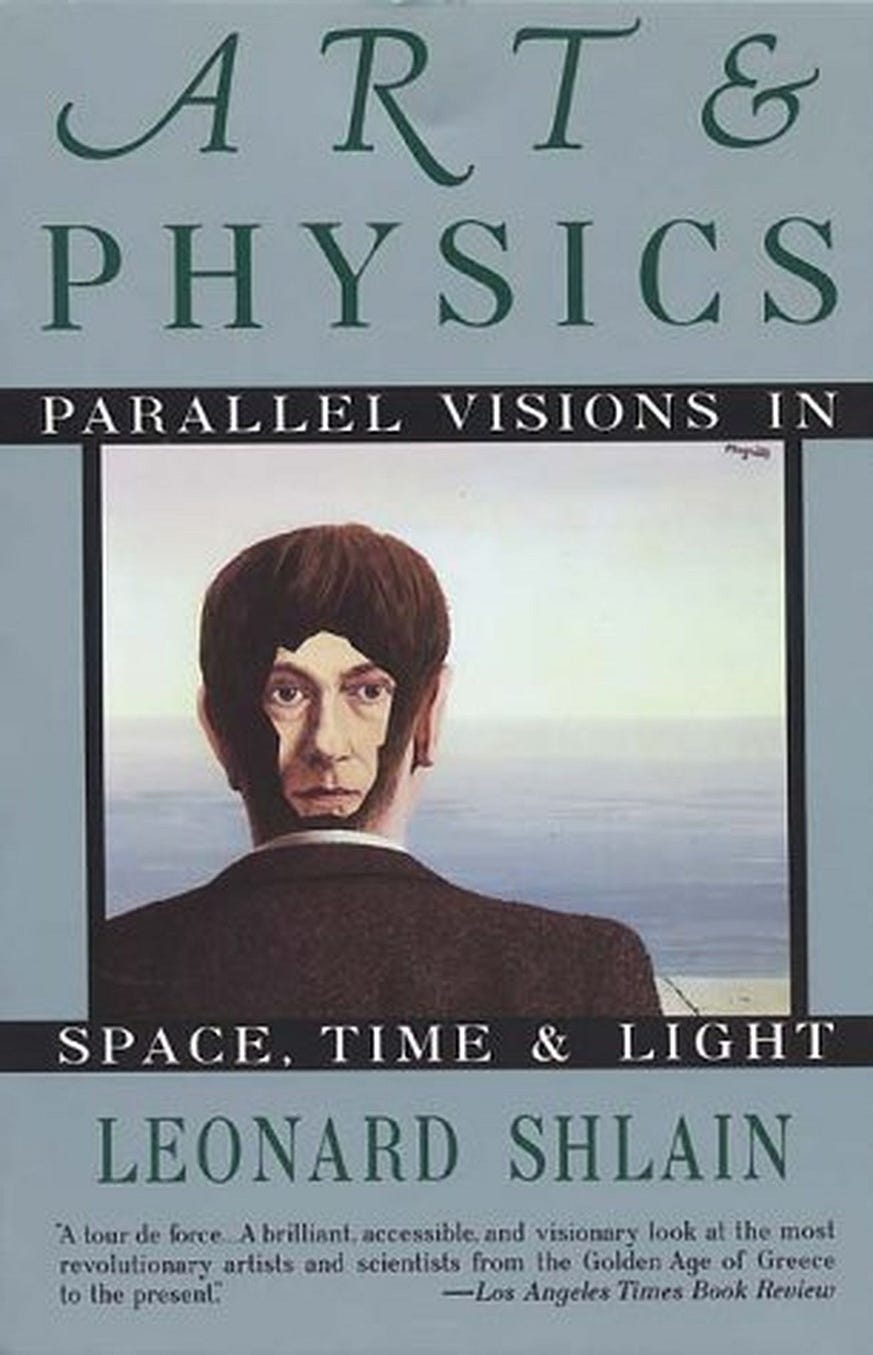
“Art interprets the visible world. Physics charts its unseen workings. The two realms seem completely opposed. But consider that both strive to reveal truths for which there are no words — with physicists using the language of mathematics and artists using visual images.

Art and Physics, Parallel Visions in Space, Time and Light — Leonard Shlain

Art & Physics | by Leonard Shlain

“Leonard Shlain proposes that the visionary artist is the first culture member to see the world in a new way. Then, nearly simultaneously, a revolutionary physicist discovers a new way to think about the world. Escorting the reader through the classical, medieval, Renaissance and modern eras, Shlain shows how the artists’ images create a compelling fit when superimposed on the physicists’ concepts.

To what extent do profound ideas reach high levels of popularity?

This post is a response to a question posed in its complete format: “To which extent do novels, or manga, conveying deep idea, or talking about social issues, relate to them given global awards, or high global popularity, to which extent does this depend on how smart the creator is, why only few reach to this level?”

Popularity and recognition are primarily not determined by intelligence, creativity, or any value generally associated with degrees of quality, skill, or craftsmanship but by timing and resonance.

The kind of popularity attributed to intelligence and creativity is recognized only through endurance throughout the ages. It is the rarest form of popularity that remains consistently in the shadow of most other forms of popularity. It does receive the occasional boost because it can garner enough of a niche following to emerge on the populist stage for a time. Still, it then retreats to becoming a niche once again.

A book like “Fifty Shades of Grey” was a literary mess on every level, from the writing to the butchered subject matter to the horrid values it sensationalized.

It was a massive success because it appealed to a repressed and widespread imagination responding to an increasingly darkening reality by retreating into dark fantasies that most would not have the courage to explore in real life.

I’m certainly not claiming that I would or have the courage or the slightest interest in exploring this area of the human condition for myself. Still, I am at least aware enough of the dynamics to understand how the story itself represents more of an expression of a mind suffering from Stockholm Syndrome indulging in titillation rather than providing realistic insights into the dynamic it attempts to portray. It’s more of a study of mental health in society than a literary masterpiece.

This leads me to my point that, as a people, we have been enduring a staggering decrease in the quality of our lives over the last several decades, shocking most of us. A piece of schlock like this validates feelings shared by a large audience and titillates the imagination through sensationalized imagery.

It became popular, not because of any enduring qualities but because it fulfilled a need for an outlet.

“The Secret” is another example of appealing to repressed sentiment, but instead of validating the repressive darkness people have been suffering through, it capitalized on a need to restore hope.

Ultimately, both literary productions created more harm than good in the same way that trolls undermine the social contract.

Once materials like these run their course, they begin to resemble porn in that a temporary titillation is an insufficient mitigation for addressing underlying causes, and like cocaine, once it’s run its course through one’s body, one is left feeling drained and hungry for more of that emotion that gave them a temporary boost in life.

There is, sadly, no real cure to this phenomenon of populism beyond two different strategies. The first strategy is the sanest, but it is also the most long-term and invisible strategy for addressing this need to bottom feed while racing toward an ever-receding bottom. It’s a strategy that will make many eyes roll once I write it as a one-word summary: education.

Education is the “magic pill” that will mitigate most of humanity’s ills — at least, it will once we address the economic roots of humanity’s ills.

It won’t ever be a cure because there is no final state to education. There is no finishing an education. Only lifelong learning exists for our species if we wish to survive anywhere near as long as the dinosaurs did.

The alternative to education is our current self-destructive trajectory, which risks the end of human civilization and, quite possibly, our species if our rock bottom is deep enough.

The alternative track to education we are on is to continue our descent into worshipping the superficially constructed Holy Grail of attention for the sake of attention. We will continue to behave like addicts drawn toward the chaos of feeding an insatiable hunger until we consume all of what we value through superficial titillations that temporarily distract us from an otherwise horrifying existence.

Surviving the nightmare ahead of us means our future progeny will have slim pickings to choose from as representations of the best human potential to pick out from the forgettable detritus of populism. The future will be as we experience it today when looking back on history and forgetting how Leonardo DaVinci had many contemporaries competing for the same artisanal benefits he remains remembered for.

We don’t remember the easily forgotten mass, but we do remember the outliers, and that’s the broad lesson of history.

If we exist as a species and civilization in another two hundred years, no one will know who or what a Kardashian is. They will note, however, how rampant superficiality characterizes this primitive and barbaric state in which we live.

No one will remember any of the Harry Potter books or the trans-hating hypocrite who fraudulently represented hope within her discardable stories. They will, however, continue to be influenced by Tolkien.

No one will remember much of anything notable about the products of this era beyond the horrid worship of excess.

Not one talking head from Fox will be given a nod of acknowledgement for their contributions to society. Rupert Murdoch might earn a passing reference as a key player in corrupting human civilization. Even he will be regarded as a side note contributing to corruption. At the same time, his success at making it so widespread will be considered a global failure in ethics that permitted monstrosities like centibillionaires to exist.

Donald Trump will be remembered as this century’s Hitler, no matter how many may find that offensive today. It’s just where we are as a species, and history has given us enough hindsight information to make such predictions with great confidence.

Those who may be offended by this prediction would do well to consider how that’s an optimistic outcome to the trajectory we are on right now because if he succeeds in achieving the maximum potential of his efforts, then we may not have much left of humanity to be capable of studying the history we make today in any way resembling our current capacity for exploring our history from yesterday.

Suppose we don’t rein in society’s current excesses of distorted power. In that case, we will be lucky to exist in any state resembling anything other than a primitive existence at the mercy of nature.

Is it possible that capitalism will lead to its own destruction?

This post is a response to a question posed in its complete format: “Is it possible that the ability of the Western-style capitalistic system to create great individual wealth will eventually lead to its own eventual destruction?”

I clearly remember my only extended holiday trip out of the country to visit Mexico in the late 1980s — around 1988. It was a fantastic month-long experience I had hoped I would do again within a few years while I was eager to explore the world. I had been living at that point, under the illusion that stability in my income would continue indefinitely while growing year by year as I applied my efforts diligently to what I was doing for employment.

At that point, I worked as an “Educational Counsellor” (according to HR) on the SAIT campus in Calgary, Alberta — a more familiar title for those with experience in post-secondary residence life would be “Residence Life Co-ordinator” — of which I learned many things. In this case, I realized job titles might be universal, but the roles vary dramatically from environment to environment. For the uninitiated, my function was essentially “Community Development,” I wore several hats to succeed in that role while being informed that I had developed — on a green field — the most advanced program in Alberta. I was pretty proud of my accomplishments and still have many good memories from that time.

In my early to mid-twenties, I believed I had developed a firm professional grounding that I could build a successful career for my future. That was less the case than I had hoped because I didn’t follow a defined career prescription and chose to carve out a path unique to my specific interests. There are many reasons for divergence from choosing the road more travelled, but they constitute a divergence from the opening sentence of this answer.

Rather than emulate Grandpa Simpson, I’ll say capitalism isn’t a formula or a universally applicable prescription anyone can follow and achieve great results if they stick to their map. The world I grew up in was filled with people who applied themselves throughout a forty-to-fifty-year stint in a role many hated but stuck with because they had mortgage payments and a family to feed. They could maintain their commitments for so long because the carrot of retirement at the end of their trek meant mortgage-free home ownership.

The first winds of change to that dynamic began to blow around the time I managed to see a small part of the world that was foreign to me. Ronald Reagan was president then, and his betrayals of the working class hadn’t been felt or predicted because the heyday of tax cuts left a lot of cash on the table for people to party it up. It wasn’t until the spend-like-a-drunken-sailor party began winding down that the hangover of austerity began kicking in — then came the dramatic downward slide of uncertain futures.

Lifetime jobs began to disappear as fast as the unions started disappearing.

At any rate, this was all academic to me at a time when I was excited to go on a month-long excursion to an exotic tropical locale that I had been familiar with from books but was eager to experience first-hand. I spent a couple of months in preparation for my trip by learning Spanish as best I could — which was relatively easy for me, having been raised in a Portuguese-speaking household. In several cases, it was more challenging for me to separate the two languages while I spoke. I had to think about my word choices to realize I may have used an unfamiliar Portuguese word when greeted with a quizzical expression.

On the other hand, it was like music to my ears when I heard a Spanish word identical to the Portuguese version of the concept. “Bastante” was such a word that made my heart jump in realization of how much both cultures have in common. The locals seemed to appreciate my efforts at communicating with them in their language and, at times, treated me like one of them. My travelling partner at the time received no such courtesy and was open about expressing her disdain toward this dynamic. For the record, I did try to help her learn the languages alongside me. However, she wasn’t very interested because she felt we would encounter enough English-speaking locals to manage without all that trouble.

Ironically, this was also my first experience with Americans abroad. I learned why many Americans affix Canadian maple leaves to their luggage when travelling abroad. I found it very easy to pick out an American from a crowd in Mexico. This isn’t to say that all were quite so brash and boorish in their entitlement, but every time I witnessed someone behaving in an overtly aggressive manner, it was always an American. To be clear, my point isn’t to trash Americans in general because I’ve known several who are decent people, but we can’t ignore the psychosis plaguing the nation at the moment without lying to ourselves about how much of it has existed for a long time. It had just never been so apparent before the afflicted began donning their colours in a political alignment of hatred as we have now.

At any rate, Mexico was and is a capitalist country, and that’s what this answer to the question intends to address. Of the many things I noted and was in awe of, such as the culture and witnessing with my popped open eyes, and the marvellous artworks of notables like Diego Rivera’s murals, was that the nature of its capitalist culture stood in stark contrast to what I had experienced in the much more subdued Canadian environment.

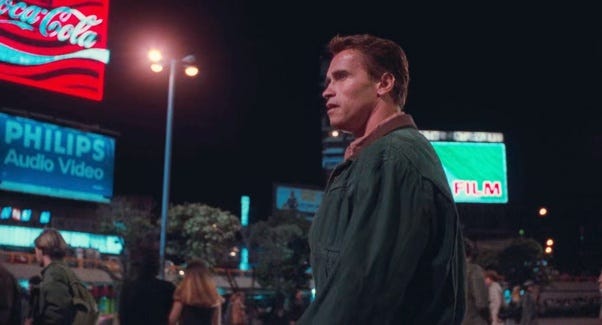
For example, my younger and naive self was quite shocked to see armed guards outside and inside every bank and shop that sold luxury goods like jewelry. This was in the “Zona Rosa” (Pink Zone) in Mexico City — a multi-block area expressly set up for tourist accommodations. Poverty was rampant, and street vendors, known as “ambulantes,” were everywhere outside the Zona Rosa in Mexico City that we travelled who set up tables at the train stations. (I remember being excited to see the Metro Station area we used as our starting point to our daily destinations a couple of years later in the 1990 movie Total Recall.) Walking around Mexico City in parts was like walking through a gigantic outdoor flea market where one could buy from an assortment of cheap electronics, music CDs, and crafts.

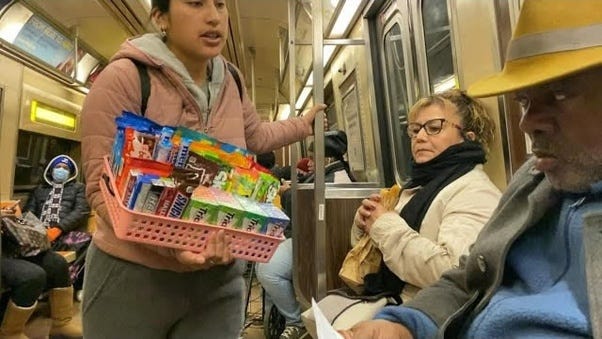
We travelled a lot by bus on excursions outside Mexico City while there for about one week. Each time we boarded a bus or when the bus stopped at locations along our route, three to five vendors wearing strapon trays filled with goods stepped on board to make their rounds and entice people to buy sticks of gum, candy, breath mints, and what have you of small goods they could carry.

(This is a screen grab from a video on a NYC subway that I found while searching for vendors at transit stations in Mexico. The hustle-culture trend from impoverished nations to the south has moved Northward. During my visit to Mexico, this was such a common event that no one responded with the shocked surprise and suspicion seen in this video. There would have been at least two or three other candy vendors on this subway if it had been the Mexico I experienced.)

This was the definition of a “hustle culture” before the term was coined.

Every poor person was a budding entrepreneur.

Mexico was dealing with serious political issues that were mainly responses to the widespread poverty that existed then. I remember hearing news of a Zapatista uprising nearby when we stayed in Oaxaca for a time before arriving at our final destination in Puerto Escondido, a beautiful and secluded beach resort.

At this beach, I experienced my most stark introduction to the world of capitalism through the lens of poverty.

I had been lazily falling asleep under a tree on the beach when I felt something graze the top of my head. I initially swatted away what I thought was an insect, but it continued to flicker on the top of my head. When I opened my eyes to see what was going on, I saw what must have been a barely eighteen-month-old child wearing only diapers and holding a wire coat hanger with handmade bracelets attached to it.

I was pretty confused by the scene as it presented itself to me, and then I saw a woman standing about ten metres behind him with a smile, nodding her head and pointing to the child. That was when I registered that this child was a street vendor in the making and his mother was using him as emotional leverage to make sales.

That’s the image I can’t get out of my mind when I think of capitalism.

Capitalism is a promise made to the desperate to survive that they can succeed if they’re willing to be creative and put in the effort to work at selling either product or themselves to get their material success.

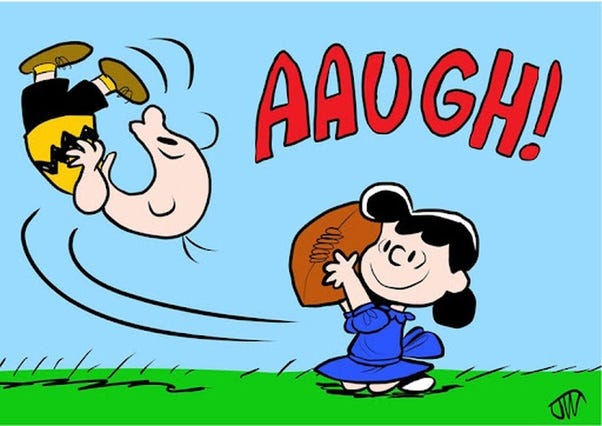
Unfortunately, it’s a promise made by the Lucys of the world to the Charlie Browns of the world that they, too, can kick the football over the goalpost if they concentrate enough and put all their effort into making that magic kick to achieve their dreams.

The desperate to survive have no choice but to play the game while knowing after a while and after having the football yanked away at the last microsecond before each kick attempt that capitalism is a game played at their expense.

There have been too many times in my life when that magic kick was within my reach, and it was yanked away by some greedy sociopath who decided their desires outweighed the needs of the many. Their Lucy attitude was rationalized in the same terms every person who combines psychopathy with manipulation as their vocational strategy for material wealth does; collateral damage is justified as the cost of doing business. If people go bankrupt as a consequence of some decision to benefit personally, then it’s their fault for making a bad choice.

Because we have put no restraints on greed, capitalism will fail, not because capitalism is flawed but because humans are flawed in their social contract-betraying greed. Moreover, humans lack the desire to regulate greed, which has always resulted in the harshest lesson in life, as history has repeatedly informed us and that the Brian Thompsons of this world have been ignoring.

There are many more Luigis among us, and if the perceived solution for the billionaires is to beef up their security, they will also regret not taking the road less travelled… not because anyone wants that. Victims only ever want justice.

“Those who make peaceful evolution impossible make violent revolution necessary.”

Why is intellectual honesty so rare in politics?

This post is a response to a question initially posed on Quora. and can also be accessed https://www.quora.com/profile/Antonio-Amaral-1/

I believe it’s less rare than cynical minds might think.

Too many people can’t see past their biases to know the difference between a politician’s words and their internal recreations of the meaning of their words.

Too many people, for example, will repeatedly utter how Joe Biden destroyed the economy while professional economists across the board praised it as one of the most successful economies in decades.

Too many people are still incapable of acknowledging the reality of the last election being one of modern history’s most secure and scrutinized elections. They will still adamantly insist that the election was stolen.

They will hang onto the words of a convicted felon who should be rotting behind bars and overlook his public money laundering schemes for overpriced watches and sincerely believe he has the best interests of the struggling class in mind.

They don’t even care how badly he bloated the debt by redistributing wealth to the plutocrats who are steadily taking over the global economy.

They would rather demonize their political opposition as “globalists” while doing the job of playing defence for the actual globalists.

None of them will stop to pause and consider the rationale of their position within any objective perspective.

Everything about their position hinges on tribal identity, and they can’t be wrong about their beliefs because it would mean the criticisms about their toxicity are truthful and correct. They desperately need mental health assistance in the same way that most people who have undergone interventions by their loved ones were deemed in desperate need of professional help.

The problem of corruption in politics is not and never has been a problem with the politicians themselves in a democratic nation where the people vote for who they entrust to manage their affairs on their behalf properly.

The evidence is beyond evident in distinguishing between politicians who at least try to truly represent their best interests and those who parasitically drain their constituents of their value while sending them deep into a pit of poverty.

I don’t even need to post a comparison between states that shows which politicians and parties best represent the needs of the people. It would be pointless to do so because their mental filters will dismiss all evidence as “fake news.”

The problem is not that politicians are dishonest but that the people who elect them cannot discern between honesty and dishonesty. That means that a significant proportion of the population is fundamentally dishonest.

If we are sincere in our desire to fix a perceived problem with dishonesty in politics, then we must be earnest in fixing our problems with being dishonest people at heart.

If we don’t don’t want dishonest politicians, we must stop being dishonest ourselves.

The Impact of “Woke Ideology” on Society

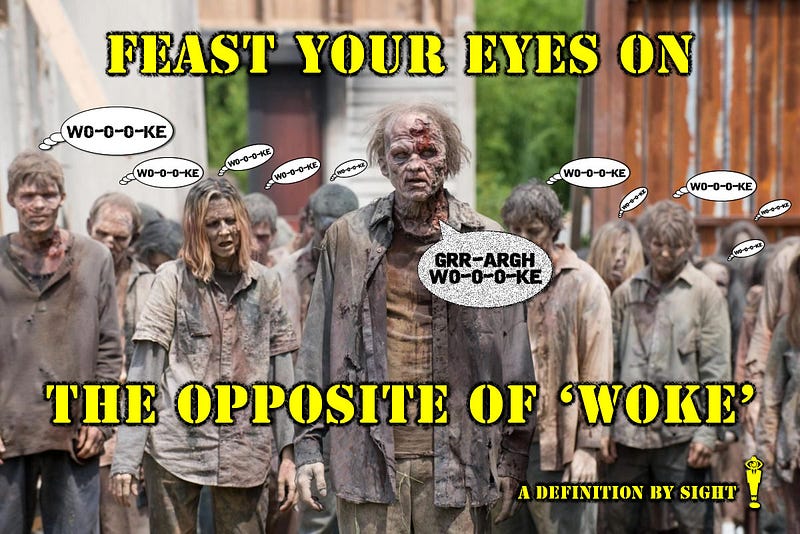
The Opposite of Woke

It’s incredible how much of an impact a non-existent thing can have on people.

It’s much like religion and a non-existent paternal figure.

“Woke” is a word that describes an attitude of awareness over systemic injustices that must be corrected in society.

That’s it.

There is no “ideology” exactly like no “woke mind virus” exists.

All of the hysteria surrounding the term “woke” amounts to nothing more than the whining of children who don’t want to be held accountable for their abusive behaviours.

An ideology is, by definition, a collection of beliefs organized under a dogmatic banner, but to be woke isn’t a belief unto itself. It’s an attitude favouring the support of justice in society and equal access to it for all people — not just the privileged few.

“Woke” itself leads to nothing because it’s not an ideology people rally around in protest of making the world “woke.” There is no singular image of “woke.” There are no collections of rules defining “woke.” There is no institution, group or body of people who represent “woke” as any organized movement for change in society.

“Woke” means simply that a person has realized a corrupt status quo is not sustainable.

“Woke” simply means a person understands and accepts how wrong it is for police to barge into a private residence and shoot people to death while they’re sleeping.

A person who is described as “woke” is just someone who is not only capable of empathy and compassion but is also not intimidated into keeping silent when injustices occur.

That’s what pisses off the people who whine about “woke” as an ideology and invent childish slurs like “woke mind virus” to serve as a boogeyman to fear and attack it out of an illusory need to protect oneself from an imaginary threat.

Some people don’t want social justice.

Some people want to hate.

It’s an addiction for those people, and the media feeds it with a steady diet of conflict porn.

Conservative politicians build their careers around hating groups of easily victimized people.

History is filled with the graves of millions sacrificed on the altar of hatred.

To be “woke” is to know this and be horrified by what humanity has done.

To be “woke” is to want better for themselves, their families, friends, and their communities.

To be “woke” is to want a better future for one’s children and all of us as humans striving to reach our potential as a species.

Some, however, are just mentally ill. Unfortunately, that group comprising “some” amounts to one in five people in our dysfunctional society.

In a city of one million residents, that means 200,000 people are suffering from visible mental health issues.

In a nation of 350 million citizens, that means 70 million citizens are in desperate need of professional mental health services.

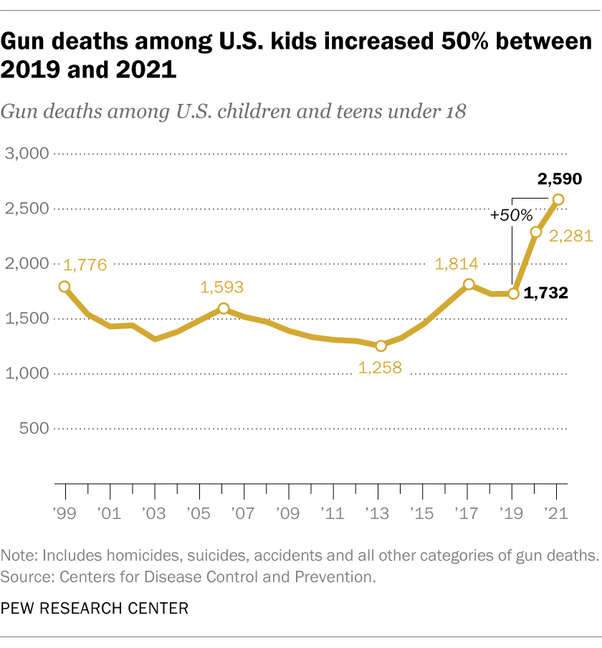
The COVID-19 pandemic shut down the entire world for fewer infectees than that, and we live with it every day in society instead by pretending it doesn’t exist or that it’s just normal — like almost daily mass shootings that extinguish the lives of thousands of children every year.

Gun Deaths Among Children — Pew Research Centre

Gun deaths among U.S. children and teens rose 50% in two years

How do the mentally ill who want this nightmare to continue deal with these horrifying facts?

They invent disparagements like a “woke ideology” or a “woke mind virus” because fixing these problems means they will no longer be able to enjoy watching people suffer. They will no longer be able to feel better about themselves if they can’t see other people suffering more than they do.

They can’t stand the idea that they have to work on themselves because they can’t accept how utterly broken they are as human beings. Some no longer even qualify for that distinction.

10 Symptoms of the Woke Mind Virus