
Why is democracy considered an ideal form of government?

This post is a response to a question initially posed on Quora, and can also be accessed via “https://www.quora.com/Why-is-democracy-considered-an-ideal-form-of-government/answer/Antonio-Amaral-1

There is no such thing as an “ideal form of government” because humans are from “ideal.”

What makes democracy a superior form of government to all others is self-determination.

What makes democracy a far more chaotic form of government than all others is self-determination.

No other form of governance is as capable as a democracy of facilitating the full achievement of human potential because no other form of governance empowers individuality.

No other form of governance is as prone to overt assaults against it, while no other form of governance can survive those assaults.

Human nature demands self-determination, while the assaults against democracy today are born of that demand for self-determination — albeit in horrifically corrupted and myopically self-serving terms.

Think about the perspectives of those displaying an aggrieved assault against democracy. They are commonly born from an autocratic mindset which expects the world to conform to their perspectives. They interpret the evolution of society as a rejection of their insular views and a violation of their rights to those views. It is Frankenstein’s monster of cancerous individuality disguising a toxic desire for sublimation to authoritarian rule by people who imagine freedom as their right to dictate the lives of others.

They are not entirely oblivious to the inherent hypocrisies they champion, or they would otherwise not conduct their protests while disguising their identities or hiding behind masks or fake profiles, managing multiple sock-puppet accounts on social media.

They are the disruptive elements in a democratic society screaming a need for a much more coherent strategy for social development. The challenge at hand, however, is not an authoritarian solution dictated to the masses, as history’s failures have made clear. Today’s dynamic in an information-rich society demands a supportive strategy of education and social welfare programs providing opportunities for healing and growth for a species emerging out of a dark and brutal history while still suffering the effects of generational PTSD.

For democracy to survive its current challenges and begin to approach whatever may be deemed as an “ideal form of governance,” our systems must evolve to prioritize the people over the plutocracy seeking to regress human civilization to a medieval state of rulers and serfs.

We will otherwise find ourselves repeating the bloody histories of our ancestors who sacrificed everything to win the freedoms far too many take for granted today.
In today’s world, the closest examples we have to an “ideal democracy” are embodied within the Nordic models of social democracy.

We would save countless lives if we could take stock of how fundamentally destructive the world’s current adoption of right-wing ideologies is for human society and global stability.


What are the implications of a two-party system on democracy in the United States?


This post is a response to a question initially posed on Quora and can also be accessed via “https://donewiththebullshit.quora.com/What-are-the-implications-of-a-two-party-system-on-democracy-in-the-United-States-1

Well, that’s simple… Gridlock.

You’ve been watching it in action for a couple of decades now.

Whatever one party initiates, the other dismantles.

The fine arts of negotiation and compromise no longer exist because one party views that as submission while the other regards that zero-sum game attitude toward cooperation as toxic and prone to counterproductive and even destructive initiatives that create problems without solving any.

For example, there is no rational justification for abortion restrictions. The entire issue is a non-issue stoked up to an irrationally unhinged fervour based on two misanthropic lies, that abortions are a lazy excuse for birth control by whores, and that they are acts of murdering babies. Neither perception resembles anything remotely true or anywhere near accurate renditions of reality.

They are lies stoked for the simple reason of creating political alignments on the vector of hating one’s fellow citizens. Since about 80% of the population is against abortion legislation, it’s been hijacked by the tyranny of a minority and leveraged as a power grab for a political party. The overblown abortion issue is a political wedge and a fundamental betrayal of a democratic system. This would not be possible in a multiparty system.

A two-party system is a recipe for conflict. In contrast, multiparty systems have been denigrated as being incapable of progress. The reality is that multiparty systems encourage negotiation and compromise among varying ideologies that more accurately reflect the expressions of individual beliefs than the aggregated pools of power occurring within a duopoly.

Another major disadvantage of a two-party system is that it limits the spread of investments the ownership class requires while choosing campaigns to finance. It’s a win-win system for them because it’s the cheapest way to hedge their bets. They can’t afford to spread their campaign investments to many parties in a multiparty system. So, their influence in politics is significantly diluted, and the will of the people is much more accurately represented by the diversity of ideological voices in Congress.

A further, much more subtle, and arguably the most profound impact on society is the homogenization of public thinking through aggregating issues into bundles. All nuance is bred out of each issue as it becomes incorporated into a party package to be accepted wholesale — like a cable deal where you can’t opt for individual strategies or solutions. It’s an all-or-nothing approach to addressing political issues that pressures the electorate to reduce the political process to the level of cheering for one’s party, like a sports team.

A two-party system cannot but lead a nation toward escalating internal strife as party positions become increasingly polarized. One party may successfully drag the other party into its ideology. However, that flexibility and willingness to accommodate the other can only go so far before the opposing party must run backwards in the opposite direction. That’s where the DNC is now, after decades of capitulating to a fascist rightwing leadership banking the complete corruption of a democratic system on the corruptibility of their opposition.

https://www.newyorker.com/cartoons/daily-cartoon/wednesday-september-23rd-meet-middle

BONUS — Reposted from Facebook

A Worthwhile Share, Given How Close D-Day is:

Stop Project 2025 Comic
Trump’s Project 2025 is a detailed plan to shut you up, and shut you out. Don’t let it do either. Read on, then vote.stopproject2025comic.org

Download the .pdf:

How to Restore, Strengthen and Preserve a Democracy

Democracies are strengthened by the degree of engagement by the people. The more people become informed, engaged with, and involved with their government and its activities, the more secure the democracy.

A disengaged and apathetic citizenry makes a government susceptible to corruption.

Restoring and reinforcing the stability of democracy begins in the classroom with a comprehensive civics-oriented strategy for equipping students with the skills and insights to achieve success in effective governance and their personal lives.

As it turns out, the overlap in skills for effective governance and success in one’s personal life are represented as an almost clean circle in a Venn diagram.

The range of interpersonal skills one can and should develop are core competencies for life. Communication skills, negotiation skills, and conflict resolution skills are all universally valuable skills. Developing competencies in areas like Robert’s Rules of Order and understanding the nature and process of effective legislation (rules to live by) may be more niche but are transferable skills that can be applied in other areas of life, particularly when they’re not considered obscure skills by a majority like they are now.

The more people who know how to declare a point of order, the fewer conflicts could escalate into violence.

Of course, the development of logic and critical thinking skills should be included in the curriculum, if not as courses but as strategies for delivering an existing course load.

Applying critical thinking skills development within a history class, for example, would increase student engagement simply by structuring the information delivery process through a means that challenges one’s thinking skills.

On an entirely different and equally crucial level is the reinforcement of a commitment to the role of the Fourth Estate in society. The profit motive must be removed to protect objectivity in the information delivery process, ensuring the public is adequately informed of relevant news in the most agnostic way possible.

Breaking corporate media into community-based employee co-ops will create a culture of checks and balances that approach the self-regulating effectiveness of the peer review process within the scientific community.

The election process is another area that must be made as agnostic as possible. Removing the undue influence of money in elections and reducing the tribalism of the currently corrosive culture in politics is critical to mitigating ideological bias. First-past-the-post elections should be replaced with proportional representation and ranked-choice voting.

With these measures, an exceptionally stable democracy can emerge on level ground with inbuilt resistance to corruption.

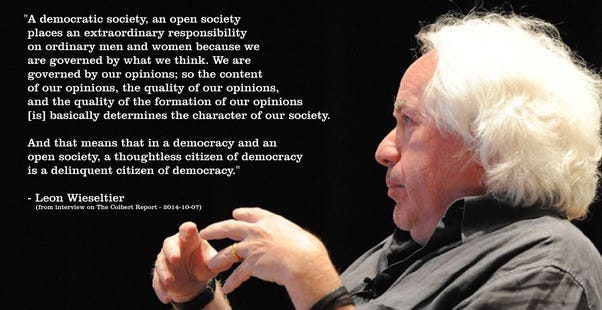
Leon Wieseltier — Quote on Democracy