Marketing is a process of leveraging communications within an ecosystem.
Marketing must continually adapt to changes in an ecosystem to be effective.
Direct mail was an effective marketing strategy fifty years ago because there were few (relatively) inexpensive alternatives then. Radio, television, and national magazine advertising were pretty much the only other primary marketing channels that could get national reach for one’s brand, and those are (and were) expensive marketing strategies. Otherwise, one would have to place ads in local publications like newspapers, quickly becoming costly when scaling up nationwide by buying space in hundreds of publications.
Then the Internet arrived, and one could gain national and international reach for almost free.
Almost overnight, what worked steadily and unpredictably no longer did. The traditional market became prohibitive and ineffective as alternative media sprouted up everywhere.
Marketing has always relied on establishing trust with its consumers to create sales. So, relationship marketing became more focused on social media because a two-way, one-to-many dialogue was made possible.
Before then, marketing was mainly defined as a one-way, one-to-many communication.
The downside, however, has been such a low entry bar that everyone and their dog could compete on an almost level playing field.
A small operation could get international reach as effectively as a large corporation. That forced corporations to up their game. A saturated media market meant more comprehensive and audacious strategies for attracting attention.
Now, we have reached a point where advertising is starting to turn people off, and it’s become difficult to pinpoint effective marketing strategies because advertising has become a reason for people to avoid rather than be attracted to a brand.
Even the “give away something for free to attract people” has been losing its lustre. For example, being asked to register one’s email address and personal information to access an article is losing its harvesting effectiveness in a world where people create “junk-catching email addresses” to avoid spam.
There is no “better or worse marketing system” in a constantly evolving world. There is only staying ahead of the “pissing people off curve” and hope to make lasting connections that one can leverage for sales.
The only thing that does not change about marketing is the need to build relationships based on trust because that’s core to the human condition.
Getting attention is easy. Converting that attention into closed deals is an entirely different ballgame.
A straightforward answer is that visuals are a LOT more time-consuming to create and fill a space than words.
What can be conveyed within a couple of paragraphs, taking only a few minutes to compose, can require at least an entire day of effort to create an infographic that depicts the same information.
Much of the reasoning for the judicious use of illustration is the cost and time required to prepare.
Newspapers are daily publications, so there is little time dedicated to comprehensive illustrations that can fill a page and convey what can be expressed through words. A daily cartoon for a cartoonist is a full-time job for a reason.
Weekly and monthly magazines have more freedom to include more visuals in their publications, which do attract more people and appeal to broader audiences, but they’re also more expensive.
Although graphs aren’t quite as time-consuming to create because many programs can generate attractive graphs from data, this is where the time-consuming challenge rears its costly head. Gathering data and refining it sufficiently to create a graph that complements an article can be beneficial if the story is data-intensive. Still, most stories are information-rich narratives that don’t translate into data parsing visuals.
Infographics are about telling stories, but creating them can involve several days of effort.
The (mostly very short) articles I compose here, which I further tweak and publish elsewhere and include illustrations, can take as long to create as the 2-minute-long article I write. I begin with an AI-generated image, which I then process through photo-editing tools that are sometimes composites of multiple AI originals. If I were to create illustrations from scratch, that would require a bulk of one day (4–6 hours) of cartoon-style illustration for an article I would have spent two to three hours composing.
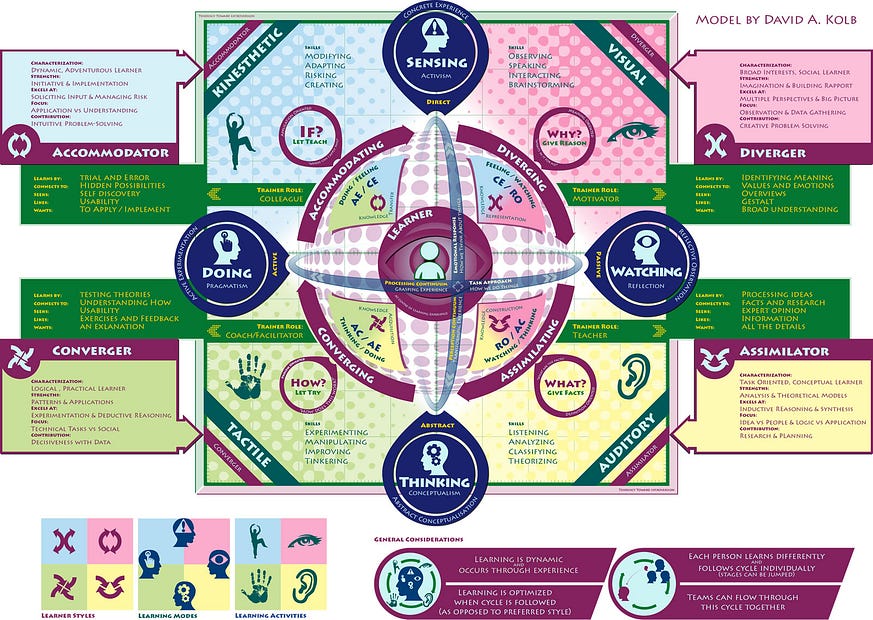
An infographic would require research in compiling data, research in identifying appropriate images to use (because it’s often faster to find glyphs to modify than it is to create them from scratch) and then arranging all of that into a pleasing visual that’s easy to follow is an evolutionary process that often requires moving stuff around to make everything fit in a way that guides a viewer’s attention. In short, it’s just more work to create an infographic. Creating unique and attractive infographics that clients want to pay good money for is a market on its own that I’ve thought of exploring at different times in my life but haven’t done so earnestly… and I kick myself for that because I’ve taken the notion of infographics much further into something I’ve called an edugraphic — which is essentially an entire course within a single graphic.
Here’s an example of one visual I created around David Kolb’s Experiential Learning Model — this took more than a week to develop (this was part of something I was working on before my life was upended) — in essence, this is a self-contained course within a single graphic which I refer to as an “edugraphic” rather than “infographic”:
This post is a response to a question posed in its complete format: “What is Quora used for? Can I use it to post my social life? What can I use Quora for?”
You can use Quora to ask questions or answer questions.
What you do with those questions or answers is entirely up to you.
For example, my use of Quora has evolved into a sketchbook of ideas where I repurpose some of the answers I write here into articles for publication on other sites.
This was a natural evolution for me that occurred from when I first joined over ten years ago. I was drawn to an academic vibe at the time, with primarily intelligent questions and answers from people who were very knowledgeable and extremely generous in sharing their knowledge.
It felt like a welcoming environment of aspiration for contributing value to our world.
Sadly, most of that is gone or buried under volumes of nonsense as the profit motive prioritized decisions that cared little about preserving knowledge sharing. Quora has succumbed to the same community-deteriorating profit-chasing phenomenon that all other social media sites have.
My personal life was also supremely upended shortly after joining, and I stuck with Quora, not out of my original intent of adding to a marketing funnel for my consulting efforts as an instructional designer but out of a therapeutic need to feel I was still able to make positive contributions to other people’s lives.
As Quora quality devolved, so did my participation to such a degree that it became a vessel for venting. As much as that has helped me to cope with what I’ve endured, it’s often toxic and destructive to a fragile state of mind. Fortunately, writing leaves a trail for facilitating introspection, which has become a path out of personal darkness for me.
I hope my latest stage of using Quora as a springboard of ideas and back into a life of some modest dignity will be a stage where I can leave most of my negativity behind and be grateful to Quora for functioning as my only source of productive therapy over the last decade.
A condition of where my life is at right now involves meeting with an actual therapist. I have concluded, however, that he’s a hired assassin for an entity that seeks to escape responsibility for the consequences of its actions through a strategy of encouraging suicidal ideation.
That may seem like hyperbole, but there is no other explanation for the overtly antagonistic and abusive behaviours exhibited by this “professional.”
For me, the only valid forms of therapy I have ever experienced have been through my creative expressions, which have mostly been through writing and creating pictures.
For me, Quora will, hopefully, be a means of moving on from a stage of inertia into a productive future where I can encapsulate ideas I’ve explored here into formats that can serve as some form of legacy to my life I can feel proud of.
What you want Quora to be for yourself is whatever value it brings to your life. Generally speaking, however, as social beings, how we manage our social interactions, whether in person or online, defines our lives for each of us.
This post is a response to a question posed in its complete format: “Do you support Meta’s (Zuckerberg’s) decision to end third-party fact-checking on Facebook? Should there be any fact-checking at all on social media platforms? Why?”
Social media appears to be entering a stage where its profit-based model is “eating itself out of existence” as the latest in end-stage capitalism’s string of “Ouroboroses” (Ourobori?).
Along with stripping costs for an expensive venture, Mark is also adding AI bot profiles to create the appearance of engagement.
This reminds me of why I lost interest in dating sites. The easiest way to know a site’s ethics is when they create bot profiles to entice people into paying membership fees to engage with non-existent people.
As much as Zuckerberg flaps the trappings of community within Facebook and social media, none of his views are legitimately about community or supporting community development.
If social media were authentically social, its focus would be community development, not profit generation.
It is precisely the model of profit generation that puts social media into a death spiral of profit chasing to the bottom of the bottom-feeding barrel.
Their metrics for engagement are derived from a superficial analysis of what engagement means. As long as someone clicks something or posts something, that counts as “engagement,” and that interpretation of engagement counts as justification for advertising rates.
Meanwhile, no one gets anything from the deal but a massive case of blue balls.
Without a mission of serving a higher purpose of community development, social media and society, by extension, cannot but devolve into the technological equivalent of a pack of stray dogs begging strangers for treats.
We will experience social anarchy in the virtual world before it greets us in the real world. Hopefully, that will create enough pressure to do something proactive to support community development before the real-world communities devolve into chaotic monstrosities of “former civilization.”
All of this is an argument in favour of social media, on some level and in some capacity, being a publicly owned and managed enterprise that exercises its self-restraint divorced from the misanthropic profit-chasing model that dehumanizes people while pretending to serve human social needs.
As much as our dialogues focus on almost everything but community development, they all serve a community needs focus.
For example, all of the discourse surrounding AI and its replacement of human labour may be considered an economic, political, or labour issue, and it’s essentially a community response to a significant change transforming human society on a fundamental level.
All social media forms the basis of community development because all social media is public discourse. However, our problems with social media stem precisely from its growth being motivated by profit over principles.
At this stage, growths in profit that can satisfy hungry boards and investors justify cutting costs to the degree that whatever spirit was initially capitalized on that prompted the development of any particular social media site has been stripped from its operation.
The justifications for stripping costs have ironically been derived from concerns about the costs of managing social engagement. Who woulda thunk it’s too expensive to properly manage human behaviour to afford the cost of developing a media enterprise focused entirely upon squeezing profits from social engagement?
People need social media. It won’t go away, but social media proves today that profiting from human interaction is the wrong way to think about social media.
We have been watching the effects everywhere as social media has been devolving into a dynamic I remember from what I used to refer to as “usenut” — that many may be more familiar with as “Google Groups,” for example. I remember this as the gutter of human interaction — where the most extreme of the extreme was its primary denizens who were free to indulge in the most hateful of behaviours and attitudes.
I still “fondly remember” one character I used to refer to as “Grog” — which wasn’t their real name, and I’m not going to publish it because he’s still active on what shreds still exist of Usenet groups. He’s still advocating for the death penalty for gay people. It turned out that his father came out of the closet late in life, and that had a devastating impact on his psychology.
At any rate, this underground dynamic of toxic attitudes has slowly been seeping into an above-ground and public state of dialogue over time. If one had not ventured into the gutters of human detritus to discover its prevalence, one would not realize it’s an undercurrent that has always existed.
We will continue witnessing a devolution to the level of bottom-feeding slugs in human interaction characterized by social media as this trend of cost-cutting and profit-squeezing continues. It’s an inevitable characteristic of the capitalist chase for profits.
At some point, we’ll experience a confluence between the demand for social media interaction and restraint on toxic behaviours that normalize the intolerable throughout society. People will grow to hate people like Zuckerberg more than they do now, as one can already see an influx of disparaging posts about him beginning to flood the social media space everywhere.
Accountability and restraint on social media will become a widespread demand because social media fulfills a human need for interaction and dialogue that has always been present in less technologically based forms, such as letters to the editor in every newspaper that once littered the landscape.
Social media won’t disappear but will require transforming from a privately profitable industry into a public service. Nations like China are already ahead in this game by using their social media enterprises as tools for managing public dynamics through social credit scores and demerits.
If we’re not careful, social media will transform from a chaotic enterprise focused on chasing profit into a tool of oppressive control over the people in a much more pernicious way than media enterprises like Fox do now with their disinformation campaigns.







 thotbag