Is it time for the equality of wealth in America?

This post is a response to a question posed in its complete format: “After the rich gets richer and poor gets poorer, it’s telling us that capitalism is failing. Is it time for communism for equality of wealth in America?”

The period between FDR’s New Deal and Ronald Reagan proves that capitalism is an effective system for creating a thriving middle class, maximizing opportunities for upward mobility, and providing a clear path to raising people out of poverty.

That was a period in which the now-myth of the “American Dream” was real and attainable. Everyone can attain a modest life of comfortable dignity, achieve beyond minimal existence, and grow their material success solely through disciplined effort.

What happened was what always happens when public memory is short, and the hardships of previous generations are forgotten.

People forgot what life was like when employment was insecure, rife with abuses, insufficient to survive on, and barely above an enslaved existence. Weekends off did not exist. Overtime pay did not exist. Statutory holidays did not exist. Job security did not exist.

For a brief time of almost one-half of an entire century, a working life was a life of dignity.

Then, we forgot and got complacent.

We grew frustrated with union strikes when they disrupted our otherwise predictable lives.

We saw corruption within unions and began forgetting their origins as a defence mechanism protecting the working class from capitalist corruption.

We began trusting the capitalist class had our best interests at heart and cheered when Ronald Reagan betrayed the once-thriving middle class by launching the beginning of a sustained assault against our only protection against capitalist corruption and abuse.

As a result, the poor are no longer becoming richer but poorer, as we have lost out on the basic dream of home ownership and a piece of the dream we were all promised.

We have lost our ability to succeed on effort alone.

Now, we are searching for solutions to our suffering outside the solution we once had that we let slip through our fingers through apathy and disinterest.

We lost our ability to live lives of dignity in the same way we have allowed a Nazi resurgence — through disengagement, apathy, and indifference.

The rich are becoming richer, and the poor are becoming ever poorer because we have allowed this to happen.

We don’t need to adopt a new system to fix what’s broken.

We don’t need to throw out the baby with the bathwater.

We must fix ourselves first and then reassert the mechanisms of control that prevent corrupt powers from further corrupting a balanced system.

We can learn from other systems, borrow ideas from them and adapt them to our needs, but we don’t need to make radical changes — at least, not radical on the level of tearing everything down and rebuilding from scratch.

We have a solid frame for a still functional society that needs only some essential architectural revisions to restore economic justice and make life prosperous for everyone again.

Perhaps the most important lesson we can extract from this historical period is the importance of restraining power. We cannot live in a stable world that permits individuals to possess more power than nations.

In a world of equals, no human is above another, regardless of one’s skills, talents, or capabilities. We are all one as a community, and we must protect the integrity of the community if we wish to ensure individuals can achieve their potential in life. A balance between community and individuality is crucial to achieving our potential because individuals pave the way for communities to follow. In contrast, communities support and enable individuals to leap safely into the unknowns that lead us all to undiscovered territories and achieve greater heights.


Will Trump’s tariffs bring new jobs?

This post is a response to a question posed in its complete format: “Is there any way that these new tariffs by Trump will bring any new jobs in the next 5 years or will they just add more inflation and costs to the US families?”

Let’s assume the plan is to increase jobs in the U.S., such as with increasing aluminum production. That would mean Trump would now be in the middle of discussions on that issue, if not initiating plans for increased energy production through hydroelectricity. Plans would be on the table for the development of dams that can serve to replace Canada’s aluminum production.

Why has there been no discussion?

Are there even any sites in the U.S that can compete with Canadian dams?

Why have there been no feasibility studies?

Why has there been no discussion about addressing the increased costs of tariffed products?

Everything about Trump can be described as a knee-jerk response from a bully. He consistently behaves like a childish bully who is used to people capitulating to his demands.

When Canada and the European Union discuss developing their trade relationships, he threatens to escalate his tariffs.

That doesn’t sound very forward-thinking to me. Does that sound like strategic thinking to you?

How does he intend to compensate for the burdens he’s been placing on the working class?

Oh… that’s right, he and Musk have been talking about how an allegedly short restraint would benefit the American people because they’ve become too complacent in their luxuries as their quality of life tanks and life expectancy shrinks.

The harsh reality is that the American people are being played for suckers by the wealthy class for who a bit of belt tightening isn’t a threat to their lives. Belt-tightening for them barely registers as cutting back on options for the new nested doll yacht purchase and cutting back on staff to maintain it on their behalf.

They won’t feel the pain of the inevitable recession he’s causing. Many are likely looking forward to it as an opportunity to invest in business purchases for fire sale prices.

How anyone may parse his decisions, they can’t avoid concluding that he intends to benefit the wealthy at the expense of the working class.

That’s the core goal of Project 2025 and the Dark Enlightenment group as they reduce the nation to a two-class system of rulers and serfs.

He doesn’t care about your jobs.

He already knows his buddy Elon will replace many jobs with intelligent robots. The little people will become even less substantial and be viewed as more of an unwanted burden.

The more he can eliminate from the bottom of the economic hierarchy, the more he can upgrade his toilets from gold to platinum.

Has Mark Carney presented a debt reduction plan?


This post is a response to a question posed in its complete format: “Has the Canadian Prime Minister Mark Carney presented a plan to bring down the massive debt?”

One of the harshest lessons I’ve had to learn when entering the professional world to hawk my services was understanding the difference between a cost-based mindset and a value-based mindset. I learned to despise the former and value the latter, most notably because it was far more rare an encounter. I learned to dislike the cost-based mindset because I found it generally characterized by a cynically misanthropic attitude that regarded intangible benefits as a scam rather than as a means of adding value.

This mindset can perform basic arithmetic but fractures into a mess of cynically driven frustration when performing simple algebraic functions.

What do you mean by greater product knowledge leading to increased confidence translates into increased sales? That’s just bogus. People want high quality for cheap. Don’t make things so complicated.” (An embittered rendition of the cost-based mindset.)

At any rate, to address the question, the answer is both yes and no… Unlike the typically myopic view of handling debt that CONservatives focus on, with a strategy that involves cutting one’s own throat by imposing austerity on the little people and redirecting more financial resources to the parasitic class, he has been busy focusing on a revenue generation strategy.

It’s difficult for MAGA Conservatives to wrap their minds around handling debt through multiple strategies. Because revenue generation is so much more complicated than simply axing a shaky infrastructure that punishes the working class, they never seem willing to examine this far better and more productive approach to fiscal management.

Carney has been busy discussing economic growth strategies with the local community and global leaders. Admittedly, these are longer-term strategies than cutting costs, as they are a far more effective and stable approach for managing debt.

Another downside is that conveying the benefits of such an approach to people who can’t or refuse to grasp multi-stage strategies is subject to the same criticisms that the Carbon Tax has faced, and that Maple MAGAts have been barking about how much they dislike it, perceiving it as a scam.

Short-term thinkers often struggle to grasp multistage concepts that require focused attention to understand how additional upfront costs can result in far more significant economic benefits in the long run through revenue growth, which more effectively manages debt than cutting costs. Cuts hamper economic growth so much that they can potentially send a nation into a financial death spiral.

Those who don’t understand the implications of short-term thinking should pay attention to how Mango Mussolini gives the world a stark lesson about how utterly misguided such a myopic focus on economics is.


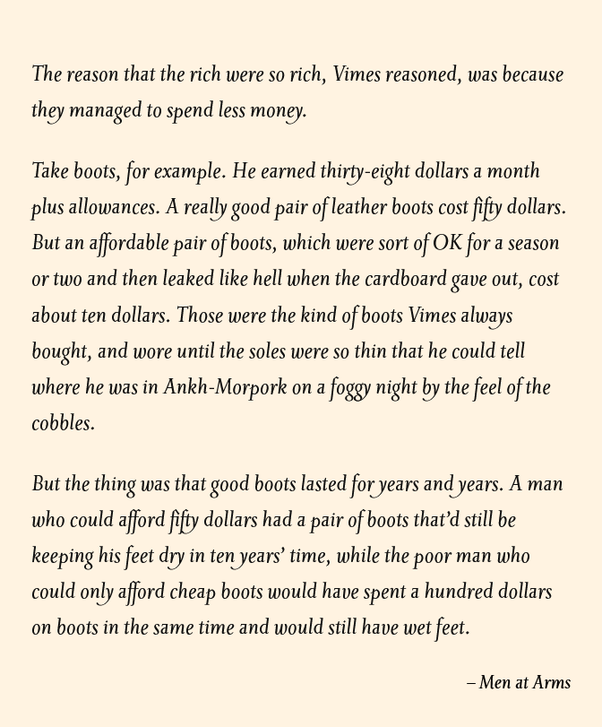
The most straightforward rendition of this view of economics is given by Terry Pratchett in his 1993 Discworld novel Men at Arms, through a character named Captain Samuel Vimes in a “Boots Theory of Economics”

Carney’s strength as an economist lies in his understanding of value and his focus on creating long-term benefits by developing a value-based rather than cost-based strategy.

This approach forgoes making quick promises to please the impatient among the crowd and requires time to develop. Some people innately understand the importance of creating a coherent strategy, and it was this unspoken expectation that a grifter like Drumpf leveraged through a trust-based scheme when he claimed to have “ideas of a plan.”

The difference here is that the work being done by Carney is obvious, and CONservatives help to make it obvious when they whine about how much gas he’s consuming by flying abroad to make deals with more stable nations than the U.S.

Carney has developed a strategic plan through his actions and decisions. He hasn’t yet summarized it in an action plan that the short-term thinkers demand. They must wait until his strategy becomes an actionable framework for followers.

Why has the UK’s economy grown so slowly under the Tories?

This post is a response to a question initially posed on Quora.

lol… but not lol

It’s sad.

It’s frustrating.

It’s maddening.

It’s a bang your head against the wall to relieve the pain of blind ignorance kind of thing.

It seems that no matter where one travels on this tiny blue pearl adrift in a lightless ocean, one universal constant that science does not accommodate is the obliviousness demonstrated toward a long and less than venerated history of fiscal incompetence by those branding themselves as fiscally competent by virtue of their propensity for preservation.

As the old adage goes, “It takes money to make money,” while the CONs among us lack the spine to explore beyond their survival instincts, which favour hoarding among the favoured class.

It’s always the little people who get stuck with the honourable burden of austerity, never the luxury recliner class. They deserve their effetes, after all, because they are superior to the little people. That’s why they’re considered “royalty,” and by God’s good graces, they have a divine Reich to rule.

They should not be expected to lift heavy fingers to make manifest a reality catering to their sensibilities. That’s what the little people are for.

The little people are the beasts of burden by divine decree, and no one should ever question that wizdumb.

Conservatives are fiscally conservative, and that makes them better money managers than the swarthy class, which demands to be paid for the value they contribute to society and the luxuries of the pampered class.

If the uncouth class manages power, then debts and deficits will be deemed horrendous failures in leadership. If they hold the keys to the halls of power, then debts and deficits are a feature, not a bug.

If the tree-hugging barbarians wish to spread the wealth around to their peers, that’s a grievous violation of overreach for which they must be punished. The trillions in wealth generated by the sweat of hundreds of millions of brows rightfully belongs to their natural rulers.

When they Reichfully sit upon their thrones, then they are empowered by the lard almighty to share it with their peers, and if it so happens that one of them over-indulges, they are permitted to trickle down the excess to the wanton waifs beneath them. They must be careful, however, not to release too much of a flood because that would embarrass their peers by revealing the extent of their gluttonous obscenities.

They cannot afford that sort of smear to their optics because that would incite the little people into another of their tizzies to make heads literally roll.

No one wants any more cake. It’s too disruptive to their digestion.

At any rate, their inability to peer past their navels and acknowledge themselves as members of the same species as the rabble they exploit into early graves makes it impossible for them to notice opportunity when it knocks on their over-filled bladders.

They would rather piss into their chamber pots than allow any of their precious golden treasure to be used to elevate the lot of humanity.


If they did that, they would soon run out of heads to trod upon and lose track of who was a worthy peer by birth or an anomaly by self-made fortune.


If this seems a bit cynical, it’s because it is quite cynical toward a movement that has steadily reversed the course of capitalism to raise a world out of poverty by weaponizing it as a means of establishing power. The economy belongs to everyone while our systems undergo a consolidation of power that has historically been the cause of systemic collapse and widespread chaos.

In the words of economist Dean Baker,

The market is just a tool, and in fact a very useful one. It makes no more sense to lash out against markets than to lash out against the wheel. The reality is that conservatives have been quite actively using the power of the government to shape market outcomes in ways that redistribute income upward. However, conservatives have been clever enough to not own up to their role in this process, pretending all along that everything is just the natural working of the market. And, progressives have been foolish enough to go along with this view.

The economy should serve the social contract, not subjugate it while Conservative politics the world around have never quite accepted the reality that we are, all of us, in this together. A successful and prosperous future requires a mindset that accommodates all needs, not just those one can personally benefit from. The fundamental difference between the conservative “me” mentality versus the liberal “we” mentality is the cause of poor economic performance. It always has been and it always will be because it constitutes myopic and self-serving thinking favouring power to the few, and not the people at large.

Should wealth be more evenly distributed?


Robin Hood Statue

No, but yes but no… but yes.

To “distribute wealth more evenly” implies a dictatorial imposition of a narrowly and politically defined sum of what constitutes “evenly.”

There are numerous problems with that strategy that go well beyond not fixing the underlying issues contributing to the corruption of what should be an agnostic system but isn’t due to how it has been corrupted.

This approach not only accomplishes nothing in the way of fixing the underlying issues, which, on that level alone, would create a “rubberband effect” of “snapping economics back to their originally corrupt state,” it would also justify an exacerbation of a centuries-long class warfare that has allowed the corruption of an economic system to take root. IOW. The degree of corruption existing today that has led to historic levels of income injustice would escalate from a cold war into a blazing furnace of vengeance against the little people by the wealthy. Their loss of wealth would be temporary, and they would be motivated by more than greed to rebuild their hoards; they would also be motivated by a desire for retribution.

We should focus instead on adjusting the parameters of a wealth redistribution system like capitalism to ensure wealth flows freely throughout the system rather than collect like plaque in arteries to clog up the entire system with private hoards held by a few whose obscene accruals threaten a system-wide collapse.

We need to establish rules to ensure equitability from a system-wide perspective to make fairness an inherent characteristic of the capitalist system. We need the system to rein in corruption at the top while empowering the middle and enabling the bottom.

If our economic systems were to operate on a holistic and agnostic basis, then success would not be a measure of how much wealth the wealthiest are collecting but how stable the economy is and the degree of economic mobility the system facilitates. We should measure economic success based on how people move out of poverty and into wealth. We should measure economic success on the stability and growth of the middle class. The middle class has always been the engine of the economy, and we must prioritize its health and efficiency to ensure that the entire system is stable.

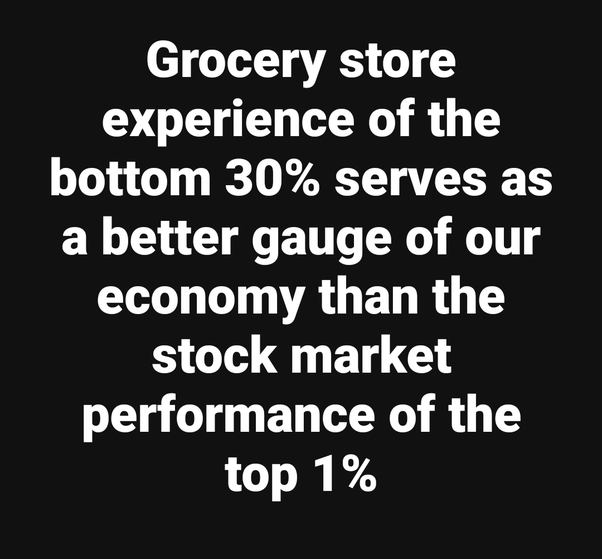
Grocery store experience of bottom 30% serves as a better gauge of our economy than the stock market performance of the top 1%.

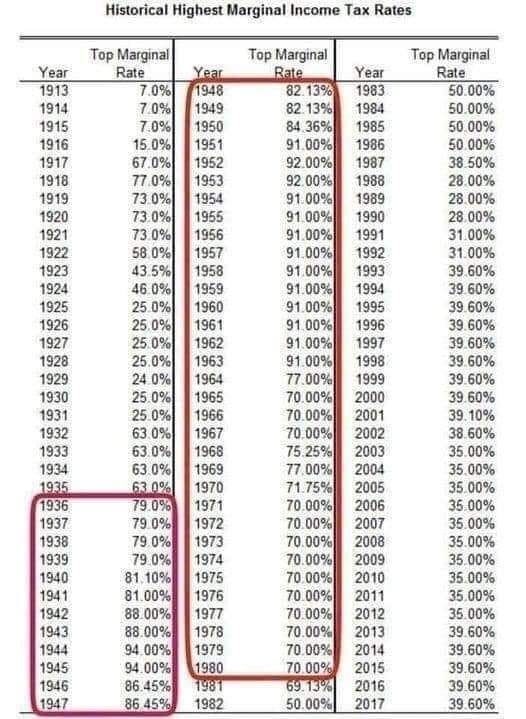
This can be “easily” accomplished (once the political will is established) through a few simple measures. We can begin with the adjustment of tax rates to levels historically proven to spur the greatest economic growth and the greatest growth of a thriving middle class.

Historic Highest Marginal Income Tax Rates

Restoring tax rates to Eisenhower levels incentivizes investments back into companies to hire more staff to minimize a tax burden. It means capital investments into the operation instead of stock buy-backs to boost share value and billionaire hoards.

Restoring tax rates to Eisenhower levels gives the economy a boost of liquidity flowing through the entire system to boost everyone’s well-being while restraining the excesses of greed, which contributes to creating a ruling class through a dynastic acquisition of wealth and political power.

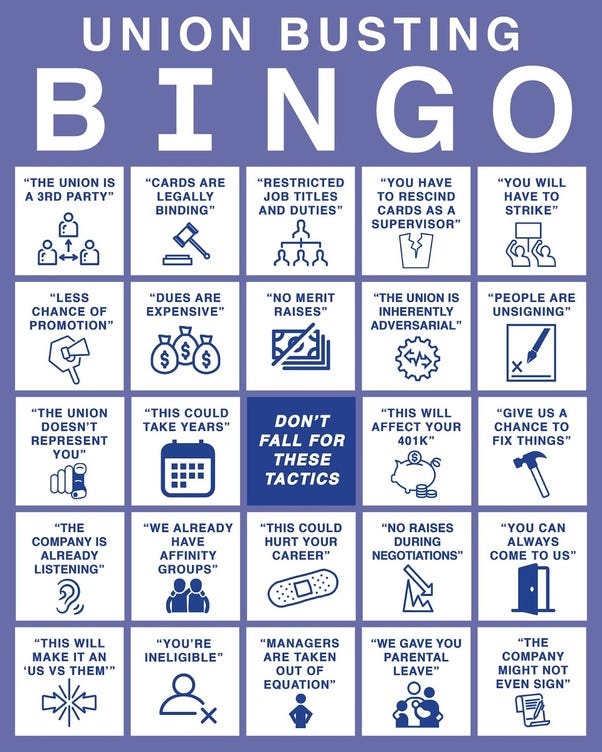
Restoring taxes to sane levels permits the implementation of a universal basic income that mitigates the leverage of wealth in labour negotiations. People will no longer be forced to choose between a depressed wage and basic survival. Since unions are an easy target to attack and disempower, as occurred following Reagan’s example, which led to a strategic initiative by employers to eradicate unions, UBI eliminates that weakness.

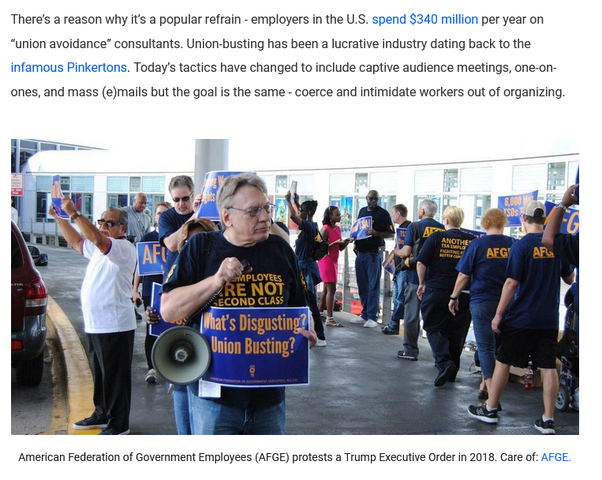
Employers in the U.S. spend $340 million per year on “union avoidance” consultants.
Union Busting Bingo

Union-busting: what to expect and how to respond

A Universal Basic Income provides economic stability for a nation because when a corporation contracts, thousands of jobs are lost, not just a few or dozens. The entire economy is impacted by an exaggerated shrinkage that benefits the wealthy at the expense of the working class.

The boom and bust outcome of a trickle-down economy is intentional because it is during a bust that the wealthiest make their greatest gains by leveraging desperation against people to buy out smaller businesses at fire sale prices.

Restoring tax rates to Eisenhower levels eliminates the boom and bust advantage while UBI insulates the vulnerable from the predatory practices of the wealthy.


The above represents two primary initiatives that would restore equity throughout the economy. These alone are temporary measures subject to reversals, putting us back on this same destructive track we are on.

We must cement fairness into our systems on levels greater than the simple vectors of corporate taxes and employee protections.

We must make fundamental changes to a vulnerable political system which allows the worst of our impulses to dominate political discourse while being manipulated through corrupt media enterprises owned by powerful stakeholders.

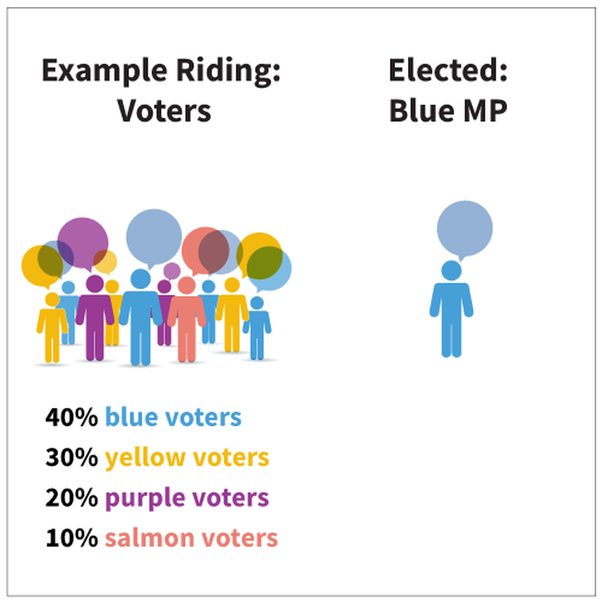
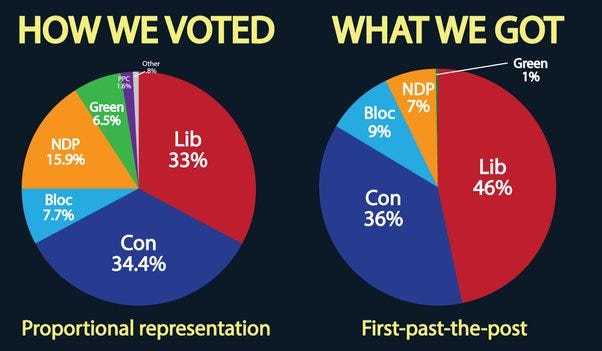
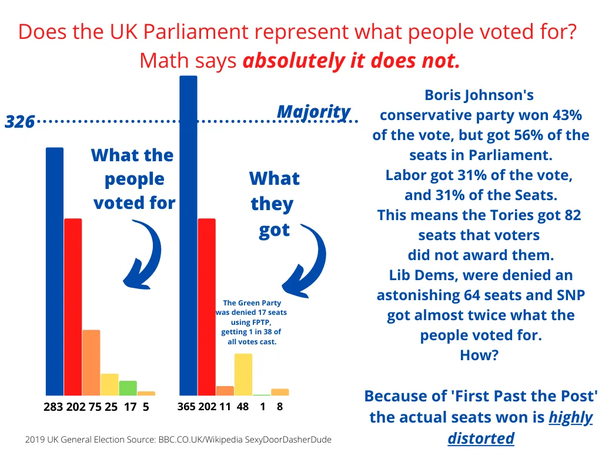
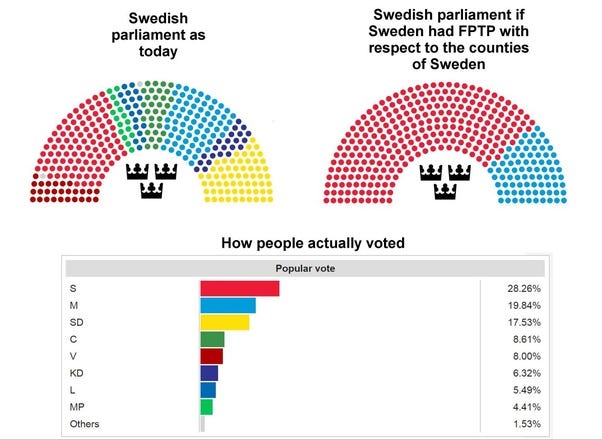
Electoral reform initiatives to eliminate the toxically competitive first-past-the-post elections and replace them with proportional representation and a ranked-choice voting process will eliminate the hegemony of party politics and allow a public to engage on an issue-resolution basis rather than be reduced to a gaggle of high school cheerleaders caught up in tribalist fervour.

This initiative also mitigates the impact of wealth on the election process because it’s much harder to “create a team of tax and revenue manipulators” when “multiple teams” exist in a multiparty system that more accurately reflects the different views and positions of a diverse voting public.

Eliminating private funding from the election process would also protect the political system from corruption. Both initiatives above would transform the entire political process into an agnostic system of representatives who fully represent the diversity of the people’s will.

First-Past-the-Post-Elections shut out most voices from representation to favour the horse race winner.

First Past the Post Elections do not represent the public.

Democracy is a government that is supposed to represent the will of ALL the people, not just the horse race-winning team.

Proportional Representation versus First-past-the-post
U.K. Election First-Past-the-Post versus Proportional Representation
Sweden use Proportional Representation
Swedish Parliament with Proportional Representation

Finally, the most difficult challenge to implement and arguably the most important initiative to protect our world’s democracies from the greatest villains we have ever fought throughout history is to rein in excesses at the top around the globe.

No one needs one billion dollars.

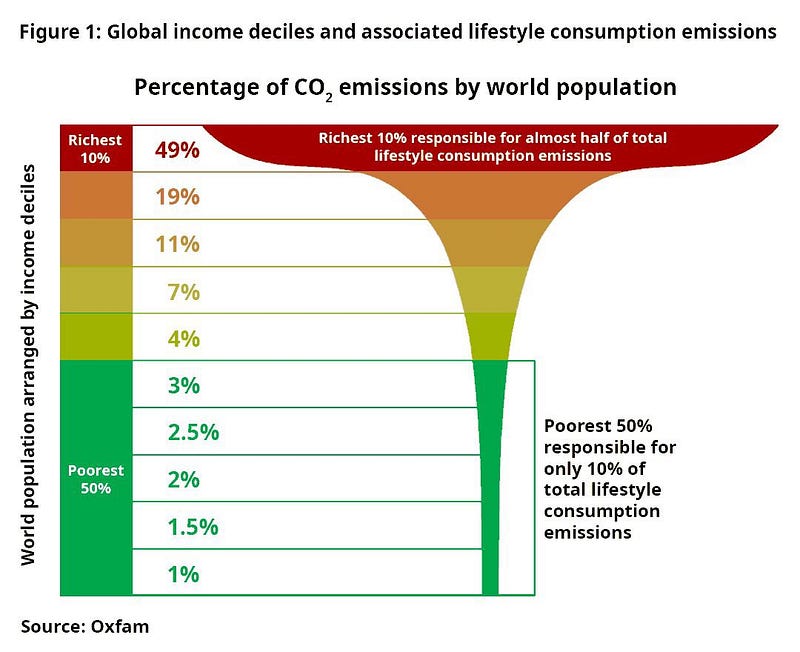
We should not keep breeding generation after generation of entitled people who assume their wealth equates to superior humanity and the right to shape the world in their image. The wealthy class is not comprised of superior beings but flawed humans. They possess too much power at such a degree of disproportion that they can individually tip the scales of humanity’s future toward extinction or utopia.

Guess where they are collectively leading us all today:

Oxfam — Percentage of Global CO2 Emissions by Lifestyle