
This post is a response to a question initially posed on Quora, and can also be accessed via “https://www.quora.com/Why-arent-Americans-taught-that-freedom-from-debt-is-an-important-freedom/answer/Antonio-Amaral-1“
For someone who values a debt-free existence, it can undoubtedly be viewed as an absence of a burden that enables greater freedom of choice. However, the entire system of capitalism is based upon leveraging debt to create revenue.
Revenue and profits are seen as far more powerful versions of freedom within a system that can be leveraged in ways in which the debts themselves can be resolved by servicing them with the increased revenue they generate or by being forgiven.
Of course, this form of debt is not the same as implied by the question, which is based on the notion of debt accrued in purchasing lifestyle augments. For example, a purchase of an air purifier I made just today was made through a credit card, constituting an assumption of debt on my behalf. This purchase will generate no revenue, but I applied my justifications to the decision before making it.
One can argue that my decision decreased my freedom, but that’s only a tiny part of my decision. I can easily say in favour of the practical benefits of making this purchase, even with the context of it ultimately increasing my freedom (from headaches, specifically). However, that makes this degree of granularity in decision-making a cartoon.
Suppose the point of this question is to criticize people for spending thousands on a 100″ television through credit debt instead of a quick payment of a couple of hundred for a 24″ television that would leave them debt-free. In that case, these discussions are merely psychological masturbation sessions where people are attempting to objectify subjective considerations for themselves and applying essentially bigoted reasoning to determine values of rationality toward decisions made by others for things they value.
The reality, however, is that if one is going to argue how debt freedom is an important freedom, then so are many other forms of freedom. For example, freedom from a crushing health exploitation system through a universal healthcare system is also an important freedom that many don’t consider freedom because they’re obligated to support it through their taxes — even if it means a reduced fiscal burden and improved services. The fact that they have no choice but to contribute to it, whereas they do have a choice in a privatized system to pay much more and be rejected by their insurance carrier to die, is also considered an important enough form of freedom for many that universal healthcare remains unimplemented in a nation that likes to think of itself as a bastion of freedom even though it has the highest incarceration rates in the world.
The point is that no matter how vital debt freedom seems to some, sound fiscal management skills are more critical because debt is contextual. The largest corporations in the world carry the most significant amount of debt and begin by getting deeply into debt. Our financial systems are geared around rewarding debt.
Your credit score, for example, drops when you’re debt-free and increases when you have debt and show that you can manage it. The only way to improve one’s debt ceiling is to go into debt. You can live your entire life being a cash-only person and living debt-free, but when you reach a point where you need debt to resolve an issue or accomplish a goal, going debt-free becomes a liability in your application for debt.
In short, Americans are not taught that freedom from debt is an essential freedom because it isn’t. The ability to service one’s debt through revenue constitutes a far greater level of freedom. After all, there isn’t one investment manager who counsels investing one’s money into risky investments. They always counsel investing other people’s money.
Some may wish to argue for a return to debtor prisons based on this dynamic, but that would just penalize the wrong people.
Here’s how wealthy people leverage debt to lower their cost of living, for example:
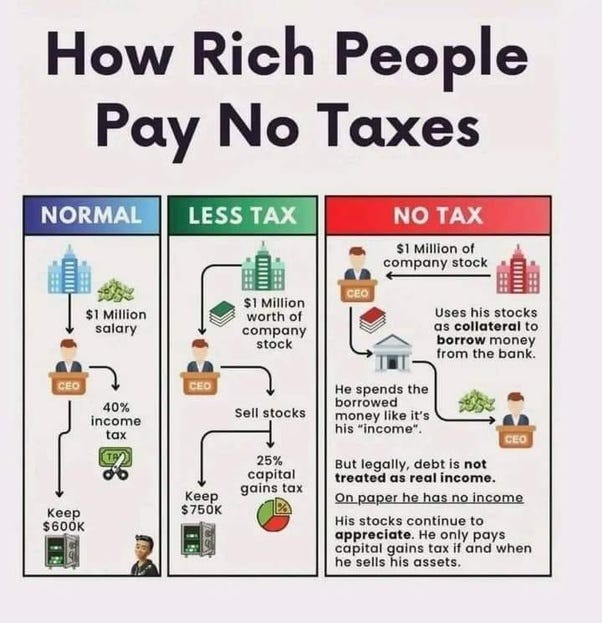
The wealthiest among us experience the most significant degree of fiscal freedom precisely by how they manage their debt.
The kind of debt and the thinking about debt described by this question is from an era when people could count on stable 40-year careers, prudent personal economic management, and modest living that would result in a comfortable retirement. Those days are long gone.


 thotbag