Why do the rich spend so lavishly instead of helping those in need?


This post is a response to a question initially posed on Quora, and can also be accessed via “https://www.quora.com/Why-do-the-rich-spend-so-lavishly-instead-of-helping-out-those-in-need/answer/Antonio-Amaral-1

…because they can, and because they’re being rewarded for their success in accruing large sums of money with more money by the puppets they pay to play the role of a government representative of the people.

Why should they care about helping those in need if that fundamentally changes nothing about the existence of those in need?

Why should they cut back on their trips across the globe for their favourite ice cream to ease someone’s suffering for only a few moments while they continue to suffer throughout their lives?

Isn’t it just easier to let the suffering die so that they can be done with their misery once and for all?

Don’t we shoot horses when they break their legs?
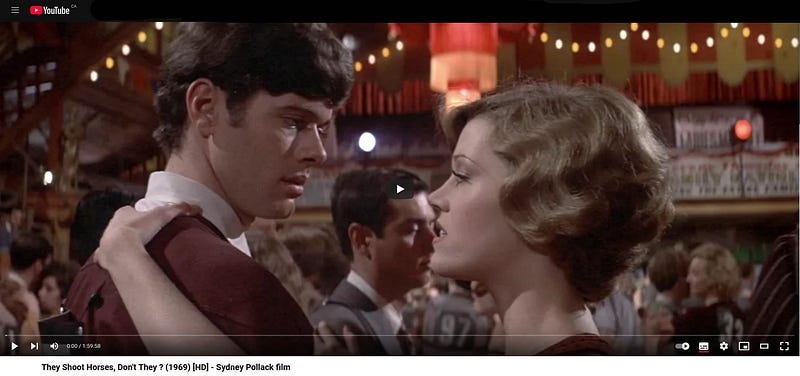
https://youtu.be/qsKQiVJkEvI?si=gfT7KT5PNSX-G4rJ

They Shoot Horses, Don’t They? (1969) ⭐ 7.8 | Drama

The real problem here is the concept of altruism. In an economically just world, altruism would be moot.

We already know that the executive boardroom is populated with the same density of psychopaths as a prison. Yet, we somehow expect they will be charitable enough with their money to sacrifice their luxuries to temporarily ease the pain of those suffering from unmet basic needs.

As individuals, they can only accomplish a little of anything.

As a group, however, we can ensure our system holds them accountable for their fair share of contributions to the world in which they disproportionately benefit from its bounties.

If they were held accountable for how they were at our height of middle-class growth, they would be more successful at helping all in need in proportion to their contributions as a whole because no one would benefit more or less from an act of altruism.

By returning tax rates on the wealthy to an Eisenhower level of progressive taxation, replete with the rules restricting corporations from benefitting from loopholes that permit them to escape a tax burden, we would resolve the needs of those in need on a systemic level.

We would not need to rely on a delusional expectation of the mega-wealthy to voluntarily practice austerity as has often been imposed upon the little people.
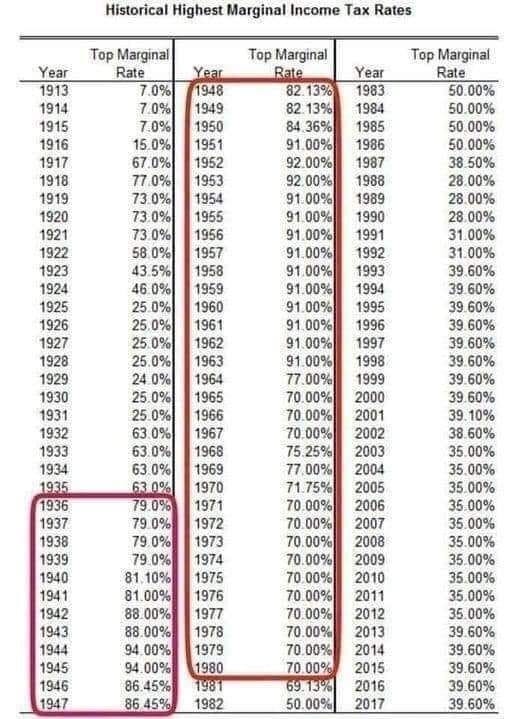
Have a close look at what happened to tax rates in the 1920s. That era was called the “Roaring 20s” because it had a booming economy due to the wealthy having much more disposable income. The same thing happened in the 1980s when Reagan dropped tax rates. The economy boomed briefly, and everyone loved Reagan because of it.

In both cases, those boom periods were finite and led, in the first case, to a worldwide war, while in the second case of Reagan’s tax cuts, it led to the “Great Recession.”

That’s what happens when large sums of money are released “out to the wild” for the peasants to get their trickle-down benefits. In the first case, that form of “voodoo economics” was called “Horse and Sparrow” economics because the Sparrow would benefit from all the food the horse hogged and shat out the other end.

That’s what trickle-down has always been. The little people get what the wealthy shit out as waste for them, and we’re supposed to find ways to live in dignity with that disgusting degree of indignity mounted onto our lives while we labour to make the rich wealthy.

It is precisely this dynamic that has been responsible for every social meltdown in history.

Meanwhile, if you look at that tax table, you’ll see the higher taxes resulted in the most tremendous growth ever for the middle class while the most significant number of people were lifted out of poverty.

None of it occurred because we relied on the generosity of greedy people but because we had our system tuned to maximize the benefits of a capitalist system.

“Trickle-down economies” are also called “boom and bust economies” because they go through cycles of recession and growth. The wealthy class loves this dynamic as the little people must suffer through periods of belt-tightening austerity. For the little people, austerity means having to go without essential needs being met, while for the wealthy class, austerity means excellent deals on going out of business sales. This is where they make their most significant cash grabs.

When small businesses thrive in a booming economy, they grow in value and expand while taking on more debt. That debt eventually crushes them when the cycle of a bear economy rears its ugly head. Many are forced to sell or go personally bankrupt and become devastated entirely for life. Many accept giving up the business that they grew out of love for what they were doing and allowed “an Elon Musk” to step in and claim credit for all their years of hard work while benefitting from that work to win humungous profits when the economy turned back into a bull.

It’s a class warfare game they have been playing with us as they corrupt the capitalist economy like it were a casino, and they’re the house that always wins, no matter how lucky any of the little people are.

This is why the guillotines come out whenever the little people figure out how badly rigged the game is against them.

The rich spend lavishly because they can and because they have rigged the game in their favour to specifically allow them to spend our money while programming the gullible among us to run interference for them as they victim-shame their fellow little people and accuse them of all the disgusting behaviours exhibited by the wealthy class, such as accusing the working class of wanting to steal the “hard-earned money of the rich” instead of demanding the money they stole returned to their victims.

The Disturbing Link Between Psychopathy And Leadership

Why are there more psychopaths in boardrooms?

Some care about those in need, but about 20% don’t, and they make it impossible to change the system because they invest billions in making it unfair while the rest reap the benefits of their corrupt activities. As a whole, they intentionally aim to strip the little people of our value precisely so they can spend gobs of money feeding their egos.

Due to their unrestrained behaviour, our species is on a trajectory toward extinction. Should we not push back on their greed and restore economic sanity, we won’t be able to continue at this pace, and we’ll be so severely humbled as a species that we may never recover, even if we survive the naive stupidity of our time.


Join the Conversation at https://ubinow.quora.com

Anyone wishing to engage in a dialogue on UBI is invited to participate in an open space on Quora dedicated to the issue. You may need to register for a Quora account — It’s free, and I don’t get any kickbacks from it. This space is intended purely for stimulating discussion on the topic — there are no hidden surprises beyond possibly needing to join Quora if you want to post comments. Visitors to the site can read the content without registration hassles.
https://ubinow.quora.com/

Why doesn’t the government give everyone 1 million each to save people from poverty?

This post is a response to a question initially posed on Quora, and can also be accessed via “https://www.quora.com/Why-doesn-t-the-government-just-give-everyone-1-million-each-to-save-people-from-poverty/answer/Antonio-Amaral-1

That’s an utterly ridiculous idea for many reasons. Probably the best example for showing how utterly absurd this idea is is not the devastating impact it would have on the economy.

The best example of why this idea represents a monolithic level of naivety is what happens when people win lotteries.

Massive lifelong windfalls are often mismanaged because people have no experience managing large sums and overestimate how far that will take them.

It’s much better to adopt the approach the wealthy class adopted with their children.

Providing people with enough to meet their needs until they can manage their affairs intelligently.

If they are responsible and resourceful, they will find they won’t need to rely on their entire inheritance to survive when it becomes available.

We are all part of a system into which we were born and collectively form a social contract by which our cumulative efforts guarantee the health of the whole.

Since we produce more than we consume, society is accountable to all its members to ensure everyone benefits enough to meet their basic needs.

The government should not participate in and create upward wealth redistribution schemes but spread the cumulative wealth to ensure people can survive with dignity.

We are at a point where it is not only feasible but inherently a superior form of economic management than we have in place now.

It will become ever more clear to ever more people as we march headlong in our transition to a fully automated society and entire classes of jobs vanish to be replaced by robots and AI.

Creating a sustainable lifeline gives people the space to be innovative because people are naturally creative problem solvers. Allowing people to determine their life course based on their interests is the quickest and most effective way to motivate them to invent new solutions to innumerable problems we all collectively face daily.

The solution is not a windfall because that is entirely counterproductive and a short-lived benefit with dramatically adverse effects on our economy that would radically increase poverty.

The solution to our economic and social issues is to provide for the basic survival needs determined by Maslow’s Hierarchy of Needs.

Food, shelter, clothing, security, and the ability to invest in oneself to build a future with dignity for oneself and one’s family.

Most people’s needs are modest and don’t require a radical sum of money to transform their lives without effort magically.

Most people rise to the challenge of building a better life if they can access systems instead of being barred from access because of prohibitive costs.

For example, instead of giving away money to drain into a sinkhole, provide free access to education, and people will take advantage of that to create better opportunities for themselves on their own and without any prodding.

The difference between thinking of supportive solutions and cynical solutions like this question is between a disparagingly misanthropic view of humanity and one’s neighbours and a caring and supportive view of one’s fellow citizens as human beings simply trying to live their best lives.

The sooner we can cure ourselves of this wholly destructive attitude toward each other that we have allowed to fester and grow in society, the sooner we can progress in making this a better world for everyone.

This wholly cynical view of humanity is cultivated mainly within the MAGAt crowd. It is deliberately cultivated by a small percentage of sociopathic billionaires who routinely dehumanize people and pit us all against each other so they can continue stripping us all of our dignity while ripping us off by the tens of trillions of dollars to send us into poverty and destitution while they laugh at our misery.

Why fascism always appears in economically struggling countries.

Freikorps members flying the flag of the German Empire during the Kapp Putsch, Munich, 1920.

When people suffer from economic struggles, particularly over a prolonged period, they become desperate for someone to step up to the plate and offer solutions they cannot devise for themselves. People become conditioned through desperation for a strong leader to take charge and “lead the way to prosperity.”

Desperation causes people to lose perspective, while critical thinking skills suffer from a need to quell the pain. Anyone who can convincingly present themselves as a saviour will be welcomed with open arms.

Even though the solutions to economic problems may be obvious, they’re also too far out of reach of hope to implement them.

In today’s world, we are dominated by a handful of wealthy people who control all our systems with deaf ears to the cries of the suffering. Most of their focus is on their well-being, fortunes, and plans for their futures and legacies. The rest of us matter only insofar as we can be useful to them.

As our economies have become global and our economic infrastructures have become multinational entities, we have lost our communities.

Only a few decades ago, our communities thrived by our connectedness to each other.

We have lost that, while those who have been the greatest beneficiaries of a global economy have lost their sense of community attachment because the entire globe is their playground.

The plutocrats among us who are most responsible for the economic hardships suffered by millions are entirely due to their wins at the expense of the millions suffering today. Their goal has never been to raise humanity out of poverty, even though that has been the promise of capitalism.

They have their armies of servants at their disposal to secure themselves against resistance and to continue reshaping the world into their image. They are perceived as being too far beyond the reach of laws to allow the little people any sense of hope for justice.

Anyone who can present themselves as a leader capable of alleviating their suffering is welcomed with a total investment of all their hopes and dreams, while a widespread perception of one capable of rising to that need is one from among the untouchable class. That’s why someone like Donald Trump can succeed in assuming control of an entire party through a cult level of worship.

The trouble is that leaders who claim to be their solution also demand their unquestioning loyalty and obedience. That’s the key which opens the door to fascism because the only way for a single leader to wield enough power is to align themselves with the existing status quo of power.

Donald Trump — “Nobody know the system better than me, which is why I alone can fix it.”