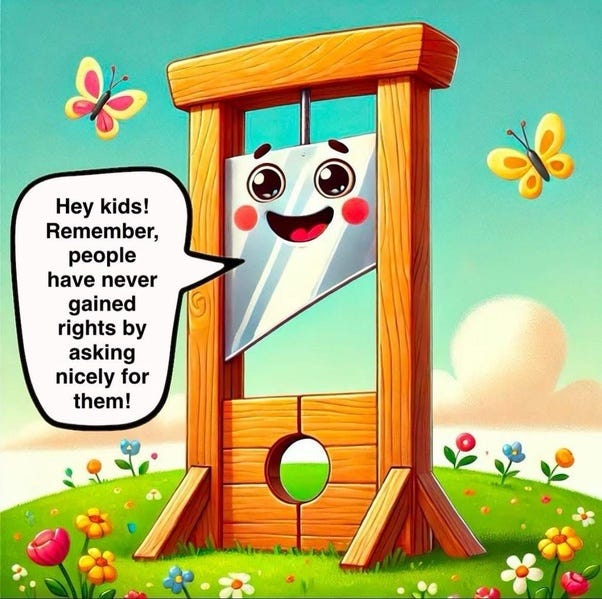
Would switching to Communism work?

This post is a response to a question posed in its complete format: “Would Communism actually work if every nation on the planet switched to it?”

Making a switch to an entirely new system is never as simple as a change of clothes.

Every significant change to an extensive system, such as a complete switch to a new form of governance, always comes at the cost of widespread chaos and rivers of blood coloured by horrors of every shade of nightmare.

That people keep talking about switching to new or resurrecting old systems because they’re overwhelmed by how broken our current system seems to be is, on one hand, understandable in their frustration and desire to restore sanity.

On the other hand, it’s horrifying to contemplate how little people understand how our current system should be working and why it isn’t working as intended.

It’s frustrating that people can see why our system is broken, as they get slapped by those reasons every day and remain utterly blind to the simple fixes that would right the upturned ship of state we all depend upon.

It’s the same kind of broken reasoning that claims we should hedge our survival bets by creating extraterrestrial colonies instead of focusing a fraction of those resources on restoring our world to a sustainable balance for life.

The simple answer to this question is that we should stop thinking about throwing the baby out with the bathwater and fix the leaks in the tub to more quickly return to struggle-free baby bathing with far less pain and suffering.

We can borrow elements and concepts from communism (and other systems) to modify and incorporate into our current systems of democracy and capitalism. Hybridization of systems has already occurred worldwide and has proven itself a successful strategy without mass casualties.

The Social Democracies developed in the Nordic nations are prime examples of the superiority of evolving systems over replacing them wholesale.

Let’s take a moment to think about an analogy that might simplify the concept of evolution over replacement.

Redesigning and building an engine from scratch still requires a lot of after-the-fact adjustment. No new engine design is fault-free from its first iteration. There are always necessary improvements to make following its first release, if not outright fatal flaws that could end production altogether.

Software applications are generally considered immature and buggy until at least the third major release. As an analogy, software development is an excellent model for understanding how social engineering can work when deliberately planned to accomplish long-term goals.

Software applications generally begin by focusing on core functions to meet various needs for various use cases. Minor updates are made to improve operational efficiencies, while new versions expand on core functionality and incorporate new features that are usually the highest in demand.

Social systems are far more complex, while system crashes cost lives. There’s not much wiggle room for errors when hundreds, thousands, and potentially millions of lives are affected by minor disruptions.

Have a look at these pictures:

Below are the same docks in L.A. that, currently, are mostly empty and without traffic. During the program this aired on (The Beat with Ari Melber — 2025.05.12), Representative Robert Garcia mentioned that before the tariff wars that Donald Trump (the deal-making artist) began, it would usually be too busy to walk where they walked without being run over by trucks due to a flurry of activity.
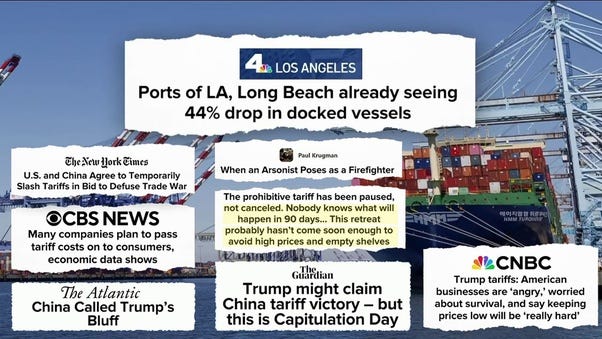
This is today’s result of the trade policy changes implemented three months ago. It took three months for a simple policy change to filter down to the port level. It will take a few more months before this effect trickles outward to impact every home nationwide.

It was mentioned in this report that hundreds of dock workers were out of work or had their hours cut back. The problem is much worse than a few hundred lost jobs, though, and they touched on the implications without adequately explaining what this all means.

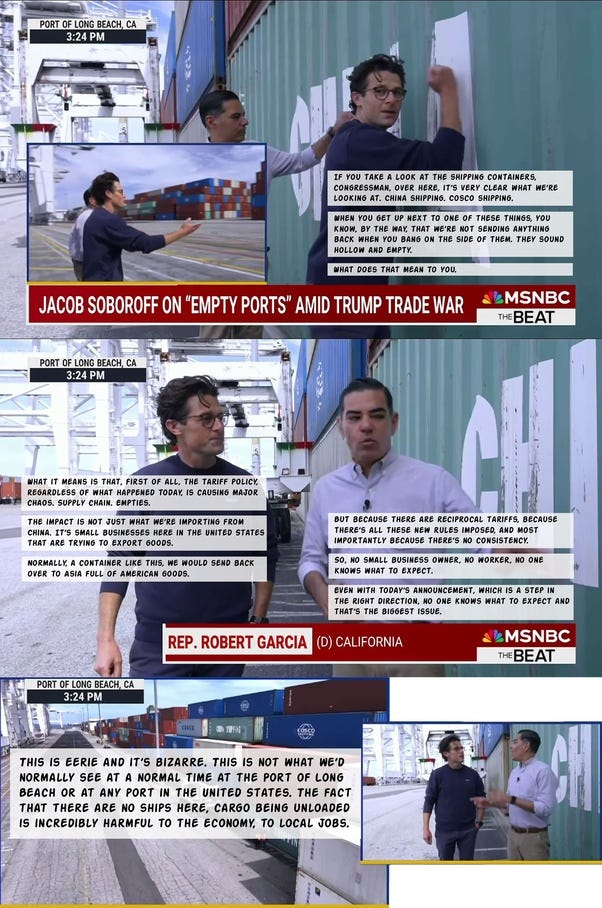
When I see these photos and hear them speak, I see a domino effect of thousands of bankruptcies picking up steam throughout the nation, to become hundreds of thousands of lives displaced and destroyed before escalating into millions of lives by next spring.

Donald Trump’s casual dismissal of the serious concerns of real people trying to survive while working multiple jobs to raise their families and pay for their living needs showed a sociopathic disregard for their struggles. When he responded with nonsense about parents needing to cut back on buying 30-plus dolls for their kids for Christmas, while he’s raking in hundreds of millions on cryptocurrency scams and spending $3 million taxpayer dollars on every day he golfs and another $100 million on a military parade for his birthday, it’s mindboggling how people can be so frustrated with their lives and not be livid with him.

Every callously self-serving decision he makes carries implications that dramatically affect lives for years. This is the impact one person can have on hundreds of millions of people in their nation. We may currently joke about memes like this. If the U.S. becomes his latest and greatest bankruptcy, very few people will laugh — and it won’t be the millions suffering the consequences of one man’s corrupt thinking.:

People worldwide will feel its impact even if it’s contained and doesn’t erupt into a global catastrophe. Millions will die. Some people still haven’t recovered from his first term in office.

This is the impact one person can have on a system that is so complex and tightly integrated that no one escapes the effects of its disruption. Imagine how dramatic the impact on people’s lives would be if, instead of a simple tariff war and an illegal immigration round-up to concentration camps orchestrated by one leader, chaos were ramped up to a full-scale restructuring of society as a whole.

If a simple Constitutional amendment requires decades of debate and challenges by competing interests, imagine how disruptive it would be to dismantle a centuries-old system and replace it with an untested one. You can claim Communism was implemented before, but it wasn’t. Perverted forms of it were implemented by despots who killed millions as they tried to remake their nation in their image, using that system as a tool for them to leverage, like Donald Trump and several others are doing today with capitalism.

There’s no way to ensure the Communism you or anyone imagines will be the Communism that would be implemented. Marx’s vision of Communism was never implemented before, and the perverted versions of his vision were worse than failures. Meanwhile, democratic governance with a capitalist system has already transformed the world. It has become so successful that several people have and do support Donald Trump’s perversion of it to become a monstrous betrayal of what it was designed to accomplish.

Changes to any system that hundreds of millions rely on for stability require predictability in their systems more than anything else it can provide.

Without knowing what’s coming next, when people don’t know what to do, they naturally do and risk as little as possible while rationing out reserves to ensure they can survive in a repressed state over an extended period.

Completely shutting down the tariff wars and restoring trade policy to where it was only a few months ago would still take several years to return the economy to a state resembling it only a few months ago.

Replacing an entire system with another system means several decades of adjustment would be required to arrive at a state of equilibrium where people could finally feel comfortable predicting their futures and making decisions with confidence in their predictions.

Several decades of adjustment would be required to switch from the current system to a system of communism that would be stable enough, where the cost in lives could be mitigated.

In the meantime, periods of chaotic transition create incentives for the parasitic predators among us to leverage the confusion in ways that benefit them at the expense of everyone else. This is precisely the dynamic we are struggling with today. Without addressing the core problem of a corrupting influence in society, we would simply be porting a virus that weakens us today to a new system to continue infecting our society while adapting their strategies to the new system.

The flying monkeys who enable their corruption would be ported along with them because that’s the nature of power. When power is concentrated in the hands of the few, they no longer need to act directly, while their supporters do all the heavy lifting of “massaging a system” to cater to their needs.

We can see that occurring primarily within the MAGA community as they’ve been frustrated with how much they’ve had to endure and are struggling ever more over the last few decades, instead of experiencing a general improvement in their quality of life, like their parents and grandparents before them. They are righteously angry because they have been betrayed. They can’t face the truth of who has been betraying them, so they accept easy targets to vent their frustrations onto.

We have all been violated on deep and visceral levels, leading us all to take desperate action to fix what we know is broken. The problem is that far too many people leverage their anger and ignorance of how systems work to further the oppression rather than mitigate it.

The people who are selling easy solutions are the same people who are responsible for creating the problems. Donald Trump embodies that scam. Many billionaires are billionaires precisely because of that scam. There isn’t one private prison billionaire who hasn’t specifically leveraged that scam. Insurance billionaires and weapons moguls are the most popularly recognized culprits of the fraud of benefiting from the problems they create. Elon Musk’s DOGE was an abomination of a scam that many still believe was an honest attempt at addressing waste and fraud rather than facilitating it all while giving Elon and many others an escape hatch from accountability for their criminal behaviours.

We can and should be fixing the bugs in our current system by eliminating exploits, such as placing a global cap on net worth and instituting UBI. No one should have more wealth and power than a small nation. If an individual can afford a personal army, then they are a threat to global stability. However, everyone in a system that produces more than what we can consume is entitled to the basics of survival while given access to whatever means are available to improve one’s status through tools of opportunity like housing, education, and healthcare.

That IS precisely what “promote the general welfare of the people” means.

What we can do is ensure distribution systems are equitable and maximize opportunity so that everyone has an equal chance to create some form of meaningful success for themselves. No one needs more than the basic implements to carve out a modest life for themselves by applying their efforts toward achieving goals. No one should be denied these basic tools in a post-scarcity society of abundance, particularly not when we’re on the verge of becoming a fully automated society.

No one should be permitted to hook up to major arteries in a system and drain wealth from it while doing nothing else but watch their hoards grow without restraint or limits.

People like Jeff Bezos and the Walton family spend hundreds of millions to thwart unionization efforts so that their underpaid people don’t have to rely on taxpayer dollars to make up the difference in being short-changed on their income.

We must restrain greed, not rebuild a new system for greedy people to continue exploiting the desperate and the gullible.

Changing our system doesn’t solve our problems when we’re not prepared to deal directly with the cause of those problems.

We still have time to address the causes of those problems before they escalate and find ourselves repeating a bloody history of correction.

Avoiding the cause of our problems by pretending we can gloss over the obscenity of gluttony with a rebuilt system from yesteryear means we’re just lying to ourselves and begging for chaos.
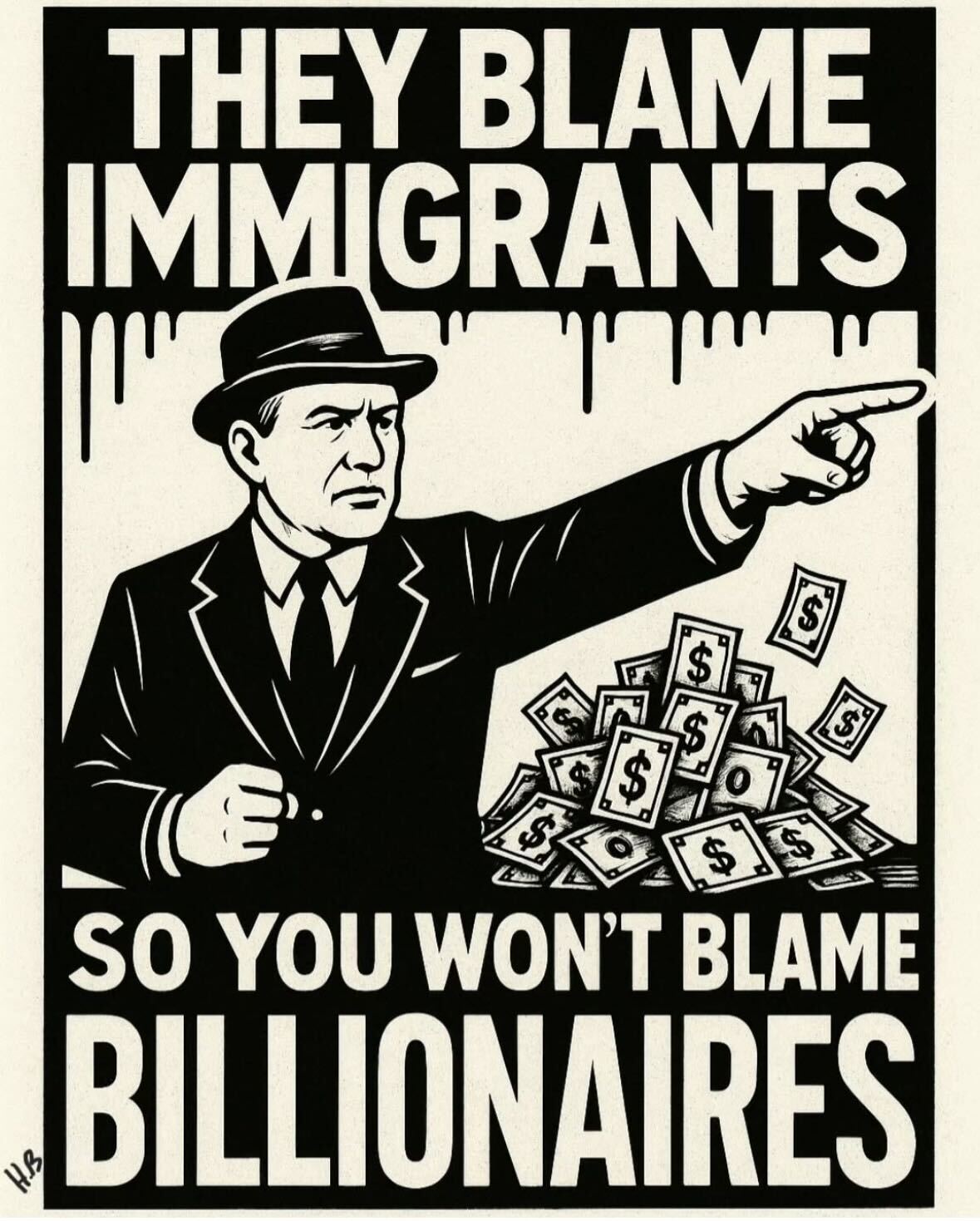
Why does the Chinese government look like geniuses run it?

This post is a response to a question posed in its complete format: “Why is that for Chinese living inside China, the Chinese government is not perfect, but for people looking at China from the outside, the Chinese government looks like it is run by geniuses who plan far ahead into the future?”

I believe it’s important to highlight a harsh truth that completely escapes MAGAt minds.

China isn’t “run by geniuses” but by ordinary minds who use “common sense” to plan “far ahead into the future.” They leverage the minds of their people, and many are geniuses, making incredible technological breakthroughs.

Nations cannot plan for the short term without missing the boat on the long term. People can prepare for the short term because the lives of individual people are short compared to the lives of nations. Nations must plan for millions of lives and not just one.

“Common sense” leadership is acknowledging one’s limitations and relying respectfully on the crowd’s wisdom to achieve a nation’s most significant potential. Authoritarian mindsets will always fail against this kind of “common sense.”

It doesn’t take a genius to figure this out.

All that’s required is not to be a stupid, short-sighted narcissist who thinks the world magically dances to the sound of one’s voice.

That’s precisely the problem fueling the self-destructive hubris sending the U.S. careening into becoming a third-world shithole and all of this is entirely due to the machinations of short-sighted bigots whose goal is the resurgence of another Reich because they continue to refuse to learn from history.

MAGAts may claim to value “common sense,” but their short-sighted and self-serving biases are not “common sense,” but an entirely “subjective and self-destructive sense.”

This period in history is teaching us once again that we must cure our species of the authoritarian virus that we have been fighting against since the dawn of human civilization.

China has had enough experience with authoritarianism to know how to handle the U.S. slide into fascism.

Why work if you can live on benefits?

This post is a response to a question posed in its complete format: “What’s the point of working if you can live through getting “benefits”?”

You’re asking the wrong question.

Instead, you should ask, “What is the point of living like a lazy slug who accomplishes nothing and does nothing to make themselves feel good about themselves or their lives?”

That’s what you’re implying with your question.

You imply a false dichotomy between living one’s life based on laziness rather than doing what motivates them or submitting themselves to an abusively dehumanizing existence as a disposable cog to make someone else rich while struggling with one’s self-respect.

Life isn’t a choice between working and not working. It’s a choice between employment as a wage slave or generating an income for oneself based on doing what matters to them and which motivates them to be excited about their lives.

Employment used to be a motivator when the income generated enough to go well beyond meeting basic needs and into enough disposable income to invest in one’s future.

That’s no longer the case.

Employment today is the equivalent of a lifetime of dog-paddling in an ocean until one gets too tired and drowns.

That’s not a life. That’s a lifetime prison sentence.

What’s the point of struggling in poverty until you die to make someone else wealthy when you can be much happier and less stressed while doing what you love?

Bonus Question:
Should there be a universal basic income to address economic inequality?

UBI doesn’t address the issue of economic inequity, and it isn’t intended to.

UBI provides economic stability and gives people room to make the best choices for themselves without having a desperate need to survive leveraged against them.

UBI frees people from the pressures of meeting basic survival needs enough to escape oppressive working conditions. The consequences of businesses losing the leverage of economic desperation to create downward pressure on wages can more easily permit upward pressure on wages.

This change in a negotiating dynamic contributes to a reduction in economic disparity, but it doesn’t address it head-on.

Would people continue to work with UBI?

This post is a response to a question posed in its complete format: “Would people continue to work if everyone received a universal basic income ($2,000 per month) for the rest of their lives?”

The numerous tests that have been performed bear out that they would, but that’s overlooking the problem with this question and its mindset.

The people who ask this question never bother to consider the percentage of the population that never has to work for someone else to sustain a living income.

The average net worth of the top 0.1% worldwide is around $62 million.

No one in this wealth category must work for an income at any point throughout their lives. Having their money in a low-interest-bearing account would be enough to live on the interest alone and without touching their capital.

0.1% of the population is 8 million people.

Eighty million people worldwide comprise the top 1% of the population, with an average net worth equivalent to the lifetime earnings of most reasonably upper-middle-class workers. No one in this entire group of 80 million people must be employed to survive comfortably.

Every time the question of how people will live once they are no longer forced into an (often abusive) employment relationship (in which abusive employment conditions comprise the primary reason people leave their jobs), the implication is that they will turn into lazy do-nothing slugs.

Meanwhile, 80 million people somehow find ways to keep themselves occupied daily without anyone wondering if they’re lazy layabouts. Even if they are, no one seems to care.

All of the tests performed to determine the viability of UBI involve people who would otherwise be compelled to work in soul-crushing roles while being subjected to people on power trips who should never have any power over other people.

No one who asks this question seems to consider how those 80 million people manage to make it through their lives doing absolutely nothing. No one assumes they do nothing because we see the results everywhere. In fact, without that group of 1% elites, we’d never know the upward mobility that has led to the creation of a centibillionaire class.

The reality that the misanthropes presuming people need to be herded like animals throughout their lives is that without having to piss away most of their lives on basic survival, people would invest their time in themselves and become involved in activities that bring meaning to their lives.

Whether that constitutes “work” or not is a matter of semantics. Many people who would not be required to commute to a daily dehumanizing ritual of functioning like a disposable cog would perform functions in society that many others would find valuable.

Some would devote their lives to becoming successful caretakers for their families, friends, and neighbours in need while adding positive value to their community with basic tasks such as performing chores others could not. They may choose not to devote their time to salaried activities because they would find more significant meaning in helping their community address some fundamental needs capitalists don’t care about addressing. After all, there’s no profit in providing mental health services to those in need.

(Meanwhile, we are suffering from a mental health pandemic affecting one in five people. A whopping majority — 70%-80% — of families are dysfunctional. We are a species in desperate need of focusing on our mental health issues.)

People in general would also be much more free to focus on community needs and political dynamics such that when they go to the polls to cast their ballot, they would do so from a perspective of much greater insight into the candidates and the issues than they can currently afford to focus on now while working two jobs to survive at a minimally conscious level.

(How are people supposed to find time to understand the intricacies of nuanced issues if a majority are unclear on how something as simple as how tariffs affect their lives?)

The people who ask this question also seem oblivious to how long and how much effort is required to develop a successful career. Without external resources and funding, creating a successful enterprise takes much more time than it does to create one that’s been heavily capitalized.

Let’s say, for example, you’ve created a special recipe for a unique jam that everyone in your neighbourhood loves. You can get busy and produce perhaps 1000 jars of jam per month, which earns you enough to continue making 1000 jars of product while supporting yourself, and while eventually being able to afford increasing your production slowly over time by being able to expand your operation by reinvesting into it. You can slowly add to equipment and materials and hire assistance on both a production level to increase output volume and a professional level to expand market presence.

Let’s say that your success allows you to create a one-million-dollar per year business after 10 years of effort. If you had the capitalization required to purchase all your equipment, staffing, and professional assistance up front, you could easily achieve that one-million-dollar per year revenue level within half the time.

This is how massive franchises grow from small mom-and-pop operations into national chains within a few years. Capitalization is everything in building a successful enterprise. If one has no capitalization, then time is everything to them. Time is money.

Without the wealth to propel a business into respectable success as defined by a capitalist marketplace, one still has to work hard on one’s dream to achieve it. People are not discouraged from working while collecting enough to live on in a UBI program. The opposite is true. They are free to pursue their dreams and benefit from the sweat of their brow without having to sacrifice their lives feeding a parasite that views them as disposable commodities.

People have a far greater incentive to work for themselves than they ever could working for an abusive employer.

That’s the lesson the one percent teach us about humanity.

Only misanthropic cynics believe human beings become slugs when they’re given enough money to choose not to submit themselves to making other people rich at the cost of their life satisfaction.

People don’t need to be whipped to work. Anyone with experience working with volunteers understands what it means to dedicate time and energy toward causes which matter, and the fact is that not all things which matter involve acquiring vast stores of material wealth.

Life satisfaction is worth far more than money.

The best and only way to achieve life satisfaction is to focus one’s time and energy on doing what they love and applying themselves to produce outcomes they can be proud of. Rarely does that satisfaction get defined by money… and certainly not by those in society whom we recognize as psychologically healthy individuals whom we respect and admire as human beings.

We have learned and continue to realize that those among us who worship wealth acquisition above basic human decency are the most broken and villainous threats to our social stability and progress.

People often blame money as the root of all evil, but that’s not the case; the love of money is above all else.

UBI is the freedom to pursue our higher human aspirations, not an excuse to become lazy.

If having money made people lazy, we would not now have centibillionaires walking among us in a psychotic competition to become the world’s first trillionaire.

What does calling farmers “collateral damage” mean?


This post is a response to a question posed in its complete format: “What does it mean in MAGA when Musk calls US farmers as “collateral damage”?”

The term “collateral damage” was first applied by the military when assessing how many innocent casualties would be created when assaulting an enemy.

It was a way of dehumanizing those who happened to be in the vicinity — in the wrong place at the wrong time — and who may or may not have been guilty of collusion with the target but were considered expendable.

For Elon, it means that he views the farmers whose lives he destroys as enemies whom he dehumanizes while waging a war against American citizens to acquire material wealth.

For someone like Elon to use this expression, he’s letting the little people know that’s how the 1% regards the majority of the people, as acceptable casualties in their power games.

He is confirming that the 1% view us all as less than human and as disposable as they have always considered their slaves to be throughout history.

The 1% have been consistent in choosing profit over lives. Elon has admitted it’s not an either/or situation but a situation of strategic intent to destroy the lives of the many to enrich the few.

Everything about the Trump administration is a blatant act of assault against the majority, while robbing us all and killing us in the process, not out of necessity but expedience.


Bonus Question:
What do you think of Musk’s Tesla losing money and Twitter crashing?

I think it can’t happen fast enough.

The best thing we can do for society and the future of humanity is to make the wealthiest man on the planet homeless and destitute.

Why?

Because it shows two things:

  • The wealthy are not invulnerable and
  • We can defeat their corruption without bloodshed.

How can a society allow everyone to succeed?

This post is a response to a question posed in its complete format: “How would you design a society where everyone has the opportunity to succeed?”

Until Ronald Reagan and Margaret Thatcher, humanity was well on its way to perfecting that democratic society in which everyone had a reasonable opportunity to achieve class mobility and a basic form of success that permitted a life of dignity with what was characterized as the “American Dream.”

A mortgage on a house with a surrounding picket fence, a vehicle, a family with 2.5 kids and an annual vacation wasn’t only possible but virtually guaranteed to anyone who made the effort to earn it.

They betrayed the entire middle class around the world to curry favour from the wealthy who have long desired a return to a barbaric age of kingdoms with rulers and disposable serfs.

We failed to modernize the one institution that has proven itself the greatest threat to the goal of an egalitarian society, industry.

Almost every other entity in society is a democratic body. Corporations, however, are holdovers from a medieval structure of rigid hierarchy fraudulently appointing members to an inner circle of power, allegedly based on merit, while elevating those who support their corrupt application of power.

We can repair this mess of corruption with only a few fixes, but one of the most important and most easily overlooked solutions will be a difficult challenge to implement. It will (and has been) meet(ing) massive resistance by those who most adamantly refuse to give up their power, as it involves restructuring how corporations exist and do business in society.

We can quickly implement numerous initiatives today, such as UBI, Universal Healthcare, and Universal access to education, that will have long-term implications leading toward much more stable societies that can guard against corruption.

Other initiatives, such as a global cap on personal net worth and restructuring industry into democratic institutions, are potentially much more disruptive to society. We are, however, fortunate to find ourselves amidst a radical transformation into full automation throughout every level of society. This transformation will allow us to restructure political systems while increasingly democratizing society and flattening global power structures.

The only way to ensure society can facilitate opportunities for everyone to succeed is to flatten power and spread it across the globe to the people. At this stage in our history, our existence faces an existential threat due to the corruption of disproportionate power running rampant throughout society. It may be the case that we will have to rely on historical inspirations to repair the damage the wealthy class has done to society and make reparations for their betrayal of the social contract.