This post is a response to a question posed in its complete format: “If Tesla automobiles are cheaper to make because of less human labour, why are they so expensive?”
Ah… the CON of capitalism is that the people believe price is a consequence of production costs when nothing could be further from the truth.
The cost of everything you buy is based on what the seller thinks will sell the most products.
Ironically, many people believe the most expensive products are the highest quality, and that misconception drives every vanity purchase.
It’s why capitalists like monopolies in their market. They can fix prices at whatever level they want, and people will gladly pay more for an inferior product. That’s how the health insurance industry works in the U.S. All they have to do is sell the idea that their consumers are getting a superior product at a lower cost because they’re not paying for supporting the poor or the immigrants they hate.
It’s a game of manipulating emotions and dulling logic with massive amounts of cheaply disseminated disinformation.
It is so successful at making billionaires richer that they’re trying to institute it in Canada. A handful of billionaires want to spread this formula worldwide with activist organizations they fund.
It’s why Donald Trump likes tariffs — they make people get used to paying more for their products so that when tariffs are lifted, prices drop by less than the tariffs, so that the products still sell at volumes they did before the tariffs were instituted.
Tariffs are a form of strategic price gouging for a market of Stockholm Syndrome victims.
We saw this strategy in action after the global pandemic lockdowns ended and supply lines returned to normal operations.
A product like the Swastitruck can be utter garbage, but because it’s unique in its design and grossly overpriced, people instinctively believe they are purchasing a superior quality product.
Market pricing is a psychological game that product manufacturers and sellers play with their consumers.
This post is a response to a question posed in its complete format: “Would you tell the truth about something to help the course of justice if it means you’d lose your job by means of corruption?”
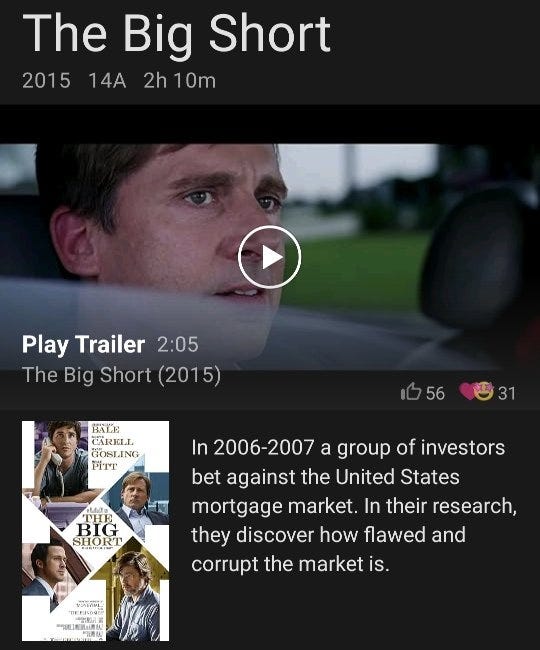
I’ve just rewatched “The Big Short” — a film about the cluster of greed and stupidity that made a few people rich and millions poor and poorer. The housing market grew in a stupidity and greed bubble that collapsed in 2008, and a publicly funded bailout ensued while long-term financial institutions were wiped out of existence.
One quote I caught this time around that I’m stunned I missed it the first time I saw it, or at least don’t remember it:
“For every one percent the unemployment rate goes up, forty thousand people die.”
The nation learned nothing and did nothing to prevent this scenario from repeating. The CDO (Collateralized Debt Obligation) — a corrupt means of bundling bad debts into bad investments to profit from- was not made illegal. However, it has been a rebranded gimmick to create profits for those with resources and market exploitation expertise.
Meanwhile, the U.S. is again heading for a major collapse because the American public seems incapable of learning from its mistakes.
This time around, however, the collapse will not be fixed by stealing from a non-existent middle class after all being robbed by trillions per year for decades.
The “Big Beautiful Bill” that Trump named will add a few trillion more to the national debt and deficit, while twelve countries have already announced they no longer accept the U.S. dollar. The U.S. dollar is losing its status as the world’s currency, making it less secure while the cost of borrowing increases (while investing shrinks).
The next stage is a credit downgrade, and store shelves will be emptier than during the pandemic while product prices go on a gouge fest that will definitely trigger a recession. There is no avoiding it now. How bad it gets is still outside my wheelhouse, but I will not be surprised if it’s deep enough to create a full depression.
The unemployment rate will skyrocket, and the forty thousand casualties of unemployment will break one million.
All of this can be possible only because hundreds of millions are so willing to lie to themselves that they can’t risk facing reality and the prospect of losing the stability they count on to survive in a dystopia.
However, they won’t have any more choices because instability and outright chaos are inevitable.
The arc of history may bend toward justice, but that’s because the trajectory of injustice always bends toward chaos.
There is no way to answer this question honestly because context and circumstances are fluid and unique to each situation. What may be true for a person one day within a given set of parameters may not be true the next day with different variables at stake.
One may hope they will make the moral choice and accept sacrifice, but that’s the kind of self-serving thinking that people often indulge in when thinking they would jump on a grenade to save a crowd.
One’s belief about one’s selfless nature rarely matches reality.
At the end of the day, whatever choice one makes will always be a balancing act between benefits and sacrifices that becomes a lifetime burden to carry.
This post is a response to a question posed in its complete format: “If the top one percent create jobs aka businesses, then without the everyday worker it would only be pipe dream right? Does money drip down not bottom up?”
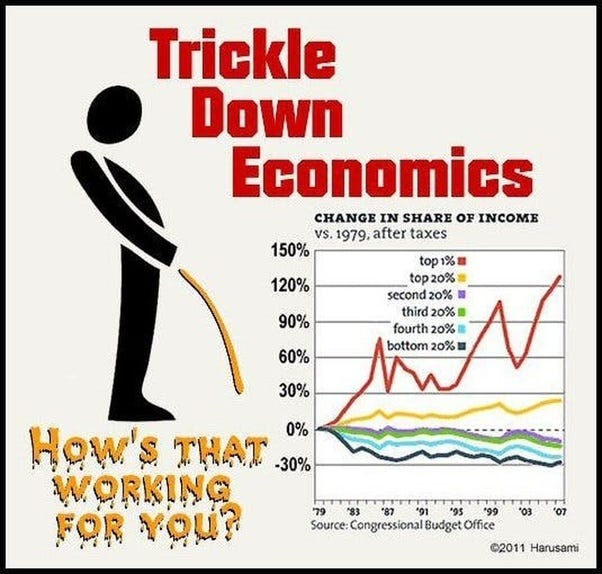
That certainly is the myth perpetrated by the one percenters, but that’s just a narrative they have invested millions in convincing the gullible to support their hoard-growing efforts.
Anyone who spends even just minutes thinking about how the working class is the engine of the economy knows that’s just bunk — simply due to numbers and how no business can survive without market demand, because you can’t force people to buy your product, no matter how much Elon Musk wishes it were the case.
The job creators in society are the mass of consumers who create enough demand within any market niche, which justifies hiring staff to meet demand.
Making matters worse has been how the one percent have perverted the capitalist system to reduce their tax burden and eliminate laws that would prevent them from indulging in job-killing initiatives like stock-buybacks that they then distribute to shareholders, board members, and executives.
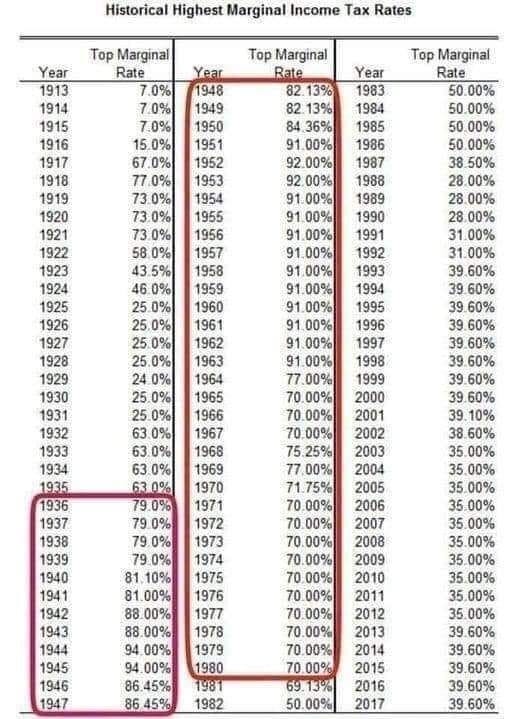
Fifty years ago, under a system of higher taxes and greater regulations limiting corruption, the one percent were incentivized to hire more people to reduce their tax burden. Further to all of that, and before the one percent went on massive “union-killing sprees” with corrupt “Right to Work” laws, the middle class had disposable incomes that they then reinvested back into the economy at greater proportions of their total wealth than the one percent ever have to create the most significant economic growth this world has ever seen.
When the middle class had disposable income, they would also have resources to create businesses and employ more people than is possible today. In today’s corporatist world, the only real employers of note are corporate employers who, when they have a bad quarter, make minor budget cuts that force hundreds to thousands at a time onto the unemployment line.
Fifty years ago, a business could fail, and fewer than one hundred people would be unemployed, with the economy easily absorbing that without a downturn. There was also enough diversity and opportunity for the recently unemployed to find new employment within one or two weeks.
In today’s world, corrupted by the one percent’s greed, people going years without finding suitable employment is not unheard of.
Money in the hands of the gluttonous never drips down. It collects in hoards to cater to sociopathic egos who regard those less fortunate with the same disdain many today consider the poor and homeless.
An economy is like a garden that relies on a strong root structure before flowering.
Economies grow from the bottom up.
Supply-side economics is a wealth redistribution scam responsible for putting the middle class on life support and making home ownership an unattainable dream, fifty years after Reagan betrayed the working class and changed the direction of the ship of state to become a tool of the oppressive class of one percenters.
Economies grow from demand.
No flower can survive without roots, just like no economy can be sustained without demand.
This post is a response to a question posed in its complete format: “Would Communism actually work if every nation on the planet switched to it?”
Making a switch to an entirely new system is never as simple as a change of clothes.
Every significant change to an extensive system, such as a complete switch to a new form of governance, always comes at the cost of widespread chaos and rivers of blood coloured by horrors of every shade of nightmare.
That people keep talking about switching to new or resurrecting old systems because they’re overwhelmed by how broken our current system seems to be is, on one hand, understandable in their frustration and desire to restore sanity.
On the other hand, it’s horrifying to contemplate how little people understand how our current system should be working and why it isn’t working as intended.
It’s frustrating that people can see why our system is broken, as they get slapped by those reasons every day and remain utterly blind to the simple fixes that would right the upturned ship of state we all depend upon.
It’s the same kind of broken reasoning that claims we should hedge our survival bets by creating extraterrestrial colonies instead of focusing a fraction of those resources on restoring our world to a sustainable balance for life.
The simple answer to this question is that we should stop thinking about throwing the baby out with the bathwater and fix the leaks in the tub to more quickly return to struggle-free baby bathing with far less pain and suffering.
We can borrow elements and concepts from communism (and other systems) to modify and incorporate into our current systems of democracy and capitalism. Hybridization of systems has already occurred worldwide and has proven itself a successful strategy without mass casualties.
The Social Democracies developed in the Nordic nations are prime examples of the superiority of evolving systems over replacing them wholesale.
Let’s take a moment to think about an analogy that might simplify the concept of evolution over replacement.
Redesigning and building an engine from scratch still requires a lot of after-the-fact adjustment. No new engine design is fault-free from its first iteration. There are always necessary improvements to make following its first release, if not outright fatal flaws that could end production altogether.
Software applications are generally considered immature and buggy until at least the third major release. As an analogy, software development is an excellent model for understanding how social engineering can work when deliberately planned to accomplish long-term goals.
Software applications generally begin by focusing on core functions to meet various needs for various use cases. Minor updates are made to improve operational efficiencies, while new versions expand on core functionality and incorporate new features that are usually the highest in demand.
Social systems are far more complex, while system crashes cost lives. There’s not much wiggle room for errors when hundreds, thousands, and potentially millions of lives are affected by minor disruptions.
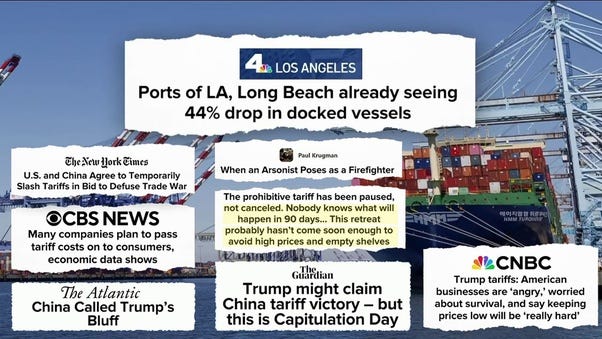
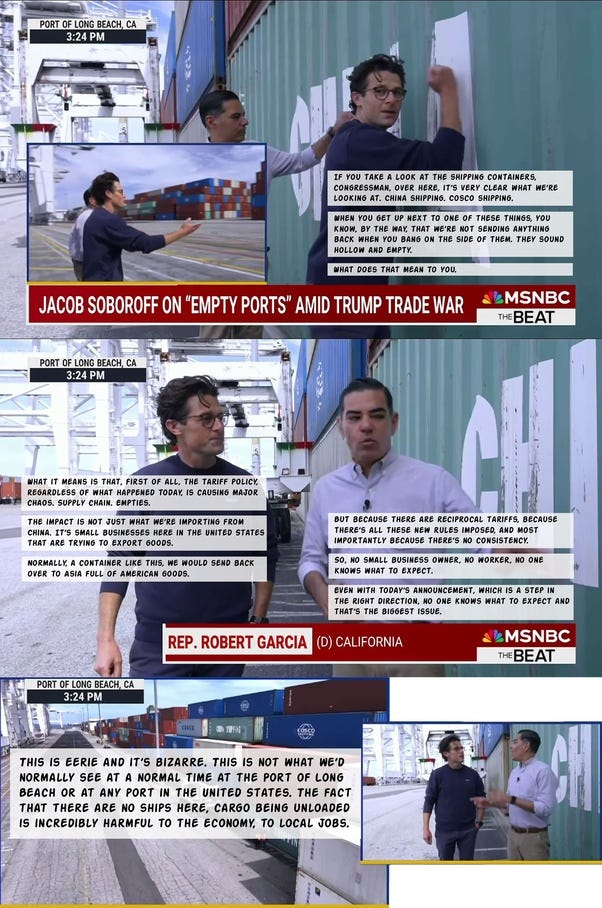
Have a look at these pictures:
Below are the same docks in L.A. that, currently, are mostly empty and without traffic. During the program this aired on (The Beat with Ari Melber — 2025.05.12), Representative Robert Garcia mentioned that before the tariff wars that Donald Trump (the deal-making artist) began, it would usually be too busy to walk where they walked without being run over by trucks due to a flurry of activity.
This is today’s result of the trade policy changes implemented three months ago. It took three months for a simple policy change to filter down to the port level. It will take a few more months before this effect trickles outward to impact every home nationwide.
It was mentioned in this report that hundreds of dock workers were out of work or had their hours cut back. The problem is much worse than a few hundred lost jobs, though, and they touched on the implications without adequately explaining what this all means.
When I see these photos and hear them speak, I see a domino effect of thousands of bankruptcies picking up steam throughout the nation, to become hundreds of thousands of lives displaced and destroyed before escalating into millions of lives by next spring.
Donald Trump’s casual dismissal of the serious concerns of real people trying to survive while working multiple jobs to raise their families and pay for their living needs showed a sociopathic disregard for their struggles. When he responded with nonsense about parents needing to cut back on buying 30-plus dolls for their kids for Christmas, while he’s raking in hundreds of millions on cryptocurrency scams and spending $3 million taxpayer dollars on every day he golfs and another $100 million on a military parade for his birthday, it’s mindboggling how people can be so frustrated with their lives and not be livid with him.
Every callously self-serving decision he makes carries implications that dramatically affect lives for years. This is the impact one person can have on hundreds of millions of people in their nation. We may currently joke about memes like this. If the U.S. becomes his latest and greatest bankruptcy, very few people will laugh — and it won’t be the millions suffering the consequences of one man’s corrupt thinking.:
People worldwide will feel its impact even if it’s contained and doesn’t erupt into a global catastrophe. Millions will die. Some people still haven’t recovered from his first term in office.
This is the impact one person can have on a system that is so complex and tightly integrated that no one escapes the effects of its disruption. Imagine how dramatic the impact on people’s lives would be if, instead of a simple tariff war and an illegal immigration round-up to concentration camps orchestrated by one leader, chaos were ramped up to a full-scale restructuring of society as a whole.
If a simple Constitutional amendment requires decades of debate and challenges by competing interests, imagine how disruptive it would be to dismantle a centuries-old system and replace it with an untested one. You can claim Communism was implemented before, but it wasn’t. Perverted forms of it were implemented by despots who killed millions as they tried to remake their nation in their image, using that system as a tool for them to leverage, like Donald Trump and several others are doing today with capitalism.
There’s no way to ensure the Communism you or anyone imagines will be the Communism that would be implemented. Marx’s vision of Communism was never implemented before, and the perverted versions of his vision were worse than failures. Meanwhile, democratic governance with a capitalist system has already transformed the world. It has become so successful that several people have and do support Donald Trump’s perversion of it to become a monstrous betrayal of what it was designed to accomplish.
Changes to any system that hundreds of millions rely on for stability require predictability in their systems more than anything else it can provide.
Without knowing what’s coming next, when people don’t know what to do, they naturally do and risk as little as possible while rationing out reserves to ensure they can survive in a repressed state over an extended period.
Completely shutting down the tariff wars and restoring trade policy to where it was only a few months ago would still take several years to return the economy to a state resembling it only a few months ago.
Replacing an entire system with another system means several decades of adjustment would be required to arrive at a state of equilibrium where people could finally feel comfortable predicting their futures and making decisions with confidence in their predictions.
Several decades of adjustment would be required to switch from the current system to a system of communism that would be stable enough, where the cost in lives could be mitigated.
In the meantime, periods of chaotic transition create incentives for the parasitic predators among us to leverage the confusion in ways that benefit them at the expense of everyone else. This is precisely the dynamic we are struggling with today. Without addressing the core problem of a corrupting influence in society, we would simply be porting a virus that weakens us today to a new system to continue infecting our society while adapting their strategies to the new system.
The flying monkeys who enable their corruption would be ported along with them because that’s the nature of power. When power is concentrated in the hands of the few, they no longer need to act directly, while their supporters do all the heavy lifting of “massaging a system” to cater to their needs.
We can see that occurring primarily within the MAGA community as they’ve been frustrated with how much they’ve had to endure and are struggling ever more over the last few decades, instead of experiencing a general improvement in their quality of life, like their parents and grandparents before them. They are righteously angry because they have been betrayed. They can’t face the truth of who has been betraying them, so they accept easy targets to vent their frustrations onto.
We have all been violated on deep and visceral levels, leading us all to take desperate action to fix what we know is broken. The problem is that far too many people leverage their anger and ignorance of how systems work to further the oppression rather than mitigate it.
The people who are selling easy solutions are the same people who are responsible for creating the problems. Donald Trump embodies that scam. Many billionaires are billionaires precisely because of that scam. There isn’t one private prison billionaire who hasn’t specifically leveraged that scam. Insurance billionaires and weapons moguls are the most popularly recognized culprits of the fraud of benefiting from the problems they create. Elon Musk’s DOGE was an abomination of a scam that many still believe was an honest attempt at addressing waste and fraud rather than facilitating it all while giving Elon and many others an escape hatch from accountability for their criminal behaviours.
We can and should be fixing the bugs in our current system by eliminating exploits, such as placing a global cap on net worth and instituting UBI. No one should have more wealth and power than a small nation. If an individual can afford a personal army, then they are a threat to global stability. However, everyone in a system that produces more than what we can consume is entitled to the basics of survival while given access to whatever means are available to improve one’s status through tools of opportunity like housing, education, and healthcare.
That IS precisely what “promote the general welfare of the people” means.
What we can do is ensure distribution systems are equitable and maximize opportunity so that everyone has an equal chance to create some form of meaningful success for themselves. No one needs more than the basic implements to carve out a modest life for themselves by applying their efforts toward achieving goals. No one should be denied these basic tools in a post-scarcity society of abundance, particularly not when we’re on the verge of becoming a fully automated society.
No one should be permitted to hook up to major arteries in a system and drain wealth from it while doing nothing else but watch their hoards grow without restraint or limits.
People like Jeff Bezos and the Walton family spend hundreds of millions to thwart unionization efforts so that their underpaid people don’t have to rely on taxpayer dollars to make up the difference in being short-changed on their income.
We must restrain greed, not rebuild a new system for greedy people to continue exploiting the desperate and the gullible.
Changing our system doesn’t solve our problems when we’re not prepared to deal directly with the cause of those problems.
We still have time to address the causes of those problems before they escalate and find ourselves repeating a bloody history of correction.
Avoiding the cause of our problems by pretending we can gloss over the obscenity of gluttony with a rebuilt system from yesteryear means we’re just lying to ourselves and begging for chaos.
This post is a response to a question posed in its complete format: “What are the most promising innovations or strategies today that could sustainably eliminate extreme poverty within the next generation?”
Thank you for the A2A, Faux-Bill. It is well beyond obvious that you are not the OG Bill Gates but a pretender. Whatever motivates you to disguise yourself as him and pose questions that he never would in such a forum is rationalized as a strategy for gaining attention that you believe you would not otherwise get.
I don’t believe questions like these require the kind of “celebrity boost” you’ve attached to them because I’m sure many people are thinking about these issues. Many politicians sadly believe people’s thoughts on these issues are irrelevant to their societal role. Nothing could be further from the truth because most of the world’s citizens sincerely desire an end to unnecessary strife across the globe.
Only the most psychologically scarred members of society wish harm to people on the other side of the globe or in the dingiest parts of their cities.
Even though people know this is a fake profile and that many would overlook this question based on precisely that, some people will still step forward and offer their views. Their answers support what I just said about people wanting to see change for the better, particularly when it is within our means to eliminate extreme poverty today.
Sadly, many politicians fail to comprehend that we are in this together, and that together means all of humanity must work toward common goals, such as eliminating poverty for it to happen. Even worse is that success requires our politicians to play the role of leader in society in earnest rather than as a performative lark to disguise their motivations for personal gain.
Far too few view their role beyond the boundaries of gamesmanship within the local jurisdiction of interpersonal dynamics of cliques, such as those commonly found in high school environments. They perform for each other and to the public at large. At the same time, their functional contributions are limited to shuffling game pieces in a subsection of the larger gameboard of their political community. Forget about communities elsewhere. That would constitute effort in thinking about and doing something about something elsewhere that isn’t directly connected to the influential factors governing their daily lives. Indirect connections don’t factor into their minds.
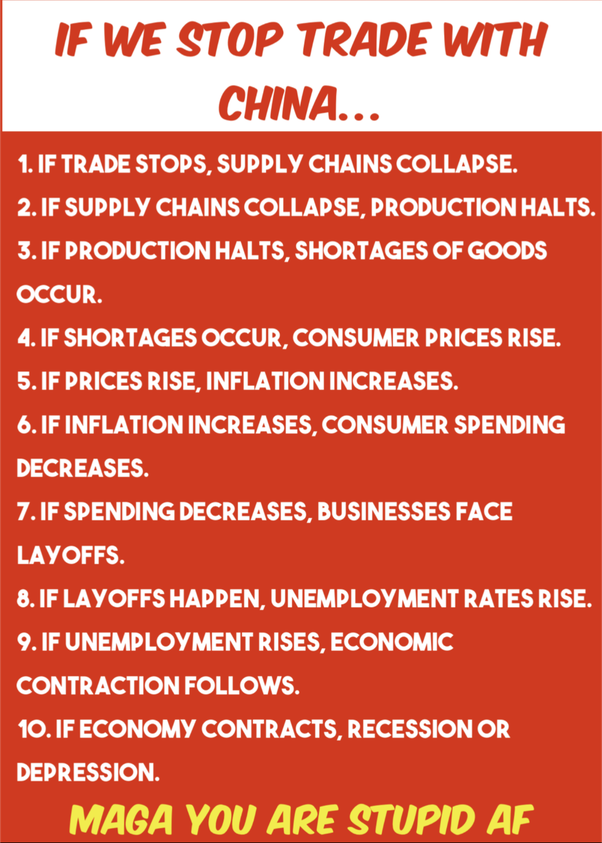
Here’s an obvious example of the complexity of dynamics that not enough people consider in their thoughts about how to improve our world and address issues like extreme poverty on the other side of the globe:
In this simple description of consequences, ten interconnected steps are outlined to arrive at the fundamental message that closing a door to a trading partner out of spite hurts oneself more than it hurts the trading partner.
China’s economy will contract briefly as it adjusts to a new reality. Americans, however, will suffer more in the long term because this attitude of bullying one’s partners closes off many doors of opportunity.
The same is true with the global tariff tirade and betraying a long-standing alliance with a supportive partner. Isolationism hurts the isolationists more than it hurts anyone they reject, and that’s where we’re at when considering issues of extreme poverty on the other side of the globe.
It is, unfortunately, too easy to rationalize how those problems “over there” are not one’s concerns here, but the reality is that poverty exists here as well. It’s just an arguable point about which is the easiest to ignore.
As you can see from the variety of answers given to this question and the variety of questions similar to this one, along with all the many other answers given to those questions, people want to solve this problem.
This brings us to the core problem at the heart of why the problem identified within this question persists.
The sad reality is that the core problem is YOU, Bill.
You and the existence of centibillionaires in today’s world are the reason why extreme poverty persists.
I understand how easy it is to rationalize your business successes as justification for having superior insights that can function like a paternalistic entity that can guide the little children of humanity toward a brighter future. I understand your rationale for the sheer capitalization required to provide the world with ecologically superior toilets. Still, you already know how you managed to distribute millions of life-saving nets in underdeveloped environments only through synergy. You relied on many people to rally behind your cause and donate whatever small amounts they could to solve a serious problem affecting millions of lives.
You made that happen, not with your capitalization but by leveraging some of your resources, connections, and celebrity status to mobilize people worldwide to provide a simple solution to a destructive problem.
Suppose you and the rest of the world sincerely desire an end to extreme poverty. In that case, there is only one solution, which begins with triage to stem the bleeding of resources that could collectively resolve the problem instead of exacerbating it, as has been the case due to extreme economic disparity.
The most successful way we have been in eliminating poverty worldwide as a society and a species has been through the massive growth of the middle class, as we experienced following the Second World War, FDR’s New Deal, and the development of unions.
By empowering the middle class with disposable income, we boosted economic performance along many vectors that were also boosted by force multipliers, which spread outward in orders of magnitude beyond what is possible today with coalesced wealth.
The existence of centibillionaires has made the goal of eliminating poverty impossible because this historically destructive concentration of wealth creates poverty through a contraction of available economic resources once wielded by hundreds of millions of people.
You know this. At least, the real Bill Gates does… as does every billionaire around the globe.
You cannot become a billionaire and be oblivious to how your concentrated wealth is a deprivation of wealth for others.
None of you is blind to this.
Since it’s taken decades of erosion of the gains that took a capitalist system decades of growth to achieve the highest level of poverty elimination, reversing that damage would mean decades of effort we don’t have the luxury of taking without experiencing a system-wide collapse.
We need bold efforts and fundamental changes to the economy and structure to meet a rapidly changing employment dynamic. We have no choice but to retool our economy before an increasingly rapid transformation toward fully automated societies where most production is performed in dark factories.
Suppose we don’t institute bold changes today. In that case, the transition will result in massive numbers of collateral damage that will be responded to with system-wide chaos because people will not shut up and die quietly as they find themselves starving for food and made homeless. When people have nothing left to live for after having their means of survival stripped from them, they become radicalized to such a degree that they are like cornered animals and will bring much destruction to the world before they exit it.
We need to reverse course on the corrosion done to our economies through the problem of wealth disparity yesterday. This should not be a debate today; if you were the real Bill Gates, you know this.
There isn’t a single billionaire who doesn’t understand this. You are all also hedging your bets while, like every cowardly politician who doesn’t want to risk their comfortable positions, none of you want to be the first to acknowledge what needs to be done. Your reticence is understandable because your community is primarily dominated by sociopathic thinking. It would behoove you to remind your peers that each passing day this nightmare of disparity remains unaddressed is a day closer to the massive unrest that brings out the guillotines.
This brings us to the core concern driving this question.
Which strategy is the most effective resource to invest your attention?
What singular and most expediently implemented solution can effectively stave off and resolve the growing pressure leading to widespread chaos?
That’s easy, and you already know the answer… if you were the real Bill Gates.
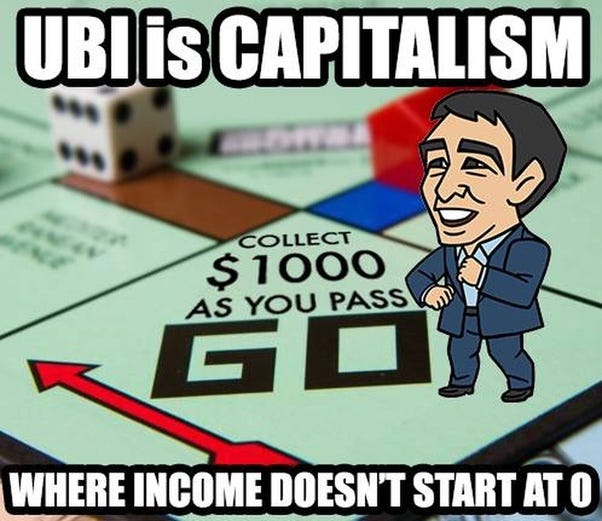
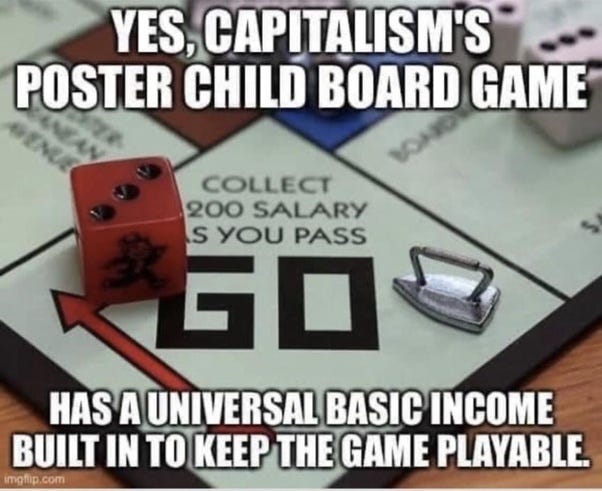
Reset capitalism like a Monopoly board.
There’s been enough testing to know this is THE solution to restore economic justice and dramatically impact poverty worldwide.
You already know this.
The only real issue at stake is the best means of implementing it.
Here’s a link introducing the various issues to consider with costing strategies that can be discussed earnestly. These are just details to work out. The result, however, is a stable economy that can eliminate poverty worldwide while eventually making performative forms of altruism moot.
However, every one-percenter should champion this solution in principle in earnest today, particularly if they want to avoid the chaos that risks them losing everything.
This post is a response to a question posed in its complete format: “What’s the point of working if you can live through getting “benefits”?”
You’re asking the wrong question.
Instead, you should ask, “What is the point of living like a lazy slug who accomplishes nothing and does nothing to make themselves feel good about themselves or their lives?”
That’s what you’re implying with your question.
You imply a false dichotomy between living one’s life based on laziness rather than doing what motivates them or submitting themselves to an abusively dehumanizing existence as a disposable cog to make someone else rich while struggling with one’s self-respect.
Life isn’t a choice between working and not working. It’s a choice between employment as a wage slave or generating an income for oneself based on doing what matters to them and which motivates them to be excited about their lives.
Employment used to be a motivator when the income generated enough to go well beyond meeting basic needs and into enough disposable income to invest in one’s future.
That’s no longer the case.
Employment today is the equivalent of a lifetime of dog-paddling in an ocean until one gets too tired and drowns.
That’s not a life. That’s a lifetime prison sentence.
What’s the point of struggling in poverty until you die to make someone else wealthy when you can be much happier and less stressed while doing what you love?
Bonus Question: Should there be a universal basic income to address economic inequality?
UBI doesn’t address the issue of economic inequity, and it isn’t intended to.
UBI provides economic stability and gives people room to make the best choices for themselves without having a desperate need to survive leveraged against them.
UBI frees people from the pressures of meeting basic survival needs enough to escape oppressive working conditions. The consequences of businesses losing the leverage of economic desperation to create downward pressure on wages can more easily permit upward pressure on wages.
This change in a negotiating dynamic contributes to a reduction in economic disparity, but it doesn’t address it head-on.
This post is a response to a question posed in its complete format: “Would people continue to work if everyone received a universal basic income ($2,000 per month) for the rest of their lives?”
The numerous tests that have been performed bear out that they would, but that’s overlooking the problem with this question and its mindset.
The people who ask this question never bother to consider the percentage of the population that never has to work for someone else to sustain a living income.
The average net worth of the top 0.1% worldwide is around $62 million.
No one in this wealth category must work for an income at any point throughout their lives. Having their money in a low-interest-bearing account would be enough to live on the interest alone and without touching their capital.
0.1% of the population is 8 million people.
Eighty million people worldwide comprise the top 1% of the population, with an average net worth equivalent to the lifetime earnings of most reasonably upper-middle-class workers. No one in this entire group of 80 million people must be employed to survive comfortably.
Every time the question of how people will live once they are no longer forced into an (often abusive) employment relationship (in which abusive employment conditions comprise the primary reason people leave their jobs), the implication is that they will turn into lazy do-nothing slugs.
Meanwhile, 80 million people somehow find ways to keep themselves occupied daily without anyone wondering if they’re lazy layabouts. Even if they are, no one seems to care.
All of the tests performed to determine the viability of UBI involve people who would otherwise be compelled to work in soul-crushing roles while being subjected to people on power trips who should never have any power over other people.
No one who asks this question seems to consider how those 80 million people manage to make it through their lives doing absolutely nothing. No one assumes they do nothing because we see the results everywhere. In fact, without that group of 1% elites, we’d never know the upward mobility that has led to the creation of a centibillionaire class.
The reality that the misanthropes presuming people need to be herded like animals throughout their lives is that without having to piss away most of their lives on basic survival, people would invest their time in themselves and become involved in activities that bring meaning to their lives.
Whether that constitutes “work” or not is a matter of semantics. Many people who would not be required to commute to a daily dehumanizing ritual of functioning like a disposable cog would perform functions in society that many others would find valuable.
Some would devote their lives to becoming successful caretakers for their families, friends, and neighbours in need while adding positive value to their community with basic tasks such as performing chores others could not. They may choose not to devote their time to salaried activities because they would find more significant meaning in helping their community address some fundamental needs capitalists don’t care about addressing. After all, there’s no profit in providing mental health services to those in need.
(Meanwhile, we are suffering from a mental health pandemic affecting one in five people. A whopping majority — 70%-80% — of families are dysfunctional. We are a species in desperate need of focusing on our mental health issues.)
People in general would also be much more free to focus on community needs and political dynamics such that when they go to the polls to cast their ballot, they would do so from a perspective of much greater insight into the candidates and the issues than they can currently afford to focus on now while working two jobs to survive at a minimally conscious level.
(How are people supposed to find time to understand the intricacies of nuanced issues if a majority are unclear on how something as simple as how tariffs affect their lives?)
The people who ask this question also seem oblivious to how long and how much effort is required to develop a successful career. Without external resources and funding, creating a successful enterprise takes much more time than it does to create one that’s been heavily capitalized.
Let’s say, for example, you’ve created a special recipe for a unique jam that everyone in your neighbourhood loves. You can get busy and produce perhaps 1000 jars of jam per month, which earns you enough to continue making 1000 jars of product while supporting yourself, and while eventually being able to afford increasing your production slowly over time by being able to expand your operation by reinvesting into it. You can slowly add to equipment and materials and hire assistance on both a production level to increase output volume and a professional level to expand market presence.
Let’s say that your success allows you to create a one-million-dollar per year business after 10 years of effort. If you had the capitalization required to purchase all your equipment, staffing, and professional assistance up front, you could easily achieve that one-million-dollar per year revenue level within half the time.
This is how massive franchises grow from small mom-and-pop operations into national chains within a few years. Capitalization is everything in building a successful enterprise. If one has no capitalization, then time is everything to them. Time is money.
Without the wealth to propel a business into respectable success as defined by a capitalist marketplace, one still has to work hard on one’s dream to achieve it. People are not discouraged from working while collecting enough to live on in a UBI program. The opposite is true. They are free to pursue their dreams and benefit from the sweat of their brow without having to sacrifice their lives feeding a parasite that views them as disposable commodities.
People have a far greater incentive to work for themselves than they ever could working for an abusive employer.
That’s the lesson the one percent teach us about humanity.
Only misanthropic cynics believe human beings become slugs when they’re given enough money to choose not to submit themselves to making other people rich at the cost of their life satisfaction.
People don’t need to be whipped to work. Anyone with experience working with volunteers understands what it means to dedicate time and energy toward causes which matter, and the fact is that not all things which matter involve acquiring vast stores of material wealth.
Life satisfaction is worth far more than money.
The best and only way to achieve life satisfaction is to focus one’s time and energy on doing what they love and applying themselves to produce outcomes they can be proud of. Rarely does that satisfaction get defined by money… and certainly not by those in society whom we recognize as psychologically healthy individuals whom we respect and admire as human beings.
We have learned and continue to realize that those among us who worship wealth acquisition above basic human decency are the most broken and villainous threats to our social stability and progress.
People often blame money as the root of all evil, but that’s not the case; the love of money is above all else.
UBI is the freedom to pursue our higher human aspirations, not an excuse to become lazy.
If having money made people lazy, we would not now have centibillionaires walking among us in a psychotic competition to become the world’s first trillionaire.
This post is a response to a question posed in its complete format: “After the rich gets richer and poor gets poorer, it’s telling us that capitalism is failing. Is it time for communism for equality of wealth in America?”
The period between FDR’s New Deal and Ronald Reagan proves that capitalism is an effective system for creating a thriving middle class, maximizing opportunities for upward mobility, and providing a clear path to raising people out of poverty.
That was a period in which the now-myth of the “American Dream” was real and attainable. Everyone can attain a modest life of comfortable dignity, achieve beyond minimal existence, and grow their material success solely through disciplined effort.
What happened was what always happens when public memory is short, and the hardships of previous generations are forgotten.
People forgot what life was like when employment was insecure, rife with abuses, insufficient to survive on, and barely above an enslaved existence. Weekends off did not exist. Overtime pay did not exist. Statutory holidays did not exist. Job security did not exist.
For a brief time of almost one-half of an entire century, a working life was a life of dignity.
Then, we forgot and got complacent.
We grew frustrated with union strikes when they disrupted our otherwise predictable lives.
We saw corruption within unions and began forgetting their origins as a defence mechanism protecting the working class from capitalist corruption.
We began trusting the capitalist class had our best interests at heart and cheered when Ronald Reagan betrayed the once-thriving middle class by launching the beginning of a sustained assault against our only protection against capitalist corruption and abuse.
As a result, the poor are no longer becoming richer but poorer, as we have lost out on the basic dream of home ownership and a piece of the dream we were all promised.
We have lost our ability to succeed on effort alone.
Now, we are searching for solutions to our suffering outside the solution we once had that we let slip through our fingers through apathy and disinterest.
We lost our ability to live lives of dignity in the same way we have allowed a Nazi resurgence — through disengagement, apathy, and indifference.
The rich are becoming richer, and the poor are becoming ever poorer because we have allowed this to happen.
We don’t need to adopt a new system to fix what’s broken.
We don’t need to throw out the baby with the bathwater.
We must fix ourselves first and then reassert the mechanisms of control that prevent corrupt powers from further corrupting a balanced system.
We can learn from other systems, borrow ideas from them and adapt them to our needs, but we don’t need to make radical changes — at least, not radical on the level of tearing everything down and rebuilding from scratch.
We have a solid frame for a still functional society that needs only some essential architectural revisions to restore economic justice and make life prosperous for everyone again.
Perhaps the most important lesson we can extract from this historical period is the importance of restraining power. We cannot live in a stable world that permits individuals to possess more power than nations.
In a world of equals, no human is above another, regardless of one’s skills, talents, or capabilities. We are all one as a community, and we must protect the integrity of the community if we wish to ensure individuals can achieve their potential in life. A balance between community and individuality is crucial to achieving our potential because individuals pave the way for communities to follow. In contrast, communities support and enable individuals to leap safely into the unknowns that lead us all to undiscovered territories and achieve greater heights.
This post is a response to a question posed in its complete format: “Are big companies likely to experience more fraudulent and mismanagement issues than small companies?”
This question touches on the core of the privatization argument, where people claim government inefficiency justifies a privatized alternative to a government service.
The larger the organization, the more people must be coordinated, and the more complex and inefficient it will naturally be. Whether it is a government operation or a privatized one.
Opportunities for corruption increase at scale per the degree of complexity of operation, which can hide corruption and the degree of reward available for effort expended.
The more opportunity there is for flying under the radar, the more attractive an environment becomes to the corrupt. The greater the reward, the more the corrupt will risk detection.
The larger the organization, the more vulnerable it becomes to corruption because the rewards are more significant, the chance of detection is reduced, and the effort expended is minimized.
For example, in a generic scenario, because it happens pretty often, it is a common tactic of fraudulent billing to a large company for non-rendered services by a non-existent company.
The larger the organization, the more significant the number of invoices it must handle. All are being funneled through a finance department with a large contingent of staff who cannot know the specific details of each bill passing through their office. They superficially review each invoice to determine veracity and establish a threshold at which the review process intensifies.
For example, if their threshold is $1000.00, the fraud can create a fictional company, send monthly bills under that threshold, and collect a monthly sum that can go undetected for extended periods. They will often be discovered when someone investigates the bill in detail, which may or may not result in charges, depending on how well one has covered their tracks.
In an accounts payment office handling dozens of bills per day, it can be easy to overlook something like copier maintenance invoices.
Setting all of that up requires inside knowledge of a specific operation, so I am not sharing this as an endorsement, only as a generic description of the type of fraud that can occur and does so in large organizations that would not happen in a small one.
The larger the organization, the greater the financial reward, which exposes larger organizations to ladder-climbing strategists more than smaller organizations, attracting people more interested in the quality of work, flexibility of challenges, broader scope of responsibilities, and deeper interpersonal relationships.
Larger organizations can become quite politically toxic, but that doesn’t mean smaller organizations don’t fall prey to the same levels of incompetence.
All of these are basic human behaviours we see throughout society, and ironically, they’re not much different than those we witnessed during our high school years. Sometimes, they are just as juvenile in their manifestations. More often than not, however, in large organizations, those underlying attitudes and behaviours one experiences within high school cliques are more subtle and sophisticated because they are more often among people with higher levels of education.
This post is a response to a question posed in its complete format: “With the stock market plummeting, market prices soaring, and unemployment on the rise, is it a good bet that no Republican will ever win the presidency again?”
One would think so. One would hope so.
However, history dispels that delusion.
If people remembered who was responsible for what, there would be few Republican members of Congress today.
DonOld Trump is considered “below water” in his numbers at an historical level, but that only means less than half of 350 million people support his performance.
Here are the daily results on Real Clear Politics, which aggregates results from multiple pollsters:
47.8% Approve of his performance and 48.5% disapprove of his performance.
From a polling and historical perspective, these numbers are considered disastrous for this president. Still, the reality is that almost half of the nation, by extrapolation, supports this wrecking crew of an administration.
There are over 150 million people who should be paralyzed with fear over the prospects of their future who are cheering on the destruction engine as it wreaks havoc over every aspect of their lives that they count on to survive.
These people are more focused on politics as a team sport in which they view themselves winning even though they may be losing everything. As long as their team remains in power to hurt those they hate, they care for nothing more beyond that because they expect the lives they’ve grown accustomed to living to stay as they’ve expected. None can conceive of the great steamroller bearing down on them because they believe it’s meant to destroy only the neighbours they hate.
They won’t realize the horror of the situation they are creating for themselves until being directly confronted by it. Even then, they won’t admit to being responsible for making their fates and will deflect responsibility onto their ideological enemies.
The greatest lesson we are learning about modern humans that we have been able to overlook throughout history, primarily, is the impact of mental health on the stability of our societies.
We have been living with generational PTSD for thousands of generations and have accepted many toxic attitudes and behaviours as “normal,” while in today’s world, we’ve begun asserting a need to address these toxicities. The consequence has been an escalation of toxicity because those most afflicted cannot and will not seek help for their dysphoric conditions. They will escalate their rejection of responsibility for their destructive behaviours and attack those who seek to address those behaviours to help cure our species of their horrifyingly destructive impacts.
Anyone who has dealt with abusive behaviours understands how the abuser becomes most dangerous when they feel that their grip on power is loosening. They despise it when their victims become more capable of defending themselves against them. Their response is rarely an act of introspective self-awareness, leading to acknowledging how they are being asked to transcend their hatred. Their responses are almost always an escalation and a vicious attack against those who shine a light into their darkness to force them to confront its ugliness.
DonOld Trump will never acknowledge his responsibility for escalating international conflict because he sincerely believes himself to be victimized by his victims for not simply rolling over and capitulating to his demands.
Almost 150 million Americans think like he does to varying degrees and that means Americans will be plagued by Republican betrayals of basic human decency until, like addicts, they hit rock bottom and realize they won’t survive without acknowledging how much they depend upon the support of the international community in which they belong to and begin begging for assistance.
That won’t happen until at least after they trigger a deep depression.
That also won’t happen mainly because their opposition is also in denial over the severity of their problems. They still mistakenly believe that they can reason their way back to sanity.
The DNC is still primarily in denial that they and their nation are in a war that will destroy them unless they can stir up the passion of love of country to match the passion of destruction driving their opposition. They’re still trying to play by the rules of decorum while denying how those rules are irrelevant to a monster who ignores them at best and who weaponizes them against the DNC.
This approach turns off a large contingency of potential voters because it is construed as cowardice, and to a large degree, it is. They can’t help but continually lose against an aggressive enemy when they perpetually move toward compromise.
At some point, compromise is more toxically destructive than full-on aggression, and the DNC hasn’t yet realized that it has long passed that threshold. They lost the ability to compromise when they didn’t hold the Bush administration accountable for their war crimes and now the chickens have come home to roost.
This does not bode well for America’s future and spells hardship, at best, for the rest of the world.
This is a period in human history and global politics with at least as significant an impact on our international culture as WW2 has had. How much more severe the impacts will become is impossible to guess because we haven’t even come close to the horizon that will allow us to perceive, let alone acknowledge how massive the engine of destruction is that bears down upon us all.





















 thotbag