This post is a response to a question posed in its complete format: “What happens if all the wealth in the world got distributed evenly to every human being for 1 day? Would we return back to capitalism?”
People would do far better thinking about the system that creates income disparity rather than imagining pipe dreams that would accomplish nothing.
Firstly, redistributing all the wealth in the world equally would not magically create a world of millionaires. For example, if Elon Musk were to redistribute approximately 400 billion to America’s 350 million, they would end up with only $1140.00.
The entire world’s wealth is approximately $454 trillion; if you divide that by 8 billion people, each person ends up with $56,750.00. You can’t buy a house for that in most developed countries. It’s nowhere near enough to make fundamental changes in a person’s life.
The problem may seem that we have money hoarded by too few people — such that eight people own half of the world, but that’s a symptom, not the cause of the problem. The problem is caused by how money is distributed throughout our capitalist systems.
The problem is caused by centibillionaires and corporate executives earning thousands of times more per hour than the average employee.
When that ratio was only 23 times more than employees per hour (as it was in the 1970s), more people had disposable income. When most of a population has a lot of disposable income, they buy many more goods and take advantage of many more services, which creates many more jobs and opportunities for self-employed people to sustain themselves. In short, the velocity of money in an economy is much higher — which means cash changes hands much faster than it does today when it’s mostly tied up in significant investments and essentially hoarded by too few people.
This is called a force multiplier in the economy and why the middle class is called the economy’s engine. Everybody wins.
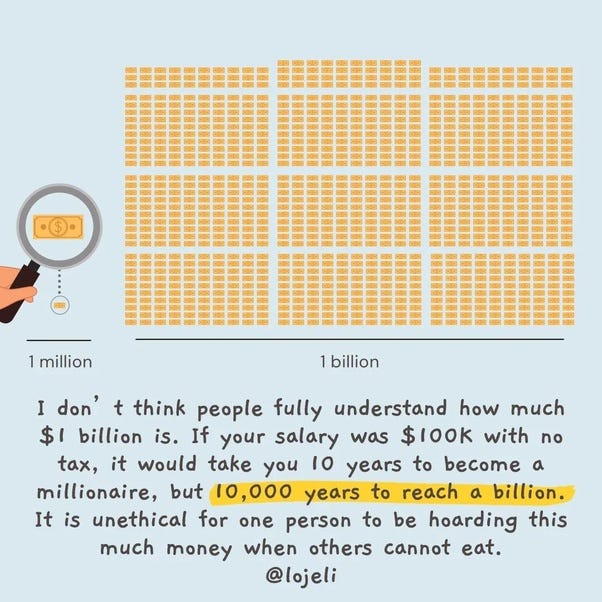
You should ask instead: Why don’t we cap an upper limit on personal net worth to ensure the economy works for everyone? This strategy not only supercharges an economy like a finely tuned vehicle, it also eliminates government corruption. With a global cap of one billion in personal net worth, we could forever eliminate the threat we face by a globalist oligarchy.
We could end a centuries-long class warfare overnight with the stroke of a pen.
We could end poverty almost overnight.
If we were united in solidarity on this point alone.
It may seem impossible, but it would happen if eight billion people decided they wanted this to happen.
Try to think about that.
It would also end wars around the globe.
The war in Ukraine would end overnight.
Vladimir Pukin’, his oligarchic buddies, and all the rich techbros thinking they could reinstall a modern monarchy would be disempowered overnight.
No more familial dynasties. No more Walton family treating their employees like dirt while forcing them to get government handouts because they’re not being paid enough.
No more arrogant stupidity by people thinking they’re better than the rest of humanity that they regard like pack animals instead of human beings.
We would reduce and eliminate many social problems because money would flow freely. People would not be dying from poverty. A child would not be dying every five seconds from hunger. Homelessness would disappear. Altruism and food banks would become moot.
Fight for a global cap of one billion because that’s more than enough to live in bloated luxury.
If we need one goal for eight billion people to rally around, we should make this our goal (along with UBI).
This post is a response to a question posed in its complete format: “Will the next President be able to reverse the current destruction of the government?”
No.
The next president can mitigate the impact of the damage, reverse all the executive orders, and pull the nation out of freefall, but the destruction will be permanent.
The damage to the nation’s international reputation is permanent.
The damage to the people who Trump’s reckless behaviour has victimized is permanent. The families he destroyed in his first term have still not recovered.
The divide he has wedged open will take the rest of this century to repair.
The nation will not and cannot return to the state before Trump took office. It was already being held together by duct tape and a skilled, lifetime politician who performed feats of magic to repair the damage done by Trump’s first term.
Too few people failed to acknowledge the significance of Biden’s leadership, and that was a consequence of a nation that was far too broken on too many levels to appreciate for most.
The nation has been falling to pieces for decades, and since Ronald Reagan betrayed the middle class. This destruction became inevitable when Reagan reversed the nation’s trajectory to favour the wealthy class.
This damage isn’t based on politics but on class.
The wealthy class have brought this tragedy to the world.
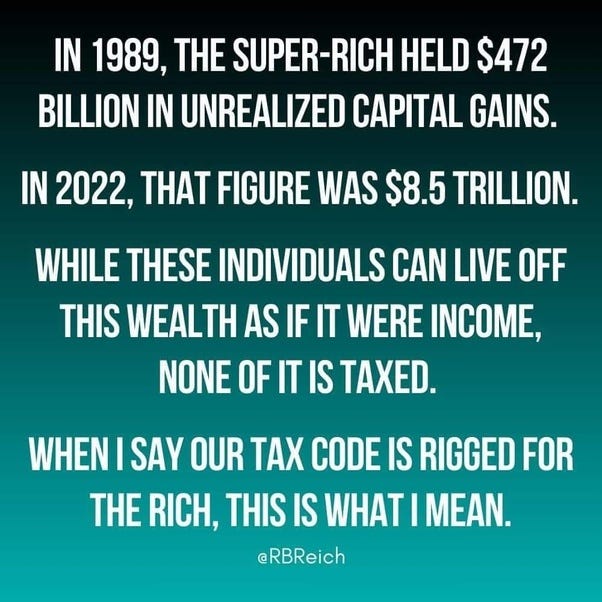
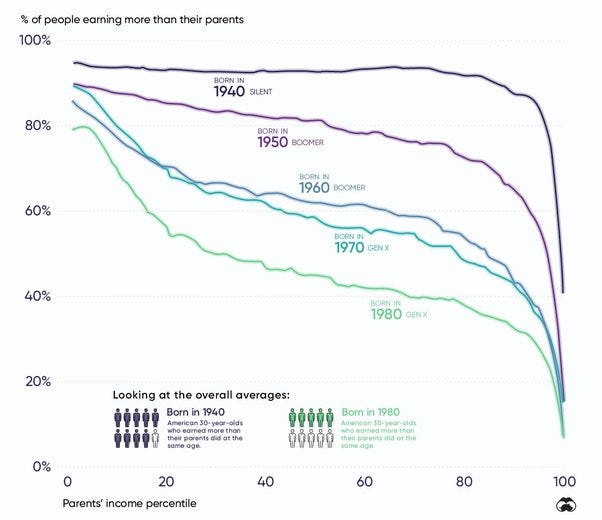
The numbers don’t lie.
The moment the people bought into the lie that the wealthy class are gods among the population and from whom we are blessed with their favour in economic growth and prosperity is when we gave up on ourselves and started turning against each other.
No president can repair this damage alone… not even if he were the second coming that far too many people pin their hopes and dreams on.
We must do the repair work, and we have to begin by repairing ourselves first.
We must focus first on the welfare of the people because, without the people’s health and welfare, there is no nation, economy, or prosperity. No wealthy class of billionaires can exist without the economy’s engine of 350 million consumers pumping value through a system designed to benefit everyone. They are more dependent upon a healthy middle class than the people who are dependent upon them to finance their pet projects.
We must weed out the greed of humanity if we are to have any hope of stability.
Reversing the destruction will require doing many things differently, but they’re not insurmountable problems. On the upside, more people are aware today of the threat of excess power in too few hands. More people understand today that medical bankruptcies occur only because a handful of greedy billionaires prioritize the bloated luxuries they have acquired by victimizing millions of people.
More people understand today that their economic struggles are due entirely to the economic disparity that led to a world war less than one century ago.
The economic destruction can be repaired, but it must begin by restoring economic justice.
The psychological destruction of today, however, can forever change the nation on a fundamental level — but sadly, the destruction is nowhere near complete enough to force enough people to wake up to the horror of what they have become.
There is still much pain ahead, affecting the entire world.
If Americans truly want to believe their anthem and be the land of the free and the home of the brave, the entire world is pleading with you all to step up to the plate and rid this world of the oligarchy scourge.
The next president can mitigate the impact of the damage, reverse all the executive orders, and pull the nation out of free fall, but the destruction will be permanent.
The damage to the nation’s international reputation is permanent.
The damage to the people who Trump’s reckless behaviour has victimized is permanent. The families he destroyed in his first term have still not recovered.
The divide he has wedged open will take the rest of this century to repair.
The nation will not and cannot return to the state before Trump took office. It was already being held together by duct tape and a skilled, lifetime politician who performed feats of magic to repair the damage done by Trump’s first term.
Too few people failed to acknowledge the significance of Biden’s leadership, and that was a consequence of a nation that was far too broken on too many levels to appreciate for most.
The nation has been falling to pieces for decades, and since Ronald Reagan betrayed the middle class. This destruction became inevitable when Reagan reversed the nation’s trajectory to favour the wealthy class.
This damage isn’t based on politics but on class.
The wealthy class have brought this tragedy to the world.
The numbers don’t lie.
The moment the people bought into the lie that the wealthy class are gods among the population and from whom we are blessed with their favour in economic growth and prosperity is when we gave up on ourselves and started turning against each other.
No president can repair this damage alone… not even if he were the second coming that far too many people pin their hopes and dreams on.
We must do the repair work, and we have to begin by repairing ourselves first.
We must focus first on the welfare of the people because, without the people’s health and welfare, there is no nation, economy, or prosperity. No wealthy class of billionaires can exist without the economy’s engine of 350 million consumers pumping value through a system designed to benefit everyone. They are more dependent upon a healthy middle class than the people who are dependent upon them to finance their pet projects.
We must weed out the greed of humanity if we are to have any hope of stability.
Reversing the destruction will require doing many things differently, but they’re not insurmountable problems. On the upside, more people are aware today of the threat of excess power in too few hands. More people understand today that medical bankruptcies occur only because a handful of greedy billionaires prioritize the bloated luxuries they have acquired by victimizing millions of people.
More people understand today that their economic struggles are due entirely to the economic disparity that led to a world war less than one century ago.
The economic destruction can be repaired, but it must begin by restoring economic justice.
The psychological destruction of today, however, can forever change the nation on a fundamental level — but sadly, the destruction is nowhere near complete enough to force enough people to wake up to the horror of what they have become.
There is still much pain ahead, affecting the entire world.
If Americans truly want to believe their anthem and be the land of the free and the home of the brave, the entire world is pleading with you all to step up to the plate and rid this world of the oligarchy scourge.
This post is a response to a question posed in its complete format: “Why won’t rich people just donate a tiny bit of all their wealth to poor people?”
Some of them do. MacKenzie Scott, the ex-wife of Amazon founder Jeff Bezos, has donated over $17 billion to charitable causes since 2019. Our problems, however, can’t be fixed by relying on a few donations by the small percentage who care about other human beings beyond themselves.
People need to stop thinking about ways to guilt the few rich capable of feeling guilt into ponying up on behalf of those who don’t care in the least about the poor as long they shut up and die quietly and out of sight.
Why do you think “hostile architecture” exists?
A lot of people don’t want to help the poor. They want them gone out of sight and out of mind. They want to blame the poor for creating their conditions of poverty.
They want to think of them as lazy addicts who irresponsibly ruined their own lives.
It’s no different than shaming a woman for her clothes or behaviour for inviting a rapist.
It’s like shaming a mugging victim for paying cash for their drink in broad daylight.
People don’t want to think about why things go wrong for other people because it means dealing with the possibility that things can go wrong for them. If people believed they could also become one of “those people.” many would just give up, while others wouldn’t be able to function past their anxieties.
Although the existence of centibillionaires is a huge symptom of a system so broken that so many poor exist, no one wants to change anything because it means having to do things differently than they’ve become used to.
Look at how impossible it’s been for Americans to adopt a universal metric system — even though it would save them money.
Look at how impossible it’s been for Americans to adopt universal healthcare — even though it would save them money and lives.
People may demand change, but they hate change. Many people prefer complaining about how bad things are to doing something different because they fear change will be worse than what they’ve gotten used to.
My province of BC has had three referendums on electoral reform that would have made our elections more representative of the people. We would have become a more democratic province that more effectively addressed the needs of the people if the people could vote for what they want rather than vote against a change they don’t understand. Even worse, the change is easy to know if one makes a small effort to educate themselves, but they don’t and won’t understand something until they’ve lived it. When people are unsure, they consistently vote to maintain a corrupt status quo instead of voting to change it.
Americans are going to continue voting for corrupt leaders until they realize their lives are at so much risk that the choice is no longer “change or continue suffering” but “change or die.”
That’s where we are right now… or at least, those who refuse to read the writing on the wall will eventually figure out that’s the case when they start seeing the suffering around them can no longer be denied. They will change only when they become more afraid of maintaining a destructive status quo than the change they can’t understand until they’ve made their change.
Rich people won’t give up their wealth, even in part to sustain a failing system until it fails so badly that they start running and hiding for their lives from the mobs who are angry enough to repeat history. They won’t change what they’ve gotten comfortable with, even if it means they’ll end up more prosperous.
This is why “woke” is such an important concept these days — because we are at the stage where a lot of people are sick and tired of screaming “Wake up!” to people who insist on ignoring the threat they’ve become to our future.
The bullying Nazis among us still think they can play their bullying games endlessly while laughing at the “librul” tears they imagine are being shed out of frustration without realizing those tears are being shed because of what comes after those tears… the mourning of having to do what could have been avoided.
The few wealthy people cannot, through donating portions of their money, fix what’s broken.
The system needs to change on fundamental levels enough to force the greedy sociopaths to acknowledge the critical importance of maintaining a universally sustainable social contract. They need to understand the benefit of giving up some of their money to pay back into a system that allowed them to become rich in the first place.
Allowing a small number of elite few to grow hoards is not how to develop a sustainable economy or lift people out of poverty.
People like Musk know this. They don’t care because they see themselves as entitled to rule over the rest of us like we were herd animals.
Eventually, someone like Musk will push society far enough for the guillotines to come out and put his head on a pike. He doesn’t believe that’s what he’s inviting into his life. He thinks he is untouchable… just like Trump thinks he’s untouchable — that no one would dare do the unthinkable.
Suppose Trump decides to start a war with Canada, and NATO steps in. In that case, the chances of an American military officer putting a bullet in his head on the brink of launching a nuclear attack against a long-time partner becomes a very real possibility. Just because he’s the “commander in chief” doesn’t mean he has carte blanche to do whatever he wants. Everyone has limits. That’s just life. We must acknowledge that and protect them for everyone, for all our sakes.
We don’t know right now what those limits are and what it will take to cross that one bridge too far… but if or when it does happen, there will be chaos in the streets. We’ll be spending the next hundred years dealing with profound regret while armed with microscopes to examine in micro-detail how it could be that we allowed this nightmare to go on as long as it did.
We will be kicking ourselves with the kind of regret that will change us forever in ways that will horrify us deeply if this happens again. We should be paying attention to how the German people have had to cope with their recovery from the madness that overtook them. We should be learning from history, but 76 million people voted for a repetition, while another 80 million said they didn’t care enough to do anything different but pretend it wasn’t their problem to solve… so they made it their problem and everyone’s problem.
Meanwhile, it’s unfair to the few wealthy who are generous and care about humanity to put the onus on them alone to solve the problems we all have a responsibility to solve.
If that means we have to start punching Nazis to get them to develop enough humility to behave like human beings, then we need to start swinging as if our lives depend on it because they do.
Nothing will change until we take this dystopia seriously enough to deal with the threats we face in the form of hatemongers who feel themselves entitled by God to rule this world.
If there’s one thing we can learn from Luigi Mangione, it’s how overwhelming this problem is and how overpowering the enemy is. They’re not taking any breaks now that they’ve been given the keys to transform the landscape radically. They’re putting the pedal to the metal, and if it means running over millions of homeless people with a bulldozer, then so be it.
They don’t care about the poor. They are happy to destroy the easily victimized among us.
Why do you think they’re starting with schoolchildren?
For someone who values a debt-free existence, it can undoubtedly be viewed as an absence of a burden that enables greater freedom of choice. However, the entire system of capitalism is based upon leveraging debt to create revenue.
Revenue and profits are seen as far more powerful versions of freedom within a system that can be leveraged in ways in which the debts themselves can be resolved by servicing them with the increased revenue they generate or by being forgiven.
Of course, this form of debt is not the same as implied by the question, which is based on the notion of debt accrued in purchasing lifestyle augments. For example, a purchase of an air purifier I made just today was made through a credit card, constituting an assumption of debt on my behalf. This purchase will generate no revenue, but I applied my justifications to the decision before making it.
One can argue that my decision decreased my freedom, but that’s only a tiny part of my decision. I can easily say in favour of the practical benefits of making this purchase, even with the context of it ultimately increasing my freedom (from headaches, specifically). However, that makes this degree of granularity in decision-making a cartoon.
Suppose the point of this question is to criticize people for spending thousands on a 100″ television through credit debt instead of a quick payment of a couple of hundred for a 24″ television that would leave them debt-free. In that case, these discussions are merely psychological masturbation sessions where people are attempting to objectify subjective considerations for themselves and applying essentially bigoted reasoning to determine values of rationality toward decisions made by others for things they value.
The reality, however, is that if one is going to argue how debt freedom is an important freedom, then so are many other forms of freedom. For example, freedom from a crushing health exploitation system through a universal healthcare system is also an important freedom that many don’t consider freedom because they’re obligated to support it through their taxes — even if it means a reduced fiscal burden and improved services. The fact that they have no choice but to contribute to it, whereas they do have a choice in a privatized system to pay much more and be rejected by their insurance carrier to die, is also considered an important enough form of freedom for many that universal healthcare remains unimplemented in a nation that likes to think of itself as a bastion of freedom even though it has the highest incarceration rates in the world.
The point is that no matter how vital debt freedom seems to some, sound fiscal management skills are more critical because debt is contextual. The largest corporations in the world carry the most significant amount of debt and begin by getting deeply into debt. Our financial systems are geared around rewarding debt.
Your credit score, for example, drops when you’re debt-free and increases when you have debt and show that you can manage it. The only way to improve one’s debt ceiling is to go into debt. You can live your entire life being a cash-only person and living debt-free, but when you reach a point where you need debt to resolve an issue or accomplish a goal, going debt-free becomes a liability in your application for debt.
In short, Americans are not taught that freedom from debt is an essential freedom because it isn’t. The ability to service one’s debt through revenue constitutes a far greater level of freedom. After all, there isn’t one investment manager who counsels investing one’s money into risky investments. They always counsel investing other people’s money.
Some may wish to argue for a return to debtor prisons based on this dynamic, but that would just penalize the wrong people.
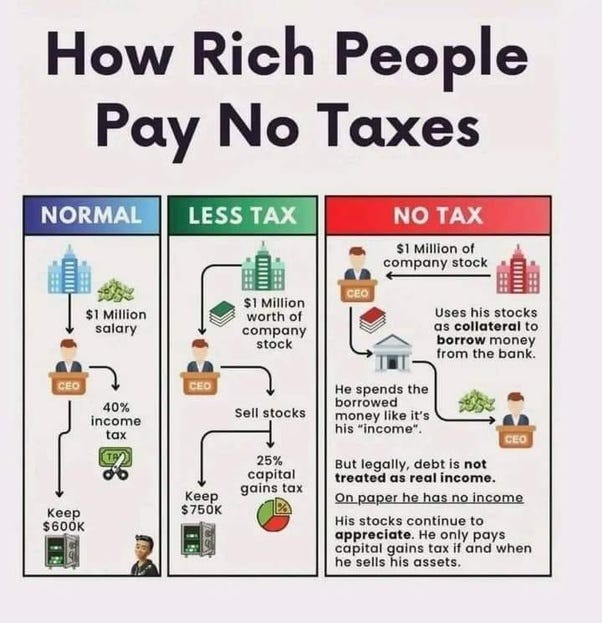
Here’s how wealthy people leverage debt to lower their cost of living, for example:
The wealthiest among us experience the most significant degree of fiscal freedom precisely by how they manage their debt.
The kind of debt and the thinking about debt described by this question is from an era when people could count on stable 40-year careers, prudent personal economic management, and modest living that would result in a comfortable retirement. Those days are long gone.
The presumption in this question is an oversimplification. It’s like saying the flu is about the sniffles, the chills, the sneezing, and the perpetual flow of mucus when it’s inherently about a virus infestation.
The hatred is the symptom of an underlying cause, or set of causes, as it were. The first cause is always the same and has always been the same throughout history, driving every public conflagration: living insecurity. In today’s world, that translates into economic insecurity.
We’ve had an odd confluence of events occurring throughout this modern phase of the class war we’ve been undergoing for centuries now and since the dawn of human civilization, as the small group of the most powerful among us seek (and have always sought) to sublimate the majority in service to their will.
Quality of life for the middle class has been steadily tanking while the ownership class has been leveraging the benefits of technological progress to ameliorate and offset the increasing hardship they’ve been imposing upon the rest of us.
For example, poverty only one-half-century ago was evident in that the appearance of failing to meet essentials like clothing for appearance was a hallmark indicating poverty. That’s no longer the case, as many of the most impoverished among the working class avail themselves of systems that allow them to maintain an appearance of modest living while enduring severe degrees of economic insecurity.
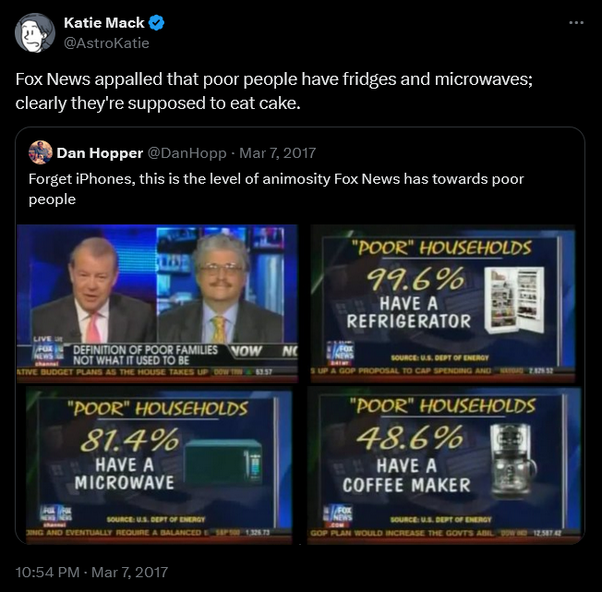
The Fox network made a big deal about people not living in poverty because they had refrigerators and microwaves. It is that kind of difference between poverty today and the poverty of last century that allows the ownership to more easily shame the victims of their efforts at impoverishing the majority in service to their hoards.
The harsh reality, however, is that most essential components of psychological health and emotional stability have been steadily stripped from the middle class in a stream of primarily invisible and ignored cuts over time.
Compensation increases virtually halted for the middle class (and have even experienced shrinkages due to inflation), while income has skyrocketed for the ownership class.
The promise of capitalism raising people out of poverty from good ol’ fashioned elbow grease and modest living has vanished. The age of the Wealthy Barber lasted only a couple of decades before it was stripped from the people.
What we are left with now is a perpetual struggle for survival that has been steadily increasing year by year in the number of victims and the scope of theft perpetrated. The most privileged among us have had enough of an economic buffer to weather the storms that have destroyed the lives of millions victimized by the economic war waged by the ownership class against the working class. For many of those who would have qualified as being “upper middle class” fifty years ago and whose wealth would be more than double what it is today had the economy continued growing as it did during the heyday of Eisenhower tax rates, the economic war has remained largely invisible to them because they have not had to face the threat of food and housing insecurity that millions of working poor do today.
They may still face medical bankruptcies because those are huge bills that could and should be non-existent in a nation as wealthy as the U.S. However, the percentage of victims of that particular form of theft is relatively rare compared to the general population. We would otherwise have already had many Luigis acting out on their frustrations by now.
Instead, we have extremist right-wing groups on terrorist watch lists because they align themselves within their tribes and stoke their hatred toward those they blame for their woes. Occasionally, their outbursts gain public attention, but mostly, they’re made manifest in the ongoing and almost daily mass murders of innocent citizens and schoolchildren.
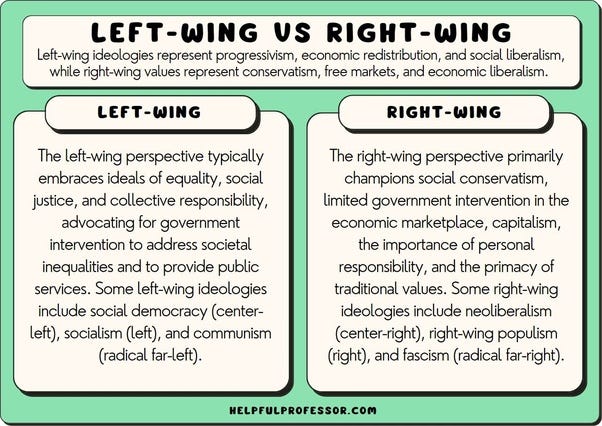
While the extreme right acts out their anger in unfocused ways, the left is targeted specifically on the causes of their anger. While the right victimizes anyone who doesn’t capitulate to their dogmatic adherence to the power wielded by those most responsible for victimizing them, like Stockholm Syndrome candidates, the mostly non-existent “extreme left” campaigns for economic justice through programs that restore equity.
Conflating the two as being identical is worse than oversimplifying a complex issue; it’s empowering the conditions that give rise to the hatred one seeks to demonize. It serves the narrative of a culture war perpetuated by the ownership class to divide the people further and distract them from the thefts perpetrated against them.
The irrational conflation made within this question merely functions as a self-fulfilling prophecy in which one declares a bullet wound fatal while stabbing the patient in the heart with a hunting knife to dig out the bullet.
This question is like accusing people of being jealous of Elon Musk’s money when the reality is that they hate white supremacists who install puppet rulers to destroy nations to attain their goal of empowering themselves at the expense of impoverishing the world. It’s a rather short-sighted attack on reality and the countless victims suffering needlessly in service to gluttonous powers.
This post is a response to a question posed in its complete format: “Imagine that millions lose their jobs due to AI. Is there a way for those who have lost their jobs to effectively declare war on AI?”
Well, that’s pointless.
People will not lose their jobs because of AI but because corporations save money on labour costs.
AI is a tool, and the argument that ammosexuals love to barf up applies here: “Guns don’t kill people. People kill people.”
AI doesn’t kill jobs. Capitalists kill jobs because they can and are incentivized by it within a system that worships personal wealth above all.
We, as citizens, kill jobs through our apathy and through our empowerment of those who prioritize their material benefits at the expense of the many they can exploit.
We bring this upon ourselves by not having a coherent social development roadmap. We allow our societies to grow by chaos rather than responsible systems management strategies.
We empower our leaders through a reactionary process of social development rather than a strategically reasoned and proactive process.
Sadly, authoritarian regimes are far more successful along this vector than democracies because their decision-making is limited to small, centralized powers.
This is part of the reason that the public has been increasingly questioning the value of democracy while looking toward authoritarian models to solve our problems for us.
Sadly, the solution for democracies to be far more effective in mobilizing social development in a coherent and unified direction is entirely contingent upon the quality of the education the public receives.
For instance, the transition to a fully automated society is an inevitability. There is no point in resisting it. We would all be much better off by leaning into it and demanding we adapt our systems to manage the transition better so that we can mitigate collateral damage.
Instead, we are experiencing a chaotic transition led by random powers following personal visions motivated by personal benefit rather than social good.
If our education systems provided a more comprehensive insight into social development, much of the public would be engaged in the political process in strategic rather than reactionary ways.
We would be more unified as a people in identifying trends and developing coherent strategies for successfully managing the challenges we face.
Instead, we are burdened by a dearth of education that reduces a population into cheerleading camps driven by emotionality that can be characterized as juvenile reactions against authorities. Considering how democracy means each person is a governing authority member, this is beyond an asinine apprehension of how one’s government works or how it can be made effective.
Democracy demands engagement, yet our apprehension of engagement is limited to how many likes one gets on one’s post. That’s not even remotely resembling engagement.
That’s like claiming every celebrity walking a red carpet and waving at the throngs is socializing with friends.
Sadly, part of the problem has been deliberately cultivated by the capitalists who want us distracted enough from the sausage-making process to allow them to remake human society into their image.
They have been succeeding remarkably within the U.S. as it has become a dystopian corporatocracy that prioritizes gun sales over the lives of children and billionaire profits over the healthcare needs of citizens.
The public has been so conditioned to prioritize profit at all costs that they will fight to preserve a billionaire’s right to kill people for profit.
We can’t govern ourselves in a democracy if all of our time is focused on survival and profit-churning. Most of us don’t care to be involved in the decision-making process, which would be okay if we could trust our information systems to prioritize informing people over chasing profits.
Instead, we have media that has become a singular, massive entity of public influence predicated upon churning conflict to maintain attention justified by revenue increases.
Instead of informing the public on issues of criticality to the future of the people, we have this kind of incendiary rhetoric from an attention whore indulging in shock stupidity to justify their salary increases by ginning up the rubes to create conflict.
Less than one hundred years ago, this kind of crap would be shut down immediately because it would be considered a precursor to war.
Instead, the attention-seeking mentality justified by the profit (and power-seeking) motive does not care about the casualties created by irresponsible language.
The value of human life has been downgraded, if it ever mattered to society, to a level that’s no greater than the Roman arenas when people were killed for entertainment.
If we don’t start asserting some standards on coherent behaviour that cultivates the best of us as a species, we will continue careening headlong into chaos.
Humans can take only so much abuse before they break. Everyone can break, and people like Watters are playing with fire. There’s no way he will be safe again crossing the border into Canada because of his disgusting language. Some might argue that any aggressive response against him is unjustifiable, and that may be valid, but it doesn’t change how humans behave when aggrieved. I’m confident few Canadians will give him a warm reception for his remarks if he ever crosses the border. At best, at least from my perspective, he’s earned a bloody nose for his garbage.
This kind of bullying rhetoric is toxic to society and is a betrayal of the social contract.
The acceptability of this nonsense and its prevalence is why we have no coherent strategy for managing our transition into a fully automated society. The acceptability of this kind of incendiary distraction from critical information the public needs to make proper decisions to minimize casualties in our transition will create unnecessary casualties. This kind of thinking is what permits bigotry to determine outcomes that dramatically affect lives.
This kind of nonsense is why this question exists in so many forms everywhere and why I’ve already answered this question in several forms by now.
The issues are not complex, but they are made so because we’re not talking about them where we need to be talking about them. We’re allowing jackasses to troll for reactions in “respectable mainstream media” that we would mute and block online if they were individuals and not expensively dressed and cosmetically pampered media personalities.
We are being betrayed by the Fourth Estate each and every day — and to the degree that a majority of the world now believes the U.S. is a tragic case of end times for a nation that has become so corrupt, it can never be trusted for leadership in the world again. However, anyone may parse the 2024 election, and one cannot ignore the role of the media in installing a monster in the top job for the nation.
If you genuinely want to declare war against the loss of jobs, then you need to take it to those who benefit from displacing jobs. You need to start pressuring the billionaires and the corporations they benefit from while ripping off the public through tax avoidance schemes.
Instead of war, you should demand responsible management for an unavoidably dramatic and traumatic societal transition by insisting on the only sane solution to this period in human history, UBI, as a starting point toward sanity in our social development.
The worst thing about where the world is at in this transition is that the next four years are being defined by a parasitic presence seeking to empower further those who are disempowering the working class while replacing workers with automated solutions to toss millions out onto the streets to fend for themselves.
We must stop blaming AI for job losses because it’s just a gun in the hands of mercenaries.
This post is a response to a question posed in its complete format: “Could taxing Elon Musk and other people with massive fortunes 80% be the solution to paying down the national debt in the USA?”
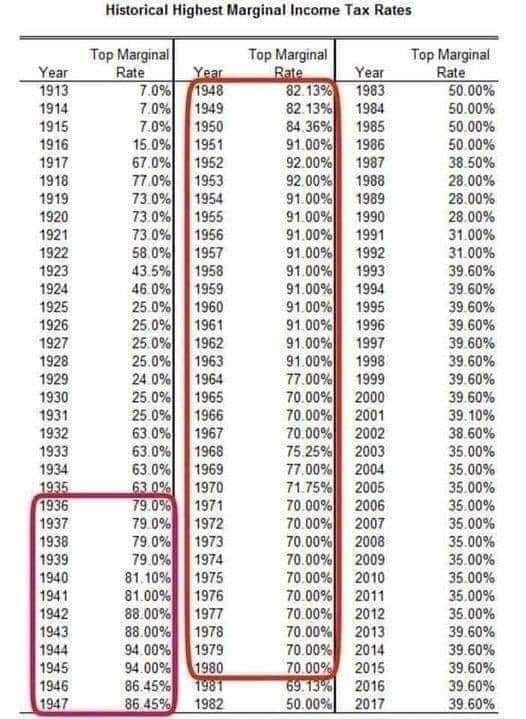
The answer is quite simple and beyond evident to anyone with eyes and a mind that’s capable of connecting simple dots from a simple table of numbers:
Here are a few points to address regarding regurgitated soporifics routinely employed by the enablers in the crowd.
Taxing the billionaires won’t be enough money. — Well… DUHHH!!!! That’s not the point. The point is multifold, but let’s cover some leading characteristics. a. Force Multiplier and b. Speed of Money
A healthily functioning economy is highly contingent upon “the speed of money flowing” through the system — like arteries in a human body. The more plaque there is that obstructs the flow, the less healthy the system is and the more prone to systemic collapse it becomes. The low tax rates that we have now and that we had leading up to the Great Depression encourage hoarding and are a leading cause of numerous social issues guaranteed to result in a dramatic economic collapse — mainly as automation speeds up.
The more money the bottom end of the economy has, the more demand for goods and services, and the more businesses grow in a feedback loop. Even more beneficial to the economy is that when more people have more resources to invest in themselves and their futures, more innovation is introduced into a system that feeds on innovation to grow.
These two concepts alone, together, make up for what the useful idiots who defend the hoarding billionaires who lack imagination for humanity’s future beyond building space penises fail to account for. It is bloody disheartening that trickle-down stars can so thoroughly blind people and make them so addicted to the taste of billionaire orifices to understand how their misanthropic stupidity is the equivalent of suicidal ideation for humanity.
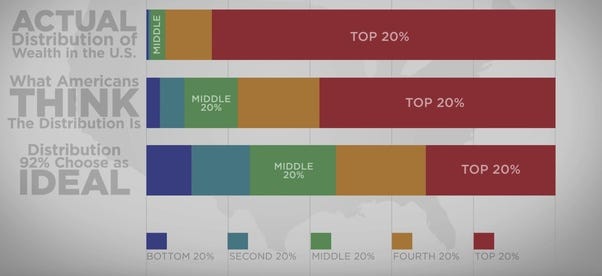
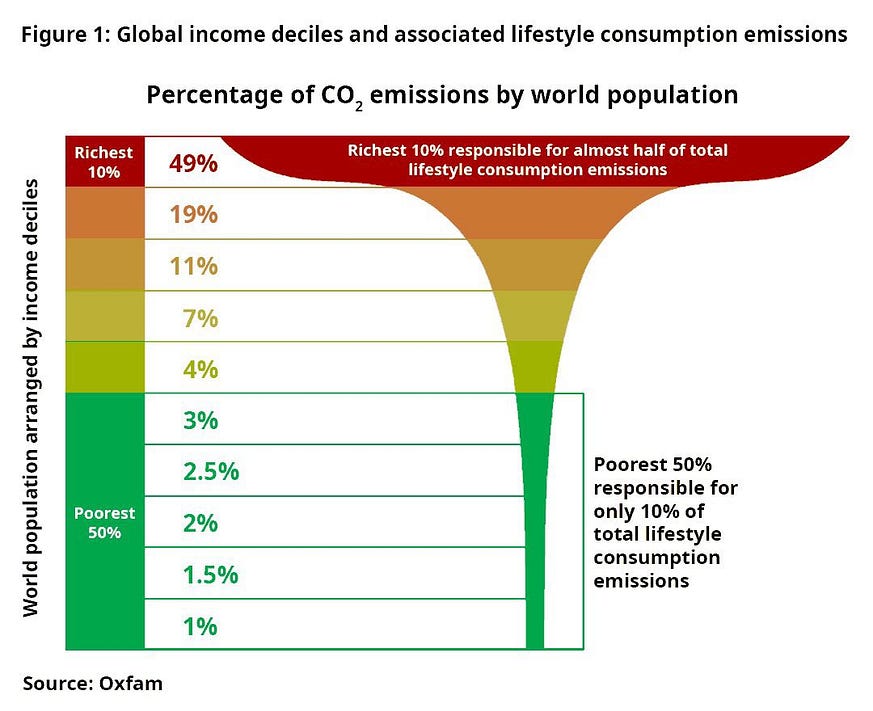
The graphic above screams the economic solution in our faces.
The lower the taxes =, the more unimaginative parasites and predators horde = the more sociopathically stupid they become =, and the more of a threat to our future as a species they become.
We create laws to mitigate the impact of excessive behaviours because we understand the destructive effects of unrestrained freedom on society. We know that if laws don’t exist to prohibit murder, many more murders would occur. The laws don’t end murder, but they function as a valve on society to mitigate and minimize the impact of widespread murder on society.
We create laws to restrain an entire host of issues resulting from the toxic extremes of human behaviour. Still, for some reason, the notion of building dynasties to rule humanity isn’t viewed as the threat that it is… even when the numbers add up to our extinction.
The main reason the billionaires should be taxed isn’t even economic, at least not quite directly the most important. The main reason they need to be restrained is that if they are not, they will destroy human civilization, and they don’t care because they have enough to build bunkers to ride out the apocalypse.
The people answering this question who are defending the atrocities of unrestrained wealth are as guilty of crimes against humanity as the MAGAts who are guilty of treason against the United States.
An astute argument was raised in response to this post that I’ve included here:
One point I would make is that taxing income and taxing wealth are two completely different things. Elon Musk may be worth $300 billion but that’s his wealth, not his income. If we start taxing wealth, be prepared to start paying taxes on the increased value of your house every time it appreciates in value. Politicians that tell you they would set a minimum of $100 million before taxing are telling half truths. They may set a limit initially but over time that can change. The original income tax was 0.5% of incomes over $1 million. How’s that working out for everyone ?
That argument sounds much like the fearmongering cynicism against raising the minimum wage — inflation will go up, or robots will replace jobs.
The reality is that property ownership is not the same thing as stock wealth, and there’s a fix for that — eliminate the corporate ownership of residential real estate.
Furthermore, the number of tax brackets that exist today is an unrealistic reflection of the historic levels of wealth disparity. For example, there are only seven tax brackets today. I checked to see how many existed during more realistic tax assessments. It was strange that learning how many tax brackets existed historically took more effort to identify than my bias believes it should.
This link below shows that in 1952, there were 28 tax brackets. Eliminating tax brackets benefits only the wealthiest in the land. The more tax brackets, the more granular the taxation rates and the less discriminatory tax rates are to the lower classes, and the more progressive taxes become — as they have always been intended to be. As it stands, the radical reduction of tax brackets has just been a means of waging a class war against the little people by allowing them to skip responsibilities that are inherently theirs while redistributing tax responsibility downward.
This post is a response to a question posed in its complete format: “Why don’t big businesses reduce profits instead of increasing prices when forced to raise wages?|
Never in the history of generating income for oneself has anyone ever said, “Gee… I think I earned too much money. I should give some of it back.”
The answers you’ve gotten essentially echo the above sentence.
For example, many companies, like Walmart, deliberately underpay their people by enforcing tactics like union-busting and denying employees full-time status to permit them to qualify for additional benefits.
What they save on employee costs forces their people to qualify for government benefits. So even if you’re not their customer, you still subsidize their operation through your taxes. Their major shareholders laugh at you and your question.
There is no way to solve this problem within the status quo. Even worse, this problem will continue to worsen as technologies in AI and robotics mature while automation replaces jobs to reduce employment costs even further.
The Walton family doesn’t care about how their employees might struggle. Jeff Bezos considers employees dying on his warehouse floor as collateral damage and the cost of doing business. A few thousand dollars toward a token effort to address optics is a low price to pay to force people into running according to the inhuman scheduling they’re forced to endure by filling orders according to a timed system.
Part of the problem with this question is that it presumes wages determine the costs of products that you pay for when that is the furthest thing from the truth. Wages are a minimal determinant in the price of products you buy.
Products are priced at the highest level that a market will bear. IOW, the price of a product is based on a formula applied to the speed at which shelves for that product are emptied. You have probably heard of the phenomenon of “supply and demand.”
The more demand for a product, the easier it is to justify its increased cost. The company knows it will still sell its product but get a higher margin, growing annual revenue and making it more attractive to investors. In turn, its stock value increases, and it appears much more successful as a company doing business in the marketplace. The entire system is geared around pricing products as high as possible while reducing costs as much as possible. The cost of labour is considered the most significant repeat cost of an operation, so it’s always targeted for reduction. Capital costs are written off in tax deductions, so a one-time purchase far exceeding the cost of labour for the year is still cheaper than labour because of that tax benefit.
When employers, capitalists, and their flying monkeys threaten higher costs for products due to higher wages, they’re just lying to the public to create the optics that their products require price increases that are functionally unnecessary but acceptable because people believe the justifications that are given. This happened due to the COVID lockdown when companies took advantage of public sentiment to indulge in price-gouging strategies.
Solutions to this and many related problems, such as the persistence and even increase in poverty, involve multiple strategies.
First, the downward pressure on wages can be addressed by eliminating the leverage of destitution that employers have with employees. Suppose an employment candidate doesn’t like the pay scale offered by an employer. In that case, they currently have a choice to begrudgingly accept being underpaid or face the risk of homelessness, starvation, and premature death. The solution to this problem is easily implemented through a Universal Basic Income. If candidates are free to turn down insufficient wages, then employers are put into a position of being more competitive to attract those they want on staff.
Corporate structures are an inherently antiquated holdover from medieval organizational structures. Corporations are strictly hierarchical entities that function like mini-autocracies. This dynamic existing within a democratic society cannot be but at odds with the society it operates within. It is in the “corporate DNA” to essentially function as a subversive entity within a democratic society that inevitably plots the demise of democracy and its overthrow to institute an oppressive two-class society of owners and serfs. The solution to this problem exists within worker co-ops.
Worker Co-ops (continued) Richard Woff is an economist and a professor emeritus of economics at the University of Massachusetts who provides compelling arguments in favour of worker co-ops. — Richard D. Wolff — Wikipedia — RDWolff –
4. (Numbering Bullets in this kind of HTML formatting truly sucks the big one) Finally, the primary solution to the greed infesting human behaviour today that functions as a threat to human society is to place a global cap on personal net worth. This is the most difficult of all challenges to implement because it’s already hard enough to have an entire nation agree on something. For the world to develop solidarity in this matter appears to be an unreal fantasy, but it may be the case that Donald Trump and Elon Musk are opening the door for the world to get on board with it. There is no valid argument against it, particularly since the only argument that once held validity — financing large-scale endeavours — is now rendered moot through crowdfunding. The more money that exists in the working class’s hands, the more able the working class can participate in a democratic economy rather than be subjected to the whims of psychopathic power-mongers. We must first drop this delusion that wealth is accrued only by “special humans” who stand above the rest of us. It’s becoming ever more apparent to the public that not only does power corrupt, it is the corrupt and corruptible who are attracted to power.
We are rapidly approaching a point of no return in which we will either quickly resolve the problems threatening human civilization or lose the ability to respond to a global environmental threat.
This post is a response to a question posed in its complete format: “What effects do you think AI will have on society? Realistically, are people overreacting who say they’ll take all the jobs and run the world?”
Realistically, machines can’t “take jobs away” from people. Organizations and the capitalists who fund them while demanding optimal revenue generation at the lowest cost possible are choosing automated solutions to the labour cost.
This trend, of course, does displace workers as technologies have always done. Unlike previous generations of technological advancement, however, the displacement is not limited to specialized functions.
For example, armies of people sawing logs by hand were not entirely displaced by the introduction of sawmills. Labour was reallocated and redefined. Instead of pushing a saw back and forth, labour became a process of pushing buttons.
Of course, fewer people needed to produce the same volume of lumber, but there was also enough demand to scale production and create employment opportunities further up the production line.
At the height of the technological transition to a digital age, we saw many jobs displaced, but new categories of employment at much higher levels of complexity emerged. Secretaries who transcribed letters were replaced by administrative assistants who functioned in a data entry capacity. At the same time, executives eventually learned it was more efficient and pleasurable to directly type their thoughts into word processors rather than proofread changes multiple times over in an often frustratingly long process.
Network technicians, web designers, database developers, and an entire class of Information Technology workers sprung up almost overnight — by contrast to how the labour demographic had evolved since the dawn of the Industrial Age.
That’s no longer the case in today’s dynamic.
The AI revolution will not spawn demand for new labour beyond the minimal replacement of armies of people pushing saws with one person pushing buttons.
Before this current stage of technological evolution, it was easily argued that displacement versus the creation of new jobs approximated a one-to-one exchange. The hundreds of thousands of trucking jobs replaced by self-driving vehicles will not result in new jobs created to transport goods globally. Self-navigating cargo vessels will not create 15 to 30 new jobs per ship when intelligent robots replace workers.
Hundreds of millions of jobs worldwide will be transitioned to an automation model.
This brutal inevitability ignores issues used as political footballs and bypasses all the fearmongering over demanding higher wages. Automation will displace jobs, but not because automation “takes those jobs.” Technological innovation has always been and always will be a more efficient way of doing business.
Although the transition to an automated society is often viewed as a technological transformation, it is primarily a social transformation. People are going to have to stop thinking about “getting jobs” and starting about how to generate revenue for themselves by leveraging services as independent entrepreneurs. This view of capitalism has always been at the heart of the capitalist vision, and it was cemented in our psychology when business was granted personhood status.
The primary challenge within this transition is to provide the means to pursue one’s independent revenue-generating efforts with the necessary resources to succeed as an independent business owner.
We are inundated with exposure to the results of resources transforming our world by creating new classes of the wealthy whose net worth far exceeds previous generations — even after accounting for inflation. Henry Ford, for example, was a highly successful industrialist, but his net worth and reach don’t come close to Elon Musk’s status as a centibillionaire. It can be argued, of course, that such a disparity is a consequence of a corrupted tax burden. Still, those factors don’t fully explain the difference in dollar value between Ford’s millions and Musk’s centibillions.
The profit potential has never been more significant simply because the markets that once comprised a few million consumers now stretch across the globe, with a population approaching eight billion potential consumers. This global reach is why it is often argued that it’s easier today to become wealthy than before.
The reality, however, is that just like yesteryear, resources are required as seed funding to support the creation of tomorrow’s industry giants.
We cannot continue to rely on dynasties to dominate the innovation engine because they are not naturally innovative. They are conservative and often repressive by nature because they are risk-avoidant.
The heart of capitalism beats to the tune of innovation. There is no more significant potential for innovation than the eight billion people mostly trying to carve out a living while engaged in activities they value. The handful of billionaires and centibillionaires cannot compete with that innovative potential. By allowing our species to be directed by such a small number of individuals, we are limiting our potential as a species while granting too much power to people who are so grossly corrupted by it that they have become a threat to our future survival.
We must level the playing field and empower the little people who can put to great shame the illusion that the powerful in society are so far above the rest of us that we can’t survive without their direction.
Not only can we survive without them, but we can prosper in ways currently impossible under their thumbs.
We need UBI to release humanity from the yoke of our oppressors and fully embrace our creative potential through the innovative possibilities unlocked to us all through a fully automated society.
























 thotbag