
This post is a response to a question initially posed on Quora, and can also be accessed via “https://www.quora.com/Do-you-think-that-the-truth-is-the-same-for-all-people/answer/Antonio-Amaral-1“
The concept of truth spans both the objective and the subjective.
“Truth” is “the sun will rise tomorrow.”
“Truth” is also “I am the master of my destiny.”
The former version of truth can be objectively measured and experienced in equal terms of empiricism by all.
The latter is a subjective determination of one’s capacity and is essentially different for everyone.
What this means is that this question requires context for precision and clarity, but it can also be answered by simply saying, “Nothing is the same for all people, not even the colours we see.”
Perception can be considered a form of experiencing “truth,” but no two people share an identical experience of a perception of an event that both will have simultaneously experienced.
Witnesses to an accident, for example, will often recount vastly different descriptions of the event.
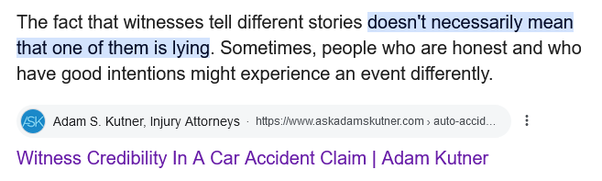
Witness Credibility In A Car Accident Claim | Adam Kutner | Vegas
This leads us to another answer, “Truth is what we can agree on. The greater the agreement between the greatest number of parties is most likely the closest form of truth we can attain.”
This is also problematic, however, because this entails the evocation of a logical fallacy of populism — or the “Bandwagon Fallacy” — “Ad Populum Fallacy” — and is precisely what we are struggling with in society today with the consequences of having our perceptions deliberately massaged to create an interpretation of a truth which abandons objective clarity and retreats into subjective bias to affect the world.


This is problematic because popularity is a metric for bias, not truth, and it can be highly destructive to society — as we’re about to learn in a very uncompromising fashion.


This leads us to a third answer, “Truth is a combination of an agreement upon perceptions as supported by empirically tested and proven realities.”
In short, the scientific method is the most accurate means for deriving an objective “truth” for our species — because it requires testability and predictability to determine its degree of accuracy in a rendition of reality.
At this point, we arrive at a final answer: “Truth is an accurate depiction of reality which exists independently from people.”
The same “truth” is available to all people, but all people must make the same trek to arrive at an objectively supportable perception of truth — otherwise, their “truth” is a self-serving delusion.
 thotbag