
This post is a response to a question posed in its complete format: “Why do some people say that eccentric introversion is masculine while extroverted conformity is feminine?”
The rule of thumb when referencing “some people” is that it means nothing more than individual bias.
Here’s an example of “some people” — one person in this case whose attitude is entirely predicated on bias and without effort in researching a topic to develop a deeper understanding of the subject they’ve indicated an interest in.

Digging deeper into the mind that seeks validation for their bias, one notices several examples of fact-free bias that they’re mining validation for instead of educating themselves on the topics they express a fraudulent interest in while disguising their biases as concerned questions.

If you look through all these questions, you’ll notice that they are all mining for validation for their biases. I won’t share this profile’s identity because it doesn’t matter. This person is just one of the “some people” you’re wondering about with your question.
The last two questions in this list highlight the nature of a subjectively focused mindset.
First, they’re interested in relieving their boredom but don’t realize the most effective way to accomplish that goal is to educate oneself. If they did that, they’d find their minds too occupied with information to be bored.
Admittedly, this conclusion is a bias that I developed early on in my life when I encountered an assessment of the statement “I’m bored,” which described that declaration as a way of saying “I’m boring.” It is pretty accurate because none of these questions reflect any depth of consideration for the topics raised.
The last question sums up their attitude toward learning as a limited benefit that fails to go beyond acknowledging value within applied knowledge that can be leveraged for pragmatic applications.
The consequence of this attitude toward learning is to limit one’s understanding of subjects one seeks insight into. In the example of the first question, they’ve already decided that “laziness” is a valid presumption upon which to build their biased views of the world.
For example, an answer they received likely skipped past their perceptions beyond the level of novelty.
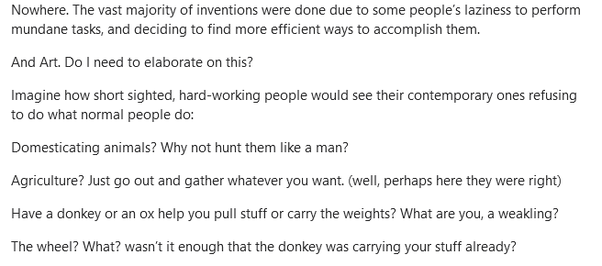
It would not dawn on them to reconsider their definition of “laziness” because of this answer beyond possibly acknowledging that laziness isn’t a universally undesirable characteristic. I sincerely doubt they would be prompted into researching causes of motivation and apathy or even bother to investigate mental health issues like executive dysfunction.
“Laziness” is “laziness” to this person and will remain so because they’re not interested in expanding their understanding. They’re interested in being entertained at a shallow and briefly distracting level to escape boredom in the most practical manner they know by catering to their ego.
This is now where I get back to your question and point out the nature of the broad brushes used in the presumptions formed by the attitudes you’ve identified.
The telltale sign to knowing whether someone is interested in developing depth in their understanding of subjects or whether they’re simply mining for confirmation bias lies in the size of the broad brush they use to smear demographics that are largely undefinable beyond a generic level.
Terms like “eccentric introversion” and “extroverted conformity” are subjectively defined biases that are not scientifically valid. For example, psychological authorities recognize different forms of introversion but don’t use judgmental terms like “eccentric.”
Here’s an example of four types of introversion as described by an authority in the field:
“Anxious introversion includes staying home from the party but for a reason. The anxious introvert feels self-conscious, and even when they’re alone, they ruminate about their social interactions.
Social introversion is a person who always says no to going to a party. They’d much rather be home doing some solitary activity. When they do socialize, they keep to small groups. This probably ties into that feeling of exhaustion. Introverts derive energy from solitary time, whereas extroverts feel energized being with others.
Thinking introversion means you’re pensive and introspective. You look inside yourself and self-reflect often. “People with high levels of thinking introversion don’t share the aversion to social events people usually associate with introversion,” writes Melissa Dahl. This rings true for me (and it’s where I score the highest on the quiz).
Restrained introversion means it takes you a while to get going. You don’t jump out of bed, ready to embrace the day. I can imagine this translates to being quiet or standoffish in social situations but would later blossom into more participation in socialization. “It takes her a while to warm up,” my mother always said.”
What Kind of Introvert Are You?
The descriptive terms used are non-judgmental observations of distinctions between characteristics.
“Eccentric” is a value judgement, not an objective description of a behavioural trait.
“Extroverted conformity” is the same kind of value judgement of a behaviour, not a clinically valid description of the behaviour they’ve identified.
By associating these judgments with genders, they’ve described their gender biases in full detail with few words.
The short answer to your question is what I indicated in my first sentence, “some people” are biased. They pass off their biases as valid judgments to entrench those biases within the public consciousness in society, and we end up with stereotypes built upon pre-existing biases.
Another characteristic of bias is when people preface their presumptions with a logical fallacy called the “bandwagon fallacy.” It appeals to the suggested popularity of a concept to grant it authority that otherwise does not exist. We’ve seen this behaviour often with the less reputable pseudo-news media outlets. They’ve overused it so much that it’s become a popular trigger for people to recognize that what follows is a bogus claim.

The expression “some people” has become a running joke that “some people” instinctively react with skepticism. I doubt you’ve heard “some people” make those statements and that they are fabrications you’ve made yourself to displace responsibility for the biases they invoke.
Your profile and question history lend credibility to my hypothesis because many of your questions wallow in subjective bias. You indicate that you’re 23 years old, making your logic errors much more forgivable than someone somewhat senior to you who should know better than to wallow in stereotypes.
Hopefully, this long-winded answer gives you some insights into how to be more objective and authentic within your future querying while realizing that people often reveal far more of themselves than they realize.
As a bonus, here’s a poster for a few common logical fallacies that many people are often guilty of committing.
Temet Nosce

 thotbag