This post is a response to a question posed in its complete format: “Are big companies likely to experience more fraudulent and mismanagement issues than small companies?”
This question touches on the core of the privatization argument, where people claim government inefficiency justifies a privatized alternative to a government service.
The larger the organization, the more people must be coordinated, and the more complex and inefficient it will naturally be. Whether it is a government operation or a privatized one.
Opportunities for corruption increase at scale per the degree of complexity of operation, which can hide corruption and the degree of reward available for effort expended.
The more opportunity there is for flying under the radar, the more attractive an environment becomes to the corrupt. The greater the reward, the more the corrupt will risk detection.
The larger the organization, the more vulnerable it becomes to corruption because the rewards are more significant, the chance of detection is reduced, and the effort expended is minimized.
For example, in a generic scenario, because it happens pretty often, it is a common tactic of fraudulent billing to a large company for non-rendered services by a non-existent company.
The larger the organization, the more significant the number of invoices it must handle. All are being funneled through a finance department with a large contingent of staff who cannot know the specific details of each bill passing through their office. They superficially review each invoice to determine veracity and establish a threshold at which the review process intensifies.
For example, if their threshold is $1000.00, the fraud can create a fictional company, send monthly bills under that threshold, and collect a monthly sum that can go undetected for extended periods. They will often be discovered when someone investigates the bill in detail, which may or may not result in charges, depending on how well one has covered their tracks.
In an accounts payment office handling dozens of bills per day, it can be easy to overlook something like copier maintenance invoices.
Setting all of that up requires inside knowledge of a specific operation, so I am not sharing this as an endorsement, only as a generic description of the type of fraud that can occur and does so in large organizations that would not happen in a small one.
The larger the organization, the greater the financial reward, which exposes larger organizations to ladder-climbing strategists more than smaller organizations, attracting people more interested in the quality of work, flexibility of challenges, broader scope of responsibilities, and deeper interpersonal relationships.
Larger organizations can become quite politically toxic, but that doesn’t mean smaller organizations don’t fall prey to the same levels of incompetence.
All of these are basic human behaviours we see throughout society, and ironically, they’re not much different than those we witnessed during our high school years. Sometimes, they are just as juvenile in their manifestations. More often than not, however, in large organizations, those underlying attitudes and behaviours one experiences within high school cliques are more subtle and sophisticated because they are more often among people with higher levels of education.
This post is a response to a question posed in its complete format: “Has the Canadian Prime Minister Mark Carney presented a plan to bring down the massive debt?”
One of the harshest lessons I’ve had to learn when entering the professional world to hawk my services was understanding the difference between a cost-based mindset and a value-based mindset. I learned to despise the former and value the latter, most notably because it was far more rare an encounter. I learned to dislike the cost-based mindset because I found it generally characterized by a cynically misanthropic attitude that regarded intangible benefits as a scam rather than as a means of adding value.
This mindset can perform basic arithmetic but fractures into a mess of cynically driven frustration when performing simple algebraic functions.
“What do you mean by greater product knowledge leading to increased confidence translates into increased sales? That’s just bogus. People want high quality for cheap. Don’t make things so complicated.” (An embittered rendition of the cost-based mindset.)
At any rate, to address the question, the answer is both yes and no… Unlike the typically myopic view of handling debt that CONservatives focus on, with a strategy that involves cutting one’s own throat by imposing austerity on the little people and redirecting more financial resources to the parasitic class, he has been busy focusing on a revenue generation strategy.
It’s difficult for MAGA Conservatives to wrap their minds around handling debt through multiple strategies. Because revenue generation is so much more complicated than simply axing a shaky infrastructure that punishes the working class, they never seem willing to examine this far better and more productive approach to fiscal management.
Carney has been busy discussing economic growth strategies with the local community and global leaders. Admittedly, these are longer-term strategies than cutting costs, as they are a far more effective and stable approach for managing debt.
Another downside is that conveying the benefits of such an approach to people who can’t or refuse to grasp multi-stage strategies is subject to the same criticisms that the Carbon Tax has faced, and that Maple MAGAts have been barking about how much they dislike it, perceiving it as a scam.
Short-term thinkers often struggle to grasp multistage concepts that require focused attention to understand how additional upfront costs can result in far more significant economic benefits in the long run through revenue growth, which more effectively manages debt than cutting costs. Cuts hamper economic growth so much that they can potentially send a nation into a financial death spiral.
Those who don’t understand the implications of short-term thinking should pay attention to how Mango Mussolini gives the world a stark lesson about how utterly misguided such a myopic focus on economics is.
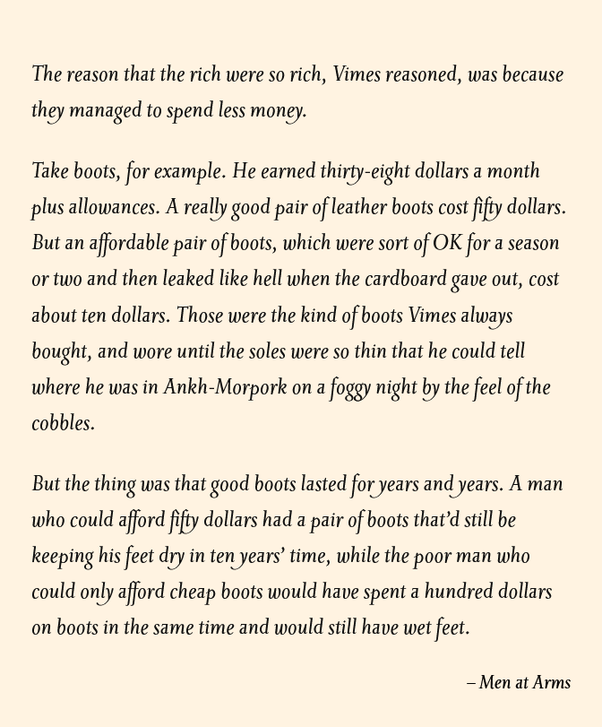
The most straightforward rendition of this view of economics is given by Terry Pratchett in his 1993 Discworld novel Men at Arms, through a character named Captain Samuel Vimes in a “Boots Theory of Economics”
Carney’s strength as an economist lies in his understanding of value and his focus on creating long-term benefits by developing a value-based rather than cost-based strategy.
This approach forgoes making quick promises to please the impatient among the crowd and requires time to develop. Some people innately understand the importance of creating a coherent strategy, and it was this unspoken expectation that a grifter like Drumpf leveraged through a trust-based scheme when he claimed to have “ideas of a plan.”
The difference here is that the work being done by Carney is obvious, and CONservatives help to make it obvious when they whine about how much gas he’s consuming by flying abroad to make deals with more stable nations than the U.S.
Carney has developed a strategic plan through his actions and decisions. He hasn’t yet summarized it in an action plan that the short-term thinkers demand. They must wait until his strategy becomes an actionable framework for followers.
This post is a response to a question posed in its complete format: “What happens if all the wealth in the world got distributed evenly to every human being for 1 day? Would we return back to capitalism?”
People would do far better thinking about the system that creates income disparity rather than imagining pipe dreams that would accomplish nothing.
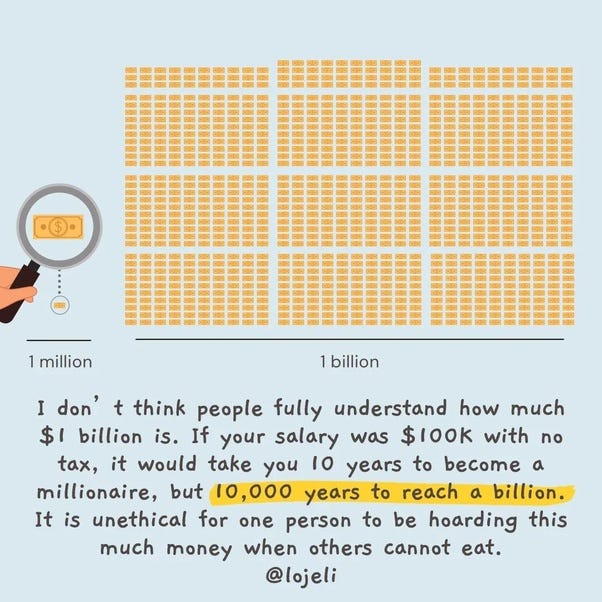
Firstly, redistributing all the wealth in the world equally would not magically create a world of millionaires. For example, if Elon Musk were to redistribute approximately 400 billion to America’s 350 million, they would end up with only $1140.00.
The entire world’s wealth is approximately $454 trillion; if you divide that by 8 billion people, each person ends up with $56,750.00. You can’t buy a house for that in most developed countries. It’s nowhere near enough to make fundamental changes in a person’s life.
The problem may seem that we have money hoarded by too few people — such that eight people own half of the world, but that’s a symptom, not the cause of the problem. The problem is caused by how money is distributed throughout our capitalist systems.
The problem is caused by centibillionaires and corporate executives earning thousands of times more per hour than the average employee.
When that ratio was only 23 times more than employees per hour (as it was in the 1970s), more people had disposable income. When most of a population has a lot of disposable income, they buy many more goods and take advantage of many more services, which creates many more jobs and opportunities for self-employed people to sustain themselves. In short, the velocity of money in an economy is much higher — which means cash changes hands much faster than it does today when it’s mostly tied up in significant investments and essentially hoarded by too few people.
This is called a force multiplier in the economy and why the middle class is called the economy’s engine. Everybody wins.
You should ask instead: Why don’t we cap an upper limit on personal net worth to ensure the economy works for everyone? This strategy not only supercharges an economy like a finely tuned vehicle, it also eliminates government corruption. With a global cap of one billion in personal net worth, we could forever eliminate the threat we face by a globalist oligarchy.
We could end a centuries-long class warfare overnight with the stroke of a pen.
We could end poverty almost overnight.
If we were united in solidarity on this point alone.
It may seem impossible, but it would happen if eight billion people decided they wanted this to happen.
Try to think about that.
It would also end wars around the globe.
The war in Ukraine would end overnight.
Vladimir Pukin’, his oligarchic buddies, and all the rich techbros thinking they could reinstall a modern monarchy would be disempowered overnight.
No more familial dynasties. No more Walton family treating their employees like dirt while forcing them to get government handouts because they’re not being paid enough.
No more arrogant stupidity by people thinking they’re better than the rest of humanity that they regard like pack animals instead of human beings.
We would reduce and eliminate many social problems because money would flow freely. People would not be dying from poverty. A child would not be dying every five seconds from hunger. Homelessness would disappear. Altruism and food banks would become moot.
Fight for a global cap of one billion because that’s more than enough to live in bloated luxury.
If we need one goal for eight billion people to rally around, we should make this our goal (along with UBI).
This post is a response to a question posed in its complete format: “Why won’t rich people just donate a tiny bit of all their wealth to poor people?”
Some of them do. MacKenzie Scott, the ex-wife of Amazon founder Jeff Bezos, has donated over $17 billion to charitable causes since 2019. Our problems, however, can’t be fixed by relying on a few donations by the small percentage who care about other human beings beyond themselves.
People need to stop thinking about ways to guilt the few rich capable of feeling guilt into ponying up on behalf of those who don’t care in the least about the poor as long they shut up and die quietly and out of sight.
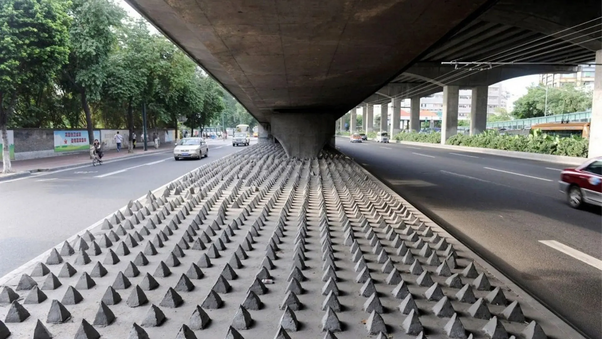
Why do you think “hostile architecture” exists?
A lot of people don’t want to help the poor. They want them gone out of sight and out of mind. They want to blame the poor for creating their conditions of poverty.
They want to think of them as lazy addicts who irresponsibly ruined their own lives.
It’s no different than shaming a woman for her clothes or behaviour for inviting a rapist.
It’s like shaming a mugging victim for paying cash for their drink in broad daylight.
People don’t want to think about why things go wrong for other people because it means dealing with the possibility that things can go wrong for them. If people believed they could also become one of “those people.” many would just give up, while others wouldn’t be able to function past their anxieties.
Although the existence of centibillionaires is a huge symptom of a system so broken that so many poor exist, no one wants to change anything because it means having to do things differently than they’ve become used to.
Look at how impossible it’s been for Americans to adopt a universal metric system — even though it would save them money.
Look at how impossible it’s been for Americans to adopt universal healthcare — even though it would save them money and lives.
People may demand change, but they hate change. Many people prefer complaining about how bad things are to doing something different because they fear change will be worse than what they’ve gotten used to.
My province of BC has had three referendums on electoral reform that would have made our elections more representative of the people. We would have become a more democratic province that more effectively addressed the needs of the people if the people could vote for what they want rather than vote against a change they don’t understand. Even worse, the change is easy to know if one makes a small effort to educate themselves, but they don’t and won’t understand something until they’ve lived it. When people are unsure, they consistently vote to maintain a corrupt status quo instead of voting to change it.
Americans are going to continue voting for corrupt leaders until they realize their lives are at so much risk that the choice is no longer “change or continue suffering” but “change or die.”
That’s where we are right now… or at least, those who refuse to read the writing on the wall will eventually figure out that’s the case when they start seeing the suffering around them can no longer be denied. They will change only when they become more afraid of maintaining a destructive status quo than the change they can’t understand until they’ve made their change.
Rich people won’t give up their wealth, even in part to sustain a failing system until it fails so badly that they start running and hiding for their lives from the mobs who are angry enough to repeat history. They won’t change what they’ve gotten comfortable with, even if it means they’ll end up more prosperous.
This is why “woke” is such an important concept these days — because we are at the stage where a lot of people are sick and tired of screaming “Wake up!” to people who insist on ignoring the threat they’ve become to our future.
The bullying Nazis among us still think they can play their bullying games endlessly while laughing at the “librul” tears they imagine are being shed out of frustration without realizing those tears are being shed because of what comes after those tears… the mourning of having to do what could have been avoided.
The few wealthy people cannot, through donating portions of their money, fix what’s broken.
The system needs to change on fundamental levels enough to force the greedy sociopaths to acknowledge the critical importance of maintaining a universally sustainable social contract. They need to understand the benefit of giving up some of their money to pay back into a system that allowed them to become rich in the first place.
Allowing a small number of elite few to grow hoards is not how to develop a sustainable economy or lift people out of poverty.
People like Musk know this. They don’t care because they see themselves as entitled to rule over the rest of us like we were herd animals.
Eventually, someone like Musk will push society far enough for the guillotines to come out and put his head on a pike. He doesn’t believe that’s what he’s inviting into his life. He thinks he is untouchable… just like Trump thinks he’s untouchable — that no one would dare do the unthinkable.
Suppose Trump decides to start a war with Canada, and NATO steps in. In that case, the chances of an American military officer putting a bullet in his head on the brink of launching a nuclear attack against a long-time partner becomes a very real possibility. Just because he’s the “commander in chief” doesn’t mean he has carte blanche to do whatever he wants. Everyone has limits. That’s just life. We must acknowledge that and protect them for everyone, for all our sakes.
We don’t know right now what those limits are and what it will take to cross that one bridge too far… but if or when it does happen, there will be chaos in the streets. We’ll be spending the next hundred years dealing with profound regret while armed with microscopes to examine in micro-detail how it could be that we allowed this nightmare to go on as long as it did.
We will be kicking ourselves with the kind of regret that will change us forever in ways that will horrify us deeply if this happens again. We should be paying attention to how the German people have had to cope with their recovery from the madness that overtook them. We should be learning from history, but 76 million people voted for a repetition, while another 80 million said they didn’t care enough to do anything different but pretend it wasn’t their problem to solve… so they made it their problem and everyone’s problem.
Meanwhile, it’s unfair to the few wealthy who are generous and care about humanity to put the onus on them alone to solve the problems we all have a responsibility to solve.
If that means we have to start punching Nazis to get them to develop enough humility to behave like human beings, then we need to start swinging as if our lives depend on it because they do.
Nothing will change until we take this dystopia seriously enough to deal with the threats we face in the form of hatemongers who feel themselves entitled by God to rule this world.
If there’s one thing we can learn from Luigi Mangione, it’s how overwhelming this problem is and how overpowering the enemy is. They’re not taking any breaks now that they’ve been given the keys to transform the landscape radically. They’re putting the pedal to the metal, and if it means running over millions of homeless people with a bulldozer, then so be it.
They don’t care about the poor. They are happy to destroy the easily victimized among us.
Why do you think they’re starting with schoolchildren?
For someone who values a debt-free existence, it can undoubtedly be viewed as an absence of a burden that enables greater freedom of choice. However, the entire system of capitalism is based upon leveraging debt to create revenue.
Revenue and profits are seen as far more powerful versions of freedom within a system that can be leveraged in ways in which the debts themselves can be resolved by servicing them with the increased revenue they generate or by being forgiven.
Of course, this form of debt is not the same as implied by the question, which is based on the notion of debt accrued in purchasing lifestyle augments. For example, a purchase of an air purifier I made just today was made through a credit card, constituting an assumption of debt on my behalf. This purchase will generate no revenue, but I applied my justifications to the decision before making it.
One can argue that my decision decreased my freedom, but that’s only a tiny part of my decision. I can easily say in favour of the practical benefits of making this purchase, even with the context of it ultimately increasing my freedom (from headaches, specifically). However, that makes this degree of granularity in decision-making a cartoon.
Suppose the point of this question is to criticize people for spending thousands on a 100″ television through credit debt instead of a quick payment of a couple of hundred for a 24″ television that would leave them debt-free. In that case, these discussions are merely psychological masturbation sessions where people are attempting to objectify subjective considerations for themselves and applying essentially bigoted reasoning to determine values of rationality toward decisions made by others for things they value.
The reality, however, is that if one is going to argue how debt freedom is an important freedom, then so are many other forms of freedom. For example, freedom from a crushing health exploitation system through a universal healthcare system is also an important freedom that many don’t consider freedom because they’re obligated to support it through their taxes — even if it means a reduced fiscal burden and improved services. The fact that they have no choice but to contribute to it, whereas they do have a choice in a privatized system to pay much more and be rejected by their insurance carrier to die, is also considered an important enough form of freedom for many that universal healthcare remains unimplemented in a nation that likes to think of itself as a bastion of freedom even though it has the highest incarceration rates in the world.
The point is that no matter how vital debt freedom seems to some, sound fiscal management skills are more critical because debt is contextual. The largest corporations in the world carry the most significant amount of debt and begin by getting deeply into debt. Our financial systems are geared around rewarding debt.
Your credit score, for example, drops when you’re debt-free and increases when you have debt and show that you can manage it. The only way to improve one’s debt ceiling is to go into debt. You can live your entire life being a cash-only person and living debt-free, but when you reach a point where you need debt to resolve an issue or accomplish a goal, going debt-free becomes a liability in your application for debt.
In short, Americans are not taught that freedom from debt is an essential freedom because it isn’t. The ability to service one’s debt through revenue constitutes a far greater level of freedom. After all, there isn’t one investment manager who counsels investing one’s money into risky investments. They always counsel investing other people’s money.
Some may wish to argue for a return to debtor prisons based on this dynamic, but that would just penalize the wrong people.
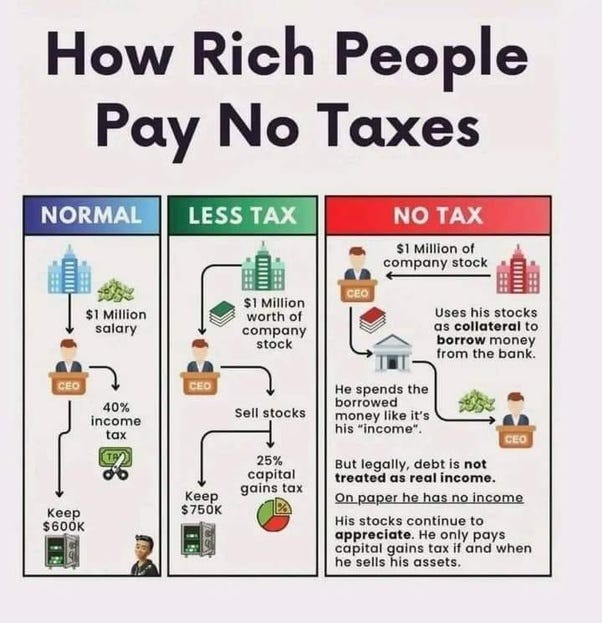
Here’s how wealthy people leverage debt to lower their cost of living, for example:
The wealthiest among us experience the most significant degree of fiscal freedom precisely by how they manage their debt.
The kind of debt and the thinking about debt described by this question is from an era when people could count on stable 40-year careers, prudent personal economic management, and modest living that would result in a comfortable retirement. Those days are long gone.
This post is a response to a question posed in its complete format: “Could taxing Elon Musk and other people with massive fortunes 80% be the solution to paying down the national debt in the USA?”
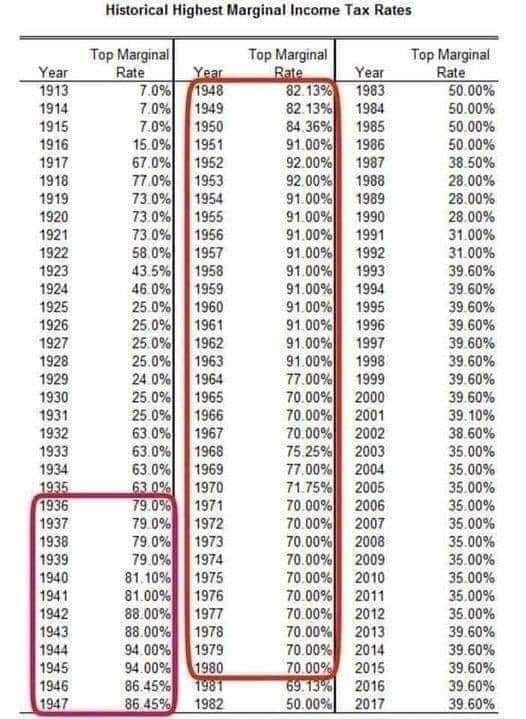
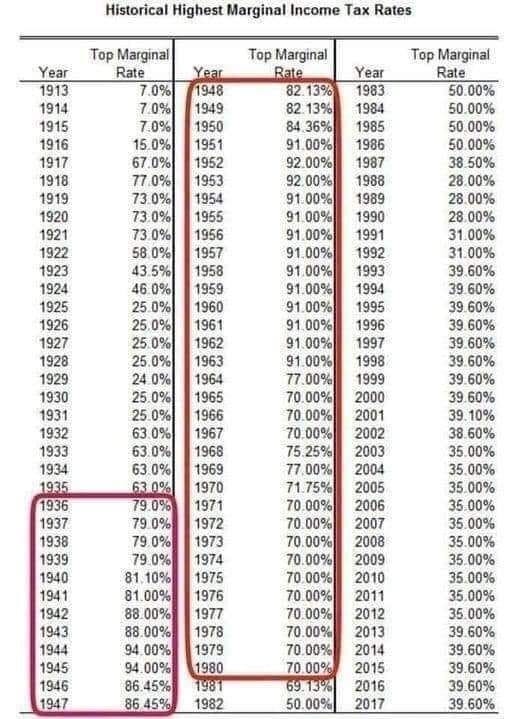
The answer is quite simple and beyond evident to anyone with eyes and a mind that’s capable of connecting simple dots from a simple table of numbers:
Here are a few points to address regarding regurgitated soporifics routinely employed by the enablers in the crowd.
Taxing the billionaires won’t be enough money. — Well… DUHHH!!!! That’s not the point. The point is multifold, but let’s cover some leading characteristics. a. Force Multiplier and b. Speed of Money
A healthily functioning economy is highly contingent upon “the speed of money flowing” through the system — like arteries in a human body. The more plaque there is that obstructs the flow, the less healthy the system is and the more prone to systemic collapse it becomes. The low tax rates that we have now and that we had leading up to the Great Depression encourage hoarding and are a leading cause of numerous social issues guaranteed to result in a dramatic economic collapse — mainly as automation speeds up.
The more money the bottom end of the economy has, the more demand for goods and services, and the more businesses grow in a feedback loop. Even more beneficial to the economy is that when more people have more resources to invest in themselves and their futures, more innovation is introduced into a system that feeds on innovation to grow.
These two concepts alone, together, make up for what the useful idiots who defend the hoarding billionaires who lack imagination for humanity’s future beyond building space penises fail to account for. It is bloody disheartening that trickle-down stars can so thoroughly blind people and make them so addicted to the taste of billionaire orifices to understand how their misanthropic stupidity is the equivalent of suicidal ideation for humanity.
The graphic above screams the economic solution in our faces.
The lower the taxes =, the more unimaginative parasites and predators horde = the more sociopathically stupid they become =, and the more of a threat to our future as a species they become.
We create laws to mitigate the impact of excessive behaviours because we understand the destructive effects of unrestrained freedom on society. We know that if laws don’t exist to prohibit murder, many more murders would occur. The laws don’t end murder, but they function as a valve on society to mitigate and minimize the impact of widespread murder on society.
We create laws to restrain an entire host of issues resulting from the toxic extremes of human behaviour. Still, for some reason, the notion of building dynasties to rule humanity isn’t viewed as the threat that it is… even when the numbers add up to our extinction.
The main reason the billionaires should be taxed isn’t even economic, at least not quite directly the most important. The main reason they need to be restrained is that if they are not, they will destroy human civilization, and they don’t care because they have enough to build bunkers to ride out the apocalypse.
The people answering this question who are defending the atrocities of unrestrained wealth are as guilty of crimes against humanity as the MAGAts who are guilty of treason against the United States.
An astute argument was raised in response to this post that I’ve included here:
One point I would make is that taxing income and taxing wealth are two completely different things. Elon Musk may be worth $300 billion but that’s his wealth, not his income. If we start taxing wealth, be prepared to start paying taxes on the increased value of your house every time it appreciates in value. Politicians that tell you they would set a minimum of $100 million before taxing are telling half truths. They may set a limit initially but over time that can change. The original income tax was 0.5% of incomes over $1 million. How’s that working out for everyone ?
That argument sounds much like the fearmongering cynicism against raising the minimum wage — inflation will go up, or robots will replace jobs.
The reality is that property ownership is not the same thing as stock wealth, and there’s a fix for that — eliminate the corporate ownership of residential real estate.
Furthermore, the number of tax brackets that exist today is an unrealistic reflection of the historic levels of wealth disparity. For example, there are only seven tax brackets today. I checked to see how many existed during more realistic tax assessments. It was strange that learning how many tax brackets existed historically took more effort to identify than my bias believes it should.
This link below shows that in 1952, there were 28 tax brackets. Eliminating tax brackets benefits only the wealthiest in the land. The more tax brackets, the more granular the taxation rates and the less discriminatory tax rates are to the lower classes, and the more progressive taxes become — as they have always been intended to be. As it stands, the radical reduction of tax brackets has just been a means of waging a class war against the little people by allowing them to skip responsibilities that are inherently theirs while redistributing tax responsibility downward.
No. The so-called “gig economy” is just a scam for large corporations to get away with paying people on a minimal scale for tasks without any commitment or standard employee protections, benefits, or pay equity.
It’s a way of paying as little as possible for disposable and interchangeable cogs who are desperate for any scraps they can get.
Even worse are the parasitic behaviours of gig exploiters like Uber, who leverage the vehicles supplied by drivers to create enough revenue to finance self-driving vehicles that will eventually eliminate all the gig workers. It’s like enriching someone who will throw you out onto the streets as a thank-you for the loyalty they expect from you.
It’s just a way of further exploiting people into poverty to leave them with nothing at the end of it all.
Forty years ago, an independent professional could earn a lucrative income from a thriving ecosystem populated by an entrepreneurial class of mom-and-pop shops that were everywhere. There was no need to deal with any large corporation to earn a comfortable living where one could easily afford a mortgage and meet all the expectations of the middle class.
Now, it’s impossible to sustain oneself without tapping into the corporate realm to earn an income. Meanwhile, their practices have grown increasingly insular while adapting to the rapidly changing technological landscape through utter ignorance and making inept judgments about candidates whose skill sets are so beyond their experience that they can’t hope to comprehend what they’re hiring for.
This is why we’ve had jokes about unicorn candidates with three years of experience with six-month-old technologies.
Surviving a gig economy is just a shortcut to long-term poverty.
…because they can, and because they’re being rewarded for their success in accruing large sums of money with more money by the puppets they pay to play the role of a government representative of the people.
Why should they care about helping those in need if that fundamentally changes nothing about the existence of those in need?
Why should they cut back on their trips across the globe for their favourite ice cream to ease someone’s suffering for only a few moments while they continue to suffer throughout their lives?
Isn’t it just easier to let the suffering die so that they can be done with their misery once and for all?
The real problem here is the concept of altruism. In an economically just world, altruism would be moot.
We already know that the executive boardroom is populated with the same density of psychopaths as a prison. Yet, we somehow expect they will be charitable enough with their money to sacrifice their luxuries to temporarily ease the pain of those suffering from unmet basic needs.
As individuals, they can only accomplish a little of anything.
As a group, however, we can ensure our system holds them accountable for their fair share of contributions to the world in which they disproportionately benefit from its bounties.
If they were held accountable for how they were at our height of middle-class growth, they would be more successful at helping all in need in proportion to their contributions as a whole because no one would benefit more or less from an act of altruism.
By returning tax rates on the wealthy to an Eisenhower level of progressive taxation, replete with the rules restricting corporations from benefitting from loopholes that permit them to escape a tax burden, we would resolve the needs of those in need on a systemic level.
We would not need to rely on a delusional expectation of the mega-wealthy to voluntarily practice austerity as has often been imposed upon the little people.
Have a close look at what happened to tax rates in the 1920s. That era was called the “Roaring 20s” because it had a booming economy due to the wealthy having much more disposable income. The same thing happened in the 1980s when Reagan dropped tax rates. The economy boomed briefly, and everyone loved Reagan because of it.
In both cases, those boom periods were finite and led, in the first case, to a worldwide war, while in the second case of Reagan’s tax cuts, it led to the “Great Recession.”
That’s what happens when large sums of money are released “out to the wild” for the peasants to get their trickle-down benefits. In the first case, that form of “voodoo economics” was called “Horse and Sparrow” economics because the Sparrow would benefit from all the food the horse hogged and shat out the other end.
That’s what trickle-down has always been. The little people get what the wealthy shit out as waste for them, and we’re supposed to find ways to live in dignity with that disgusting degree of indignity mounted onto our lives while we labour to make the rich wealthy.
It is precisely this dynamic that has been responsible for every social meltdown in history.
Meanwhile, if you look at that tax table, you’ll see the higher taxes resulted in the most tremendous growth ever for the middle class while the most significant number of people were lifted out of poverty.
None of it occurred because we relied on the generosity of greedy people but because we had our system tuned to maximize the benefits of a capitalist system.
“Trickle-down economies” are also called “boom and bust economies” because they go through cycles of recession and growth. The wealthy class loves this dynamic as the little people must suffer through periods of belt-tightening austerity. For the little people, austerity means having to go without essential needs being met, while for the wealthy class, austerity means excellent deals on going out of business sales. This is where they make their most significant cash grabs.
When small businesses thrive in a booming economy, they grow in value and expand while taking on more debt. That debt eventually crushes them when the cycle of a bear economy rears its ugly head. Many are forced to sell or go personally bankrupt and become devastated entirely for life. Many accept giving up the business that they grew out of love for what they were doing and allowed “an Elon Musk” to step in and claim credit for all their years of hard work while benefitting from that work to win humungous profits when the economy turned back into a bull.
It’s a class warfare game they have been playing with us as they corrupt the capitalist economy like it were a casino, and they’re the house that always wins, no matter how lucky any of the little people are.
This is why the guillotines come out whenever the little people figure out how badly rigged the game is against them.
The rich spend lavishly because they can and because they have rigged the game in their favour to specifically allow them to spend our money while programming the gullible among us to run interference for them as they victim-shame their fellow little people and accuse them of all the disgusting behaviours exhibited by the wealthy class, such as accusing the working class of wanting to steal the “hard-earned money of the rich” instead of demanding the money they stole returned to their victims.
Some care about those in need, but about 20% don’t, and they make it impossible to change the system because they invest billions in making it unfair while the rest reap the benefits of their corrupt activities. As a whole, they intentionally aim to strip the little people of our value precisely so they can spend gobs of money feeding their egos.
Due to their unrestrained behaviour, our species is on a trajectory toward extinction. Should we not push back on their greed and restore economic sanity, we won’t be able to continue at this pace, and we’ll be so severely humbled as a species that we may never recover, even if we survive the naive stupidity of our time.
Anyone wishing to engage in a dialogue on UBI is invited to participate in an open space on Quora dedicated to the issue. You may need to register for a Quora account — It’s free, and I don’t get any kickbacks from it. This space is intended purely for stimulating discussion on the topic — there are no hidden surprises beyond possibly needing to join Quora if you want to post comments. Visitors to the site can read the content without registration hassles.
When people suffer from economic struggles, particularly over a prolonged period, they become desperate for someone to step up to the plate and offer solutions they cannot devise for themselves. People become conditioned through desperation for a strong leader to take charge and “lead the way to prosperity.”
Desperation causes people to lose perspective, while critical thinking skills suffer from a need to quell the pain. Anyone who can convincingly present themselves as a saviour will be welcomed with open arms.
Even though the solutions to economic problems may be obvious, they’re also too far out of reach of hope to implement them.
In today’s world, we are dominated by a handful of wealthy people who control all our systems with deaf ears to the cries of the suffering. Most of their focus is on their well-being, fortunes, and plans for their futures and legacies. The rest of us matter only insofar as we can be useful to them.
As our economies have become global and our economic infrastructures have become multinational entities, we have lost our communities.
Only a few decades ago, our communities thrived by our connectedness to each other.
We have lost that, while those who have been the greatest beneficiaries of a global economy have lost their sense of community attachment because the entire globe is their playground.
The plutocrats among us who are most responsible for the economic hardships suffered by millions are entirely due to their wins at the expense of the millions suffering today. Their goal has never been to raise humanity out of poverty, even though that has been the promise of capitalism.
They have their armies of servants at their disposal to secure themselves against resistance and to continue reshaping the world into their image. They are perceived as being too far beyond the reach of laws to allow the little people any sense of hope for justice.
Anyone who can present themselves as a leader capable of alleviating their suffering is welcomed with a total investment of all their hopes and dreams, while a widespread perception of one capable of rising to that need is one from among the untouchable class. That’s why someone like Donald Trump can succeed in assuming control of an entire party through a cult level of worship.
The trouble is that leaders who claim to be their solution also demand their unquestioning loyalty and obedience. That’s the key which opens the door to fascism because the only way for a single leader to wield enough power is to align themselves with the existing status quo of power.
















 thotbag