This post is a response to a question posed in its complete format: “Are factory jobs the jobs of the future in the United States? How would that work?”
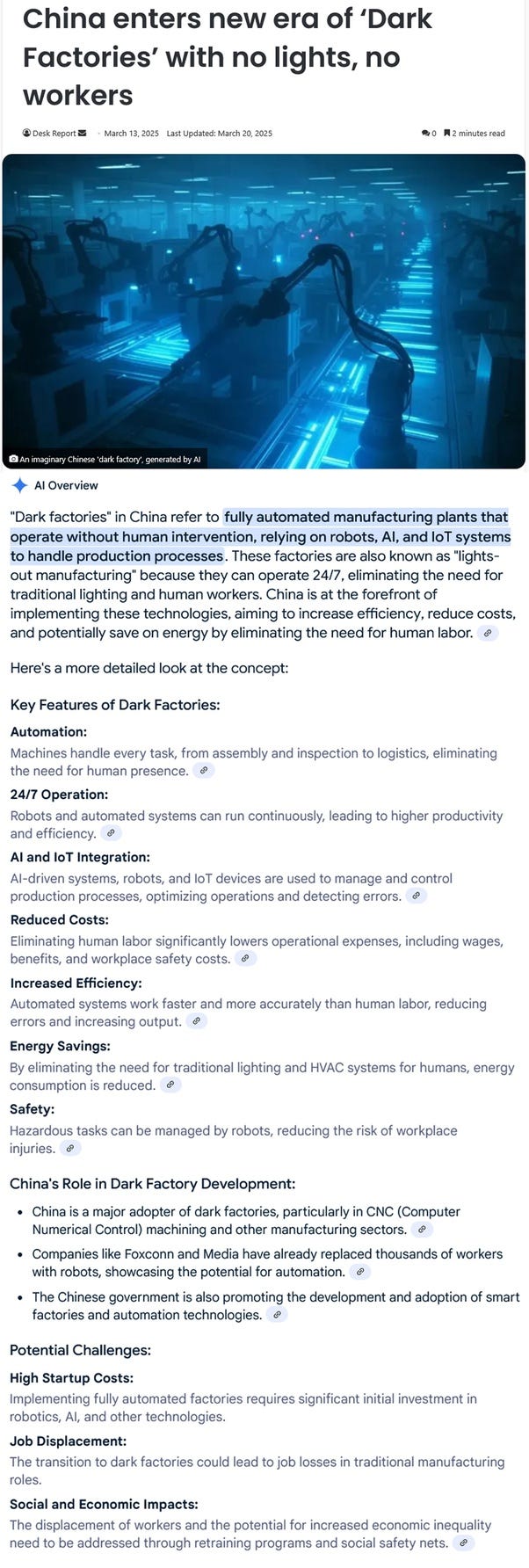
Factory jobs will mostly go the way of blacksmith jobs worldwide as “Dark factories” become the norm.
Here’s a video introduction to a massive change that is already transforming the factory landscape on an enormous scale to displace over 10 million factory workers in China alone:
Below this bit of my two cents is a long assessment by AI that will give you an overview of the reasons driving this transformation.
How that affects us as individuals is another issue altogether.
Much of what we can do as individuals is determined by our resources. As individuals or small groups of friends, we can focus our resources on investing in small business ventures that can generate profits by producing custom solutions, services and/or products that will still be in demand.
Almost all mass-produced products in society will be handled by automated systems with minimal human oversight.
Smaller markets will emerge, however, as 3D manufacturing matures enough to create local production facilities for customized products. As 3D matures, we will likely see growth in creative design areas where people will buy product designs or templates rather than products, which they then print with their in-home 3D printers. These will, of course, be limited in their capacity as they become more available to consumers, as laser printers have, which will create cottage industries for a higher production level.
In essence, I can envision three levels of production: large-scale factories producing for a global market, local factories producing for local municipalities (which begs the question of raw materials like PLA, along with a radical evolution of printable materials to expand production choices made on a global level), and home-based production.
Factory jobs and jobs where people go to every day by the hundreds or thousands to perform functions for a large organization’s profits are disappearing. That type of work dynamic is vanishing, particularly on a production floor.
We may see organizations grow out of opportunities for innovation, where, instead of going to a job to perform mechanical functions in a production process, we will see large groups emerge in an innovation-driven enterprise model. Hundreds of scientists, engineers, electricians, programmers, etc., will collaborate on new technologies for space exploration, for example, or medical advancements.
Companies specializing in material sciences will emerge to create new printable materials to advance 3D printing technologies, for example.
At any rate, here’s the screen grab of an AI overview of dark factories:
This post is a response to a question posed in its complete format: “What effects do you think AI will have on society? Realistically, are people overreacting who say they’ll take all the jobs and run the world?”
Realistically, machines can’t “take jobs away” from people. Organizations and the capitalists who fund them while demanding optimal revenue generation at the lowest cost possible are choosing automated solutions to the labour cost.
This trend, of course, does displace workers as technologies have always done. Unlike previous generations of technological advancement, however, the displacement is not limited to specialized functions.
For example, armies of people sawing logs by hand were not entirely displaced by the introduction of sawmills. Labour was reallocated and redefined. Instead of pushing a saw back and forth, labour became a process of pushing buttons.
Of course, fewer people needed to produce the same volume of lumber, but there was also enough demand to scale production and create employment opportunities further up the production line.
At the height of the technological transition to a digital age, we saw many jobs displaced, but new categories of employment at much higher levels of complexity emerged. Secretaries who transcribed letters were replaced by administrative assistants who functioned in a data entry capacity. At the same time, executives eventually learned it was more efficient and pleasurable to directly type their thoughts into word processors rather than proofread changes multiple times over in an often frustratingly long process.
Network technicians, web designers, database developers, and an entire class of Information Technology workers sprung up almost overnight — by contrast to how the labour demographic had evolved since the dawn of the Industrial Age.
That’s no longer the case in today’s dynamic.
The AI revolution will not spawn demand for new labour beyond the minimal replacement of armies of people pushing saws with one person pushing buttons.
Before this current stage of technological evolution, it was easily argued that displacement versus the creation of new jobs approximated a one-to-one exchange. The hundreds of thousands of trucking jobs replaced by self-driving vehicles will not result in new jobs created to transport goods globally. Self-navigating cargo vessels will not create 15 to 30 new jobs per ship when intelligent robots replace workers.
Hundreds of millions of jobs worldwide will be transitioned to an automation model.
This brutal inevitability ignores issues used as political footballs and bypasses all the fearmongering over demanding higher wages. Automation will displace jobs, but not because automation “takes those jobs.” Technological innovation has always been and always will be a more efficient way of doing business.
Although the transition to an automated society is often viewed as a technological transformation, it is primarily a social transformation. People are going to have to stop thinking about “getting jobs” and starting about how to generate revenue for themselves by leveraging services as independent entrepreneurs. This view of capitalism has always been at the heart of the capitalist vision, and it was cemented in our psychology when business was granted personhood status.
The primary challenge within this transition is to provide the means to pursue one’s independent revenue-generating efforts with the necessary resources to succeed as an independent business owner.
We are inundated with exposure to the results of resources transforming our world by creating new classes of the wealthy whose net worth far exceeds previous generations — even after accounting for inflation. Henry Ford, for example, was a highly successful industrialist, but his net worth and reach don’t come close to Elon Musk’s status as a centibillionaire. It can be argued, of course, that such a disparity is a consequence of a corrupted tax burden. Still, those factors don’t fully explain the difference in dollar value between Ford’s millions and Musk’s centibillions.
The profit potential has never been more significant simply because the markets that once comprised a few million consumers now stretch across the globe, with a population approaching eight billion potential consumers. This global reach is why it is often argued that it’s easier today to become wealthy than before.
The reality, however, is that just like yesteryear, resources are required as seed funding to support the creation of tomorrow’s industry giants.
We cannot continue to rely on dynasties to dominate the innovation engine because they are not naturally innovative. They are conservative and often repressive by nature because they are risk-avoidant.
The heart of capitalism beats to the tune of innovation. There is no more significant potential for innovation than the eight billion people mostly trying to carve out a living while engaged in activities they value. The handful of billionaires and centibillionaires cannot compete with that innovative potential. By allowing our species to be directed by such a small number of individuals, we are limiting our potential as a species while granting too much power to people who are so grossly corrupted by it that they have become a threat to our future survival.
We must level the playing field and empower the little people who can put to great shame the illusion that the powerful in society are so far above the rest of us that we can’t survive without their direction.
Not only can we survive without them, but we can prosper in ways currently impossible under their thumbs.
We need UBI to release humanity from the yoke of our oppressors and fully embrace our creative potential through the innovative possibilities unlocked to us all through a fully automated society.
This post is a response to a question posed in its complete format: “Will money and economies still exist, if all jobs get automated? If all jobs are automated, what will people work to earn money? If all jobs are automated, will people receive everything they want and need, for free, without having to work?”
Within a fully automated society, people will have their needs taken care of.
Wants are an entirely different beast.
If you want money to travel around the globe, you’ll still need to earn money to afford that.
If you want to buy a sportscar instead of using public transit, you’ll still need to earn money to afford that.
How you make money will be more a choice for you rather than a necessity made of compromise by a perpetual lowering of your expectations.
You won’t be forced to take a job you hate because you’re afraid of being made homeless. You’ll be able to hold out until you find a vocation you like and that brings meaning to you and your life.
You’ll have many more options for being self-employed than now in ways only emerging today as viable systems to help you bring your imagination to life.
I’ve recently discovered an entirely new concept for doing just that. Check it out:
The site is called “Makeship.” What makes it unique is that you can design your character, and if your design is accepted, it will be made into a plush toy that you can sell for a profit. They handle all the “heavy lifting” from converting your design into a 3D plush toy, its production process, and, to a large extent, a lot of your marketing through crowd-funded campaigns.
Many new initiatives are sprouting up everywhere that approach manufacturing, sales, and distribution from a service-oriented perspective.
You’ve probably already heard about dropshipping, where you can essentially choose products from a distribution catalogue and assemble them in a store where you handle all the sales for those products. They handle all the packaging and shipping for you.
This is just the beginning of the new world of automation.
Large entities will capitalize on individual ingenuity, innovation, and effort by empowering the little people to go out and carve their niches in the commercial world.
With the assistance of AI, we’ll be able to produce full-scale movies for distribution simply by the prompts and tweaks we make to flesh out our creative visions in ways that others would want to consume.
Life won’t cater to people without ambition or desire to work, but it will become a panoply of options and opportunities everyone can exploit.
With these tools at our disposal, we’ll finally enter an age where merit is not lip service disguising favouritism. Whatever you imagine will stand or fall on the strength of your effort without being buffeted about by the day’s politics.
Instead of fearing automation, we should be learning to embrace it and leaning into it to begin pushing our governments to adapt to a new world without waiting for widespread suffering through the transition process to compel them to solve problems that can be avoided.
UBI will save millions of lives if we begin implementing it now. If we wait until millions of jobs are lost, then we will lose a lot more than millions of lives, and we’ll end up coping with the daily chaos of ongoing riots and widespread destruction of property.



 thotbag