
This post is a response to a question posed in its complete format: “What are the most promising innovations or strategies today that could sustainably eliminate extreme poverty within the next generation?”
Thank you for the A2A, Faux-Bill. It is well beyond obvious that you are not the OG Bill Gates but a pretender. Whatever motivates you to disguise yourself as him and pose questions that he never would in such a forum is rationalized as a strategy for gaining attention that you believe you would not otherwise get.
I don’t believe questions like these require the kind of “celebrity boost” you’ve attached to them because I’m sure many people are thinking about these issues. Many politicians sadly believe people’s thoughts on these issues are irrelevant to their societal role. Nothing could be further from the truth because most of the world’s citizens sincerely desire an end to unnecessary strife across the globe.
Only the most psychologically scarred members of society wish harm to people on the other side of the globe or in the dingiest parts of their cities.
Even though people know this is a fake profile and that many would overlook this question based on precisely that, some people will still step forward and offer their views. Their answers support what I just said about people wanting to see change for the better, particularly when it is within our means to eliminate extreme poverty today.
Sadly, many politicians fail to comprehend that we are in this together, and that together means all of humanity must work toward common goals, such as eliminating poverty for it to happen. Even worse is that success requires our politicians to play the role of leader in society in earnest rather than as a performative lark to disguise their motivations for personal gain.
Far too few view their role beyond the boundaries of gamesmanship within the local jurisdiction of interpersonal dynamics of cliques, such as those commonly found in high school environments. They perform for each other and to the public at large. At the same time, their functional contributions are limited to shuffling game pieces in a subsection of the larger gameboard of their political community. Forget about communities elsewhere. That would constitute effort in thinking about and doing something about something elsewhere that isn’t directly connected to the influential factors governing their daily lives. Indirect connections don’t factor into their minds.
Here’s an obvious example of the complexity of dynamics that not enough people consider in their thoughts about how to improve our world and address issues like extreme poverty on the other side of the globe:
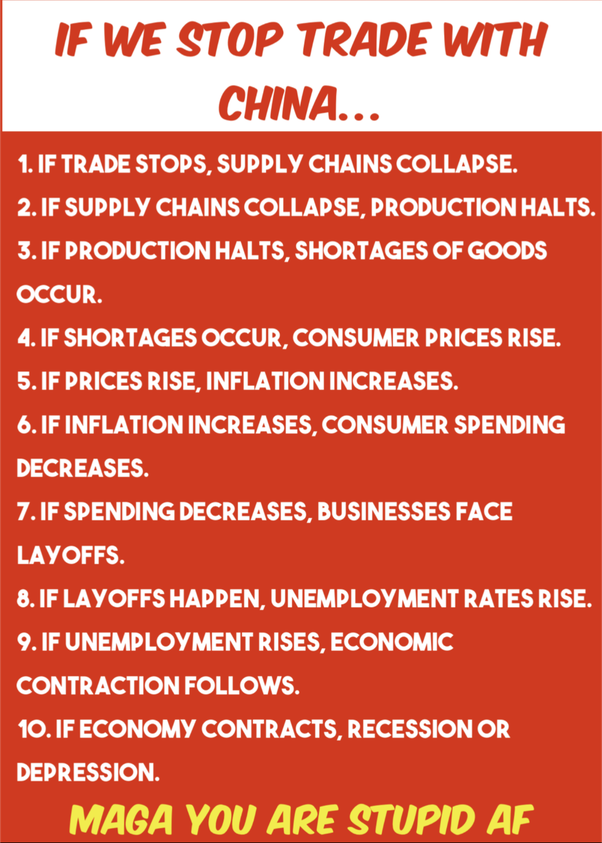
In this simple description of consequences, ten interconnected steps are outlined to arrive at the fundamental message that closing a door to a trading partner out of spite hurts oneself more than it hurts the trading partner.
China’s economy will contract briefly as it adjusts to a new reality. Americans, however, will suffer more in the long term because this attitude of bullying one’s partners closes off many doors of opportunity.
The same is true with the global tariff tirade and betraying a long-standing alliance with a supportive partner. Isolationism hurts the isolationists more than it hurts anyone they reject, and that’s where we’re at when considering issues of extreme poverty on the other side of the globe.
It is, unfortunately, too easy to rationalize how those problems “over there” are not one’s concerns here, but the reality is that poverty exists here as well. It’s just an arguable point about which is the easiest to ignore.
As you can see from the variety of answers given to this question and the variety of questions similar to this one, along with all the many other answers given to those questions, people want to solve this problem.
This brings us to the core problem at the heart of why the problem identified within this question persists.
The sad reality is that the core problem is YOU, Bill.
You and the existence of centibillionaires in today’s world are the reason why extreme poverty persists.
I understand how easy it is to rationalize your business successes as justification for having superior insights that can function like a paternalistic entity that can guide the little children of humanity toward a brighter future. I understand your rationale for the sheer capitalization required to provide the world with ecologically superior toilets. Still, you already know how you managed to distribute millions of life-saving nets in underdeveloped environments only through synergy. You relied on many people to rally behind your cause and donate whatever small amounts they could to solve a serious problem affecting millions of lives.
You made that happen, not with your capitalization but by leveraging some of your resources, connections, and celebrity status to mobilize people worldwide to provide a simple solution to a destructive problem.
Suppose you and the rest of the world sincerely desire an end to extreme poverty. In that case, there is only one solution, which begins with triage to stem the bleeding of resources that could collectively resolve the problem instead of exacerbating it, as has been the case due to extreme economic disparity.
The most successful way we have been in eliminating poverty worldwide as a society and a species has been through the massive growth of the middle class, as we experienced following the Second World War, FDR’s New Deal, and the development of unions.
By empowering the middle class with disposable income, we boosted economic performance along many vectors that were also boosted by force multipliers, which spread outward in orders of magnitude beyond what is possible today with coalesced wealth.
The existence of centibillionaires has made the goal of eliminating poverty impossible because this historically destructive concentration of wealth creates poverty through a contraction of available economic resources once wielded by hundreds of millions of people.
You know this. At least, the real Bill Gates does… as does every billionaire around the globe.
You cannot become a billionaire and be oblivious to how your concentrated wealth is a deprivation of wealth for others.
None of you is blind to this.
Since it’s taken decades of erosion of the gains that took a capitalist system decades of growth to achieve the highest level of poverty elimination, reversing that damage would mean decades of effort we don’t have the luxury of taking without experiencing a system-wide collapse.
We need bold efforts and fundamental changes to the economy and structure to meet a rapidly changing employment dynamic. We have no choice but to retool our economy before an increasingly rapid transformation toward fully automated societies where most production is performed in dark factories.
Suppose we don’t institute bold changes today. In that case, the transition will result in massive numbers of collateral damage that will be responded to with system-wide chaos because people will not shut up and die quietly as they find themselves starving for food and made homeless. When people have nothing left to live for after having their means of survival stripped from them, they become radicalized to such a degree that they are like cornered animals and will bring much destruction to the world before they exit it.
We need to reverse course on the corrosion done to our economies through the problem of wealth disparity yesterday. This should not be a debate today; if you were the real Bill Gates, you know this.
There isn’t a single billionaire who doesn’t understand this. You are all also hedging your bets while, like every cowardly politician who doesn’t want to risk their comfortable positions, none of you want to be the first to acknowledge what needs to be done. Your reticence is understandable because your community is primarily dominated by sociopathic thinking. It would behoove you to remind your peers that each passing day this nightmare of disparity remains unaddressed is a day closer to the massive unrest that brings out the guillotines.
This brings us to the core concern driving this question.
Which strategy is the most effective resource to invest your attention?
What singular and most expediently implemented solution can effectively stave off and resolve the growing pressure leading to widespread chaos?
That’s easy, and you already know the answer… if you were the real Bill Gates.
Reset capitalism like a Monopoly board.
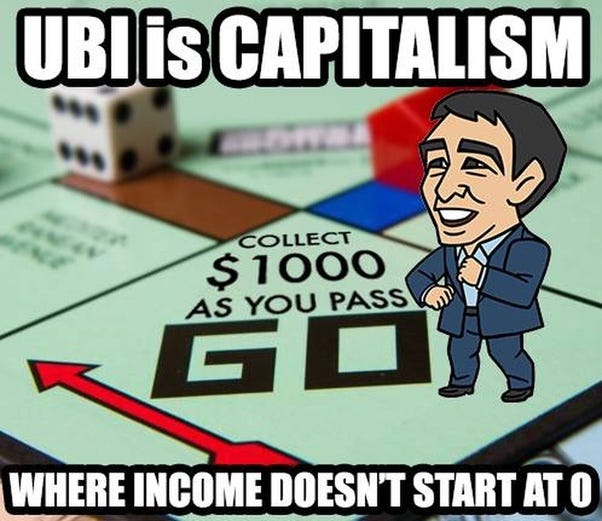
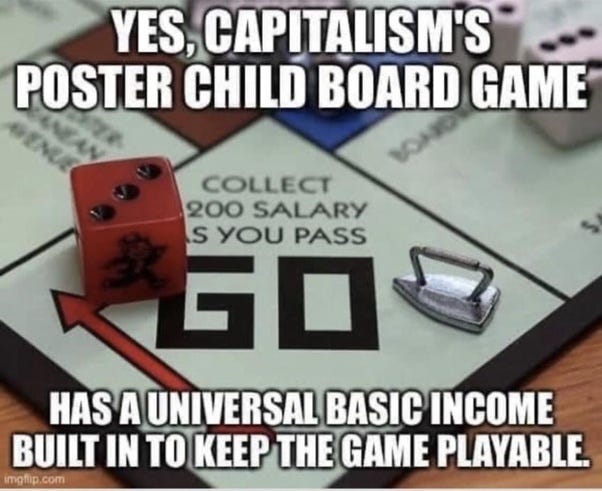
There’s been enough testing to know this is THE solution to restore economic justice and dramatically impact poverty worldwide.
You already know this.
The only real issue at stake is the best means of implementing it.
Here’s a link introducing the various issues to consider with costing strategies that can be discussed earnestly. These are just details to work out. The result, however, is a stable economy that can eliminate poverty worldwide while eventually making performative forms of altruism moot.
However, every one-percenter should champion this solution in principle in earnest today, particularly if they want to avoid the chaos that risks them losing everything.
How to Calculate the Cost of Universal Basic Income (Hint: It’s Not As Easy As You Might Think)
Update:



 thotbag