Would switching to Communism work?

This post is a response to a question posed in its complete format: “Would Communism actually work if every nation on the planet switched to it?”

Making a switch to an entirely new system is never as simple as a change of clothes.

Every significant change to an extensive system, such as a complete switch to a new form of governance, always comes at the cost of widespread chaos and rivers of blood coloured by horrors of every shade of nightmare.

That people keep talking about switching to new or resurrecting old systems because they’re overwhelmed by how broken our current system seems to be is, on one hand, understandable in their frustration and desire to restore sanity.

On the other hand, it’s horrifying to contemplate how little people understand how our current system should be working and why it isn’t working as intended.

It’s frustrating that people can see why our system is broken, as they get slapped by those reasons every day and remain utterly blind to the simple fixes that would right the upturned ship of state we all depend upon.

It’s the same kind of broken reasoning that claims we should hedge our survival bets by creating extraterrestrial colonies instead of focusing a fraction of those resources on restoring our world to a sustainable balance for life.

The simple answer to this question is that we should stop thinking about throwing the baby out with the bathwater and fix the leaks in the tub to more quickly return to struggle-free baby bathing with far less pain and suffering.

We can borrow elements and concepts from communism (and other systems) to modify and incorporate into our current systems of democracy and capitalism. Hybridization of systems has already occurred worldwide and has proven itself a successful strategy without mass casualties.

The Social Democracies developed in the Nordic nations are prime examples of the superiority of evolving systems over replacing them wholesale.

Let’s take a moment to think about an analogy that might simplify the concept of evolution over replacement.

Redesigning and building an engine from scratch still requires a lot of after-the-fact adjustment. No new engine design is fault-free from its first iteration. There are always necessary improvements to make following its first release, if not outright fatal flaws that could end production altogether.

Software applications are generally considered immature and buggy until at least the third major release. As an analogy, software development is an excellent model for understanding how social engineering can work when deliberately planned to accomplish long-term goals.

Software applications generally begin by focusing on core functions to meet various needs for various use cases. Minor updates are made to improve operational efficiencies, while new versions expand on core functionality and incorporate new features that are usually the highest in demand.

Social systems are far more complex, while system crashes cost lives. There’s not much wiggle room for errors when hundreds, thousands, and potentially millions of lives are affected by minor disruptions.

Have a look at these pictures:

Below are the same docks in L.A. that, currently, are mostly empty and without traffic. During the program this aired on (The Beat with Ari Melber — 2025.05.12), Representative Robert Garcia mentioned that before the tariff wars that Donald Trump (the deal-making artist) began, it would usually be too busy to walk where they walked without being run over by trucks due to a flurry of activity.
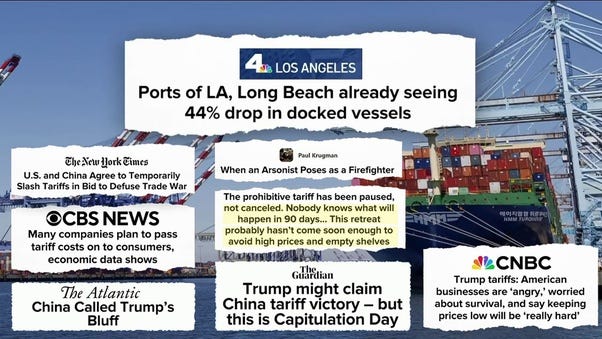
This is today’s result of the trade policy changes implemented three months ago. It took three months for a simple policy change to filter down to the port level. It will take a few more months before this effect trickles outward to impact every home nationwide.

It was mentioned in this report that hundreds of dock workers were out of work or had their hours cut back. The problem is much worse than a few hundred lost jobs, though, and they touched on the implications without adequately explaining what this all means.


When I see these photos and hear them speak, I see a domino effect of thousands of bankruptcies picking up steam throughout the nation, to become hundreds of thousands of lives displaced and destroyed before escalating into millions of lives by next spring.

Donald Trump’s casual dismissal of the serious concerns of real people trying to survive while working multiple jobs to raise their families and pay for their living needs showed a sociopathic disregard for their struggles. When he responded with nonsense about parents needing to cut back on buying 30-plus dolls for their kids for Christmas, while he’s raking in hundreds of millions on cryptocurrency scams and spending $3 million taxpayer dollars on every day he golfs and another $100 million on a military parade for his birthday, it’s mindboggling how people can be so frustrated with their lives and not be livid with him.

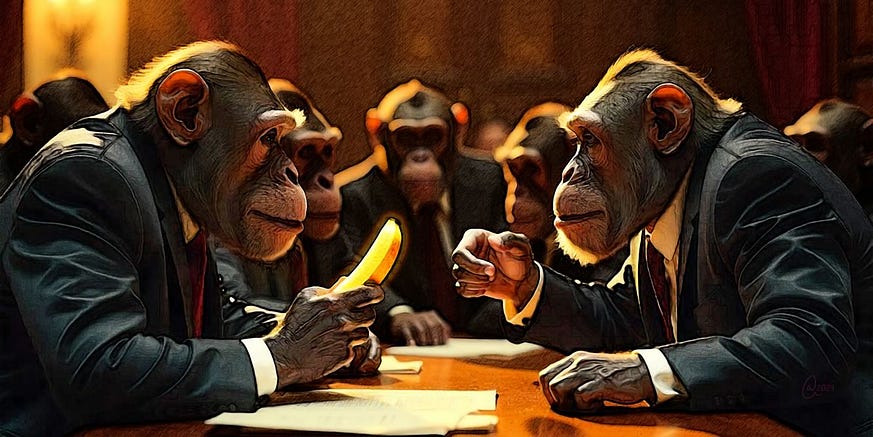
Every callously self-serving decision he makes carries implications that dramatically affect lives for years. This is the impact one person can have on hundreds of millions of people in their nation. We may currently joke about memes like this. If the U.S. becomes his latest and greatest bankruptcy, very few people will laugh — and it won’t be the millions suffering the consequences of one man’s corrupt thinking.:

People worldwide will feel its impact even if it’s contained and doesn’t erupt into a global catastrophe. Millions will die. Some people still haven’t recovered from his first term in office.

This is the impact one person can have on a system that is so complex and tightly integrated that no one escapes the effects of its disruption. Imagine how dramatic the impact on people’s lives would be if, instead of a simple tariff war and an illegal immigration round-up to concentration camps orchestrated by one leader, chaos were ramped up to a full-scale restructuring of society as a whole.

If a simple Constitutional amendment requires decades of debate and challenges by competing interests, imagine how disruptive it would be to dismantle a centuries-old system and replace it with an untested one. You can claim Communism was implemented before, but it wasn’t. Perverted forms of it were implemented by despots who killed millions as they tried to remake their nation in their image, using that system as a tool for them to leverage, like Donald Trump and several others are doing today with capitalism.

There’s no way to ensure the Communism you or anyone imagines will be the Communism that would be implemented. Marx’s vision of Communism was never implemented before, and the perverted versions of his vision were worse than failures. Meanwhile, democratic governance with a capitalist system has already transformed the world. It has become so successful that several people have and do support Donald Trump’s perversion of it to become a monstrous betrayal of what it was designed to accomplish.

Changes to any system that hundreds of millions rely on for stability require predictability in their systems more than anything else it can provide.

Without knowing what’s coming next, when people don’t know what to do, they naturally do and risk as little as possible while rationing out reserves to ensure they can survive in a repressed state over an extended period.

Completely shutting down the tariff wars and restoring trade policy to where it was only a few months ago would still take several years to return the economy to a state resembling it only a few months ago.

Replacing an entire system with another system means several decades of adjustment would be required to arrive at a state of equilibrium where people could finally feel comfortable predicting their futures and making decisions with confidence in their predictions.

Several decades of adjustment would be required to switch from the current system to a system of communism that would be stable enough, where the cost in lives could be mitigated.

In the meantime, periods of chaotic transition create incentives for the parasitic predators among us to leverage the confusion in ways that benefit them at the expense of everyone else. This is precisely the dynamic we are struggling with today. Without addressing the core problem of a corrupting influence in society, we would simply be porting a virus that weakens us today to a new system to continue infecting our society while adapting their strategies to the new system.

The flying monkeys who enable their corruption would be ported along with them because that’s the nature of power. When power is concentrated in the hands of the few, they no longer need to act directly, while their supporters do all the heavy lifting of “massaging a system” to cater to their needs.

We can see that occurring primarily within the MAGA community as they’ve been frustrated with how much they’ve had to endure and are struggling ever more over the last few decades, instead of experiencing a general improvement in their quality of life, like their parents and grandparents before them. They are righteously angry because they have been betrayed. They can’t face the truth of who has been betraying them, so they accept easy targets to vent their frustrations onto.

We have all been violated on deep and visceral levels, leading us all to take desperate action to fix what we know is broken. The problem is that far too many people leverage their anger and ignorance of how systems work to further the oppression rather than mitigate it.

The people who are selling easy solutions are the same people who are responsible for creating the problems. Donald Trump embodies that scam. Many billionaires are billionaires precisely because of that scam. There isn’t one private prison billionaire who hasn’t specifically leveraged that scam. Insurance billionaires and weapons moguls are the most popularly recognized culprits of the fraud of benefiting from the problems they create. Elon Musk’s DOGE was an abomination of a scam that many still believe was an honest attempt at addressing waste and fraud rather than facilitating it all while giving Elon and many others an escape hatch from accountability for their criminal behaviours.

We can and should be fixing the bugs in our current system by eliminating exploits, such as placing a global cap on net worth and instituting UBI. No one should have more wealth and power than a small nation. If an individual can afford a personal army, then they are a threat to global stability. However, everyone in a system that produces more than what we can consume is entitled to the basics of survival while given access to whatever means are available to improve one’s status through tools of opportunity like housing, education, and healthcare.

That IS precisely what “promote the general welfare of the people” means.

What we can do is ensure distribution systems are equitable and maximize opportunity so that everyone has an equal chance to create some form of meaningful success for themselves. No one needs more than the basic implements to carve out a modest life for themselves by applying their efforts toward achieving goals. No one should be denied these basic tools in a post-scarcity society of abundance, particularly not when we’re on the verge of becoming a fully automated society.

No one should be permitted to hook up to major arteries in a system and drain wealth from it while doing nothing else but watch their hoards grow without restraint or limits.

People like Jeff Bezos and the Walton family spend hundreds of millions to thwart unionization efforts so that their underpaid people don’t have to rely on taxpayer dollars to make up the difference in being short-changed on their income.

We must restrain greed, not rebuild a new system for greedy people to continue exploiting the desperate and the gullible.

Changing our system doesn’t solve our problems when we’re not prepared to deal directly with the cause of those problems.

We still have time to address the causes of those problems before they escalate and find ourselves repeating a bloody history of correction.

Avoiding the cause of our problems by pretending we can gloss over the obscenity of gluttony with a rebuilt system from yesteryear means we’re just lying to ourselves and begging for chaos.
Has China become more democratic?


This post is a response to a question posed in its complete format: “Has China become more democratic as its economy grew in the 1st quarter of the 21st century?”

China has become more accommodating of the needs of the people while maintaining a paternalistic attitude toward the masses — which has been effective, to a degree, in maintaining order while educating and empowering the people as they work toward common goals benefiting their society.

As a system of governance, Xi has been moving toward increased consolidation of presidential power while questions about how much control he has over the levers of power have arisen. In essence, however, China remains a single-party system that they sometimes call a “People’s Democratic Dictatorship,” and in other cases a “Socialist Consultative Democracy.”

The magical ingredient of their community-based social evolution has been lost within the hyper-independence cultivated in the West. China has avoided the manifestation of extreme sociopathic disregard for one’s fellow citizens from a philosophical perspective. However, they have profited from the paternalistic exploitation of workers to enrich the community and the rich in more of a partnership than as disposable commodities in the West.

In contrast to the planned societies in China, today’s “Western-based” corporatocracy has resulted in a legalized re-institution of a medieval social structure built upon publicly denied but implied class divisions as the plutocrat class feigns partnerships with the working class through empty slogans like “essential workers.” Ironically, China’s single-party rule of the people has been transforming from an iron-handed autocracy into a kindly old grandfather who watches and guides the product of their efforts to discipline their offspring and bear fruit.

China was rightly criticized for its suicide nets, and I’m not sure how prevalent those are these days, nor how gruelling their factory work remains, but the sacrifices of those who gave their lives in service to a horrid existence appear to be making way toward the emergence of superior societies built around advanced technological progress. Planned cities like Zhenzhen and Chengdu have become global technology hubs, making breakthroughs that rival American developmental efforts.

At this rate, American dominance in technological breakthroughs will become a memory within the next few decades.

As more technologically sophisticated societies emerge, the less reliant the public will be on autocratic structures to maintain order because they will become capable of the self-regulation that accompanies higher technological and psychological development levels.

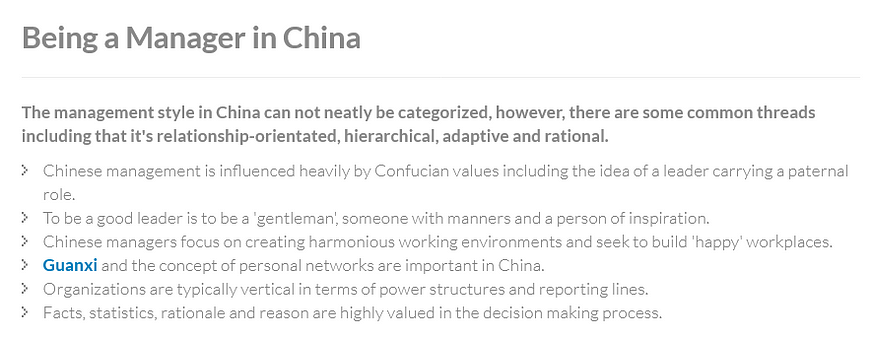
Knowledge work has been woefully misunderstood by Western thinking. Capitalists like Musk, who consider highly educated people disposable assets rather than allies, rely on controlling talent they treat in abusively disposable ways instead of leveraging them as partners who could help him overcome his limitations. As we see with Chinese corporate structures, the way of the future is a more nurturing management style in their operations, favouring mentorship and career development support, than Western corporate autocracies favouring cultures with toxic cutthroat competition.

The Chinese Management Style
A free guide to being a manager in China. Learn about Chinese Management styles, Business Management, Project…www.commisceo-global.com

For the last few decades, workers in Western high-tech environments have been far more competent than leadership incapable of comprehending, much less appreciating how much more skilled their employees are than they are in their knowledge domains. Companies in the West hire down to the level of incompetence of the management rather than hire up to empower their organizations with capabilities that can empower their growth. They are still stuck in the dark ages of employment, which is why most people still don’t understand how disastrous DOGE’s cuts will be for the functional needs of the nation.

Far too many believe the laid-off labourers can be replaced like obedient cogs to continue functioning as before. They fail to realize they’re impacting human lives and professionals who once cared about their roles and their impact on their operations. They fail to recognize the cost of replacing professionals is not as simple as identifying another body to fill a space. Workers are now being incentivized to disengage and stop caring because they’ve been consistently confronted with proof that their contributions bear no value to any psychopath with power.

If the public was ever upset when dealing with dispassionate bureaucrats who did the least they could get away with in their jobs, welcome to “I don’t give a shit version 2.”

The deterioration of the human spirit currently prevalent within the Western sensibility merely gives China the impetus to continue empowering its people because global leadership is just around the corner for them.


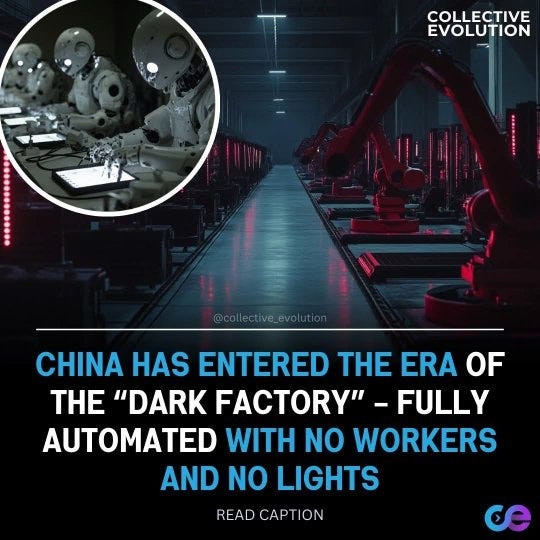
With the advent of “Dark Factories” — fully automated factories, the Chinese people are ahead of Western Industries and their government is likely better equipped psychologically to transition their support systems for the people than what we’re seeing now in the reckless Chainsaw antics of cutting necessary systems indulged in by American plutocrats.

How this translates into a better-equipped governance system to represent the people makes American-style pseudo-democracies appear less capable of being the governments of the people and for the people than the Chinese government of a paternalistic entity ruling the people. It’s no wonder people had become more amenable to a fascist style of government before Trump’s bull-in-a-chinashop rampage began.

Fortunately, the world has better models for democracy in the Nordic styles of social democracies, which borrow concepts from both governance styles to create an effective balance between necessary support infrastructures and free market capitalist principles with realistic restraints on power.

In short, China hasn’t “become more democratic,” but it has become more efficient at meeting the needs of the people. Their system will continue to evolve as their industrial sector evolves and drives social change as it has since the beginning of the Industrial Age.

Will the next President be able to reverse the current destruction of the government?

This post is a response to a question initially posed on Quora, and can also be accessed via “”https://donewiththebullshit.quora.com/Will-the-next-President-be-able-to-reverse-the-current-destruction-of-the-government-3

No.

The next president can mitigate the impact of the damage, reverse all the executive orders, and pull the nation out of free fall, but the destruction will be permanent.

The damage to the nation’s international reputation is permanent.

The damage to the people who Trump’s reckless behaviour has victimized is permanent. The families he destroyed in his first term have still not recovered.

The divide he has wedged open will take the rest of this century to repair.

The nation will not and cannot return to the state before Trump took office. It was already being held together by duct tape and a skilled, lifetime politician who performed feats of magic to repair the damage done by Trump’s first term.

Too few people failed to acknowledge the significance of Biden’s leadership, and that was a consequence of a nation that was far too broken on too many levels to appreciate for most.

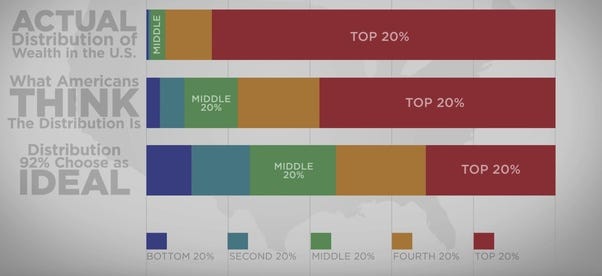
The nation has been falling to pieces for decades, and since Ronald Reagan betrayed the middle class. This destruction became inevitable when Reagan reversed the nation’s trajectory to favour the wealthy class.

This damage isn’t based on politics but on class.

The wealthy class have brought this tragedy to the world.

The numbers don’t lie.

The moment the people bought into the lie that the wealthy class are gods among the population and from whom we are blessed with their favour in economic growth and prosperity is when we gave up on ourselves and started turning against each other.

No president can repair this damage alone… not even if he were the second coming that far too many people pin their hopes and dreams on.

We must do the repair work, and we have to begin by repairing ourselves first.

We must focus first on the welfare of the people because, without the people’s health and welfare, there is no nation, economy, or prosperity. No wealthy class of billionaires can exist without the economy’s engine of 350 million consumers pumping value through a system designed to benefit everyone. They are more dependent upon a healthy middle class than the people who are dependent upon them to finance their pet projects.

We must weed out the greed of humanity if we are to have any hope of stability.

Reversing the destruction will require doing many things differently, but they’re not insurmountable problems. On the upside, more people are aware today of the threat of excess power in too few hands. More people understand today that medical bankruptcies occur only because a handful of greedy billionaires prioritize the bloated luxuries they have acquired by victimizing millions of people.

More people understand today that their economic struggles are due entirely to the economic disparity that led to a world war less than one century ago.

The economic destruction can be repaired, but it must begin by restoring economic justice.

The psychological destruction of today, however, can forever change the nation on a fundamental level — but sadly, the destruction is nowhere near complete enough to force enough people to wake up to the horror of what they have become.

There is still much pain ahead, affecting the entire world.

If Americans truly want to believe their anthem and be the land of the free and the home of the brave, the entire world is pleading with you all to step up to the plate and rid this world of the oligarchy scourge.

Why is democracy considered an ideal form of government?

This post is a response to a question initially posed on Quora, and can also be accessed via “https://www.quora.com/Why-is-democracy-considered-an-ideal-form-of-government/answer/Antonio-Amaral-1

There is no such thing as an “ideal form of government” because humans are from “ideal.”

What makes democracy a superior form of government to all others is self-determination.

What makes democracy a far more chaotic form of government than all others is self-determination.

No other form of governance is as capable as a democracy of facilitating the full achievement of human potential because no other form of governance empowers individuality.

No other form of governance is as prone to overt assaults against it, while no other form of governance can survive those assaults.

Human nature demands self-determination, while the assaults against democracy today are born of that demand for self-determination — albeit in horrifically corrupted and myopically self-serving terms.

Think about the perspectives of those displaying an aggrieved assault against democracy. They are commonly born from an autocratic mindset which expects the world to conform to their perspectives. They interpret the evolution of society as a rejection of their insular views and a violation of their rights to those views. It is Frankenstein’s monster of cancerous individuality disguising a toxic desire for sublimation to authoritarian rule by people who imagine freedom as their right to dictate the lives of others.

They are not entirely oblivious to the inherent hypocrisies they champion, or they would otherwise not conduct their protests while disguising their identities or hiding behind masks or fake profiles, managing multiple sock-puppet accounts on social media.

They are the disruptive elements in a democratic society screaming a need for a much more coherent strategy for social development. The challenge at hand, however, is not an authoritarian solution dictated to the masses, as history’s failures have made clear. Today’s dynamic in an information-rich society demands a supportive strategy of education and social welfare programs providing opportunities for healing and growth for a species emerging out of a dark and brutal history while still suffering the effects of generational PTSD.

For democracy to survive its current challenges and begin to approach whatever may be deemed as an “ideal form of governance,” our systems must evolve to prioritize the people over the plutocracy seeking to regress human civilization to a medieval state of rulers and serfs.

We will otherwise find ourselves repeating the bloody histories of our ancestors who sacrificed everything to win the freedoms far too many take for granted today.

In today’s world, the closest examples we have to an “ideal democracy” are embodied within the Nordic models of social democracy.

We would save countless lives if we could take stock of how fundamentally destructive the world’s current adoption of right-wing ideologies is for human society and global stability.

Why was communism always imposed on countries and never voted for democratically?

Every government imposed on a country has been authoritarian.

Marx’s vision for communism has never been implemented and was never realistically possible to implement in the manner he envisioned.

His view was that socialism (which he often used interchangeably with communism) was an intermediary step to communism. For the people to own the means of production implies a democratic form of ownership, which has never been the case with socialist systems in an authoritarian framework.

His definition of communism was based on the principle, “From each according to his ability, to each according to his needs.” — it is, by definition, a meritocracy (which, in itself, is problematic). The problem, however, is that no system is possible — at least at this stage of human development — without some hierarchy of authority.

Every implementation of what has been popularly viewed as communism has never been communism as Marx envisioned it (while he accurately predicted the flaws in Capitalism would lead to the situation we are suffering from today) and failed precisely because they have been authoritarian systems based upon a centralized authority.

Today’s capitalism can be argued to be an authoritarian system imposed upon the people, entirely consistent with the historical failures of the implementations/impositions of pseudo-communism. (Particularly since the U.S. is on the brink of transforming into a fully-fledged fascist state stripped of its last vestige of Democracy by Drumpf’s promise to end elections. The state of corporatocracy that the U.S. has today has arguably been imposed upon a people without their knowledge or consent. A corporate infrastructure is a totalitarian style of monarchic rule as an operating system of administration… and precisely why corporations are anachronistic holdovers from a medieval era that cannot help but evolve into a threat to democratic governments.)

Marx’s vision of communism can be argued that it was intended to be an organically evolved system, which, by today’s measure, means a form of advanced direct democracy.

To contradict the presumption in this question, Lenin did not impose his brand of communism on the country. He won the support of a majority of the people against the Provisional Government in place at the time. The people who endorsed his program supported his confiscation of land to nationalize it and divide it among the peasants.

This is eerily much like where the U.S. is at with the potential installation of an Orange Nazi Turd who should be rotting behind bars like every other convicted felon instead of roaming about free to campaign on a platform of destroying 243 years of American democracy.

The real problem we have is dialectical and a propensity for oversimplification.

Even authoritative sources like Britannica fail to offer clarity in defining governmental systems. As far as that source is concerned, there are five countries it identifies communism as an “official form of government”: China, North Korea, Laos, Cuba, and Vietnam.

Meanwhile, descriptions of each nation contradict that statement:

Vietnam — The politics of Vietnam is dominated by a single party under an authoritarian system, the Communist Party of Vietnam (CPV).

North Korea — A totalitarian dictatorship with a comprehensive cult of personality around the Kim family.

Laos — Lao People’s Democratic Republic (commonly known as Laos) takes place in the framework of a one-party parliamentary socialist republic.

Cuba — Cuba has had a socialist political system since 1961 based on the “one state — one party” principle. Cuba is constitutionally defined as a single-party Marxist–Leninist socialist republic with semi-presidential powers.

China — The Chinese constitution describes China’s system of government as a people’s democratic dictatorship. The CCP has also used other terms to officially describe China’s system of government, including “socialist consultative democracy”, and whole-process people’s democracy.

(This post was an answer to a Question posed on Quora — where all my posts on Medium have originated; hence the personal response indicated within this article. — https://www.quora.com/profile/Antonio-Amaral-1/ )